Recognition: unknown
Taming Trotter Errors with Quantum Resources
Pith reviewed 2026-05-10 13:18 UTC · model grok-4.3
The pith
States with more entanglement show lower variance in Trotter errors while higher magic reduces the chance of large error outliers.
A machine-rendered reading of the paper's core claim, the machinery that carries it, and where it could break.
Core claim
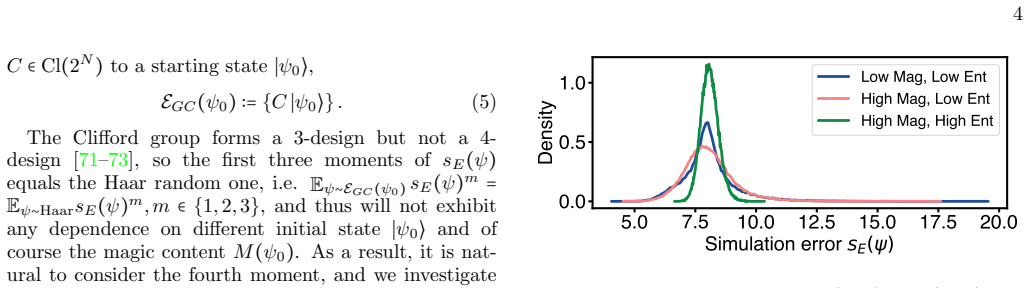
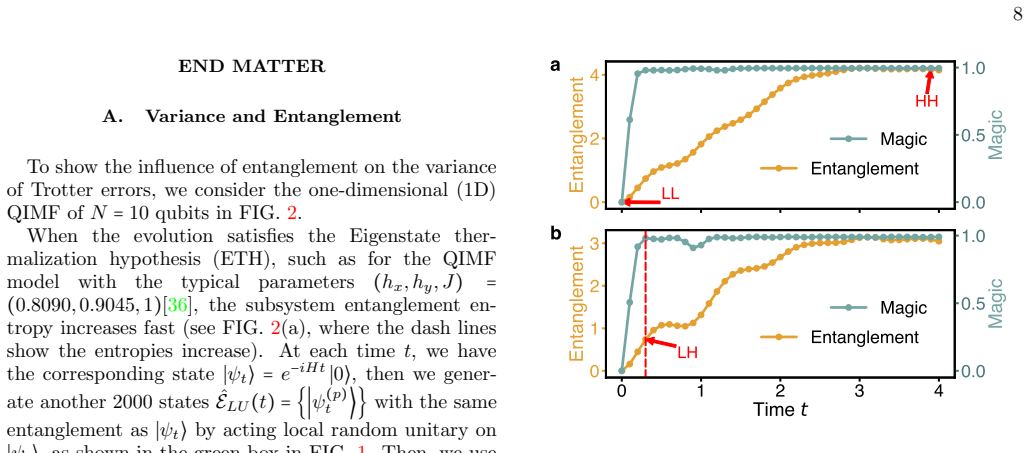
By studying ensembles of states with fixed entanglement entropy or fixed magic, the authors show that the variance of the Trotter error decreases with increasing entanglement entropy while the kurtosis exhibits a negative linear dependence on magic. The first effect produces stronger concentration of the error around its mean for entangled states; the second produces lighter-tailed distributions and therefore lower probability of large deviations for high-magic states.
What carries the argument
Statistical moments (variance and kurtosis) of the Trotter error distribution evaluated over ensembles of states constrained to fixed entanglement entropy or fixed magic.
If this is right
- Trotter-based simulations of highly entangled states require smaller time steps or fewer repetitions to reach a target accuracy because the error is more concentrated.
- High-magic initial states lower the risk of rare but catastrophic simulation failures in Trotterized evolution.
- The same resources that obstruct classical emulation also supply an intrinsic error-suppression mechanism for the quantum algorithm.
- Error statistics can be tuned by preparing states with chosen levels of entanglement or magic rather than by changing the Hamiltonian or the Trotter order.
Where Pith is reading between the lines
- Circuit designers could deliberately inject controlled entanglement early in an algorithm to exploit the variance reduction for later Trotter steps.
- The same moment-analysis technique might be applied to other product formulas or to qubitization to test whether the resource-robustness link is method-specific.
- In the presence of hardware noise the error-taming effect could partially offset decoherence if the algorithmic errors and noise errors have different tail behaviors.
- Numerical checks on small systems with tunable magic (such as Clifford+T circuits) would give a direct test of the kurtosis-magic relation before scaling to larger simulations.
Load-bearing premise
The observed statistical trends in fixed-entanglement and fixed-magic ensembles are representative of the states that appear in actual quantum simulation tasks.
What would settle it
Compute the Trotter error variance for a sequence of random states whose entanglement entropy is increased in controlled steps while all other simulation parameters are held fixed, and check whether the variance decreases monotonically.
Figures



read the original abstract
Quantum simulation is a cornerstone application of quantum computing, yet how fundamental quantum resources--entanglement and non-stabilizerness (``magic")--shape simulation fidelity remains an open question. In this work, we establish a rigorous connection between these resources and the statistical behavior of algorithmic errors arising in Hamiltonian simulation based on the Trotter-Suzuki formula. By analyzing ensembles of states with fixed entanglement entropy or magic, we make two key discoveries: First, the variance of the Trotter error decreases with increasing entanglement entropy, indicating a stronger concentration of error for entangled states. Moreover, we find that the kurtosis of the error exhibits a negative linear dependence on magic, implying that states with high magic possess lighter-tailed error distributions and thus a reduced probability of large deviations. These findings reveal a subtle phenomenon: quantum resources that obstruct classical emulation may, paradoxically, enhance the intrinsic robustness of quantum simulation, highlighting a constructive interplay between complexity and stability in quantum computation.
Editorial analysis
A structured set of objections, weighed in public.
Referee Report
Summary. The manuscript claims to establish a rigorous connection between quantum resources (entanglement entropy and non-stabilizerness/magic) and the statistical properties of Trotter-Suzuki errors in Hamiltonian simulation. By sampling ensembles of states with these resources held fixed, the authors report two main findings: the variance of the Trotter error decreases with increasing entanglement entropy (indicating stronger error concentration), and the kurtosis of the error distribution exhibits a negative linear dependence on magic (implying lighter tails and lower probability of large deviations for high-magic states). These are interpreted as evidence that quantum resources can paradoxically enhance simulation robustness.
Significance. If the central statistical relations hold and generalize, the work would provide a novel perspective on how entanglement and magic affect algorithmic error distributions, potentially informing error analysis and mitigation in quantum simulation. The ensemble approach yields quantitative, falsifiable relations between resources and error moments (variance and kurtosis), which is a methodological strength. However, the practical relevance depends on whether the fixed-resource ensembles accurately reflect error statistics for states arising in actual simulations.
major comments (1)
- [Ensemble construction and statistical analysis sections] The central claim that the observed variance reduction and kurtosis-magic relation imply enhanced robustness for quantum simulations rests on the assumption that fixed-EE/magic ensembles are representative of states encountered in Trotter evolution. No comparison is provided between error distributions over these ensembles and those over dynamically generated states (e.g., time-evolved product states under the same Hamiltonian), leaving open whether the reported concentration and tail-lightening are general properties or artifacts of the ensemble construction. This is load-bearing for the interpretation in the abstract and conclusion.
minor comments (1)
- [Abstract] The abstract asserts a 'rigorous connection' and specific discoveries but contains no equations, definitions of the ensembles, or details on the Trotter formula implementation, making initial assessment of the claims difficult.
Simulated Author's Rebuttal
We thank the referee for the detailed and constructive report. We address the major comment below and indicate the revisions we will make to clarify the scope of our results.
read point-by-point responses
-
Referee: [Ensemble construction and statistical analysis sections] The central claim that the observed variance reduction and kurtosis-magic relation imply enhanced robustness for quantum simulations rests on the assumption that fixed-EE/magic ensembles are representative of states encountered in Trotter evolution. No comparison is provided between error distributions over these ensembles and those over dynamically generated states (e.g., time-evolved product states under the same Hamiltonian), leaving open whether the reported concentration and tail-lightening are general properties or artifacts of the ensemble construction. This is load-bearing for the interpretation in the abstract and conclusion.
Authors: The fixed-resource ensembles were constructed precisely to isolate the dependence of Trotter-error moments on entanglement entropy and magic, independent of any particular dynamical trajectory. This controlled sampling yields quantitative, falsifiable relations that are difficult to extract from single time-evolved states, where resource values and error statistics are correlated through the evolution itself. We agree that the manuscript does not contain an explicit comparison to dynamically generated states, and that such a comparison would strengthen the claim of practical relevance. In the revised manuscript we will add a dedicated paragraph in the discussion section that (i) states the assumption underlying the ensemble approach, (ii) notes that the reported trends are properties of states with given resource content rather than of the full time-evolution operator, and (iii) identifies comparison with dynamically evolved ensembles as an important direction for future work. revision: yes
Circularity Check
No circularity: statistical findings derived from independent ensemble sampling
full rationale
The paper's central claims rest on direct analysis of ensembles constructed with fixed entanglement entropy or magic, from which variance and kurtosis of Trotter errors are computed as observable quantities. No step equates a derived prediction to its own input by construction, renames a fitted parameter as a forecast, or relies on a self-citation chain for a uniqueness theorem. The reported negative linear dependence and variance reduction are presented as empirical outcomes of the sampling procedure rather than tautological re-expressions of the ensemble definitions. The derivation chain therefore remains self-contained against external benchmarks and does not trigger any of the enumerated circularity patterns.
Axiom & Free-Parameter Ledger
axioms (1)
- standard math Variance and kurtosis are well-defined statistical measures that can be computed over ensembles of quantum states and their associated Trotter errors.
Reference graph
Works this paper leans on
-
[1]
R. P. Feynman, Simulating physics with computers, International Journal of Theoretical Physics21, 467 (1982)
1982
-
[2]
R. P. Feynman, Quantum Mechanical Computers, Optics News11, 11 (1985)
1985
- [3]
-
[4]
Quantum Simulators: Architectures and Opportunities,
E. Altman, K. R. Brown, G. Carleo, L. D. Carr, E. Dem- ler, C. Chin, B. DeMarco, S. E. Economou, M. A. Eriks- son, K.-M. C. Fu, M. Greiner, K. R. Hazzard, R. G. Hulet, A. J. Koll´ ar, B. L. Lev, M. D. Lukin, R. Ma, X. Mi, S. Misra, C. Monroe, K. Murch, Z. Nazario, K.-K. Ni, A. C. Potter, P. Roushan, M. Saffman, M. Schleier- Smith, I. Siddiqi, R. Simmonds,...
-
[5]
Schollw¨ ock, The density-matrix renormalization group in the age of matrix product states, Annals of Physics 326, 96 (2011), january 2011 Special Issue
U. Schollw¨ ock, The density-matrix renormalization group in the age of matrix product states, Annals of Physics 326, 96 (2011), january 2011 Special Issue
2011
- [6]
-
[7]
Vidal, Efficient classical simulation of slightly entan- gled quantum computations, Phys
G. Vidal, Efficient classical simulation of slightly entan- gled quantum computations, Phys. Rev. Lett.91, 147902 (2003)
2003
-
[8]
F. A. Y. N. Schr¨ oder, D. H. P. Turban, A. J. Musser, N. D. M. Hine, and A. W. Chin, Tensor network sim- ulation of multi-environmental open quantum dynamics via machine learning and entanglement renormalisation, Nature Communications10, 1062 (2019)
2019
-
[10]
Veitch, S
V. Veitch, S. A. Hamed Mousavian, D. Gottesman, and J. Emerson, The resource theory of stabilizer quantum computation, New Journal of Physics16, 013009 (2014)
2014
- [11]
- [12]
-
[13]
The Heisenberg Representation of Quantum Computers
D. Gottesman, The heisenberg representation of quan- tum computers (1998), arXiv:quant-ph/9807006 [quant- ph]
work page internal anchor Pith review arXiv 1998
-
[14]
Aaronson and D
S. Aaronson and D. Gottesman, Improved simulation of stabilizer circuits, Phys. Rev. A70, 052328 (2004)
2004
- [15]
-
[16]
Howard and E
M. Howard and E. Campbell, Application of a resource theory for magic states to fault-tolerant quantum com- puting, Phys. Rev. Lett.118, 090501 (2017)
2017
-
[17]
S ¸ahino˘ glu and R
B. S ¸ahino˘ glu and R. D. Somma, Hamiltonian simulation in the low-energy subspace, npj Quantum Information7, 119 (2021)
2021
-
[19]
B. S ¸ahino˘ glu and R. D. Somma, Hamiltonian simulation in the low-energy subspace, npj Quantum Information7, 10.1038/s41534-021-00451-w (2021)
-
[20]
W. Gong, S. Zhou, and T. Li, Complexity of Digital Quantum Simulation in the Low-Energy Subspace: Ap- plications and a Lower Bound, Quantum8, 1409 (2024)
2024
- [21]
-
[22]
Yi and E
C. Yi and E. Crosson, Spectral analysis of product formu- las for quantum simulation, npj Quantum Information8, 37
-
[23]
Q. Zhao, Y. Zhou, A. F. Shaw, T. Li, and A. M. Childs, Hamiltonian simulation with random inputs, Phys. Rev. Lett.129, 270502 (2022)
2022
-
[24]
Chen and F
C.-F. Chen and F. G. S. L. Brand˜ ao, Average-case speedup for product formulas, Communications in Math- ematical Physics405, 32 (2024)
2024
-
[25]
Burgarth, N
D. Burgarth, N. Galke, A. Hahn, and L. van Luijk, State- dependent trotter limits and their approximations, Phys. Rev. A107, L040201 (2023)
2023
-
[26]
Burgarth, P
D. Burgarth, P. Facchi, A. Hahn, M. Johnsson, and K. Yuasa, Strong error bounds for trotter and strang- splittings and their implications for quantum chemistry, Phys. Rev. Res.6, 043155 (2024)
2024
-
[27]
Becker, N
S. Becker, N. Galke, L. van Luijk, and R. Salzmann, Con- vergence rates for the trotter splitting for unbounded op- erators, Foundations of Computational Mathematics , 1 (2025)
2025
-
[28]
M¨ obus, On Strong Bounds for Trotter and Zeno Prod- uct Formulas with Bosonic Applications, Quantum8, 1424 (2024)
T. M¨ obus, On Strong Bounds for Trotter and Zeno Prod- uct Formulas with Bosonic Applications, Quantum8, 1424 (2024)
2024
- [29]
-
[30]
T. Hatomura, The first-order trotter decomposition in the dynamical-invariant basis (2023), arXiv:2308.15100 [quant-ph]
-
[31]
Hatomura, State-dependent error bound for digital quantum simulation of driven systems, Phys
T. Hatomura, State-dependent error bound for digital quantum simulation of driven systems, Phys. Rev. A105, L050601 (2022)
2022
-
[32]
D. An, D. Fang, and L. Lin, Time-dependent unbounded hamiltonian simulation with vector norm scaling, Quan- tum5, 459 (2021)
2021
-
[33]
Su, H.-Y
Y. Su, H.-Y. Huang, and E. T. Campbell, Nearly tight trotterization of interacting electrons, Quantum5, 495 (2021)
2021
- [34]
-
[35]
Q. Zhao, Y. Zhou, and A. M. Childs, Entanglement ac- celerates quantum simulation, Nature Physics21, 1338 (2025)
2025
-
[36]
H. Kim, T. N. Ikeda, and D. A. Huse, Testing whether all eigenstates obey the eigenstate thermalization hypothe- sis, Phys. Rev. E90, 052105 (2014)
2014
-
[37]
H. F. Trotter, On the product of semi-groups of opera- tors, Proceedings of the American Mathematical Society 10, 545 (1959)
1959
-
[38]
Suzuki, General theory of fractal path integrals with applications to many-body theories and statistical physics, Journal of mathematical physics32, 400 (1991)
M. Suzuki, General theory of fractal path integrals with applications to many-body theories and statistical physics, Journal of mathematical physics32, 400 (1991)
1991
-
[39]
Lloyd, Universal quantum simulators, Science273, 1073 (1996)
S. Lloyd, Universal quantum simulators, Science273, 1073 (1996)
1996
-
[40]
A. M. Childs, D. Maslov, Y. Nam, N. J. Ross, and Y. Su, Toward the first quantum simulation with quan- tum speedup, Proceedings of the National Academy of Sciences115, 9456 (2018)
2018
-
[41]
Yoshida, Construction of higher order symplectic in- tegrators, Physics Letters A150, 262
H. Yoshida, Construction of higher order symplectic in- tegrators, Physics Letters A150, 262
-
[42]
M. E. S. Morales, P. C. S. Costa, G. Pantaleoni, D. K. Burgarth, Y. R. Sanders, and D. W. Berry, Selection and improvement of product formulae for best performance of quantum simulation, Quantum Information & Computa- tion25, 1–35 (2025)
2025
-
[43]
W. Gong, S. Zhou, and T. Li, Complexity of digital quan- tum simulation in the low-energy subspace: Applications and a lower bound, Quantum8, 1409 (2024)
2024
-
[44]
Mizuta and T
K. Mizuta and T. Kuwahara, Trotterization is substan- tially efficient for low-energy states, Phys. Rev. Lett.135, 130602 (2025)
2025
-
[45]
A. M. Childs, Y. Su, M. C. Tran, N. Wiebe, and S. Zhu, Theory of trotter error with commutator scaling, Phys. Rev. X11, 011020 (2021)
2021
-
[46]
Collins and P
B. Collins and P. ´Sniady, Integration with respect to the haar measure on unitary, orthogonal and symplectic group, Communications in Mathematical Physics264, 773 (2006)
2006
-
[47]
A. A. Mele, Introduction to haar measure tools in quan- 7 tum information: A beginner’s tutorial, Quantum8, 1340 (2024)
2024
-
[48]
E. T. Campbell and D. E. Browne, Bound states for magic state distillation in fault-tolerant quantum com- putation, Phys. Rev. Lett.104, 030503 (2010)
2010
-
[49]
Bravyi and A
S. Bravyi and A. Kitaev, Universal quantum computa- tion with ideal clifford gates and noisy ancillas, Phys. Rev. A71, 022316 (2005)
2005
-
[50]
E. T. Campbell, B. M. Terhal, and C. Vuillot, Roads towards fault-tolerant universal quantum computation, Nature549, 172 (2017)
2017
-
[51]
Eastin and E
B. Eastin and E. Knill, Restrictions on transversal en- coded quantum gate sets, Phys. Rev. Lett.102, 110502 (2009)
2009
-
[52]
Bravyi and J
S. Bravyi and J. Haah, Magic-state distillation with low overhead, Physical Review A86, 052329 (2012)
2012
-
[53]
Howard and E
M. Howard and E. Campbell, Application of a resource theory for magic states to fault-tolerant quantum com- puting, Physical review letters118, 090501 (2017)
2017
-
[54]
P. Niroula, C. D. White, Q. Wang, S. Johri, D. Zhu, C. Monroe, C. Noel, and M. J. Gullans, Phase transition in magic with random quantum circuits, Nature Physics 20, 1786 (2024), arXiv:2304.10481
-
[55]
A. Wills, M.-H. Hsieh, and H. Yamasaki, Constant- overhead magic state distillation, Nature Physics , 1 (2025), arXiv:2408.07764
-
[56]
Carrasco, M
J. Carrasco, M. Langer, A. Neven, and B. Kraus, Gaining confidence on the correct realization of arbitrary quan- tum computations, Phys. Rev. Res.6, L032074 (2024)
2024
- [57]
-
[58]
J. Chen, Y. Yan, and Y. Zhou, Magic of quantum hyper- graph states, Quantum8, 1351 (2024)
2024
-
[59]
P. S. Tarabunga, E. Tirrito, T. Chanda, and M. Dal- monte, Many-body magic via pauli-markov chains—from criticality to gauge theories, PRX Quantum4, 040317 (2023)
2023
-
[60]
Turkeshi, A
X. Turkeshi, A. Dymarsky, and P. Sierant, Pauli spec- trum and nonstabilizerness of typical quantum many- body states, Physical Review B111, 054301 (2025)
2025
- [61]
-
[62]
Passarelli, P
G. Passarelli, P. Lucignano, D. Rossini, and A. Rus- somanno, Chaos and magic in the dissipative quantum kicked top, Quantum9, 1653 (2025)
2025
-
[63]
K. Goto, T. Nosaka, and M. Nozaki, Probing chaos by magic monotones, Phys. Rev. D106, 126009 (2022)
2022
- [64]
-
[65]
Haug and L
T. Haug and L. Piroli, Stabilizer entropies and nonstabi- lizerness monotones, Quantum7, 1092 (2023)
2023
-
[66]
Leone and L
L. Leone and L. Bittel, Stabilizer entropies are mono- tones for magic-state resource theory, Phys. Rev. A110, L040403 (2024)
2024
-
[67]
N. Dowling, P. Kos, and X. Turkeshi, Magic Resources of the Heisenberg Picture, Physical Review Letters135, 050401 (2025), arXiv:2408.16047
-
[68]
Lami and M
G. Lami and M. Collura, Nonstabilizerness via Perfect Pauli Sampling of Matrix Product States, Physical Re- view Letters131, 180401 (2023)
2023
-
[69]
P. S. Tarabunga, E. Tirrito, M. C. Ba˜ nuls, and M. Dal- monte, Nonstabilizerness via Matrix Product States in the Pauli Basis, Physical Review Letters133, 010601 (2024)
2024
-
[70]
G.-C. Li, L. Chen, S.-Q. Zhang, X.-S. Hong, H. Xu, Y. Liu, Y. Zhou, G. Chen, C.-F. Li, G.-C. Guo, et al., Invested and potential magic resources in measurement- based quantum computation, Physical Review Letters 135, 160203 (2025)
2025
-
[71]
Webb, The clifford group forms a unitary 3-design (2016), arXiv:1510.02769 [quant-ph]
Z. Webb, The clifford group forms a unitary 3-design (2016), arXiv:1510.02769 [quant-ph]
-
[72]
H. Zhu, R. Kueng, M. Grassl, and D. Gross, The clifford group fails gracefully to be a unitary 4-design (2016), arXiv:1609.08172 [quant-ph]
work page Pith review arXiv 2016
- [73]
-
[74]
P. H. Westfall, Kurtosis as peakedness, 1905–2014. rip, The American Statistician68, 191 (2014)
1905
-
[75]
Zhou and Q
Y. Zhou and Q. Liu, Performance analysis of multi-shot shadow estimation, Quantum7, 1044 (2023)
2023
-
[76]
See Supplementary Materials for more details
-
[77]
K. P. Balanda and H. MacGillivray, Kurtosis: a critical review, The American Statistician42, 111 (1988)
1988
-
[78]
S. He, J. Zhang, and S. Zhang, Bounding probability of small deviation: A fourth moment approach, Mathemat- ics of Operations Research35, 208 (2010)
2010
-
[79]
Zelen, Bounds on a distribution function that are functions of moments to order four1, Journal of Research of the National Bureau of Standards53, 377 (1954)
M. Zelen, Bounds on a distribution function that are functions of moments to order four1, Journal of Research of the National Bureau of Standards53, 377 (1954)
1954
-
[80]
Pearson, Mathematical contributions to the theory of evolution.—xix
K. Pearson, Mathematical contributions to the theory of evolution.—xix. second supplement to a memoir on skew variation, Philosophical Transactions of the Royal Soci- ety of London. Series A, Containing Papers of a Mathe- matical or Physical Character216, 429 (1916)
1916
-
[81]
Toniolo and S
D. Toniolo and S. Bose, Dynamicalα-r´ enyi entropies of local hamiltonians grow at most linearly in time, Phys. Rev. X15, 031046
-
[82]
X. Turkeshi, E. Tirrito, and P. Sierant, Magic spread- ing in random quantum circuits, Nature Communications 16, 10.1038/s41467-025-57704-x (2025)
discussion (0)
Sign in with ORCID, Apple, or X to comment. Anyone can read and Pith papers without signing in.