Recognition: unknown
Enhancing Event Reconstruction in Hyper-Kamiokande with Machine Learning: A ResNet Implementation
Pith reviewed 2026-05-10 12:45 UTC · model grok-4.3
The pith
ResNet neural networks match traditional Hyper-Kamiokande reconstruction accuracy while running thousands of times faster on simulated single-particle events.
A machine-rendered reading of the paper's core claim, the machinery that carries it, and where it could break.
Core claim
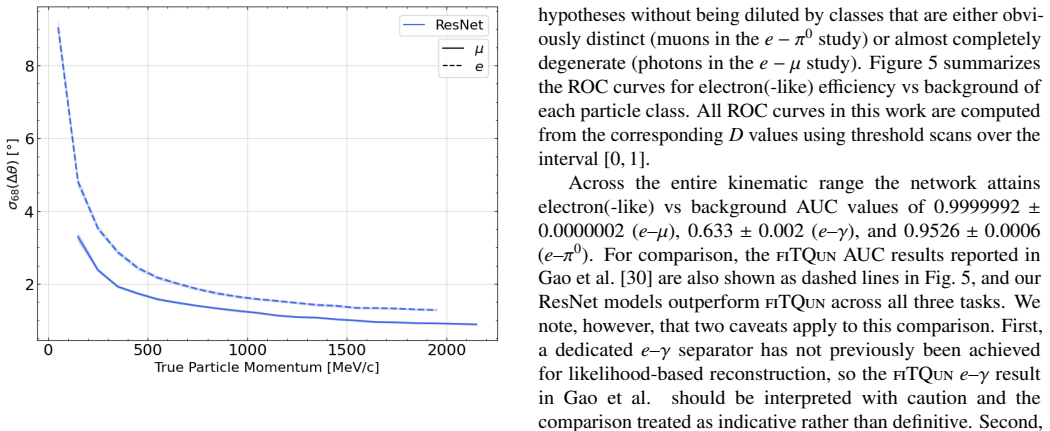
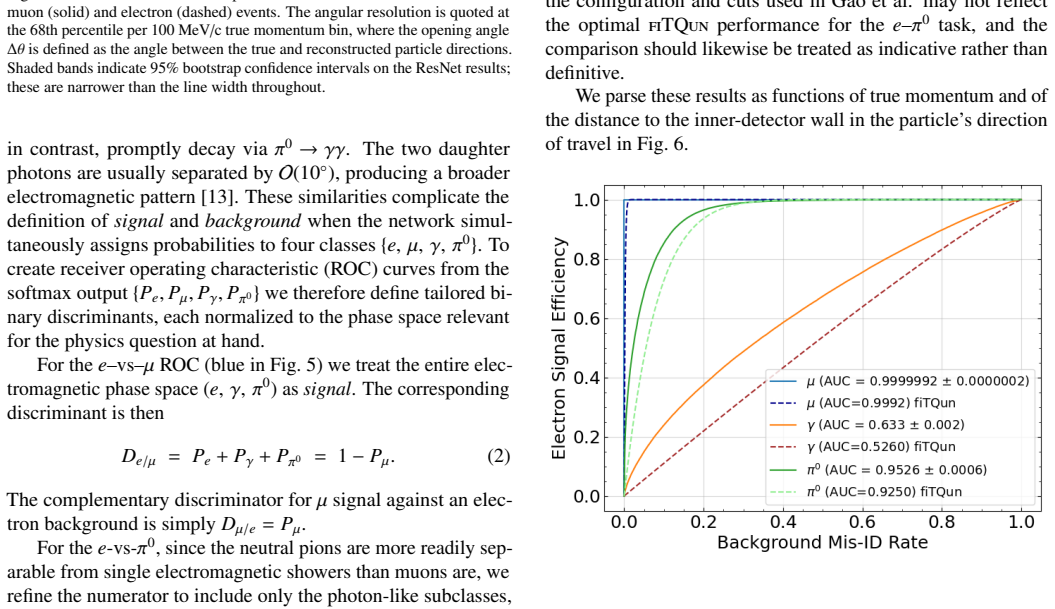
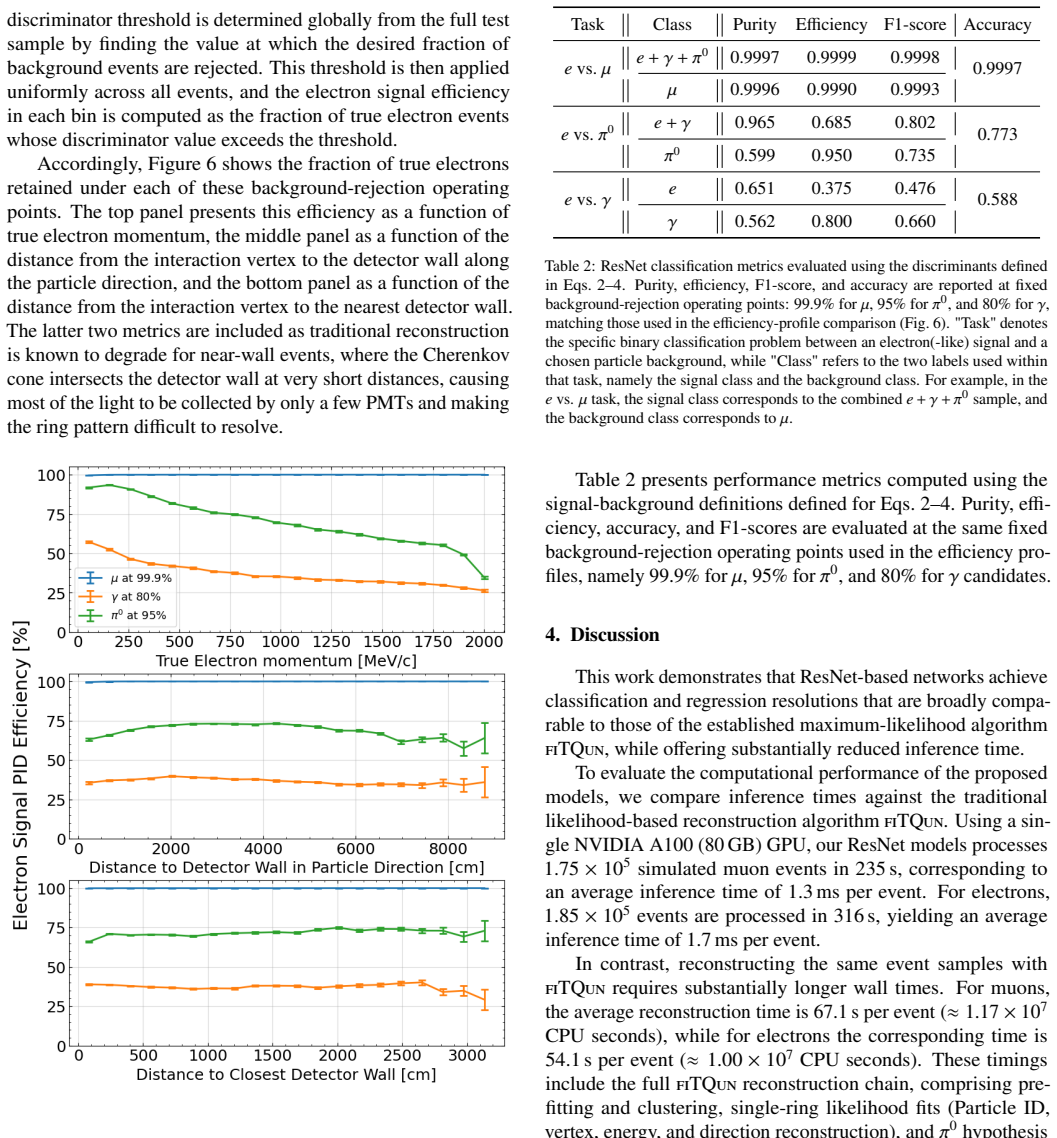
Averaged over the full kinematic range from Cherenkov threshold to 2 GeV, the regression models achieve momentum resolutions of 1.35% and 2.39%, angular resolutions of 1.25° and 1.94°, and vertex resolutions of 28.2 cm and 25.4 cm for muons and electrons respectively, broadly consistent with traditional methods. The classifier improves e-μ, e-γ, and e-π⁰ separation with ROC areas of 0.9999992, 0.633, and 0.9526. The networks run at 1-2 ms per event on a single GPU, delivering speed-ups of 3.2×10⁴ to 5.2×10⁴ relative to likelihood-based reconstruction.
What carries the argument
ResNet models inside the WatChMaL framework that take two-channel 190×189 images encoding photomultiplier-tube charge and timing as input and output both particle-type probabilities and regression values for vertex, direction, and momentum.
If this is right
- Large-scale Monte Carlo campaigns required for Hyper-Kamiokande systematic uncertainty budgets become computationally feasible.
- Event-by-event processing can move from offline clusters to near-real-time GPU hardware.
- Particle identification between electrons, muons, photons, and neutral pions improves for single-ring events in the 0-2 GeV range.
Where Pith is reading between the lines
- The same image-based approach could be extended to multi-particle final states or to events that include Michel electrons or other delayed activity.
- Once trained, the networks could serve as a fast pre-filter that passes only ambiguous events to the slower likelihood fitter, combining the speed of machine learning with the precision of traditional methods.
- Similar image-to-parameter networks might be portable to other large water-Cherenkov detectors facing comparable data-volume pressures.
Load-bearing premise
That the accuracy measured on Monte Carlo simulations will transfer to real detector data without large losses caused by unmodeled effects such as calibration drifts or noise.
What would settle it
A side-by-side comparison of the neural-network and likelihood reconstructions on the same set of real Hyper-Kamiokande calibration data, checking whether resolution and classification performance degrade beyond the Monte-Carlo expectations.
Figures


read the original abstract
The forthcoming Hyper-Kamiokande experiment requires substantially larger Monte Carlo datasets than previous experiments to satisfy stringent systematic-uncertainty requirements. While traditional maximum-likelihood reconstruction provides high-quality results, its per-event computational cost makes processing these large samples increasingly impractical. We demonstrate a neural-network-based reconstruction approach for the Hyper-Kamiokande far detector using simulated data. Single-particle events with kinetic energies from the Cherenkov threshold up to 2 GeV are propagated through the detector, with PMT charge and timing information mapped to $190\times189$ two-channel images serving as inputs to ResNet models in the WatChMaL framework. These models (i) classify events into four particle hypotheses ($e$, $\mu$, $\gamma$, $\pi^{0}$) and (ii) regress the vertex, direction, and momentum of electrons and muons. Averaged over the full kinematic range, the regression models achieve momentum resolutions of $1.35\%$ and $2.39\%$, angular resolutions of $1.25^\circ$ and $1.94^\circ$, and vertex resolutions of $28.2$ cm and $25.4$ cm, for muons and electrons respectively, broadly consistent with traditional methods. The classifier improves $e$-$\mu$, $e$-$\gamma$, and $e$-$\pi^{0}$ separation, with ROC curve areas of $0.9999992$, $0.633$, and $0.9526$. Crucially, our networks achieve inference times of 1-2 ms per event on a single GPU, yielding speed-ups of $3.2\times10^{4}$-$5.2\times10^{4}$ relative to likelihood-based reconstruction, highlighting deep learning as a scalable alternative for Hyper-Kamiokande event reconstruction.
Editorial analysis
A structured set of objections, weighed in public.
Referee Report
Summary. The manuscript describes the application of ResNet models within the WatChMaL framework to reconstruct single-particle events in the Hyper-Kamiokande detector using simulated data. PMT charge and timing information is converted into 190×189 two-channel images, which are used to classify events into e, μ, γ, π⁰ hypotheses and to regress vertex position, direction, and momentum for electrons and muons. The reported performance includes momentum resolutions of 1.35% (muons) and 2.39% (electrons), angular resolutions of 1.25° and 1.94°, vertex resolutions of 28.2 cm and 25.4 cm, and high ROC areas for classification, with inference times of 1-2 ms per event providing speed-ups of 3.2×10⁴ to 5.2×10⁴ over likelihood-based methods.
Significance. If the reported performance holds under realistic conditions, the approach could enable efficient processing of the very large Monte Carlo samples needed for Hyper-Kamiokande systematic studies, providing a practical complement to traditional reconstruction.
major comments (2)
- [Abstract] Abstract: the quoted momentum, angular, and vertex resolutions are presented without any description of the training/validation split, regularization strategy, or whether the figures include systematic uncertainties arising from the Monte Carlo simulation itself.
- [Results] Results section: all resolution and ROC metrics are obtained solely on single-particle Monte Carlo events; no tests with real detector data or with injected unmodeled effects (PMT calibration drifts, water attenuation variations, electronics noise) are reported, which is load-bearing for the claim that the method constitutes a scalable alternative for Hyper-Kamiokande operations.
minor comments (1)
- [Methods] Clarify the precise ResNet architecture (number of layers, residual blocks) and any data-augmentation or preprocessing steps applied to the 190×189 images.
Simulated Author's Rebuttal
We thank the referee for the careful review and constructive feedback. We address each major comment below and have revised the manuscript to improve clarity and acknowledge limitations.
read point-by-point responses
-
Referee: [Abstract] Abstract: the quoted momentum, angular, and vertex resolutions are presented without any description of the training/validation split, regularization strategy, or whether the figures include systematic uncertainties arising from the Monte Carlo simulation itself.
Authors: We agree that the abstract would benefit from additional context. In the revised manuscript we have added a brief description of the training/validation split used on the simulated dataset, the regularization strategy employed, and clarified that the quoted resolutions represent statistical uncertainties obtained from the Monte Carlo sample without incorporation of systematic effects from the simulation model. Expanded details on these aspects remain in the Methods section. revision: yes
-
Referee: [Results] Results section: all resolution and ROC metrics are obtained solely on single-particle Monte Carlo events; no tests with real detector data or with injected unmodeled effects (PMT calibration drifts, water attenuation variations, electronics noise) are reported, which is load-bearing for the claim that the method constitutes a scalable alternative for Hyper-Kamiokande operations.
Authors: The present work benchmarks the ResNet approach on controlled single-particle Monte Carlo events, which is the standard first step for developing and validating reconstruction algorithms prior to deployment. We have revised the Results and Conclusions sections to explicitly note this scope and to state that the demonstrated inference speed-up is intended to address the computational demands of generating the large Monte Carlo samples required for Hyper-Kamiokande systematic studies. We agree that validation against real data and robustness to unmodeled detector effects are essential for operational use and have added text identifying these as priorities for future work. The current results support the claim of a practical complement for MC processing as described in the introduction. revision: partial
Circularity Check
No circularity: performance metrics are direct empirical comparisons on held-out Monte Carlo
full rationale
The paper trains ResNet models on simulated single-particle events mapped to 190x189 charge-timing images and reports regression resolutions and classification ROC areas obtained by direct comparison to truth labels and to likelihood-based reconstruction on the same held-out MC sample. No parameter is fitted to a target quantity and then renamed as a prediction, no self-citation supplies a load-bearing uniqueness theorem or ansatz, and the speed-up claim is a straightforward wall-clock timing measurement. All central numbers are therefore independent of the paper's own outputs by construction.
Axiom & Free-Parameter Ledger
axioms (1)
- domain assumption Monte Carlo simulations accurately model real PMT charge and timing response across the full kinematic range
Reference graph
Works this paper leans on
-
[1]
Hyper-Kamiokande Design Report
K. Abe, et al., Hyper-Kamiokande Design Report (5 2018). arXiv:1805.04163
work page Pith review arXiv 2018
-
[2]
K. Abe, et al., Physics potential of a long-baseline neutrino oscillation experiment using a J-PARC neutrino beam and Hyper-Kamiokande, PTEP 2015 (2015) 053C02. arXiv: 1502.05199,doi:10.1093/ptep/ptv061
-
[3]
K. Abe, et al., Sensitivity of the Hyper-Kamiokande exper- iment to neutrino oscillation parameters using accelerator neutrinos, Eur. Phys. J. C 86 (2026) 170. arXiv:2505. 15019,doi:10.1140/epjc/s10052-025-14938-9
-
[4]
M. Koshiba, et al., KAMIOKANDE — Kamioka Nucleon Decay Experiment: Status and Performance, in: Low En- ergy Tests of Conservation Laws in Particle Physics, AIP Conference Proceedings, 1984
1984
-
[5]
Y . Fukuda, et al., Evidence for Oscillation of At- mospheric Neutrinos, Phys. Rev. Lett. 81 (1998) 1562–1567. arXiv:hep-ex/9807003, doi:10.1103/ PhysRevLett.81.1562
-
[6]
Fukuda, et al., The Super-Kamiokande detector, Nucl
S. Fukuda, et al., The Super-Kamiokande detector, Nucl. Instrum. Meth. A 501 (2003) 418–462. doi:10.1016/ S0168-9002(03)00425-X
2003
-
[7]
Abe, et al., The T2K Experiment, Nucl
K. Abe, et al., The T2K Experiment, Nucl. Instrum. Meth. A 659 (2011) 106–135. arXiv:1106.1238, doi: 10.1016/j.nima.2011.06.067
-
[8]
K. Abe, et al., Measurements of neutrino oscillation param- eters from the T2K experiment using 3 .6 × 1021 protons on target, Eur. Phys. J. C 83 (9) (2023) 782. arXiv:2303. 03222,doi:10.1140/epjc/s10052-023-11819-x
-
[9]
Abe, et al., J-PARC Neutrino Beamline Upgrade Tech- nical Design Report (2019).arXiv:1908.05141
K. Abe, et al., J-PARC Neutrino Beamline Upgrade Tech- nical Design Report (2019).arXiv:1908.05141
-
[10]
P. A. ˇCerenkov, Visible Radiation Produced by Electrons Moving in a Medium with Velocities Exceeding that of Light, Phys. Rev. 52 (1937) 378–379. doi:10.1103/ PhysRev.52.378
1937
-
[11]
Electromagnetic effects and weak form factors
O. Lalakulich, U. Mosel, K. Gallmeister, Neutrino energy reconstruction in quasielastic-like scattering in the Mini- BooNE and T2K experiments, Phys. Rev. C 86 (2012) 054606. arXiv:1208.3678, doi:10.1103/PhysRevC. 86.054606
-
[12]
Kose, The Hyper-Kamiokande experiment: Status and prospect, SciPost Phys
U. Kose, The Hyper-Kamiokande experiment: Status and prospect, SciPost Phys. Proc. 17 (2025) 019. doi:10. 21468/SciPostPhysProc.17.019
2025
-
[13]
Interferometric signatures of black holes with multiple photon spheres.Phys
S. Navas, et al., Review of Particle Physics, Phys. Rev. D 110 (3) (2024) 030001. doi:10.1103/PhysRevD.110. 030001
-
[14]
S. M. Bilenky, B. Pontecorvo, Lepton Mixing and Neutrino Oscillations, Phys. Rept. 41 (1978) 225–261. doi:10. 1016/0370-1573(78)90095-9
1978
-
[15]
N. Prouse, P. de Perio, W. Fedorko, Machine Learning Techniques to Enhance Event Reconstruction in Water Cherenkov Detectors, Phys. Sci. Forum 8 (1) (2023) 63. doi:10.3390/psf2023008063
-
[16]
Krizhevsky, I
A. Krizhevsky, I. Sutskever, G. E. Hinton, ImageNet Classi- fication with Deep Convolutional Neural Networks, in: Ad- vances in Neural Information Processing Systems, V ol. 25, 2012
2012
-
[17]
K. He, X. Zhang, S. Ren, J. Sun, Deep Residual Learning for Image Recognition, in: 2016 IEEE Conference on Computer Vision and Pattern Recognition (CVPR), 2016, pp. 770–778.doi:10.1109/CVPR.2016.90
-
[18]
Yankelevich, Machine Learning Methods for Super- Kamiokande Solar Neutrino Classification, Phys
A. Yankelevich, Machine Learning Methods for Super- Kamiokande Solar Neutrino Classification, Phys. Sci. Fo- rum 8 (1) (2023) 42.doi:10.3390/psf2023008042. 10
-
[19]
B. Jamieson, M. Stubbs, S. Ramanna, J. Walker, N. Prouse, R. Akutsu, P. de Perio, W. Fedorko, Using Machine Learn- ing to Improve Neutron Identification in Water Cherenkov Detectors, Front. Big Data 5 (2022) 978857. arXiv: 2206.12954,doi:10.3389/fdata.2022.978857
-
[20]
J. Aguilar, et al., Classification of electron and muon neutrino events for the ESS νSB near water Cherenkov detector using Graph Neural Networks, JINST 20 (08) (2025) P08030. arXiv:2503.15247, doi:10.1088/ 1748-0221/20/08/P08030
-
[21]
Qian, et al., Vertex and energy reconstruction in JUNO with machine learning methods, Nucl
Z. Qian, et al., Vertex and energy reconstruction in JUNO with machine learning methods, Nucl. Instrum. Meth. A 1010 (2021) 165527. arXiv:2101.04839, doi:10. 1016/j.nima.2021.165527
-
[22]
A. Aurisano, et al., A Convolutional Neu- ral Network Neutrino Event Classifier, JINST 11 (09) (2016) P09001. arXiv:1604.01444, doi:10.1088/1748-0221/11/09/P09001
-
[23]
WatChMaL Collaboration, WatChMaL: Water Cherenkov Machine Learning, https://github.com/WatChMaL (2025)
2025
-
[24]
WCSim Collaboration, WCSim: Water Cherenkov Simula- tor,https://github.com/WCSim/WCSim(2025)
2025
- [25]
-
[26]
K. He, X. Zhang, S. Ren, J. Sun, Delving Deep into Rectifiers: Surpassing Human-Level Performance on Im- ageNet Classification, in: IEEE International Conference on Computer Vision (ICCV 2015), 2015, pp. 1026–1034. doi:10.1109/ICCV.2015.123
-
[27]
Batch Normalization: Accelerating Deep Network Training by Reducing Internal Covariate Shift
S. Ioffe, C. Szegedy, Batch Normalization: Accelerating Deep Network Training by Reducing Internal Covariate Shift, in: Proceedings of the 32nd International Conference on Machine Learning, 2015.arXiv:1502.03167
work page internal anchor Pith review arXiv 2015
-
[28]
Decoupled Weight Decay Regularization
I. Loshchilov, F. Hutter, Decoupled Weight Decay Regular- ization, in: International Conference on Learning Repre- sentations, 2019.arXiv:1711.05101
work page internal anchor Pith review Pith/arXiv arXiv 2019
-
[29]
M. Jiang, et al., Atmospheric Neutrino Oscillation Analysis with Improved Event Reconstruction in Super-Kamiokande IV, PTEP 2019 (5) (2019) 053F01. arXiv:1901.03230, doi:10.1093/ptep/ptz015
-
[30]
Gao, The Calibration of the Super-Kamiokande Outer- Detector and Particle Kinematics Reconstruction in Hyper- Kamiokande, Ph.D
J. Gao, The Calibration of the Super-Kamiokande Outer- Detector and Particle Kinematics Reconstruction in Hyper- Kamiokande, Ph.D. thesis, King’s College London (2024)
2024
-
[31]
I. M. Frank, I. E. Tamm, Coherent visible radiation of fast electrons passing through matter, Compt. Rend. Acad. Sci. URSS 14 (3) (1937) 109–114. doi:10.3367/UFNr. 0093.196710o.0388
-
[32]
L. Canetti, M. Drewes, M. Shaposhnikov, Matter and anti- matter in the universe, New J. Phys. 14 (2012) 095012. arXiv:1204.4186, doi:10.1088/1367-2630/14/9/ 095012
-
[33]
A. D. Sakharov, Violation of CP Invariance, C asym- metry, and baryon asymmetry of the universe, Pisma Zh. Eksp. Teor. Fiz. 5 (1967) 32–35. doi:10.1070/ PU1991v034n05ABEH002497
1967
-
[34]
A. D. Sakharov, Violation of CP invariance, C asym- metry, and baryon asymmetry of the universe, Sov. Phys. Usp. 34 (5) (1991) 392–393. doi:10.1070/ PU1991v034n05ABEH002497
1991
-
[35]
Fukugita, T
M. Fukugita, T. Yanagida, Baryogenesis Without Grand Unification, Phys. Lett. B 174 (1986) 45–47. doi:10. 1016/0370-2693(86)91126-3
1986
-
[36]
Z. Maki, M. Nakagawa, S. Sakata, Remarks on the Uni- fied Model of Elementary Particles, Prog. Theor. Phys. 28 (1962) 870–880.doi:10.1143/PTP.28.870
-
[37]
Pontecorvo, Neutrino Experiments and the Problem of Conservation of Leptonic Charge, Sov
B. Pontecorvo, Neutrino Experiments and the Problem of Conservation of Leptonic Charge, Sov. Phys. JETP 26 (1968) 984–988
1968
-
[38]
M. Kobayashi, T. Maskawa, CP-Violation in the Renormal- izable Theory of Weak Interaction, Prog. Theor. Phys. 49 (1973) 652–657.doi:10.1143/PTP.49.652
-
[39]
M. A. Acero, et al., New constraints on oscillation parame- ters from νe appearance and νµ disappearance in the NOvA experiment, Phys. Rev. D 98 (3) (2018) 032012. arXiv: 1806.00096,doi:10.1103/PhysRevD.98.032012
- [40]
-
[41]
NuFit-6.0: Updated global analysis of three-flavor neutrino oscillations
I. Esteban, M. C. Gonzalez-Garcia, M. Maltoni, T. Schwetz, A. Zhou, NuFit-6.0: updated global analysis of three-flavor neutrino oscillations, JHEP 09 (2024) 178. arXiv:2410.05380, doi:10.1007/ JHEP09(2024)178
work page internal anchor Pith review arXiv 2024
-
[42]
S. Abubakar, et al., Joint neutrino oscillation analysis from the T2K and NOvA experiments, Nature 646 (8086) (2025) 818–824. arXiv:2510.19888, doi:10.1038/ s41586-025-09599-3
-
[43]
R. B. Patterson, E. M. Laird, Y . Liu, P. D. Meyers, I. Stancu, H. A. Tanaka, The Extended-track event reconstruction for MiniBooNE, Nucl. Instrum. Meth. A 608 (2009) 206–
2009
-
[44]
arXiv:0902.2222, doi:10.1016/j.nima.2009. 06.064. 11
-
[45]
A. D. Missert, Improving the T2K Oscillation Analysis With fiTQun: A New Maximum-Likelihood Event Recon- struction for Super-Kamiokande, in: J. Phys. Conf. Ser., V ol. 888, 2017, p. 012066. doi:10.1088/1742-6596/ 888/1/012066. Appendix A. Physics Motivation Understanding the matter–antimatter asymmetry of the Uni- verse [32] remains one of the foremost ch...
discussion (0)
Sign in with ORCID, Apple, or X to comment. Anyone can read and Pith papers without signing in.