Recognition: unknown
Topologically equivalent yet radiatively distinct orbits in EMRI system
Pith reviewed 2026-05-10 13:01 UTC · model grok-4.3
The pith
Orbits sharing the same topological indices can still emit distinct gravitational waveforms in extreme-mass-ratio inspirals around dyonic black holes.
A machine-rendered reading of the paper's core claim, the machinery that carries it, and where it could break.
Core claim
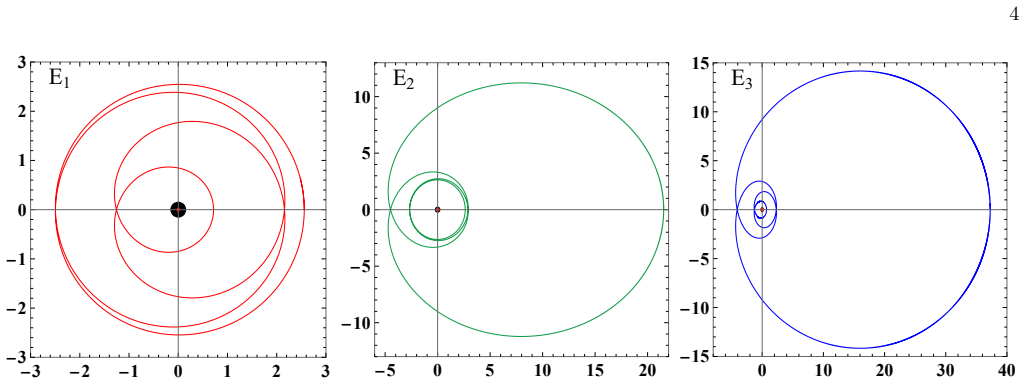
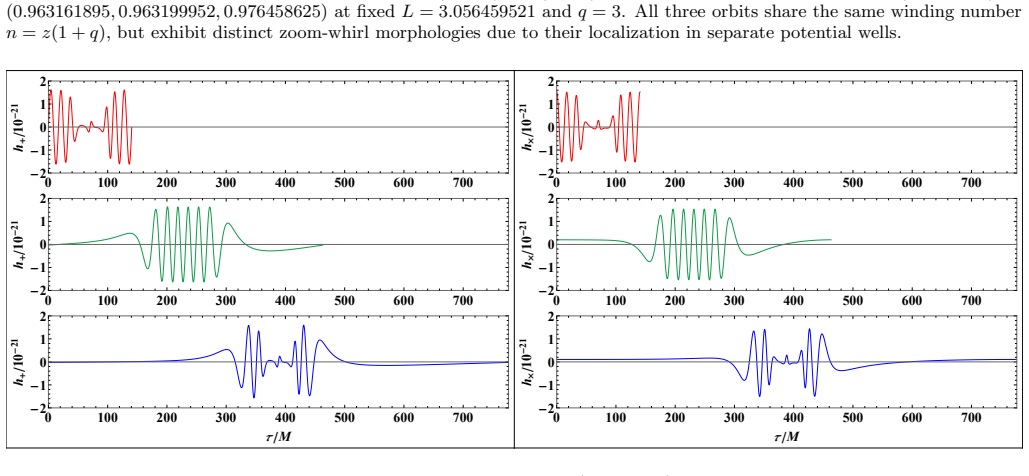
In the dyonic black hole spacetime, multiple coexisting branches of bound periodic orbits can share the same rational rotation number and therefore identical topological indices, yet they generate radiatively distinct gravitational waves because each branch spans different regions of spacetime curvature, producing differences in amplitude modulation and harmonic content.
What carries the argument
The multi-well effective potential for massive test particles in the dyonic black hole metric, which supports distinct families of bound orbits sharing identical rational rotation numbers.
If this is right
- Periodic orbits on different branches produce gravitational waves whose amplitude modulation differs.
- The harmonic content of the emitted waves varies between the branches.
- These waveform differences furnish a direct observational probe of strong-field gravitational dynamics beyond general relativity.
- The distinctions may be detectable by future space-based gravitational wave observatories.
Where Pith is reading between the lines
- This effect could require branch-specific parameters in waveform models when analyzing signals from exotic compact objects.
- Similar multi-branch orbit behavior might occur in other modified-gravity spacetimes that deviate from the single-well Schwarzschild potential.
- Template banks for extreme-mass-ratio inspirals could be augmented to account for curvature-dependent waveform variations.
Load-bearing premise
The dyonic black hole metric produces multiple distinct potential wells that support coexisting branches of bound orbits with the same rational rotation numbers while sampling different curvature strengths.
What would settle it
A direct computation of the gravitational waveforms produced by two periodic orbits that share the same rational rotation number in the dyonic metric, showing identical amplitude modulation and harmonic content despite their different radial ranges.
Figures




read the original abstract
Multiple potential wells for massive test particles, allowing distinct families of bound orbits to coexist, are a characteristic feature of certain exotic compact objects beyond general relativity. Taking the dyonic black hole as a representative example, we demonstrate that such multi-well geometries generically support multiple coexisting branches of bound orbits, in contrast to the single-branch behavior observed in the Schwarzschild spacetime. Crucially, the periodic orbits sharing identical rational rotation number, and hence identical topological indices can nevertheless produce \emph{radiatively distinct} gravitational waves in a representative extreme-mass-ratio inspirals: their amplitude modulation and harmonic content differ because each branch spans different regions of spacetime curvature. These ``topologically equivalent yet waveform-distinguishable'' signatures provide a direct observational probe of strong field gravitational dynamics beyond general relativity, potentially accessible to future space-based gravitational wave detectors.
Editorial analysis
A structured set of objections, weighed in public.
Referee Report
Summary. The paper claims that the dyonic black hole spacetime supports multiple effective potential wells for massive test particles, enabling coexisting branches of bound periodic orbits. These branches can share identical rational rotation numbers (and thus the same topological indices) yet produce radiatively distinct gravitational waveforms in the extreme-mass-ratio inspiral limit. The distinction arises because each branch samples different regions of spacetime curvature, resulting in different amplitude modulations and harmonic contents. This is shown by presenting the dyonic metric, deriving the effective potential for equatorial geodesics, numerically locating the coexisting orbit branches for a given rational rotation number, and computing the leading-order waveforms via the quadrupole approximation, in contrast to the single-branch behavior in Schwarzschild.
Significance. If the central result holds, the work provides a concrete observational signature for exotic compact objects beyond general relativity that could be probed by future space-based gravitational-wave detectors such as LISA. The demonstration that topologically equivalent orbits can nevertheless be radiatively distinguishable supplies a new diagnostic of strong-field dynamics in multi-well geometries. The manuscript earns credit for supplying the explicit metric, deriving the effective potential, performing the numerical orbit classification, and directly computing the quadrupole waveforms; these elements make the distinction between branches falsifiable and relevant to EMRI data analysis.
minor comments (3)
- §2: the dyonic metric is introduced without an explicit reference to the underlying action or field equations; adding a one-sentence citation to the original derivation would improve traceability for readers unfamiliar with dyonic solutions.
- Figure 3 (waveform comparison): the plots would benefit from explicit annotation of the dominant harmonics (e.g., m=2, m=3) on each panel to make the reported difference in harmonic content immediately visible.
- §4.3: the rotation number is stated to be identical for both branches, but the precise numerical procedure (e.g., the integral definition or fitting method) is only summarized; a short appendix equation would allow independent verification.
Simulated Author's Rebuttal
We thank the referee for the careful reading and positive evaluation of our manuscript, including the accurate summary of the multi-well effective potential, coexisting orbit branches with identical rational rotation numbers, and the resulting radiatively distinct quadrupole waveforms. The recommendation for minor revision is noted; we will prepare the revised version accordingly.
Circularity Check
No significant circularity
full rationale
The paper supplies the dyonic black hole metric, derives the equatorial effective potential, numerically identifies coexisting bound-orbit branches sharing the same rational rotation number, and computes leading-order quadrupole waveforms. These steps are explicit calculations that demonstrate distinct curvature sampling and resulting waveform differences; none reduce by construction to a fitted input, self-definition, or load-bearing self-citation chain. The central claim rests on independent numerical evidence rather than definitional equivalence.
Axiom & Free-Parameter Ledger
Reference graph
Works this paper leans on
-
[1]
B. P. Abbottet al.[LIGO Scientific and Virgo], Phys. Rev. Lett.116, 061102 (2016), [arXiv:1602.03837 [gr- qc]]
work page internal anchor Pith review arXiv 2016
- [2]
-
[3]
First M87 Event Horizon Telescope Results. I. The Shadow of the Supermassive Black Hole
K. Akiyamaet al.[Event Horizon Telescope], Astro- phys. J. Lett.875, L1 (2019), [arXiv:1906.11238 [astro- ph.GA]]
work page internal anchor Pith review arXiv 2019
-
[4]
Laser Interferometer Space Antenna
P. Amaro-Seoaneet al.[LISA], [arXiv:1702.00786 [astro- ph.IM]]
work page internal anchor Pith review Pith/arXiv arXiv
-
[5]
W. R. Hu and Y. L. Wu, Natl. Sci. Rev.4, 685 (2017)
2017
-
[6]
TianQin: a space-borne gravitational wave detector
J. Luoet al.[TianQin], Class. Quant. Grav.33, 035010 (2016), [arXiv:1512.02076 [astro-ph.IM]]
work page Pith review arXiv 2016
- [7]
- [8]
- [9]
-
[10]
S. Haroon and T. Zhu, Phys. Rev. D112, 4, (2025), [arXiv:2502.09171 [gr-qc]]
- [11]
- [12]
- [13]
- [14]
- [15]
- [16]
- [17]
- [18]
- [19]
- [20]
- [21]
- [22]
- [23]
- [24]
- [25]
- [26]
- [27]
- [28]
-
[29]
J. Levin and G. Perez-Giz, Phys. Rev. D77, 103005 (2008), [arXiv:0802.0459 [gr-qc]]
- [30]
- [31]
- [32]
- [33]
- [34]
-
[35]
K. Yagi and N. Seto, Phys. Rev. D83, 044011 (2011), [erratum: Phys. Rev. D95, 109901 (2017)], [arXiv:1101.3940 [astro-ph.CO]]. Appendix: Gravitational-wave features of multi-branch EMRIs To elucidate the dynamical origin (10) of the waveform distinctions among different energy branches, we focus on the periodic orbit with (z, w, v) = (1,3,0), which admits...
discussion (0)
Sign in with ORCID, Apple, or X to comment. Anyone can read and Pith papers without signing in.