Recognition: unknown
A boldsymbol{2d times d times d} Spacetime Volume Implementation of a Logical S Gate in the Surface Code
Pith reviewed 2026-05-10 13:00 UTC · model grok-4.3
The pith
A new twist defect braiding protocol implements the logical S gate in the surface code using a spacetime volume of 2d × d × d.
A machine-rendered reading of the paper's core claim, the machinery that carries it, and where it could break.
Core claim
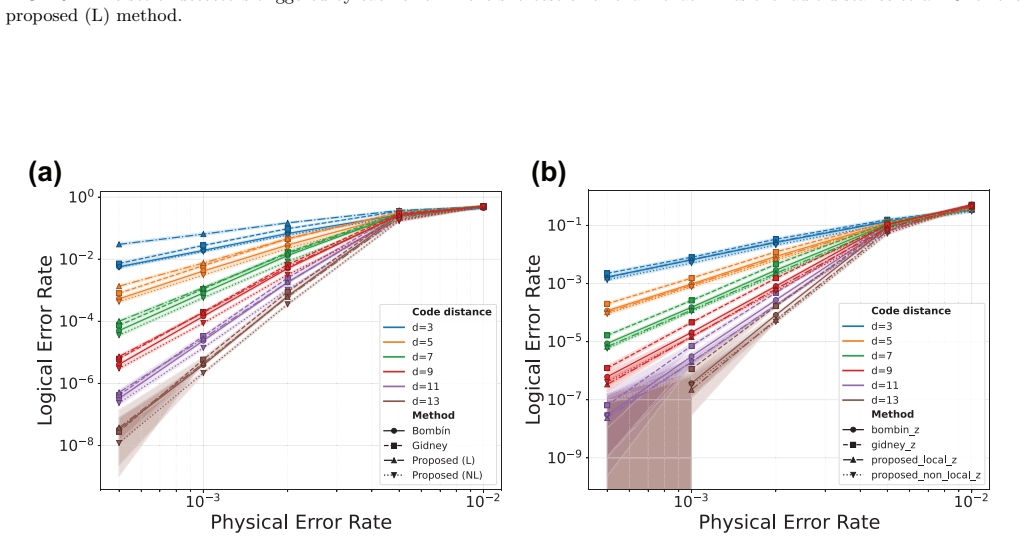
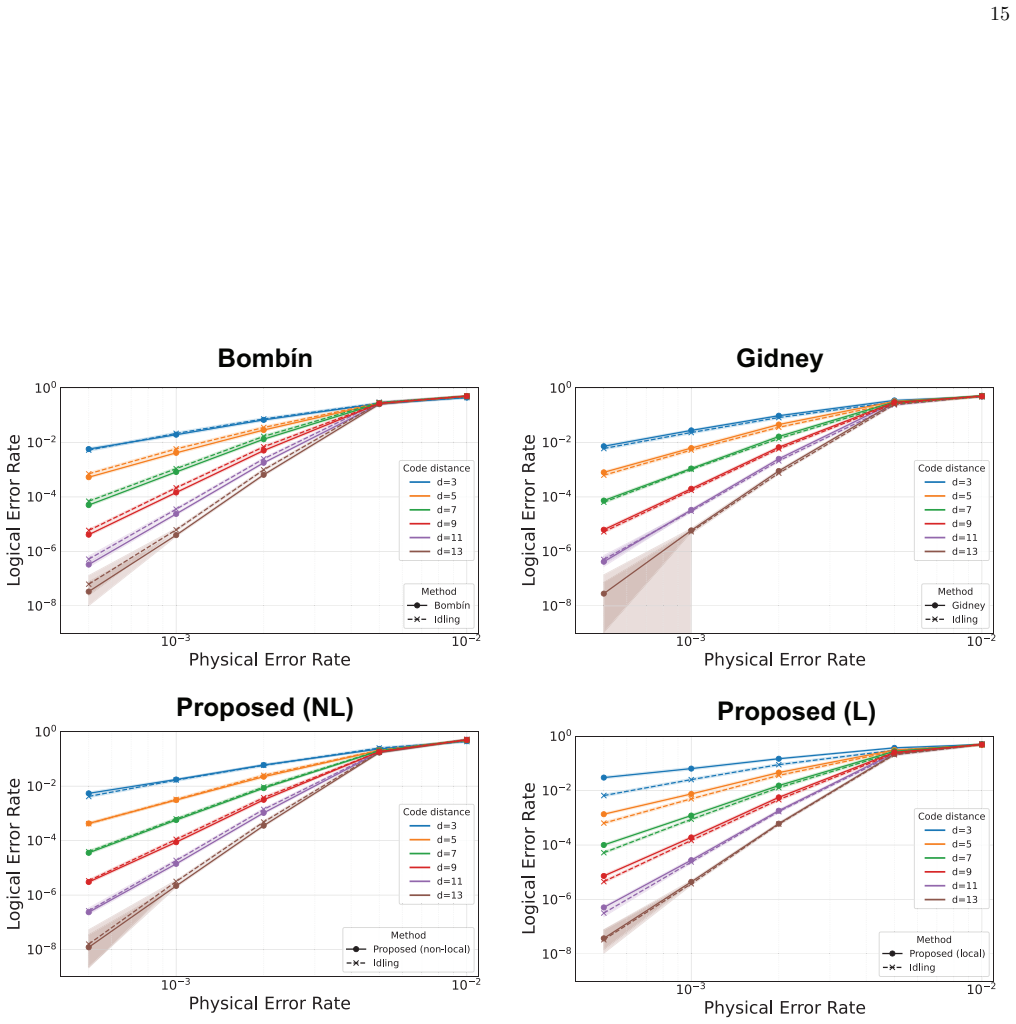
We provide the missing circuit-level implementations of existing logical S-gate methods and propose a novel twist defect braiding protocol that reduces the spacetime volume to 2d × d × d. The protocol is first realized with constant-length non-local gates and then refined to nearest-neighbor two-qubit gates on a square grid without increasing two-qubit gate depth beyond that of standard syndrome extraction circuits. Numerical simulations evaluate fault distances and logical error rates for both existing and proposed methods, showing that although the proposed method reduces the fault distance by one or three, its logical error rates remain comparable to those of existing methods at large d (
What carries the argument
twist defect braiding protocol, which executes the logical S gate by moving and braiding twist defects through a compact 2d × d × d spacetime arrangement
If this is right
- The protocol halves the spatial extent in one dimension relative to the common 2d by 2d by d baseline.
- Both non-local and nearest-neighbor circuit versions are supplied, each without added two-qubit gate depth beyond syndrome extraction.
- Logical error rates stay comparable to prior methods once d reaches 5 or larger at physical error rates near 10 to the minus 3.
- The method supplies explicit circuit implementations that were previously unavailable for quantitative fault-distance comparison.
Where Pith is reading between the lines
- The reduced volume could permit a higher density of S gates inside the same total spacetime budget of a full algorithm.
- The same defect-braiding compaction idea might be adapted to other logical Clifford gates to lower overall resource demands.
- Hardware runs on small surface-code patches could directly test whether the simulated error rates persist under device-specific noise.
- Combining the protocol with lattice-surgery or other surface-code primitives could produce still lower-overhead universal gate sets.
Load-bearing premise
The numerical simulations of the circuit-level implementation with nearest-neighbor gates accurately capture the true fault distance and logical error rates of the proposed braiding protocol under realistic hardware noise.
What would settle it
A circuit-level simulation or hardware demonstration at code distance d equals 5 and physical error rate p equals 10 to the minus 3 that shows the proposed method's logical error rate clearly exceeding the rate of the 2d by 2d by d baseline would falsify the claim of comparable performance.
Figures







read the original abstract
The logical S gate implemented via twist defect braiding in the surface code is one of the major sources of overhead in fault-tolerant quantum computing, since an S-gate correction is required in every logical T-gate teleportation. Existing logical S-gate implementations require spacetime volumes of \(2d \times 2d \times d\) or \(2d \times 1.5d \times d\), where $d$ is the code distance of the surface code. To the best of our knowledge, their circuit-level implementations have not yet been shown, hindering quantitative comparisons of fault distances and logical error rates. In this work, we provide these missing circuit-level implementations. Additionally, we propose a novel twist defect braiding protocol that reduces the spacetime volume to \(2d \times d \times d\). First, we construct an implementation of the proposed method using constant-length non-local gates, and then refine it to utilize only nearest-neighbor two-qubit gates on a square grid, without requiring additional two-qubit gate depth beyond that of standard syndrome extraction circuits. Through numerical simulations, we evaluate the fault distances and logical error rates for both existing and proposed methods. Our results show that, although the proposed method reduces the fault distance by one or three, its logical error rates remain comparable to those of existing methods at large code distances (\(d \ge 5\)) and at physical error rates near \(p = 10^{-3}\). This demonstrates that the proposed method is promising for near-term fault-tolerant quantum computing.
Editorial analysis
A structured set of objections, weighed in public.
Referee Report
Summary. The manuscript presents explicit circuit-level implementations of logical S gates via twist defect braiding in the surface code, including existing protocols with spacetime volumes 2d × 2d × d and 2d × 1.5d × d. It proposes a new braiding protocol achieving 2d × d × d volume, first using constant-length non-local gates and then refined to nearest-neighbor two-qubit gates on a square grid without added depth beyond standard syndrome extraction. Numerical Monte Carlo simulations under depolarizing noise are used to evaluate fault distances and logical error rates, claiming that despite a reduction in fault distance by 1 or 3, the logical error rates remain comparable to prior methods for d ≥ 5 at physical error rates near p = 10^{-3}.
Significance. If the numerical results hold under the stated conditions, the reduced spacetime volume would lower overhead for a frequently used gate in fault-tolerant quantum computing (required for every logical T teleportation), with direct relevance to near-term hardware. Strengths include the provision of missing circuit-level constructions for quantitative comparison and the explicit refinement to nearest-neighbor connectivity, which addresses a practical implementation gap.
major comments (2)
- [Numerical Simulations] Numerical Simulations section: the central claim of comparable logical error rates at d ≥ 5 and p ≈ 10^{-3} despite reduced fault distance rests on Monte Carlo results, but the manuscript does not specify the procedure for extracting fault distance (e.g., minimum-weight logical operator search versus fitting), the number of shots per data point, or full error model parameters. This prevents verification that the nearest-neighbor refinement introduces no additional error channels or depth that would invalidate the volume or error-rate comparison.
- [Circuit Construction] Circuit Construction and Refinement sections: the claim that the nearest-neighbor square-grid version requires 'no additional two-qubit gate depth beyond that of standard syndrome extraction circuits' is load-bearing for the spacetime volume assertion of 2d × d × d. Without explicit depth counts, circuit diagrams, or timing analysis showing how twist defect braiding is scheduled within existing syndrome rounds, it is unclear whether hidden overheads arise that offset the volume reduction.
minor comments (1)
- [Abstract] The abstract states 'to the best of our knowledge' regarding prior circuit-level implementations; a brief citation to the specific prior works on twist-defect braiding would strengthen this.
Simulated Author's Rebuttal
We thank the referee for their thorough review and valuable feedback on our manuscript. We have carefully considered the major comments and will revise the manuscript to provide the requested clarifications and additional details, which we believe will strengthen the presentation of our results.
read point-by-point responses
-
Referee: Numerical Simulations section: the central claim of comparable logical error rates at d ≥ 5 and p ≈ 10^{-3} despite reduced fault distance rests on Monte Carlo results, but the manuscript does not specify the procedure for extracting fault distance (e.g., minimum-weight logical operator search versus fitting), the number of shots per data point, or full error model parameters. This prevents verification that the nearest-neighbor refinement introduces no additional error channels or depth that would invalidate the volume or error-rate comparison.
Authors: We agree that these details are essential for reproducibility and verification. In the revised manuscript, we will expand the Numerical Simulations section to explicitly describe the procedure for extracting the fault distance (using minimum-weight logical operator search), the number of Monte Carlo shots per data point, and the complete parameters of the depolarizing error model. We confirm that the nearest-neighbor refinement does not introduce additional error channels or depth beyond what is accounted for in the volume calculation. revision: yes
-
Referee: Circuit Construction and Refinement sections: the claim that the nearest-neighbor square-grid version requires 'no additional two-qubit gate depth beyond that of standard syndrome extraction circuits' is load-bearing for the spacetime volume assertion of 2d × d × d. Without explicit depth counts, circuit diagrams, or timing analysis showing how twist defect braiding is scheduled within existing syndrome rounds, it is unclear whether hidden overheads arise that offset the volume reduction.
Authors: We acknowledge that the current presentation lacks sufficient explicit documentation to fully substantiate this claim. To address this, we will include in the revised manuscript additional figures or appendices with circuit diagrams for the nearest-neighbor implementation and a detailed timing analysis showing the scheduling of the braiding operations. This analysis will demonstrate that the twist defect movements and measurements are performed within the standard syndrome extraction cycles without requiring extra two-qubit gate layers. We have ensured through our construction that the depth remains the same as standard surface code syndrome extraction, preserving the 2d × d × d spacetime volume. revision: yes
Circularity Check
No circularity: explicit construction plus independent Monte Carlo simulation
full rationale
The paper derives its central claim via an explicit twist-defect braiding circuit construction (first non-local, then nearest-neighbor square-grid) followed by direct circuit-level Monte Carlo simulation of fault distance and logical error rates under depolarizing noise. These steps are not algebraic reductions, parameter fits renamed as predictions, or self-citation chains; the implementations of both the new 2d×d×d protocol and the prior 2d×2d×d / 2d×1.5d×d methods are newly supplied in the manuscript, and the numerical results are generated from those circuits rather than from any pre-fitted quantities or author-specific ansätze. No load-bearing step collapses to a definition or prior self-result by construction.
Axiom & Free-Parameter Ledger
axioms (2)
- domain assumption Surface codes of distance d can correct up to floor((d-1)/2) errors.
- domain assumption Twist defects can be braided to realize the logical S gate.
Reference graph
Works this paper leans on
-
[1]
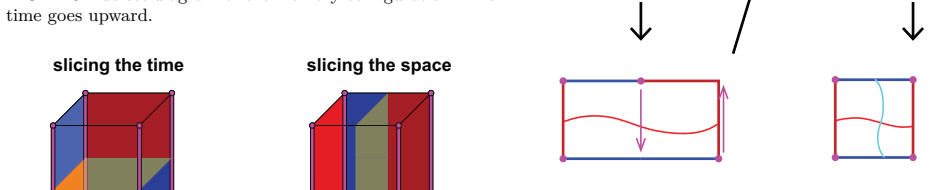
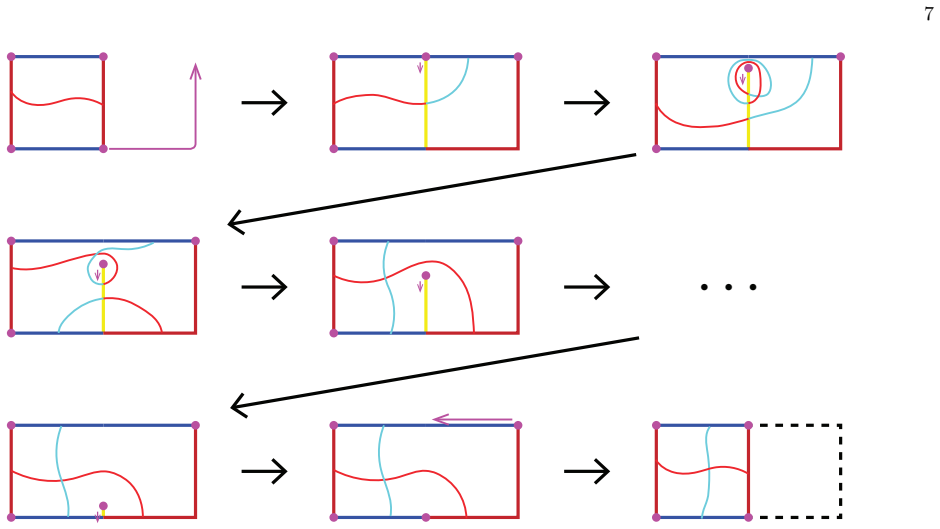
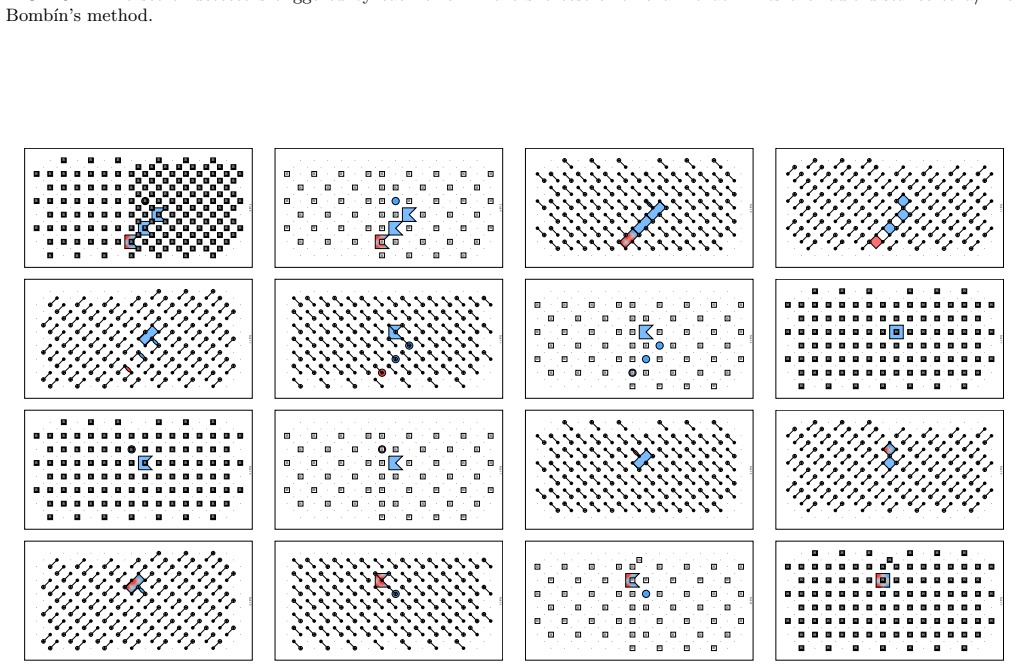
Expand the surface code spatially from the X boundary while braiding the twist defects in the middle-bottom to the right-bottom corner
-
[3]
Braid the twist defects from the middle-top to the 5 /u1D451 /u1D451 2/u1D451 FIG. 7. 3D defect diagram of Bombín’s method. The time goes upward. bottom side, and from the right-bottom to the right-top corner
-
[4]
Perform d±O(1) rounds of syndrome measurement again to maintain the fault distance d
-
[5]
Shrink the surface code to its original size. Note that while we describe Bombín’s method with a domain wall slicing through time, it can also be imple- mented with a domain wall slicing through space by uti- lizing XXZZ stabilizers in the middle column. To the best of our knowledge, this is the most efficient implementa- tion that maintains a separation o...
-
[6]
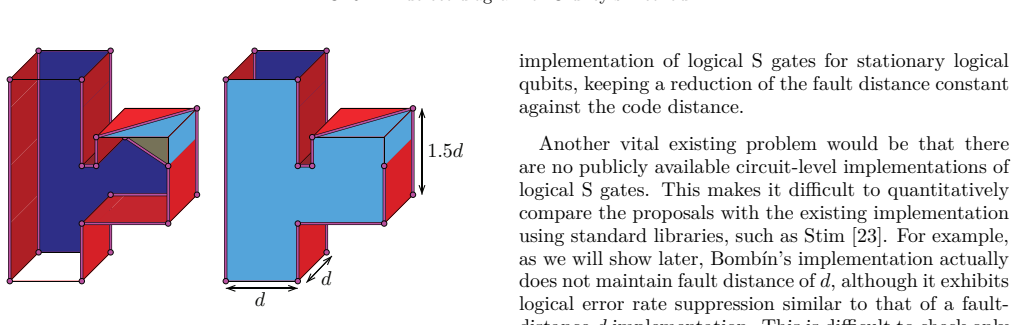
Expand the surface code spatially from the X boundary
-
[7]
Perform d±O(1) rounds of syndrome measurement to maintain the fault distance d
-
[8]
Split the surface code into two patches via lattice surgery
-
[9]
At a glance, Gidney’s implementation does not appear to maintain a full fault distance d, as the pair of twist defects is separated by only d/2 geometrically
Perform an inplace Y measurement on the right surface code patch. At a glance, Gidney’s implementation does not appear to maintain a full fault distance d, as the pair of twist defects is separated by only d/2 geometrically. However, due to the asymmetry of the Y-error mechanism between time-like and space-like errors, it was shown that Y-errors cannot gr...
-
[10]
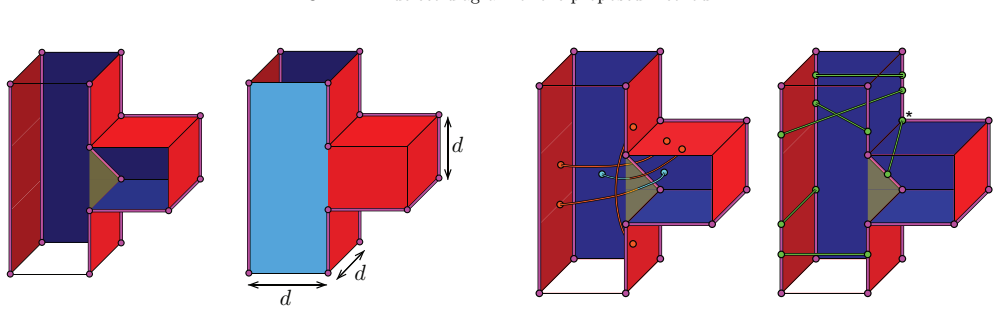
Expand the surface code spatially from the X boundary while braiding the middle-bottom twist defect to the right-top corner with creating the do- main wall
-
[11]
Perform sequential Y measurements along the mid- dle column to gradually move the middle-top twist defect to the bottom side
-
[12]
Shrink the surface code to its original while braid- ing the twist defect at the right-top corner to the middle-top. * FIG. 13. The error chains in the proposed method. The blue (red) strings represent Z (X) error chains in the left panel. The green strings represent Y error chains in the right panel. Note that while Gidney’s method utilizes the triangula...
-
[13]
Lacroix, A
N. Lacroix, A. Bourassa, F. J. Heras, L. M. Zhang, J. Bausch, A. W. Senior, T. Edlich, N. Shutty, V. Sivak, A. Bengtsson, et al., Scaling and logic in the color code on a superconducting quantum processor, Nature , 1 (2025)
2025
-
[14]
G. Q. AI and Collaborators, Quantum error correc- tion below the surface code threshold, Nature 638, 920 (2025)
2025
-
[15]
E. Rosenfeld, C. Gidney, G. Roberts, A. Morvan, N. Lacroix, D. Kafri, J. Marshall, M. Li, V. Sivak, D. Abanin, et al. , Magic state cultivation on a superconducting quantum processor, arXiv preprint arXiv:2512.13908 (2025)
-
[16]
Zhang, Z.-Y
J. Zhang, Z.-Y. Chen, Y.-J. Wang, B.-H. Lu, H.-F. Zhang, J.-N. Li, P. Duan, Y.-C. Wu, and G.-P. Guo, Demonstrating a universal logical gate set in error- detecting surface codes on a superconducting quantum processor, npj Quantum Information 11, 177 (2025)
2025
-
[17]
A. M. Stephens, Fault-tolerant thresholds for quantum error correction with the surface code, Physical Review A 89, 022321 (2014)
2014
-
[18]
A. G. Fowler, A. M. Stephens, and P. Groszkowski, High- threshold universal quantum computation on the surface code, Physical Review A—Atomic, Molecular, and Opti- cal Physics 80, 052312 (2009)
2009
-
[19]
Higgott and C
O. Higgott and C. Gidney, Sparse Blossom: correcting a million errors per core second with minimum-weight matching, Quantum 9, 1600 (2025)
2025
-
[20]
Bombín and M
H. Bombín and M. A. Martin-Delgado, Quantum mea- surements and gates by code deformation, Journal of Physics A: Mathematical and Theoretical 42, 095302 (2009)
2009
-
[21]
G. P. Gehér, C. McLauchlan, E. T. Campbell, A. E. Moylett, and O. Crawford, Error-corrected hadamard gate simulated at the circuit level, Quantum 8, 1394 (2024)
2024
-
[22]
B. J. Brown, K. Laubscher, M. S. Kesselring, and J. R. Wootton, Poking holes and cutting corners to achieve clifford gates with the surface code, Physical Review X 7, 021029 (2017)
2017
-
[23]
Sahay, Y
K. Sahay, Y. Lin, S. Huang, K. R. Brown, and S. Puri, Error correction of transversal cnot gates for scalable surface-code computation, PRX quantum 6, 020326 (2025)
2025
-
[24]
T. J. Yoder and I. H. Kim, The surface code with a twist, Quantum 1, 2 (2017)
2017
-
[25]
J. E. Moussa, Transversal clifford gates on folded surface codes, Physical Review A 94, 042316 (2016)
2016
-
[26]
Z.-H. Chen, M.-C. Chen, C.-Y. Lu, and J.-W. Pan, Transversal logical clifford gates on rotated surface codes with reconfigurable neutral atom arrays, arXiv preprint arXiv:2412.01391 (2024)
-
[27]
Gidney, Inplace access to the surface code y basis, Quantum 8, 1310 (2024)
C. Gidney, Inplace access to the surface code y basis, Quantum 8, 1310 (2024)
2024
-
[28]
Bombin, C
H. Bombin, C. Dawson, R. V. Mishmash, N. Nickerson, F. Pastawski, and S. Roberts, Logical blocks for fault- tolerant topological quantum computation, PRX Quan- tum 4, 020303 (2023)
2023
-
[29]
Horsman, A
D. Horsman, A. G. Fowler, S. Devitt, and R. Van Meter, Surface code quantum computing by lattice surgery, New Journal of Physics 14, 123011 (2012)
2012
-
[30]
Magic state cultivation: growing T states as cheap as CNOT gates
C. Gidney, N. Shutty, and C. Jones, Magic state culti- vation: growing t states as cheap as cnot gates, arXiv preprint arXiv:2409.17595 (2024)
work page internal anchor Pith review arXiv 2024
- [31]
-
[32]
Efficient Magic State Cultivation on the Surface Code
Y. Vaknin, S. Jacoby, A. Grimsmo, and A. Retzker, Ef- ficient magic state cultivation on the surface code, arXiv preprint arXiv:2502.01743 (2025)
-
[33]
Litinski and F
D. Litinski and F. von Oppen, Lattice surgery with a twist: Simplifying clifford gates of surface codes, Quan- tum 2, 62 (2018)
2018
-
[34]
Chamberland and E
C. Chamberland and E. T. Campbell, Circuit-level proto- col and analysis for twist-based lattice surgery, Physical Review Research 4, 023090 (2022)
2022
-
[35]
Gidney, Stim: a fast stabilizer circuit simulator, Quantum 5, 497 (2021)
C. Gidney, Stim: a fast stabilizer circuit simulator, Quantum 5, 497 (2021)
2021
-
[36]
Maurya and S
S. Maurya and S. Tannu, Synchronization for fault- tolerant quantum computers, in Proceedings of the 52nd Annual International Symposium on Computer Architec- ture (2025) pp. 1370–1385
2025
-
[37]
com/yugahirai/logical_s_gate (2026)
All circuits in stim are available here, https://github. com/yugahirai/logical_s_gate (2026)
2026
- [38]
-
[39]
Higgott, Pymatching: A python package for decoding quantum codes with minimum-weight perfect matching, ACM Transactions on Quantum Computing 3, 1 (2022)
O. Higgott, Pymatching: A python package for decoding quantum codes with minimum-weight perfect matching, ACM Transactions on Quantum Computing 3, 1 (2022)
2022
-
[40]
McEwen, D
M. McEwen, D. Bacon, and C. Gidney, Relaxing hard- ware requirements for surface code circuits using time- dynamics, Quantum 7, 1172 (2023)
2023
-
[41]
Crumble, a prototype stabilizer circuit editor, https:// algassert.com/crumble (2026)
2026
-
[42]
Litinski, A game of surface codes: Large-scale quan- tum computing with lattice surgery, Quantum 3, 128 (2019)
D. Litinski, A game of surface codes: Large-scale quan- tum computing with lattice surgery, Quantum 3, 128 (2019)
2019
-
[43]
Bombín, Topological order with a twist: Ising anyons from an abelian model, Physical review letters 105, 030403 (2010)
H. Bombín, Topological order with a twist: Ising anyons from an abelian model, Physical review letters 105, 030403 (2010)
2010
- [44]
discussion (0)
Sign in with ORCID, Apple, or X to comment. Anyone can read and Pith papers without signing in.