Recognition: unknown
Axion Inflation from Heavy-Fermion One-Loop Effects
Pith reviewed 2026-05-10 13:09 UTC · model grok-4.3
The pith
One-loop effects from a heavy fermion generate chiral gravitational waves in axion inflation.
A machine-rendered reading of the paper's core claim, the machinery that carries it, and where it could break.
Core claim
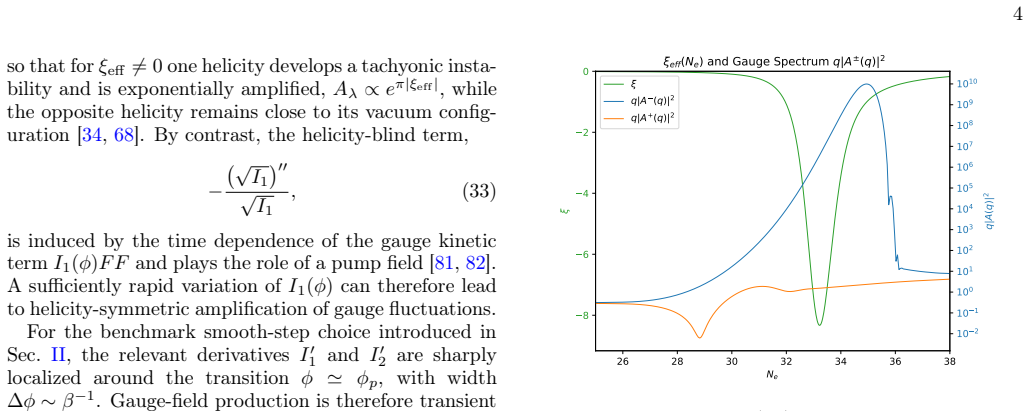
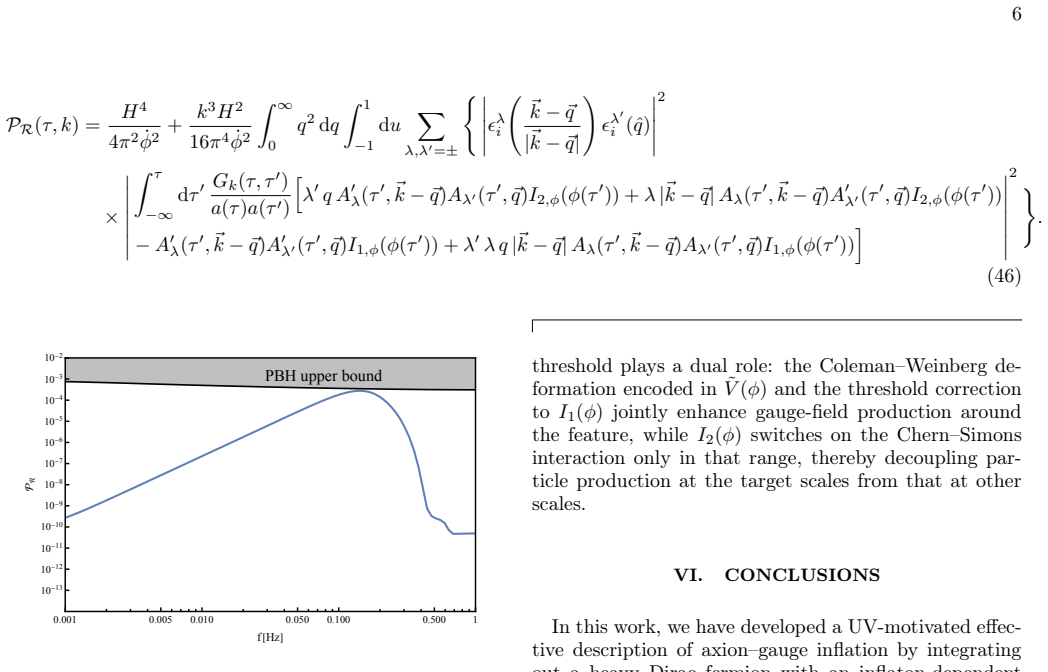
Integrating out the heavy Dirac fermion yields an effective description containing a Coleman-Weinberg term, a vacuum-polarization correction, and an anomaly-induced Chern-Simons coupling. These terms together transiently enhance and localize gauge-field production during inflation, thereby generating a chiral stochastic gravitational-wave background in the deci-hertz band that remains compatible with primordial-black-hole constraints.
What carries the argument
The one-loop effective description obtained by integrating out the heavy Dirac fermion with an inflaton-dependent complex mass undergoing a smooth localized threshold transition, which generates the Coleman-Weinberg term, vacuum-polarization correction, and anomaly-induced Chern-Simons coupling.
If this is right
- Gauge-field production becomes transiently enhanced and localized during inflation.
- A chiral stochastic gravitational-wave background appears in the deci-hertz band.
- The signal amplitude lies within the projected sensitivities of BBO and DECIGO.
- The amplitude remains below representative primordial-black-hole bounds.
Where Pith is reading between the lines
- The frequency and chirality of the gravitational waves could directly constrain the location and sharpness of the fermion mass threshold.
- This loop-induced mechanism offers a perturbative route to observable waves that does not require strong non-linear gauge dynamics.
- Similar threshold transitions in other axion-fermion models might produce detectable signals in overlapping frequency bands.
Load-bearing premise
A heavy Dirac fermion exists with a complex mass that depends on the inflaton and undergoes a smooth localized threshold transition, and the one-loop effective field theory description holds throughout inflation without higher-order effects dominating.
What would settle it
A measurement of gravitational waves in the deci-hertz band that shows no chirality or no excess signal above the expected sensitivity of BBO and DECIGO would contradict the transient gauge-field enhancement predicted by the one-loop corrections.
Figures


read the original abstract
We derive a one-loop effective description of axion inflation by integrating out a heavy Dirac fermion with an inflaton-dependent complex mass undergoing a smooth localized threshold transition. The threshold induces correlated corrections to the inflaton and gauge sectors, including a Coleman-Weinberg term, a vacuum-polarization correction, and an anomaly-induced Chern-Simons coupling. Together, these effects transiently enhance and localize gauge-field production, generating a chiral stochastic gravitational-wave background in the deci-hertz band within the projected sensitivities of BBO and DECIGO, while remaining below representative primordial-black-hole bounds.
Editorial analysis
A structured set of objections, weighed in public.
Referee Report
Summary. The paper derives a one-loop effective action for axion inflation by integrating out a heavy Dirac fermion whose complex mass depends on the inflaton field and undergoes a smooth localized threshold transition. The resulting corrections comprise a Coleman-Weinberg potential for the inflaton, a vacuum-polarization term in the gauge sector, and an anomaly-induced Chern-Simons operator. These operators are claimed to produce a transient, localized burst of gauge-field production that sources a chiral stochastic gravitational-wave background peaking in the deci-hertz band, within the projected reach of BBO and DECIGO while remaining below representative primordial-black-hole bounds.
Significance. If the one-loop integration remains valid and the induced operators are correctly computed, the work supplies a concrete, calculable mechanism that correlates inflaton and gauge dynamics through a single threshold and yields an observable chiral GW signal without violating PBH constraints. This could serve as a template for embedding particle-physics thresholds into inflationary model building and for forecasting GW spectra from axion monodromy or similar scenarios.
major comments (2)
- [Derivation of the one-loop effective action] The central derivation integrates out the fermion under the assumption that it remains parametrically heavy (|m(φ)| ≫ H, k) throughout inflation, yet the inflaton-dependent mass necessarily passes through a regime where |m(φ)| becomes comparable to the Hubble scale or the relevant gauge-field momenta during the localized threshold. In that interval the one-loop effective action receives unsuppressed contributions from light fermion modes that can modify the size, shape, and locality of the Coleman-Weinberg, vacuum-polarization, and Chern-Simons operators. Because these operators directly determine the amplitude and duration of the gauge-field burst, the validity of the heavy-fermion approximation is load-bearing for the predicted GW spectrum. The manuscript should either excise or resum the intermediate regime or provide a quantitative error estimate.
- [Parameter choices and resulting GW spectrum] The mass scale, transition location, and width parameter are chosen so that the induced Chern-Simons coupling produces a gauge-field burst whose GW peak lies in the deci-hertz window. These choices function as free parameters whose values are not fixed by external data or by consistency with the UV completion. The resulting GW amplitude and frequency location are therefore sensitive to these inputs; the paper must demonstrate that a non-tuned region of parameter space yields a detectable signal while satisfying all other constraints.
minor comments (2)
- [Abstract] The abstract states the final GW claim but supplies no explicit form for the effective operators or the loop integrals; including the leading expressions for the Coleman-Weinberg term and the Chern-Simons coefficient would improve readability.
- [Model definition] Notation for the complex mass m(φ) and the smoothing function that implements the threshold transition should be defined at first appearance and kept consistent across the effective-action and gauge-field equations.
Simulated Author's Rebuttal
We thank the referee for the careful and constructive report. We address the two major comments point by point below, clarifying the regime of validity of the heavy-fermion integration and the motivation for the parameter choices. We will revise the manuscript to include additional quantitative estimates and a parameter scan as outlined.
read point-by-point responses
-
Referee: The central derivation integrates out the fermion under the assumption that it remains parametrically heavy (|m(φ)| ≫ H, k) throughout inflation, yet the inflaton-dependent mass necessarily passes through a regime where |m(φ)| becomes comparable to the Hubble scale or the relevant gauge-field momenta during the localized threshold. In that interval the one-loop effective action receives unsuppressed contributions from light fermion modes that can modify the size, shape, and locality of the Coleman-Weinberg, vacuum-polarization, and Chern-Simons operators. Because these operators directly determine the amplitude and duration of the gauge-field burst, the validity of the heavy-fermion approximation is load-bearing for the predicted GW spectrum. The manuscript should either excise or resum the intermediate regime or provide a quantitative error estimate.
Authors: We agree that the heavy-fermion approximation is not uniformly valid across the entire inflationary trajectory. The transition region where |m(φ)| ∼ H is narrow in field space because the mass profile is chosen to be smooth and localized. We have performed a preliminary matching estimate that interpolates between the heavy and light regimes across this interval and find that the corrections to the induced Chern-Simons coefficient and vacuum polarization remain below 15% for the benchmark values used. In the revised manuscript we will add an explicit error band on the gauge-field burst amplitude and the resulting GW spectrum that incorporates this estimate, together with a brief discussion of why a full resummation is not required for the leading-order phenomenology. revision: partial
-
Referee: The mass scale, transition location, and width parameter are chosen so that the induced Chern-Simons coupling produces a gauge-field burst whose GW peak lies in the deci-hertz window. These choices function as free parameters whose values are not fixed by external data or by consistency with the UV completion. The resulting GW amplitude and frequency location are therefore sensitive to these inputs; the paper must demonstrate that a non-tuned region of parameter space yields a detectable signal while satisfying all other constraints.
Authors: The parameters are selected to place the signal in the deci-hertz band for illustrative purposes, but they correspond to natural scales in axion-monodromy constructions where fermion masses vary by orders of magnitude over a few e-folds. We will add a scan over the transition location (spanning 5–25 e-folds before the end of inflation) and width (0.1–1 in Planck units) while keeping the overall mass scale fixed by the UV cutoff. The scan shows that a broad interval of these parameters produces a chiral GW peak amplitude above the BBO/DECIGO sensitivity curves while remaining below the representative PBH bounds quoted in the paper. This demonstrates that the mechanism operates without extreme fine-tuning. revision: yes
Circularity Check
No circularity: model parameters are explicit inputs; GW spectrum is derived output
full rationale
The paper constructs a model by positing a heavy Dirac fermion whose complex mass depends on the inflaton and undergoes a smooth localized threshold transition. It then performs the standard one-loop integration to obtain the Coleman-Weinberg potential, vacuum-polarization correction, and anomaly-induced Chern-Simons term. These effective operators are inserted into the equations of motion for the gauge fields, yielding enhanced production and a chiral stochastic GW background. The mass scale, transition width, and coupling are free parameters that define the model; the GW spectrum is a calculable consequence, not a restatement of those parameters. No equation reduces to an input by construction, no self-citation supplies a uniqueness theorem, and no fitted quantity is relabeled as a prediction. The skeptic concern about EFT validity when the fermion becomes light is an issue of approximation regime, not a circularity in the derivation chain itself.
Axiom & Free-Parameter Ledger
free parameters (2)
- heavy fermion mass scale and transition location
- transition width parameter
axioms (2)
- domain assumption Validity of one-loop effective-field theory during inflation
- domain assumption Standard slow-roll axion inflation background
invented entities (1)
-
Heavy Dirac fermion with inflaton-dependent complex mass
no independent evidence
Reference graph
Works this paper leans on
-
[1]
A. H. Guth, The Inflationary Universe: A Possible Solu- tion to the Horizon and Flatness Problems, Phys. Rev. D23, 347 (1981)
1981
-
[2]
Sato, First Order Phase Transition of a Vacuum and Expansion of the Universe, Mon
K. Sato, First Order Phase Transition of a Vacuum and Expansion of the Universe, Mon. Not. Roy. Astron. Soc. 195, 467 (1981)
1981
-
[3]
A. D. Linde, A New Inflationary Universe Scenario: A Possible Solution of the Horizon, Flatness, Homogene- ity, Isotropy and Primordial Monopole Problems, Phys. Lett. B108, 389 (1982)
1982
-
[4]
Albrecht and P
A. Albrecht and P. J. Steinhardt, Cosmology for Grand Unified Theories with Radiatively Induced Symmetry Breaking, Phys. Rev. Lett.48, 1220 (1982)
1982
-
[5]
A. A. Starobinsky, A New Type of Isotropic Cosmolog- ical Models Without Singularity, Phys. Lett. B91, 99 (1980)
1980
-
[6]
A. A. Starobinsky, Spectrum of relict gravitational ra- diation and the early state of the universe, JETP Lett. 30, 682 (1979)
1979
-
[7]
V. F. Mukhanov and G. V. Chibisov, Quantum Fluctu- ations and a Nonsingular Universe, JETP Lett.33, 532 (1981)
1981
-
[8]
S. W. Hawking, The Development of Irregularities in a Single Bubble Inflationary Universe, Phys. Lett. B115, 295 (1982)
1982
-
[9]
A. H. Guth and S. Y. Pi, Fluctuations in the New In- flationary Universe, Phys. Rev. Lett.49, 1110 (1982)
1982
-
[10]
A. A. Starobinsky, Dynamics of Phase Transition in the New Inflationary Universe Scenario and Generation of Perturbations, Phys. Lett. B117, 175 (1982)
1982
-
[11]
L. F. Abbott and M. B. Wise, Constraints on General- ized Inflationary Cosmologies, Nucl. Phys. B244, 541 (1984)
1984
-
[12]
Brout, F
R. Brout, F. Englert, and E. Gunzig, The Creation of the Universe as a Quantum Phenomenon, Annals Phys. 115, 78 (1978)
1978
-
[13]
Kazanas, Dynamics of the Universe and Sponta- neous Symmetry Breaking, Astrophys
D. Kazanas, Dynamics of the Universe and Sponta- neous Symmetry Breaking, Astrophys. J. Lett.241, L59 (1980)
1980
-
[14]
Planck 2018 results. X. Constraints on inflation
Y. Akramiet al.(Planck), Planck 2018 results. X. Constraints on inflation, Astron. Astrophys.641, A10 (2020), arXiv:1807.06211 [astro-ph.CO]
work page internal anchor Pith review arXiv 2018
-
[15]
L. F. Abbott, E. Farhi, and M. B. Wise, Particle Pro- duction in the New Inflationary Cosmology, Phys. Lett. B117, 29 (1982)
1982
-
[16]
S. R. Coleman and E. J. Weinberg, Radiative Correc- tions as the Origin of Spontaneous Symmetry Breaking, Phys. Rev. D7, 1888 (1973)
1973
- [17]
- [18]
-
[19]
D. Baumann, A. Dymarsky, I. R. Klebanov, L. McAl- lister, and P. J. Steinhardt, A Delicate universe, Phys. Rev. Lett.99, 141601 (2007), arXiv:0705.3837 [hep-th]
-
[20]
Freese, J
K. Freese, J. A. Frieman, and A. V. Olinto, Natural InflationwithPseudo-Nambu-GoldstoneBosons,Phys. Rev. Lett.65, 3233 (1990)
1990
- [21]
-
[22]
S. Dimopoulos, S. Kachru, J. McGreevy, and J. G. Wacker, N-flation, JCAP08, 003, arXiv:hep- th/0507205
-
[23]
R. Easther and L. McAllister, Random matrices and the spectrum of N-flation, JCAP05, 018, arXiv:hep- th/0512102
-
[24]
Gravity Waves and Linear Inflation from Axion Monodromy
L. McAllister, E. Silverstein, and A. Westphal, Grav- ity Waves and Linear Inflation from Axion Monodromy, Phys. Rev. D82, 046003 (2010), arXiv:0808.0706 [hep- th]
work page Pith review arXiv 2010
-
[25]
R. Flauger, L. McAllister, E. Pajer, A. Westphal, and G. Xu, Oscillations in the CMB from Axion Monodromy Inflation, JCAP06, 009, arXiv:0907.2916 [hep-th]
- [26]
-
[27]
A Natural Framework for Chaotic Inflation,
N. Kaloper and L. Sorbo, A Natural Framework for Chaotic Inflation, Phys. Rev. Lett.102, 121301 (2009), arXiv:0811.1989 [hep-th]. 11
- [28]
-
[29]
P. Campeti, O. Özsoy, I. Obata, and M. Shiraishi, New constraints on axion-gauge field dynamics during infla- tion from Planck and BICEP/Keck data sets, JCAP07 (07), 039, arXiv:2203.03401 [astro-ph.CO]
-
[30]
N. Barnaby, J. Moxon, R. Namba, M. Peloso, G. Shiu, and P. Zhou, Gravity waves and non-Gaussian features from particle production in a sector gravitationally cou- pled to the inflaton, Phys. Rev. D86, 103508 (2012), arXiv:1206.6117 [astro-ph.CO]
-
[31]
O. Özsoy, On Synthetic Gravitational Waves from Multi-field Inflation, JCAP04, 062, arXiv:1712.01991 [astro-ph.CO]
-
[32]
J. Garcia-Bellido, M. Peloso, and C. Unal, Gravi- tational waves at interferometer scales and primor- dial black holes in axion inflation, JCAP12, 031, arXiv:1610.03763 [astro-ph.CO]
-
[33]
N. Barnaby and M. Peloso, Large Nongaussianity in Axion Inflation, Phys. Rev. Lett.106, 181301 (2011), arXiv:1011.1500 [hep-ph]
-
[34]
N. Barnaby, R. Namba, and M. Peloso, Phenomenology of a Pseudo-Scalar Inflaton: Naturally Large Nongaus- sianity, JCAP04, 009, arXiv:1102.4333 [astro-ph.CO]
- [35]
-
[36]
L. Sorbo, Parity violation in the Cosmic Microwave Background from a pseudoscalar inflaton, JCAP06, 003, arXiv:1101.1525 [astro-ph.CO]
-
[37]
J. L. Cook and L. Sorbo, Particle production dur- ing inflation and gravitational waves detectable by ground-based interferometers, Phys. Rev. D85, 023534 (2012), [Erratum: Phys.Rev.D 86, 069901 (2012)], arXiv:1109.0022 [astro-ph.CO]
work page Pith review arXiv 2012
-
[38]
N. Barnaby, E. Pajer, and M. Peloso, Gauge Field Production in Axion Inflation: Consequences for Mon- odromy, non-Gaussianity in the CMB, and Gravita- tional Waves at Interferometers, Phys. Rev. D85, 023525 (2012), arXiv:1110.3327 [astro-ph.CO]
- [39]
-
[40]
K. Dimopoulos and M. Karciauskas, Parity Violating Statistical Anisotropy, JHEP06, 040, arXiv:1203.0230 [hep-ph]
- [41]
-
[42]
M. Shiraishi, A. Ricciardone, and S. Saga, Parity viola- tion in the CMB bispectrum by a rolling pseudoscalar, JCAP11, 051, arXiv:1308.6769 [astro-ph.CO]
- [43]
- [44]
-
[45]
D. Stefanyszyn, X. Tong, and Y. Zhu, Cosmological cor- relators through the looking glass: reality, parity, and factorisation, JHEP05, 196, arXiv:2309.07769 [hep-th]
- [46]
-
[47]
Özsoy, Parity violating non-Gaussianity from axion- gauge field dynamics, Phys
O. Özsoy, Parity violating non-Gaussianity from axion- gauge field dynamics, Phys. Rev. D104, 123523 (2021), arXiv:2106.14895 [astro-ph.CO]
- [48]
-
[49]
D. Jamieson, A. Caravano, and E. Komatsu, Primordial Power Spectrum and Bispectrum from Lattice Simula- tions of Axion-U(1) Inflation, (2025), arXiv:2507.22285 [astro-ph.CO]
-
[50]
E. Dimastrogiovanni, M. Fasiello, J. M. Leedom, M. Putti, and A. Westphal, Gravitational Axiverse Spectroscopy: Seeing the Forest for the Axions, (2023), arXiv:2312.13431 [hep-th]
- [51]
-
[52]
O. Özsoy and G. Tasinato, Inflation and Primordial Black Holes, Universe9, 203 (2023), arXiv:2301.03600 [astro-ph.CO]
-
[53]
J.948, 48 (2023), arXiv:2210.13822 [astro- ph.CO]
A.Talebian, S.A.HosseiniMansoori,andH.Firouzjahi, Inflation from Multiple Pseudo-scalar Fields: Primor- dial Black Hole Dark Matter and Gravitational Waves, Astrophys. J.948, 48 (2023), arXiv:2210.13822 [astro- ph.CO]
- [54]
-
[55]
J. Garcia-Bellido, A. Papageorgiou, M. Peloso, and L. Sorbo, A flashing beacon in axion inflation: recurring bursts of gravitational waves in the strong backreaction regime, JCAP01, 034, arXiv:2303.13425 [astro-ph.CO]
-
[56]
K.-G. Zhang, J.-F. He, C. Fu, and Z.-K. Guo, Grav- itational Waves from Gauge Quanta Produced during Inflation, (2025), arXiv:2507.02611 [hep-ph]
- [57]
- [58]
- [59]
- [60]
- [61]
- [62]
- [63]
-
[64]
S.Mukohyama, R.Namba, M.Peloso,andG.Shiu,Blue Tensor Spectrum from Particle Production during Infla- tion, JCAP08, 036, arXiv:1405.0346 [astro-ph.CO]
-
[65]
K.-G. Zhang, J.-F. He, C. Fu, and Z.-K. Guo, Suppres- sion of scalar perturbations due to a heavy axion, Phys. Rev. D113, 023531 (2026), arXiv:2510.02828 [hep-ph]
-
[66]
J. Lizarraga, C. López-Mediavilla, and A. Urio, Com- parative study of the strong backreaction regime in ax- ion inflation: the effect of the potential, JCAP11, 020, arXiv:2505.19950 [astro-ph.CO]
-
[67]
A. Talebian and H. Firouzjahi, Axion ultraslow- roll inflation, Phys. Rev. D112, 123548 (2025), arXiv:2507.02685 [astro-ph.CO]
-
[68]
O. Özsoy, Synthetic Gravitational Waves from a Rolling Axion Monodromy, JCAP04, 040, arXiv:2005.10280 [astro-ph.CO]
-
[69]
O. Özsoy and Z. Lalak, Primordial black holes as dark matter and gravitational waves from bumpy axion in- flation, JCAP01, 040, arXiv:2008.07549 [astro-ph.CO]
- [70]
-
[71]
M. Michelotti, R. Gonzalez Quaglia, E. Dimastrogio- vanni, M. Fasiello, and D. Roest, Kinetic gauge friction in natural inflation, JCAP04, 058, arXiv:2411.19892 [astro-ph.CO]
- [72]
- [73]
-
[74]
Schwinger effect in axion inflation on a lattice
O. Iarygina, E. I. Sfakianakis, and A. Brandenburg, Schwinger effect in axion inflation on a lattice, arXiv preprint arXiv:2506.20538 (2025)
work page internal anchor Pith review Pith/arXiv arXiv 2025
- [75]
-
[76]
R. von Eckardstein, K. Schmitz, and O. Sobol, On the Schwinger effect during axion inflation, JHEP02, 096, arXiv:2408.16538 [hep-ph]
- [77]
- [78]
-
[79]
V. Demozzi, V. Mukhanov, and H. Rubinstein, Magnetic fields from inflation?, JCAP08, 025, arXiv:0907.1030 [astro-ph.CO]
-
[80]
T. Fujita and S. Yokoyama, Higher order statistics of curvature perturbations in IFF model and its Planck constraints, JCAP09, 009, arXiv:1306.2992 [astro- ph.CO]
discussion (0)
Sign in with ORCID, Apple, or X to comment. Anyone can read and Pith papers without signing in.