Scalable framework for quantum transport across large physical networks
Pith reviewed 2026-05-10 12:40 UTC · model grok-4.3
The pith
An efficient partitioning scheme scales the variational polaron framework to quantum transport networks with hundreds to thousands of sites.
A machine-rendered reading of the paper's core claim, the machinery that carries it, and where it could break.
Core claim
By dividing a large transport network into partitions that respect its inherent length-scale hierarchy, the variational parameters for each subsystem can be solved independently; the resulting second-order master equation then reproduces the correct open-system dynamics without introducing uncontrolled errors, thereby extending the variational polaron approach from small clusters to networks of hundreds to thousands of sites.
What carries the argument
The efficient partitioning scheme that splits the network according to its multi-scale structure and couplings, allowing independent variational optimization within each partition.
If this is right
- Dynamics of light-harvesting complexes can now be simulated at their natural physical sizes.
- Exciton transport in disordered semiconductors becomes accessible without uncontrolled approximations.
- The second-order master equation remains reliable for intermediate and strong system-environment couplings in these large networks.
- Physically motivated exploration of many-body quantum transport across extended physical geometries is unlocked.
- Environment effects can be retained in the model while avoiding exponential growth of the full Hilbert space.
Where Pith is reading between the lines
- The same length-scale partitioning idea may transfer to other variational open-system methods that currently face similar scalability walls.
- Biological light-harvesting efficiency could be studied by embedding realistic pigment geometries into the scaled framework.
- Disorder-averaged transport statistics in large semiconductor samples become computable, potentially linking microscopic couplings to macroscopic mobility.
- A concrete test would be to increase network size stepwise and verify that transport observables converge smoothly to the unpartitioned limit on smaller subsystems.
Load-bearing premise
Natural energy transport networks possess a multi-scale structure that permits partitioning while preserving the accuracy of the second-order master equation dynamics.
What would settle it
Apply the partitioned method to a network of a few hundred sites whose exact or high-accuracy dynamics are already known from smaller-system benchmarks or alternative numerical techniques, and check whether the predicted transport rates or site populations deviate beyond the expected error of the unpartitioned second-order master equation.
Figures




read the original abstract
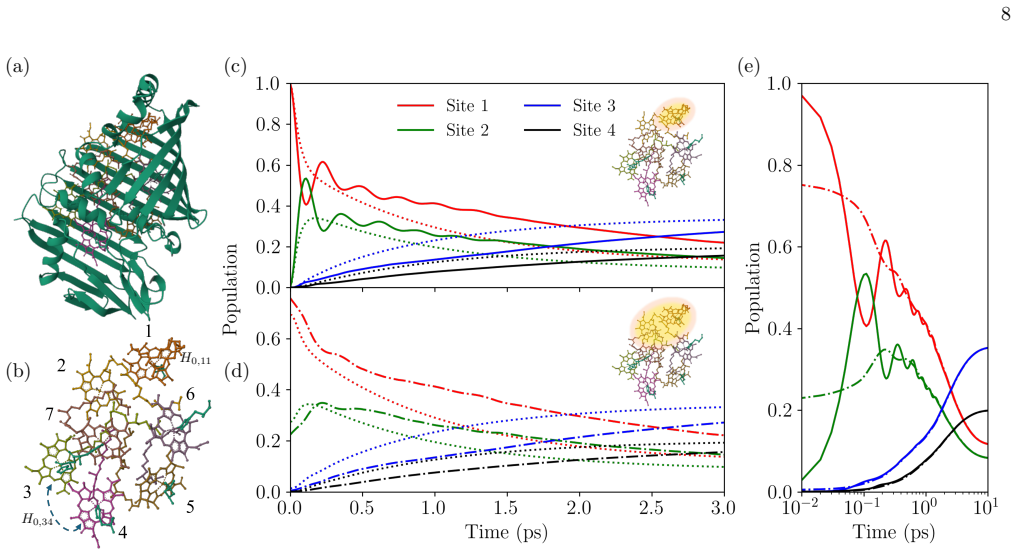
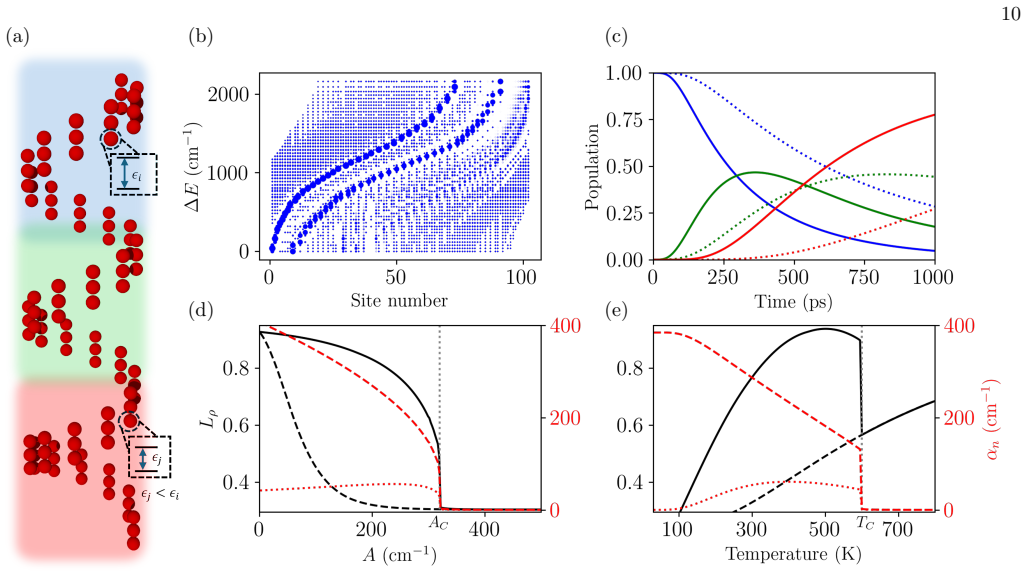
Accurately modelling many-body quantum transport systems poses a challenge both conceptually and computationally due to the growth of the Hilbert space and the multi-scale nature of the geometries and couplings present in most naturally occurring networks. A compounding complexity of such systems is that the environment typically plays a key role in the transport dynamics. Utilising variational unitary transformations that displace environmental degrees of freedom allows for the deployment of a second-order master equation capable of capturing the dynamics of intermediate and strongly coupled systems, which are ubiquitous in microscopic energy transport systems. However, direct implementations of this approach suffer from fundamental scalability issues due to the complexity of the self-consistent equations required to solve for the variational parameters. Here, we present an efficient partitioning scheme that leverages the inherent multi-scale nature of natural energy transport networks. This enables scaling of the variational polaron framework to quantum energy transport systems, constituting hundreds to thousands of sites. Our work unlocks the physically motivated exploration of large transport networks, for example, those present within light-harvesting complexes and exciton transport in disordered semiconductors.
Editorial analysis
A structured set of objections, weighed in public.
Referee Report
Summary. The paper claims that by exploiting the inherent multi-scale structure of natural energy transport networks, an efficient partitioning scheme can be applied to the variational polaron transformation, thereby scaling the associated second-order master equation to quantum transport systems with hundreds to thousands of sites while preserving accuracy in intermediate and strong coupling regimes; this is illustrated for applications such as light-harvesting complexes and exciton transport in disordered semiconductors.
Significance. If the partitioning demonstrably controls errors in the effective Liouvillian, the work would enable first-principles exploration of realistically sized many-body transport networks that are currently inaccessible to direct variational polaron methods, providing a concrete route to modeling environment-assisted quantum transport at scales relevant to biology and materials.
major comments (2)
- [Partitioning scheme] The partitioning procedure (described in the section introducing the scalable framework) supplies no quantitative bound or criterion on the magnitude of inter-partition couplings that remain after the polaron transformation; without such a bound, it is impossible to guarantee that the neglected cross terms do not induce O(1) deviations in the second-order master-equation rates or steady-state currents as the total number of sites grows to hundreds or thousands.
- [Numerical results / validation] No numerical validation, benchmark comparisons against exact diagonalization or alternative methods, or error analysis for partitioned versus unpartitioned systems is presented for intermediate or strong system-bath coupling; this omission leaves the central claim that accuracy is preserved untested.
minor comments (1)
- [Abstract] The abstract and introduction would benefit from a concise statement of the precise multi-scale criterion used to define partitions (e.g., a threshold on intra- versus inter-partition coupling strengths).
Simulated Author's Rebuttal
We thank the referee for the constructive comments, which identify key areas where the manuscript can be strengthened. We address each major comment below and will incorporate revisions to improve the rigor and validation of the partitioning scheme.
read point-by-point responses
-
Referee: The partitioning procedure (described in the section introducing the scalable framework) supplies no quantitative bound or criterion on the magnitude of inter-partition couplings that remain after the polaron transformation; without such a bound, it is impossible to guarantee that the neglected cross terms do not induce O(1) deviations in the second-order master-equation rates or steady-state currents as the total number of sites grows to hundreds or thousands.
Authors: We agree that the manuscript lacks an explicit quantitative bound on residual inter-partition couplings after the transformation. The scheme relies on the multi-scale structure of the networks, with partitioning chosen such that inter-partition couplings remain weak relative to intra-partition ones. To address this, we will add an error analysis (in a new appendix or methods subsection) deriving an estimate for the contribution of neglected cross terms to the rates and currents. This will show that, for the intermediate-to-strong coupling regimes and network topologies considered, the errors remain controlled and do not produce O(1) deviations with increasing system size. revision: yes
-
Referee: No numerical validation, benchmark comparisons against exact diagonalization or alternative methods, or error analysis for partitioned versus unpartitioned systems is presented for intermediate or strong system-bath coupling; this omission leaves the central claim that accuracy is preserved untested.
Authors: The current manuscript emphasizes the framework development and its application to large-scale examples but does not include direct numerical benchmarks or error comparisons between partitioned and unpartitioned variational polaron calculations. This is a valid observation. In the revision, we will add a dedicated validation section with numerical results on smaller systems (where full unpartitioned calculations are feasible), including comparisons to exact diagonalization where possible, specifically in the intermediate and strong coupling regimes to quantify the accuracy of the partitioned approach. revision: yes
Circularity Check
No circularity in derivation chain
full rationale
The paper introduces a new partitioning scheme that exploits the multi-scale structure of transport networks to extend the variational polaron + second-order master equation approach to hundreds or thousands of sites. This is framed as a structural decomposition of the system Hamiltonian and Liouvillian, not as a redefinition or renaming of existing quantities. No step reduces a claimed prediction to a fitted parameter by construction, no uniqueness theorem is imported from the authors' prior work to force the choice, and the central scalability claim rests on the physical premise of weak inter-partition couplings after the polaron transform rather than on self-referential equations. The derivation is therefore self-contained and does not collapse to its inputs.
Axiom & Free-Parameter Ledger
axioms (2)
- domain assumption Variational unitary transformations can displace environmental degrees of freedom sufficiently to justify a second-order master equation even in intermediate and strong coupling regimes.
- ad hoc to paper Natural energy transport networks possess an exploitable multi-scale structure that permits partitioning without loss of essential transport physics.
Reference graph
Works this paper leans on
-
[1]
F. Caycedo-Soler, A. Mattioni, J. Lim, T. Renger, S. Huelga, and M. Plenio, Exact simulation of pigment- protein complexes unveils vibronic renormalization of electronic parameters in ultrafast spectroscopy, Nature Communications13, 1 (2022)
work page 2022
-
[2]
D. Balzer and I. Kassal, Mechanism of delocalization- enhanced exciton transport in disordered organic semi- conductors, The journal of physical chemistry letters.14, 2155 (2023)
work page 2023
-
[3]
D. Balzer and I. Kassal, Delocalisation enables efficient charge generation in organic photovoltaics, even with lit- tle to no energetic offset, Chem. Sci.15, 4779
-
[4]
Mukamel,Principles of Nonlinear Optical Spectroscopy (Oxford University Press, New York, 1995)
S. Mukamel,Principles of Nonlinear Optical Spectroscopy (Oxford University Press, New York, 1995)
work page 1995
-
[5]
Holstein, Studies of polaron motion: Part i
T. Holstein, Studies of polaron motion: Part i. the molecular-crystal model, Annals of Physics8, 325 (1959)
work page 1959
-
[6]
R. W. Munn and R. Silbey, Theory of electronic trans- port in molecular crystals. iii. diffusion coefficient incor- porating nonlocal linear electron–phonon coupling, The Journal of Chemical Physics83, 1854 (1985)
work page 1985
-
[7]
D. M. Rouse, E. Gauger, and B. W. Lovett, Optimal power generation using dark states in dimers strongly coupled to their environment, New Journal of Physics 21, 063025 (2019)
work page 2019
-
[8]
D. P. S. McCutcheon and A. Nazir, Quantum dot rabi rotations beyond the weak exciton–phonon coupling regime, New Journal of Physics12, 113042 (2010)
work page 2010
-
[9]
A. Nazir and D. P. McCutcheon, Modelling exciton– phonon interactions in optically driven quantum dots, Journal of Physics: Condensed Matter28, 103002 (2016)
work page 2016
-
[10]
J. Wiercinski, M. Cygorek, and E. M. Gauger, Role of po- laron dressing in superradiant emission dynamics, Phys. Rev. Res.6, 033231 (2024)
work page 2024
-
[11]
G. D. Scholes, G. R. Fleming, L. X. Chen, A. Aspuru- Guzik, A. Buchleitner, D. F. Coker, G. S. Engel, R. van Grondelle, A. Ishizaki, D. M. Jonas, J. S. Lundeen, J. K. 13 McCusker, S. Mukamel, J. P. Ogilvie, A. Olaya-Castro, M. A. Ratner, F. C. Spano, K. B. Whaley, and X. Zhu, Using coherence to enhance function in chemical and bio- physical systems, Natur...
work page 2017
-
[12]
A. Ishizaki and G. R. Fleming, Theoretical exam- ination of quantum coherence in a photosynthetic system at physiological temperature, Proceedings of the National Academy of Sciences106, 17255 (2009), https://www.pnas.org/doi/pdf/10.1073/pnas.0908989106
-
[13]
N. Lorenzoni, T. Lacroix, J. Lim, D. Tamascelli, S. F. Huelga, and M. B. Plenio, Full microscopic simulations uncover persistent quantum effects in primary photosyn- thesis (2025), arXiv:2503.17282 [physics.chem-ph]
-
[14]
E. J. Dodson, N. Werren, Y. Paltiel, E. M. Gauger, and N. Keren, Large-scale fret simulations reveal the control parameters of phycobilisome light-harvesting complexes, Journal of The Royal Society Interface19, 20220580 (2022)
work page 2022
-
[15]
M. K. S ¸ener, J. D. Olsen, C. N. Hunter, and K. Schul- ten, Atomic-level structural and functional model of a bacterial photosynthetic membrane vesicle, Proceedings of the National Academy of Sciences104, 15723 (2007), https://www.pnas.org/doi/pdf/10.1073/pnas.0706861104
-
[16]
D. R. Martin and D. V. Matyushov, Electron-transfer chain in respiratory complex i, Scientific Reports7, 5495 (2017)
work page 2017
-
[17]
S. Gane, D. Georganakis, K. Maniati, M. Vamvakias, N. Ragoussis, E. M. C. Skoulakis, and L. Turin, Molec- ular vibration-sensing component in human olfaction, PLOS ONE8, 1 (2013)
work page 2013
-
[18]
H. G. Hiscock, S. Worster, D. R. Kattnig, C. Steers, Y. Jin, D. E. Manolopoulos, H. Mourit- sen, and P. J. Hore, The quantum needle of the avian magnetic compass, Proceedings of the Na- tional Academy of Sciences113, 4634 (2016), https://www.pnas.org/doi/pdf/10.1073/pnas.1600341113
-
[19]
E. M. Gauger, E. Rieper, J. J. L. Morton, S. C. Ben- jamin, and V. Vedral, Sustained quantum coherence and entanglement in the avian compass, Phys. Rev. Lett.106, 040503 (2011)
work page 2011
-
[20]
D. Hallett, J. Wiercinski, L. Hallacy, S. Sheldon, R. Dost, N. Martin, A. Fenzl, I. Farrer, A. Verma, M. Cygorek, E. M. Gauger, M. S. Skolnick, and L. R. Wilson, Con- trolling coherence between waveguide-coupled quantum dots (2025), arXiv:2410.17890 [quant-ph]
- [21]
- [22]
-
[23]
The TEMPO collaboration, OQuPy: A python 3 package to efficiently compute non-markovian open quantum sys- tems,http://dx.doi.org/10.5281/zenodo.4428316. (2020)
-
[24]
N. Makri, Small matrix disentanglement of the path integral: Overcoming the exponential tensor scaling with memory length, The Journal of Chemical Physics152, 041104 (2020), https://pubs.aip.org/aip/jcp/article- pdf/doi/10.1063/1.5139473/13277383/041104 1 online.pdf
-
[25]
N. Makri, Small matrix path integral with extended memory, Journal of Chemical Theory and Computation 17, 1 (2021), https://doi.org/10.1021/acs.jctc.0c00987
-
[26]
Y. Tanimura, Numerically “exact” approach to open quantum dynamics: The hierarchical equations of motion (heom), The Journal of Chemical Physics153, 020901 (2020), https://doi.org/10.1063/5.0011599
-
[27]
A. D. Somoza, O. Marty, J. Lim, S. F. Huelga, and M. B. Plenio, Dissipation-assisted matrix product factorization, Phys. Rev. Lett.123, 100502 (2019)
work page 2019
-
[28]
B. Le D´ e, A. Jaouadi, E. Mangaud, A. W. Chin, and M. Desouter-Lecomte, Managing temperature in open quantum systems strongly coupled with structured environments, The Journal of Chemical Physics160, 244102 (2024), https://pubs.aip.org/aip/jcp/article- pdf/doi/10.1063/5.0214051/20009074/244102 1 5.0214051.pdf
- [29]
-
[30]
A. Strathearn, P. Kirton, D. Kilda, J. Keeling, and B. W. Lovett, Efficient non-markovian quantum dynamics using time-evolving matrix product operators, Nature Commu- nications9, 3322 (2018)
work page 2018
-
[31]
V. Link, H.-H. Tu, and W. T. Strunz, Open quantum sys- tem dynamics from infinite tensor network contraction, Phys. Rev. Lett.132, 200403 (2024)
work page 2024
-
[32]
M. Cygorek and E. M. Gauger, Ace: A general-purpose non-markovian open quantum systems simulation toolkit based on process tensors, The Journal of Chemical Physics161, 074111 (2024)
work page 2024
- [33]
-
[34]
A. REDFIELD, The theory of relaxation processes* *this work was started while the author was at harvard univer- sity, and was then partially supported by joint services contract n5ori-76, project order i., inAdvances in Mag- netic Resonance, Advances in Magnetic and Optical Res- onance, Vol. 1, edited by J. S. Waugh (Academic Press,
-
[35]
G. Lindblad, On the generators of quantum dynamical semigroups, Communications in Mathematical Physics 48, 119 (1976)
work page 1976
-
[36]
M. Yang and G. R. Fleming, Influence of phonons on exciton transfer dynamics: comparison of the red- field, f¨ orster, and modified redfield equations, Chemical Physics275, 355 (2002)
work page 2002
-
[37]
F. Shibata, Y. Takahashi, and N. Hashitsume, A gener- alized stochastic liouville equation. non-markovian ver- sus memoryless master equations, Journal of Statistical Physics17, 171 (1977)
work page 1977
-
[38]
I. de Vega and D. Alonso, Dynamics of non-markovian open quantum systems, Rev. Mod. Phys.89, 015001 (2017)
work page 2017
-
[39]
G. D. Mahan,Many-Particle Physics(Springer Science & Business Media, 2013)
work page 2013
-
[40]
M. Hohenadler and W. von der Linden, Lang-firsov ap- proaches to polaron physics: From variational methods to unbiased quantum monte carlo simulations, inPo- larons in Advanced Materials, edited by A. S. Alexandrov (Springer Netherlands, Dordrecht, 2007) pp. 463–502
work page 2007
-
[41]
N. Anto-Sztrikacs and D. Segal, Capturing non- markovian dynamics with the reaction coordinate method, Phys. Rev. A104, 052617 (2021)
work page 2021
-
[42]
A. Kolli, A. Nazir, and A. Olaya-Castro, Elec- tronic excitation dynamics in multichromophoric systems described via a polaron-representation mas- 14 ter equation, The Journal of Chemical Physics135, 154112 (2011), https://pubs.aip.org/aip/jcp/article- pdf/doi/10.1063/1.3652227/15443151/154112 1 online.pdf
-
[43]
D. P. S. McCutcheon, N. S. Dattani, E. M. Gauger, B. W. Lovett, and A. Nazir, A general approach to quantum dy- namics using a variational master equation: Application to phonon-damped rabi rotations in quantum dots, Phys. Rev. B84, 081305 (2011)
work page 2011
-
[44]
G. S. Engel, T. R. Calhoun, E. L. Read, T.-K. Ahn, T. Manˇ cal, Y.-C. Cheng, R. E. Blankenship, and G. R. Fleming, Evidence for wavelike energy transfer through quantum coherence in photosynthetic systems, Nature 446, 782 (2007)
work page 2007
-
[45]
A. Ishizaki and G. R. Fleming, Quantum coherence in photosynthetic light harvesting, Annual Review of Con- densed Matter Physics3, 333 (2012)
work page 2012
-
[46]
E. Zerah-Harush and Y. Dubi, Effects of disorder and interactions in environment assisted quantum transport, Phys. Rev. Res.2, 023294 (2020)
work page 2020
-
[47]
S. Davidson, F. A. Pollock, and E. Gauger, Eliminat- ing radiative losses in long-range exciton transport, PRX Quantum3, 020354 (2022)
work page 2022
-
[48]
F˝ orster, 10th spiers memorial lecture
T. F˝ orster, 10th spiers memorial lecture. transfer mecha- nisms of electronic excitation, Discuss. Faraday Soc.27, 7 (1959)
work page 1959
-
[49]
S. Jang, Y.-C. Cheng, D. R. Reichman, and J. D. Eaves, Theory of coherent resonance energy transfer, The Jour- nal of Chemical Physics129, 101104 (2008)
work page 2008
-
[50]
F. A. Pollock, D. P. McCutcheon, B. W. Lovett, E. M. Gauger, and A. Nazir, A multi-site variational master equation approach to dissipative energy transfer, New Journal of Physics15, 075018 (2013)
work page 2013
-
[51]
R. Silbey and R. A. Harris, Variational calculation of the dynamics of a two level system interact- ing with a bath, The Journal of Chemical Physics 80, 2615 (1984), https://pubs.aip.org/aip/jcp/article- pdf/80/6/2615/18948010/2615 1 online.pdf
work page 1984
-
[52]
J. Cao, R. J. Cogdell, D. F. Coker, H.-G. Duan, J. Hauer, U. Kleinekath¨ ofer, T. L. C. Jansen, T. Manˇ cal, R. J. D. Miller, J. P. Ogilvie, V. I. Prokhorenko, T. Renger, H.-S. Tan, R. Tempelaar, M. Thorwart, E. Thyrhaug, S. West- enhoff, and D. Zigmantas, Quantum biology revisited, Science Advances6, eaaz4888 (2020)
work page 2020
-
[53]
P. Nalbach, D. Braun, and M. Thorwart, Exciton trans- fer dynamics and quantumness of energy transfer in the fenna-matthews-olson complex, Phys. Rev. E84, 041926 (2011)
work page 2011
-
[54]
H.-G. Duan, V. I. Prokhorenko, R. J. Cogdell, K. Ashraf, A. L. Stevens, M. Thorwart, and R. J. D. Miller, Nature does not rely on long-lived electronic quantum coherence for photosynthetic energy transfer, Proceedings of the National Academy of Sciences114, 8493 (2017), https://www.pnas.org/doi/pdf/10.1073/pnas.1702261114
-
[55]
M. R¨ atsep and A. Freiberg, Electron–phonon and vi- bronic couplings in the fmo bacteriochlorophyll a antenna complex studied by difference fluorescence line narrow- ing, Journal of Luminescence127, 251 (2007), proceed- ings of the Ninth International Meeting on Hole Burn- ing, Single Molecule, and Related Spectroscopies: Sci- ence and Applications
work page 2007
-
[56]
S. Kundu, R. Dani, and N. Makri, Tight inner ring architecture and quantum motion of nuclei enable efficient energy transfer in bacterial light harvesting, Science Advances8, eadd0023 (2022), https://www.science.org/doi/pdf/10.1126/sciadv.add0023
-
[57]
S. Tretiak, C. Middleton, V. Chernyak, and S. Mukamel, Exciton hamiltonian for the bacteriochlorophyll system in the lh2 antenna complex of purple bacteria, The Journal of Physical Chemistry B104, 4519 (2000), https://doi.org/10.1021/jp9939930
-
[58]
M. R¨ atsep, Z.-L. Cai, J. R. Reimers, and A. Freiberg, Demonstration and interpretation of significant asymme- try in the low-resolution and high-resolution qy fluores- cence and absorption spectra of bacteriochlorophyll a, The Journal of Chemical Physics134, 024506 (2011)
work page 2011
-
[59]
A. R. Coates, B. W. Lovett, and E. M. Gauger, From goldilocks to twin peaks: multiple optimal regimes for quantum transport in disordered networks, Phys. Chem. Chem. Phys.25, 10103 (2023)
work page 2023
-
[60]
D. M. Rouse, E. M. Gauger, and B. W. Lovett, Influ- ence of strong molecular vibrations on decoherence of molecular polaritons, ACS Photonics11, 5215 (2024), https://doi.org/10.1021/acsphotonics.4c01446. 15 Appendix A. Master equation formulation in the variational frame By writing the interaction Hamiltonian in the form ˜HI = PN 2 i=1 Si ⊗E i (with inter...
discussion (0)
Sign in with ORCID, Apple, or X to comment. Anyone can read and Pith papers without signing in.