Recognition: unknown
Gravitational emissions and light curves of quasi-periodic orbits in Schwarzschild spacetime embedded in a Dehnen-type dark matter halo
Pith reviewed 2026-05-10 12:31 UTC · model grok-4.3
The pith
Dark matter halo parameters enlarge closed orbits around black holes and produce phase lags in their gravitational wave signals.
A machine-rendered reading of the paper's core claim, the machinery that carries it, and where it could break.
Core claim
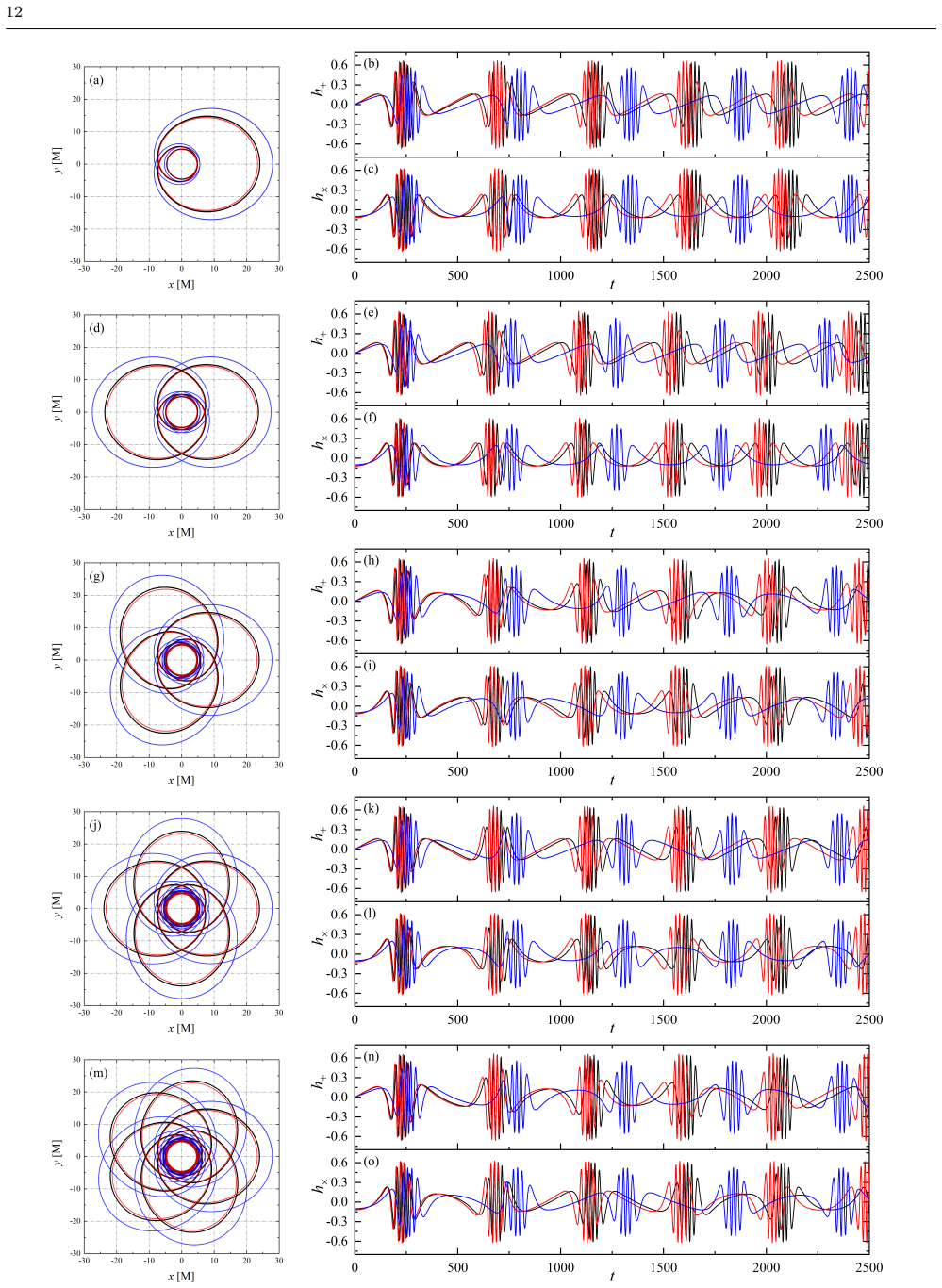
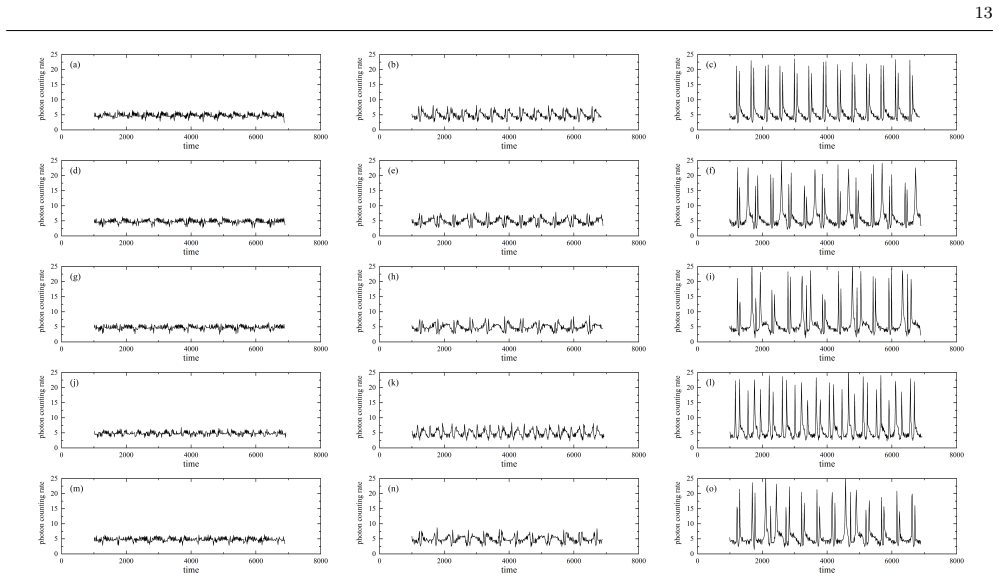
In the Schwarzschild spacetime embedded in a Dehnen-type dark matter halo, strictly closed timelike orbits exist and their morphologies are governed by the ratio of the azimuthal period to the radial period. The dark matter halo parameters amplify the orbital scale and thereby induce a discernible phase lag in the gravitational wave signals. Although the number of leaves in the orbital structures remains difficult to distinguish from gravitational wave signals alone, these structures produce identifiable signatures in the characteristic peaks of the associated electromagnetic light curves.
What carries the argument
The ratio of azimuthal period to radial period, which fixes the shape and leaf count of the closed timelike orbits in the combined metric.
If this is right
- Halo core scale and density parameters increase the size of closed orbits.
- The increased orbital scale produces measurable phase lags in gravitational wave signals.
- Leaf counts in the orbits cannot be reliably extracted from gravitational waves alone.
- Light curves exhibit distinct peaks that identify those leaf counts.
- Multi-messenger signals from such orbits can link black hole environments to dark matter distributions.
Where Pith is reading between the lines
- Phase lags measured in future gravitational wave detections could be used to infer dark matter halo parameters.
- Joint gravitational wave and electromagnetic monitoring might resolve ambiguities between different orbital leaf numbers.
- The same period-ratio mechanism may produce analogous signatures in other dark matter halo models.
Load-bearing premise
Strictly closed timelike orbits exist and stay stable in the Schwarzschild metric with the embedded Dehnen dark matter halo.
What would settle it
Gravitational wave data from orbiting sources around a supermassive black hole that show no phase lag at the amplitudes predicted for realistic Dehnen halo parameters would falsify the claimed amplification effect.
Figures


read the original abstract
Timelike orbits in curved spacetimes encode intrinsic information about the background geometry and serve as critical probes for investigating gravitational theories and source distributions. In this study, we investigate strictly closed timelike orbits within a Schwarzschild spacetime embedded in a Dehnen-type dark matter halo. By solving the geodesic equations, we identify various configurations of these closed orbits and simulate their corresponding gravitational waves and electromagnetic light curves. Our findings reveal that the morphology of closed orbits is primarily governed by the ratio of the azimuthal period to the radial period. Notably, dark matter halo parameters such as the core scale and density parameters exert a significant amplification effect on the orbital scale, which further induces a discernible phase lag in the gravitational wave signals. Furthermore, although certain orbital structures including the number of leaves remain challenging to distinguish via gravitational wave signals alone, they exhibit identifiable signatures in the characteristic peaks of light curves. These findings reveal the multi-messenger potential of closed orbits in bridging black hole environments and dark matter properties, providing theoretical guidance for future dark matter searches.
Editorial analysis
A structured set of objections, weighed in public.
Referee Report
Summary. The paper examines strictly closed timelike orbits in Schwarzschild spacetime embedded in a Dehnen-type dark matter halo. It solves the geodesic equations to identify orbit configurations, simulates the associated gravitational-wave signals and electromagnetic light curves, and reports that the halo's core scale and density parameters amplify orbital scales, producing observable phase lags in the GW signals while light-curve peaks distinguish orbital leaf structures that GWs alone cannot resolve.
Significance. If the central results hold, the work would offer a concrete multi-messenger framework linking black-hole environments to dark-matter halo properties via phase lags and light-curve morphology. However, the absence of demonstrated exact period commensurability, stability analysis, and quantitative error estimates substantially reduces the immediate impact; the claimed amplification and distinguishability remain provisional until these elements are supplied.
major comments (3)
- [Abstract] Abstract and title: the abstract repeatedly asserts the existence of 'strictly closed timelike orbits' whose radial-to-azimuthal period ratio is rational, yet the title refers to 'quasi-periodic orbits'. In the pure Schwarzschild metric bound timelike geodesics precess; the Dehnen halo modifies the effective potential, but the manuscript must explicitly demonstrate that the chosen core-radius and density parameters render the periods exactly commensurate (e.g., via numerical integration showing closure to machine precision after many radial periods) rather than merely approximately periodic. Without this demonstration the reported phase lag and leaf-number signatures do not follow.
- [Abstract] The abstract states that geodesic equations were solved and signals simulated, yet the provided information contains no convergence tests, step-size studies, or comparison against known Schwarzschild limits (e.g., the exact precession rate for a given energy and angular momentum). Consequently the claimed amplification effect on orbital scale and the distinguishability of light-curve peaks cannot be assessed for numerical reliability.
- [Abstract] The load-bearing assumption that the chosen halo parameters produce orbits that remain stable against small perturbations is not addressed. Stability must be verified (second derivative of the effective potential or Lyapunov exponents) before the multi-messenger signatures can be regarded as observationally relevant; the current presentation leaves this unexamined.
minor comments (2)
- The manuscript should supply error bars or uncertainty estimates on all reported phase lags and peak positions, together with the specific numerical integrator and tolerance settings used.
- Notation for the Dehnen halo parameters (core scale, density) should be defined once in the text and used consistently; the abstract introduces them without explicit symbols.
Simulated Author's Rebuttal
We thank the referee for the constructive and detailed comments. These have highlighted important areas where the manuscript can be strengthened with additional demonstrations of numerical accuracy and stability. We address each major comment below and will revise the manuscript accordingly.
read point-by-point responses
-
Referee: [Abstract] Abstract and title: the abstract repeatedly asserts the existence of 'strictly closed timelike orbits' whose radial-to-azimuthal period ratio is rational, yet the title refers to 'quasi-periodic orbits'. In the pure Schwarzschild metric bound timelike geodesics precess; the Dehnen halo modifies the effective potential, but the manuscript must explicitly demonstrate that the chosen core-radius and density parameters render the periods exactly commensurate (e.g., via numerical integration showing closure to machine precision after many radial periods) rather than merely approximately periodic. Without this demonstration the reported phase lag and leaf-number signatures do not follow.
Authors: We agree that the title and abstract terminology should be aligned and that explicit demonstration of exact period commensurability is required. The manuscript selects specific Dehnen halo parameters for which the radial-to-azimuthal period ratio is rational, yielding strictly closed orbits; the title employs 'quasi-periodic' in the broader sense of the spacetime class. To address the concern, we will revise the title to 'Gravitational emissions and light curves of closed timelike orbits in Schwarzschild spacetime embedded in a Dehnen-type dark matter halo' and add a new subsection with numerical integration results. These will show that, for the reported core scale and density values, the orbit closes to machine precision (azimuthal and radial mismatch below 10^{-12}) after an integer number of radial periods, confirming the phase lags and leaf structures. revision: yes
-
Referee: [Abstract] The abstract states that geodesic equations were solved and signals simulated, yet the provided information contains no convergence tests, step-size studies, or comparison against known Schwarzschild limits (e.g., the exact precession rate for a given energy and angular momentum). Consequently the claimed amplification effect on orbital scale and the distinguishability of light-curve peaks cannot be assessed for numerical reliability.
Authors: We concur that quantitative validation of the numerical scheme is essential. The revised manuscript will include a dedicated numerical methods subsection reporting the geodesic integration algorithm, step-size convergence tests (showing orbital frequencies stable to better than 0.1% under refinement), and direct comparisons to the analytic Schwarzschild periastron precession rate in the zero-halo-density limit. These additions will confirm the reliability of the reported orbital-scale amplification and the resulting gravitational-wave phase lags. revision: yes
-
Referee: [Abstract] The load-bearing assumption that the chosen halo parameters produce orbits that remain stable against small perturbations is not addressed. Stability must be verified (second derivative of the effective potential or Lyapunov exponents) before the multi-messenger signatures can be regarded as observationally relevant; the current presentation leaves this unexamined.
Authors: We recognize that stability must be explicitly verified for the results to be observationally relevant. In the revision we will add an analysis of the effective potential, demonstrating that its second derivative is positive at the radial turning points for the chosen energies and angular momenta. We will also report Lyapunov exponents (computed via the variational equations) showing no exponential divergence for the selected halo parameters, thereby confirming local stability of the closed orbits and supporting the multi-messenger signatures. revision: yes
Circularity Check
No significant circularity; derivations rest on explicit numerical integration of geodesics
full rationale
The paper solves the geodesic equations in the Schwarzschild-plus-Dehnen metric, identifies closed orbits via the ratio of azimuthal to radial periods, and computes GW waveforms and light curves from those trajectories. No equation or claim reduces a reported effect (phase lag, amplification, light-curve peaks) to a quantity defined by the same halo parameters or by a self-citation chain. The central results follow from direct integration rather than from fitting a parameter to a subset of the output data and relabeling it a prediction. Self-citations, if present, are not invoked to establish uniqueness or to smuggle in an ansatz that carries the load-bearing step. The derivation chain is therefore self-contained against external benchmarks.
Axiom & Free-Parameter Ledger
free parameters (2)
- core scale parameter
- density parameter
axioms (2)
- standard math Timelike geodesics in the Schwarzschild-plus-Dehnen metric obey the standard geodesic equation derived from the metric
- domain assumption The Dehnen profile accurately represents the dark matter distribution around the black hole
Reference graph
Works this paper leans on
-
[1]
LIGO Scientific Collaboration and Virgo Collabora- tion, Observation of Gravitational Waves from a Binary Black Hole Merger, Phys. Rev. Lett.116(6), 061102 (2016). DOI 10.1103/PhysRevLett.116.061102
-
[2]
Event Horizon Telescope Collaboration, First M87 Event Horizon Telescope Results. I. The Shadow of the Supermassive Black Hole, Astrophys. J. Lett.875(1), L1 (2019). DOI 10.3847/2041-8213/ab0ec7
-
[3]
Event Horizon Telescope Collaboration, First Sagittar- ius A* Event Horizon Telescope Results. I. The Shadow of the Supermassive Black Hole in the Center of the Milky Way, Astrophys. J. Lett.930(2), L12 (2022). DOI 10.3847/2041-8213/ac6674
-
[4]
, archivePrefix = "arXiv", eprint =
GRAVITY Collaboration, Detection of the gravitational redshift in the orbit of the star S2 near the Galactic centre massive black hole, Astron. Astrophys.615, L15 (2018). DOI 10.1051/0004-6361/201833718
-
[5]
A. Hees, T. Do, A.M. Ghez, G.D. Martinez, S. Naoz, E.E. Becklin, A. Boehle, S. Chappell, D. Chu, A. De- hghanfar, K. Kosmo, J.R. Lu, K. Matthews, M.R. Morris, S. Sakai, R. Sch¨ odel, G. Witzel, Testing General Relativity with Stellar Orbits around the Supermassive Black Hole in Our Galactic Center, Phys. Rev. Lett.118(21), 211101 (2017). DOI 10.1103/PhysR...
-
[6]
M. Grould, F.H. Vincent, T. Paumard, G. Perrin, Gen- eral relativistic effects on the orbit of the S2 star with GRAVITY, Astron. Astrophys.608, A60 (2017). DOI 10.1051/0004-6361/201731148
-
[7]
GRAVITY Collaboration, Modeling the orbital motion of Sgr A*’s near-infrared flares, Astron. Astrophys.635, A143 (2020). DOI 10.1051/0004-6361/201937233
-
[8]
J. Einasto, A. Kaasik, E. Saar, Dynamic evidence on massive coronas of galaxies, Nature250(5464), 309 (1974). DOI 10.1038/250309a0
-
[9]
V.C. Rubin, W.K. Ford, Jr., N. Thonnard, Extended rotation curves of high-luminosity spiral galaxies. IV. Systematic dynamical properties, Sa - Sc., Phys. Rev. Lett.225, L107 (1978). DOI 10.1086/182804
-
[10]
D. Clowe, A. Gonzalez, M. Markevitch, Weak-Lensing Mass Reconstruction of the Interacting Cluster 1E 0657- 558: Direct Evidence for the Existence of Dark Matter, Astrophys. J.604(2), 596 (2004). DOI 10.1086/381970
-
[11]
D. Clowe, M. Bradaˇ c, A.H. Gonzalez, M. Markevitch, S.W. Randall, C. Jones, D. Zaritsky, A Direct Empirical Proof of the Existence of Dark Matter, Astrophys. J. Lett.648(2), L109 (2006). DOI 10.1086/508162
-
[12]
M.C. Chen, T. Broadhurst, J. Lim, S.M. Molnar, J.M. Diego, M. Oguri, L.L. Lee, Geometric Support for Dark Matter by an Unaligned Einstein Ring in A3827, As- trophys. J.898(1), 81 (2020). DOI 10.3847/1538- 4357/ab9ebc
-
[13]
J.W. Moffat, V.T. Toth, Applying modified grav- ity to the lensing and Einstein ring in Abell 3827, Phys. Rev. D103(4), 044045 (2021). DOI 10.1103/PhysRevD.103.044045
-
[14]
G. Bertone, D. Hooper, History of dark matter, Rev. Mod. Phys.90(4), 045002 (2018). DOI 10.1103/RevModPhys.90.045002
-
[18]
Konoplya, Shadow of a black hole surrounded by dark matter, Phys
R.A. Konoplya, Shadow of a black hole surrounded by dark matter, Phys. Lett. B795, 1 (2019). DOI 10.1016/j.physletb.2019.05.043
-
[19]
K. Jusufi, M. Jamil, P. Salucci, T. Zhu, S. Haroon, Black Hole Surrounded by a Dark Matter Halo in the M87 Galactic Center and its Identification with Shadow Images, Phys. Rev. D100(4), 044012 (2019). DOI 10.1103/PhysRevD.100.044012
-
[20]
S. Haroon, M. Jamil, K. Jusufi, K. Lin, R.B. Mann, Shadow and Deflection Angle of Rotating Black Holes in Perfect Fluid Dark Matter with a Cosmological Con- stant, Phys. Rev. D99(4), 044015 (2019). DOI 10.1103/PhysRevD.99.044015
-
[21]
Z. Xu, X. Gong, S.N. Zhang, Black hole immersed dark matter halo, Phys. Rev. D101(2), 024029 (2020). DOI 10.1103/PhysRevD.101.024029
-
[22]
B. Narzilloev, J. Rayimbaev, S. Shaymatov, A. Abdu- jabbarov, B. Ahmedov, C. Bambi, Dynamics of test par- ticles around a Bardeen black hole surrounded by per- fect fluid dark matter, Phys. Rev. D102(10), 104062 (2020). DOI 10.1103/PhysRevD.102.104062 15
-
[23]
K. Jusufi, Quasinormal Modes of Black Holes Sur- rounded by Dark Matter and Their Connection with the Shadow Radius, Phys. Rev. D101(8), 084055 (2020). DOI 10.1103/PhysRevD.101.084055
-
[26]
S. Shaymatov, D. Malafarina, B. Ahmedov, Effect of perfect fluid dark matter on particle motion around a static black hole immersed in an external magnetic field, Phys. Dark Univ.34, 100891 (2021). DOI 10.1016/j.dark.2021.100891
-
[27]
F. Atamurotov, A. Abdujabbarov, W.B. Han, Effect of plasma on gravitational lensing by a Schwarzschild black hole immersed in perfect fluid dark mat- ter, Phys. Rev. D104(8), 084015 (2021). DOI 10.1103/PhysRevD.104.084015
-
[28]
K. Saurabh, K. Jusufi, Imprints of dark matter on black hole shadows using spherical accretions, Eur. Phys. J. C 81(6), 490 (2021). DOI 10.1140/epjc/s10052-021-09280- 9
-
[29]
Z. Stuchl´ ık, J. Vrba, Supermassive black holes sur- rounded by dark matter modeled as anisotropic fluid: epicyclic oscillations and their fitting to observed QPOs, J. Cosmol. Astropart. Phys.11(11), 059 (2021). DOI 10.1088/1475-7516/2021/11/059
-
[30]
X.X. Zeng, K.J. He, G.P. Li, Effects of dark matter on shadows and rings of Brane-World black holes illumi- nated by various accretions, Sci. China Phys. Mech. As- tron.65(9), 290411 (2022). DOI 10.1007/s11433-022- 1896-0
-
[31]
J. Liu, S. Chen, J. Jing, Tidal effects of a dark mat- ter halo around a galactic black hole*, Chin. Phys. C 46(10), 105104 (2022). DOI 10.1088/1674-1137/ac7856
-
[32]
E. Kurmanov, K. Boshkayev, R. Giamb` o, T. Konys- bayev, O. Luongo, D. Malafarina, H. Quevedo, Accre- tion Disk Luminosity for Black Holes Surrounded by Dark Matter with Anisotropic Pressure, Astrophys. J. 925(2), 210 (2022). DOI 10.3847/1538-4357/ac41d4
-
[33]
M. Heydari-Fard, S.G. Honarvar, M. Heydari-Fard, Thin accretion disc luminosity and its image around ro- tating black holes in perfect fluid dark matter, Mon. Not. Roy. Astron. Soc.521(1), 708 (2023). DOI 10.1093/mnras/stad558
-
[34]
D. Liu, Y. Yang, A. ¨Ovg¨ un, Z.W. Long, Z. Xu, Gravita- tional ringing and superradiant instabilities of the Kerr- like black holes in a dark matter halo, Eur. Phys. J. C 83(7), 565 (2023). DOI 10.1140/epjc/s10052-023-11739- w
-
[35]
X. Qin, S. Chen, Z. Zhang, J. Jing, Polarized image of a rotating black hole surrounded by a cold dark mat- ter halo, Eur. Phys. J. C83(2), 159 (2023). DOI 10.1140/epjc/s10052-023-11300-9
-
[36]
A. ¨Ovg¨ un, L.J.F. Sese, R.C. Pantig, Constraints via the Event Horizon Telescope for Black Hole Solutions with Dark Matter under the Generalized Uncertainty Prin- ciple Minimal Length Scale Effect, Ann. Phys.536(4), 2300390 (2024). DOI 10.1002/andp.202300390
-
[37]
Y. Feng, A. Ashraf, S. Mumtaz, S.K. Maurya, G. Mustafa, F. Atamurotov, Orbital motion and epicyclic oscillations around Bardeen black hole surrounded by perfect fluid dark matter, J. High Energy Astrop.43, 158 (2024). DOI 10.1016/j.jheap.2024.07.003
-
[38]
X.X. Zeng, C.Y. Yang, M.I. Aslam, R. Saleem, S. Aslam, Kerr-like black hole surrounded by cold dark mat- ter halo: the shadow images and EHT constraints, J. Cosmol. Astropart. Phys.08, 066 (2025). DOI 10.1088/1475-7516/2025/08/066
-
[39]
K.J. He, G.P. Li, C.Y. Yang, X.X. Zeng, Observational features of the rotating Bardeen black hole surrounded by perfect fluid dark matter, Eur. Phys. J. C85(6), 662 (2025). DOI 10.1140/epjc/s10052-025-14391-8
-
[40]
M.I. Aslam, R. Saleem, C.Y. Yang, X.X. Zeng, Im- prints of dark matter on the shadow and polarization images of a black hole illuminated by various thick disks, J. High Energy Astrop.51, 100551 (2026). DOI 10.1016/j.jheap.2026.100551
-
[41]
J.R. Bond, G. Efstathiou, Cosmic background radia- tion anisotropies in universes dominated by nonbaryonic dark matter, Astrophys. J. Lett.285, L45 (1984). DOI 10.1086/184362
-
[42]
J.F. Navarro, C.S. Frenk, S.D.M. White, The Struc- ture of Cold Dark Matter Halos, Astrophys. J.462, 563 (1996). DOI 10.1086/177173
-
[43]
Einasto, U
J. Einasto, U. Haud, Galactic models with massive corona. I - Method. II - Galaxy, Astron. Astrophys. 223(1-2), 89 (1989)
1989
-
[44]
1995, ApJL, 447, L25, doi: 10.1086/309560
A. Burkert, The Structure of Dark Matter Halos in Dwarf Galaxies, Astrophys. J. Lett.447, L25 (1995). DOI 10.1086/309560
-
[45]
Dehnen, A Family of Potential-Density Pairs for Spherical Galaxies and Bulges, Mon
W. Dehnen, A Family of Potential-Density Pairs for Spherical Galaxies and Bulges, Mon. Not. R. Astron. Soc.265, 250 (1993). DOI 10.1093/mnras/265.1.250
-
[46]
M.M. Gohain, P. Phukon, K. Bhuyan, Thermody- namics and null geodesics of a Schwarzschild black hole surrounded by a Dehnen type dark matter halo, Phys. Dark Univ.46, 101683 (2024). DOI 10.1016/j.dark.2024.101683
-
[47]
M. Alloqulov, T. Xamidov, S. Shaymatov, B. Ahmedov, Gravitational waveforms from periodic orbits around a Schwarzschild black hole embedded in a Dehnen-type dark matter halo, Eur. Phys. J. C85(7), 798 (2025). DOI 10.1140/epjc/s10052-025-14529-8
-
[48]
A. Al-Badawi, S. Shaymatov, Quasinormal modes and shadow of Schwarzschild black holes embedded in a Dehnen-type dark matter halo exhibiting a cloud of strings, Commun. Theor. Phys.77(3), 035402 (2025). DOI 10.1088/1572-9494/ad89b2
-
[50]
Predictions for bottomonium from a relativistic screened potential model,
A. Al-Badawi, S. Shaymatov, Astrophysical properties of static black holes embedded in a Dehnen type dark matter halo with the presence of quintessential field, Chin. Phys. C49(5), 055101 (2025). DOI 10.1088/1674- 1137/adb2fd
-
[51]
B. Hamil, A. Al-Badawi, B.C. L¨ utf¨ uo˘ glu, Geodesics and scalar perturbations of Schwarzschild black holes embedded in a Dehnen-type dark matter halo with quintessence, Phys. Scripta.100(10), 105008 (2025). DOI 10.1088/1402-4896/ae0ed7
-
[52]
B.C. L¨ utf¨ uo˘ glu, A. Shermatov, J. Rayimbaev, M. Maty- oqubov, O. Sirajiddin, Gravitational spectra and wave propagation in regular black holes supported by a 16 Dehnen Halo, Eur. Phys. J. C85(12), 1484 (2025). DOI 10.1140/epjc/s10052-025-15234-2
-
[53]
Z. Li, J. Yu, Observational properties of a Schwarzschild black hole surrounded by a Dehnen-type dark mat- ter halo, Eur. Phys. J. C85(10), 1170 (2025). DOI 10.1140/epjc/s10052-025-14911-6
-
[54]
Q.Q. Liang, D. Liu, Z.W. Long, Quasinormal modes of Schwarzschild black holes in the Dehnen-(1, 4, 5/2) type dark matter halos, Eur. Phys. J. C85(10), 1107 (2025). DOI 10.1140/epjc/s10052-025-14850-2
-
[56]
D. Senjaya, Black hole in Dehnen (1,4,1/2) dark mat- ter halo: exact solution, lensing, light ring, and thermo- dynamics, Eur. Phys. J. C85(11), 1256 (2025). DOI 10.1140/epjc/s10052-025-15005-z
-
[57]
A. Ashoorioon, R. Casadio, K. Jafarzade, M.B. Jahani Poshteh, O. Luongo, Gravitational radiation reaction around a static black hole surrounded by a Dehnen type dark matter halo, J. Cosmol. Astropart. Phys.2026(2), 007 (2026). DOI 10.1088/1475-7516/2026/02/007
-
[58]
R. Massey, L. Williams, R. Smit, M. Swinbank, T.D. Kitching, D. Harvey, M. Jauzac, H. Israel, D. Clowe, A. Edge, M. Hilton, E. Jullo, A. Leonard, J. Liesen- borgs, J. Merten, I. Mohammed, D. Nagai, J. Richard, A. Robertson, P. Saha, R. Santana, J. Stott, E. Titt- ley, The behaviour of dark matter associated with four bright cluster galaxies in the 10 kpc ...
-
[59]
R. Massey, D. Harvey, J. Liesenborgs, J. Richard, S. Stach, M. Swinbank, P. Taylor, L. Williams, D. Clowe, F. Courbin, A. Edge, H. Israel, M. Jauzac, R. Joseph, E. Jullo, T.D. Kitching, A. Leonard, J. Merten, D. Nagai, J. Nightingale, A. Robertson, L.J. Romualdez, P. Saha, R. Smit, S.I. Tam, E. Tittley, Dark matter dynamics in Abell 3827: new data consist...
-
[60]
Planck Collaboration, Planck 2018 results. VI. Cosmo- logical parameters, Astron. Astrophys.641, A6 (2020). DOI 10.1051/0004-6361/201833910
-
[61]
M.S. Delos, T. Linden, Dark matter microhalos in the solar neighborhood: Pulsar timing signatures of early matter domination, Phys. Rev. D105(12), 123514 (2022). DOI 10.1103/PhysRevD.105.123514
-
[62]
J.M. Diego, B. Sun, H. Yan, L.J. Furtak, E. Zackrisson, L. Dai, P. Kelly, M. Nonino, N. Adams, A.K. Meena, S.P. Willner, A. Zitrin, S.H. Cohen, J.C.J. D’Silva, R.A. Jansen, J. Summers, R.A. Windhorst, D. Coe, C.J. Conselice, S.P. Driver, B. Frye, N.A. Grogin, A.M. Koekemoer, M.A. Marshall, N. Pirzkal, A. Robotham, M.J. Rutkowski, R.E. Ryan, S. Tompkins, C...
-
[63]
D.D. Li, Q. Liu, G.M. Eadie, R.G. Abraham, F.R. Mar- leau, W.E. Harris, P. van Dokkum, A.J. Romanowsky, S. Danieli, P.E. Brown, A. Stringer, Candidate Dark Galaxy-2: Validation and Analysis of an Almost Dark Galaxy in the Perseus Cluster, Astrophys. J. Lett. 986(2), L18 (2025). DOI 10.3847/2041-8213/adddab
-
[64]
M.M. Muru, J. Silk, N.I. Libeskind, S. Gottl¨ ober, Y. Hoffman, Fermi-LAT Galactic Center Excess Mor- phology of Dark Matter in Simulations of the Milky Way Galaxy, Phys. Rev. Lett.135(16), 161005 (2025). DOI 10.1103/g9qz-h8wd
-
[65]
Totani, JCAP11, 080 (2025) doi:10.1088/1475-7516/2025/11/080 [arXiv:2507.07209 [astro-ph.HE]]
T. Totani, 20 GeV halo-like excess of the Galactic diffuse emission and implications for dark matter annihilation, J. Cosmol. Astropart. Phys.2025(11), 080 (2025). DOI 10.1088/1475-7516/2025/11/080
-
[66]
D.M. Powell, J.P. McKean, S. Vegetti, C. Spingola, S.D.M. White, C.D. Fassnacht, A million-solar-mass ob- ject detected at a cosmological distance using gravi- tational imaging, Nat. Astron.9, 1714 (2025). DOI 10.1038/s41550-025-02651-2
-
[67]
Y. Chen, M. Daniel, D.J. D’Orazio, X. Fan, A. Mitri- date, L. Sagunski, X. Xue, Nanograv Collaboration, G. Agazie, A. Anumarlapudi, A.M. Archibald, Z. Ar- zoumanian, J.G. Baier, P.T. Baker, B. B´ ecsy, L. Blecha, A. Brazier, P.R. Brook, S. Burke-Spolaor, R. Burnette, J.A. Casey-Clyde, M. Charisi, S. Chatterjee, T. Cohen, J.M. Cordes, N.J. Cornish, F. Craw...
-
[68]
T. Jacobson, T.P. Sotiriou, Spinning Black Holes as Particle Accelerators, Phys. Rev. Lett.104(2), 021101 (2010). DOI 10.1103/PhysRevLett.104.021101
-
[69]
S.W. Wei, Y.X. Liu, H. Guo, C.E. Fu, Charged spinning black holes as particle accelerators, Phys. Rev. D82(10), 103005 (2010). DOI 10.1103/PhysRevD.82.103005
-
[70]
M. Guo, S. Gao, Kerr black holes as accelerators of spin- ning test particles, Phys. Rev. D93(8), 084025 (2016). DOI 10.1103/PhysRevD.93.084025
-
[71]
M. Takahashi, H. Koyama, Chaotic Motion of Charged Particles in an Electromagnetic Field Surrounding a Ro- tating Black Hole, Astrophys. J.693(1), 472 (2009). DOI 10.1088/0004-637X/693/1/472
-
[72]
The Astrophysical Journal745(2), 174 (2012)
O. Kop´ aˇ cek, V. Karas, Inducing Chaos by Breaking Axial Symmetry in a Black Hole Magnetosphere, As- trophys. J.787(2), 117 (2014). DOI 10.1088/0004- 637X/787/2/117
-
[73]
R. P´ anis, M. Koloˇ s, Z. Stuchl´ ık, Determination of chaotic behaviour in time series generated by charged particle motion around magnetized Schwarzschild black holes, Eur. Phys. J. C79(6), 479 (2019). DOI 10.1140/epjc/s10052-019-6961-7 17
-
[74]
D. Li, X. Wu, Chaotic motion of neutral and charged particles in a magnetized Ernst-Schwarzschild space- time, Eur. Phys. J. Plus134(3), 96 (2019). DOI 10.1140/epjp/i2019-12502-9
-
[75]
S. Hu, X. Wu, E. Liang, Construction of a Second- order Six-dimensional Hamiltonian-conserving Scheme, Astrophys. J. Suppl. S.257(2), 40 (2021). DOI 10.3847/1538-4365/ac1ff3
-
[76]
W. Sun, Y. Wang, F. Liu, X. Wu, Applying explicit symplectic integrator to study chaos of charged particles around magnetized Kerr black hole, Eur. Phys. J. C 81(9), 785 (2021). DOI 10.1140/epjc/s10052-021-09579- 7
-
[77]
Y. Wang, W. Sun, F. Liu, X. Wu, Construction of Ex- plicit Symplectic Integrators in General Relativity. II. Reissner-Nordstr¨ om Black Holes, Astrophys. J.909(1), 22 (2021). DOI 10.3847/1538-4357/abd701
-
[78]
Y. Wang, W. Sun, F. Liu, X. Wu, Construction of Explicit Symplectic Integrators in General Relativity. III. Reissner–Nordstr¨ om-(anti)-de Sitter Black Holes, Astrophys. J. Suppl. S.254(1), 8 (2021). DOI 10.3847/1538-4365/abf116
-
[79]
Z. Huang, G. Huang, A. Hu, Application of Ex- plicit Symplectic Integrators in a Magnetized Deformed Schwarzschild Black Spacetime, Astrophys. J.925(2), 158 (2022). DOI 10.3847/1538-4357/ac3edf
-
[80]
L. Zhang, S. Chen, Q. Pan, J. Jing, Chaotic motion of scalar particle coupling to Chern–Simons invariant in the stationary axisymmetric Einstein–Maxwell dilaton black hole spacetime, Eur. Phys. J. C83(9), 828 (2023). DOI 10.1140/epjc/s10052-023-12008-6
-
[81]
Z. Xu, D. Ma, W. Cao, K. Li, Chaotic motion of charged test particles in a Kerr-MOG black hole with explicit symplectic algorithms, Eur. Phys. J. C85(7), 770 (2025). DOI 10.1140/epjc/s10052-025-14425-1
-
[82]
D. Cao, L. Zhang, S. Chen, Q. Pan, J. Jing, Chaotic motion of particles around a dyonic Kerr– Newman black hole immersed in the Melvin-swirling universe, Eur. Phys. J. C85(11), 1250 (2025). DOI 10.1140/epjc/s10052-025-15002-2
-
[83]
Z. Stuchl´ ık, M. Koloˇ s, Acceleration of the charged par- ticles due to chaotic scattering in the combined black hole gravitational field and asymptotically uniform mag- netic field, Eur. Phys. J. C76, 32 (2016). DOI 10.1140/epjc/s10052-015-3862-2
-
[84]
J. Levin, G. Perez-Giz, A periodic table for black hole orbits, Phys. Rev. D77(10), 103005 (2008). DOI 10.1103/PhysRevD.77.103005
-
[85]
V. Misra, J. Levin, Rational Orbits around Charged Black Holes, Phys. Rev. D82, 083001 (2010). DOI 10.1103/PhysRevD.82.083001
-
[86]
G.Z. Babar, A.Z. Babar, Y.K. Lim, Periodic or- bits around a spherically symmetric naked singular- ity, Phys. Rev. D96(8), 084052 (2017). DOI 10.1103/PhysRevD.96.084052
-
[87]
S.W. Wei, J. Yang, Y.X. Liu, Geodesics and periodic or- bits in Kehagias-Sfetsos black holes in deformed Hoˇ rava- Lifshitz gravity, Phys. Rev. D99(10), 104016 (2019). DOI 10.1103/PhysRevD.99.104016
discussion (0)
Sign in with ORCID, Apple, or X to comment. Anyone can read and Pith papers without signing in.