On hyperbolic and rational solutions of the cubically nonlinear Schr\"odinger equation
Pith reviewed 2026-05-10 12:20 UTC · model grok-4.3
The pith
The cubically nonlinear Schrödinger equation has an additional family of hyperbolic and rational solutions in non-generic cases.
A machine-rendered reading of the paper's core claim, the machinery that carries it, and where it could break.
Core claim
The authors construct a further family of explicit hyperbolic and rational solutions to the cubically nonlinear Schrödinger equation that are valid precisely when the coefficients satisfy the non-generic relations identified in prior work, thereby enlarging the set of admissible solutions beyond those already exhibited.
What carries the argument
A new parametric family of hyperbolic and rational function ansatzes inserted into the non-generic case of the cubically nonlinear Schrödinger equation.
If this is right
- The collection of exact solutions available for the non-generic regime grows by at least one additional family.
- These solutions remain admissible only inside the same restricted parameter domain where earlier solutions were found.
- The same reduction technique that produced the new family can be applied to search for still more solutions.
Where Pith is reading between the lines
- The pattern of non-generic solvability may indicate an underlying algebraic structure that organizes all admissible solutions.
- Numerical or experimental checks in physical systems governed by the cubic Schrödinger equation could target the specific coefficient ratios that admit these solutions.
- Similar non-existence versus conditional-existence distinctions may appear in other nonlinear wave equations when the same reduction methods are used.
Load-bearing premise
The derived expressions must satisfy the differential equation identically once the non-generic coefficient constraints are imposed.
What would settle it
Substitute the explicit forms into the equation, impose the non-generic coefficient conditions, and verify whether every term cancels.
Figures






read the original abstract
In a previous article we have proved non-existence of certain "solutions" of the cubically nonlinear Schr\"odinger equation in the general case, and presented solutions in the non-generic case. -- In the present article we describe a further family of solutions enlarging the set of non-generic solutions.
Editorial analysis
A structured set of objections, weighed in public.
Referee Report
Summary. The manuscript extends prior work on the cubically nonlinear Schrödinger equation by constructing an additional family of explicit hyperbolic and rational solutions valid exclusively in the non-generic parameter regime. After recalling the non-existence result for the general case, the authors introduce new ansatzes, derive the associated algebraic constraints, and present the resulting solution forms that satisfy the PDE only when those constraints hold.
Significance. If the explicit forms are shown to solve the PDE under the stated restrictions, the work enlarges the catalog of exact solutions for this integrable nonlinear equation, which is relevant to nonlinear optics and water-wave modeling. The systematic separation of generic versus non-generic cases provides a clear framework for identifying when closed-form solutions exist, complementing the previous non-existence theorem.
major comments (2)
- [§3] §3, the substitution step following Eq. (12): the manuscript states that the proposed hyperbolic form satisfies the NLS equation under the non-generic condition, but does not display the residual computation or the algebraic cancellation that occurs only when the restriction is imposed. Without this explicit verification, it is impossible to confirm that the expressions solve the PDE precisely when claimed and not identically (which would contradict the prior non-existence result).
- [§4.1] §4.1, the rational solution family: the parameter restrictions defining the non-generic case are introduced after the ansatz but before the final expressions; the manuscript must demonstrate that these restrictions are necessary (i.e., that the residual is nonzero for generic parameters) rather than merely sufficient, to ensure the new family does not inadvertently overlap with or contradict the general-case non-existence theorem.
minor comments (2)
- [§2] The notation for the non-generic parameters (e.g., the symbol used for the auxiliary constant in Eq. (8)) should be introduced with a clear reference back to the previous paper to avoid ambiguity for readers unfamiliar with the earlier work.
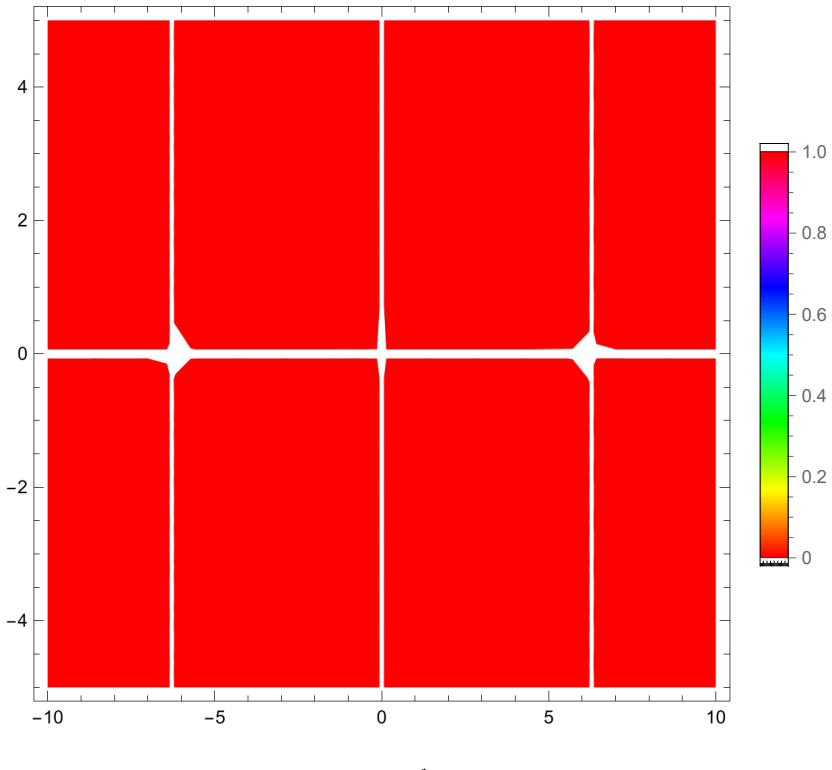
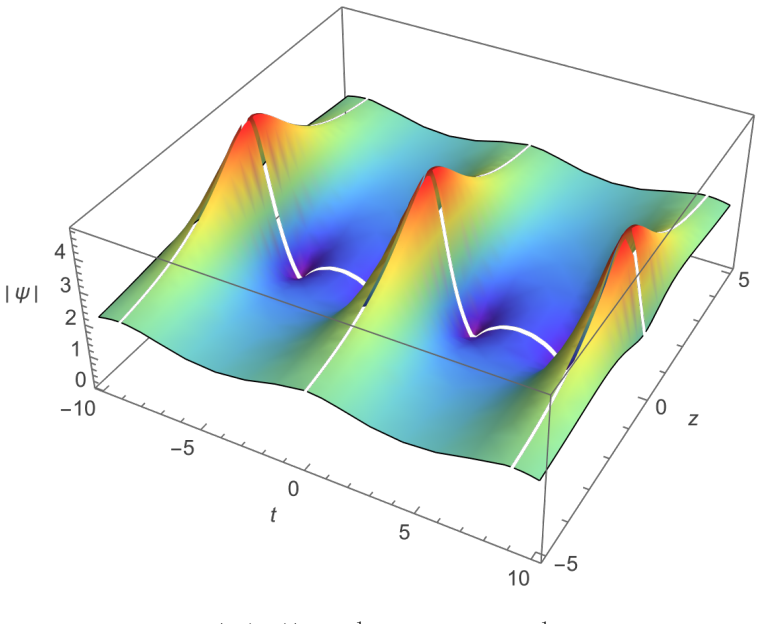
- Figure 1 (if present) or the plotted profiles of the new solutions would benefit from explicit labeling of the non-generic parameter values used, to illustrate the domain of validity.
Simulated Author's Rebuttal
We thank the referee for the careful reading of our manuscript and for the constructive comments, which help clarify the presentation of our new family of solutions. We address each major comment below and have revised the manuscript to incorporate explicit verifications where needed.
read point-by-point responses
-
Referee: [§3] §3, the substitution step following Eq. (12): the manuscript states that the proposed hyperbolic form satisfies the NLS equation under the non-generic condition, but does not display the residual computation or the algebraic cancellation that occurs only when the restriction is imposed. Without this explicit verification, it is impossible to confirm that the expressions solve the PDE precisely when claimed and not identically (which would contradict the prior non-existence result).
Authors: We agree that the explicit residual computation strengthens the rigor of the argument. In the revised manuscript, we now insert the full substitution of the hyperbolic ansatz (following Eq. (12)) into the cubically nonlinear Schrödinger equation, expand the residual, and display the algebraic terms that cancel if and only if the non-generic condition holds. This calculation confirms that the solutions are valid precisely under the stated restriction and do not hold identically, thereby remaining consistent with the earlier non-existence theorem. revision: yes
-
Referee: [§4.1] §4.1, the rational solution family: the parameter restrictions defining the non-generic case are introduced after the ansatz but before the final expressions; the manuscript must demonstrate that these restrictions are necessary (i.e., that the residual is nonzero for generic parameters) rather than merely sufficient, to ensure the new family does not inadvertently overlap with or contradict the general-case non-existence theorem.
Authors: We have added a short but explicit verification in §4.1 of the revised version. After presenting the rational ansatz, we substitute it into the PDE for generic parameter values (i.e., without imposing the non-generic restrictions) and show that the resulting residual is a nonzero expression. This demonstrates necessity of the restrictions and guarantees that the new family lies strictly outside the scope of the general-case non-existence result. revision: yes
Circularity Check
Minor self-citation to prior non-existence result; new explicit solutions derived independently
full rationale
The paper cites its own prior work solely to establish non-existence of solutions in the general case and to delimit the non-generic regime. The central contribution is the explicit construction of additional hyperbolic and rational forms that enlarge the non-generic solution set. These forms are presented for direct substitution into the cubically nonlinear Schrödinger equation, rendering the derivation self-contained and verifiable without reducing to the cited non-existence theorem by definition or construction. The self-citation is therefore not load-bearing for the validity of the new family.
Axiom & Free-Parameter Ledger
axioms (1)
- domain assumption Solutions exist and can be found in the non-generic case of the cubically nonlinear Schrödinger equation.
Reference graph
Works this paper leans on
-
[1]
N. Akhmediev and A. Ankiewicz, Solitons: Nonlinear Pulses and Beams, (Chapmann and Hall, Boca Raton, 1997)
work page 1997
-
[2]
V. E. Zakharov, J. Appl. Mech. Tech. Phys. 9, 190 (1968)
work page 1968
- [3]
- [4]
- [5]
-
[6]
(a) S.Yu. Vernov, Theor. Math. Phys., Vol. 146, 131-139 (2006); (b) S.Yu. Vernov, J.Phys. A: Math.and Theor., Vol. 40, 9833-9844 (2007)
work page 2006
-
[7]
N. Akhmediev, V.M. Eleonskii and N.E. Kulagin, Theor. Math. Phys., Vol. 72, 809 (1987)
work page 1987
-
[8]
Since (11) implies y(0)=y_0, R(y_0)=0 holds; but (11) is valid for any constant y_0 , not necessarily for a zero of R(y)=0
-
[9]
Chandrasekharan, Elliptic Functions, 43-44, (Springer, Berlin, 1985)
K. Chandrasekharan, Elliptic Functions, 43-44, (Springer, Berlin, 1985)
work page 1985
-
[10]
Sch\"urmann and V.S Serov, arXiv: 2204.05846 (2022)
H.W. Sch\"urmann and V.S Serov, arXiv: 2204.05846 (2022)
-
[11]
Hence only k_ - with g (=g_0) must be considered
With k_ = c_1 2 -ac_2 a Eq.(16a) yields g=2 -c_2 a . Hence only k_ - with g (=g_0) must be considered. Substitution of g_0 in Eq.(16b) leads to c_2=0 or c_2=- a 4 . Evaluation of Eq.(17) with k_ - , g_0, c_2=0 yields to g(t, z)=0 , with k_ - , g_0, c_2=- a 4 we get g(t, z)=1
-
[12]
Handbook of Mathematical Functions, 18.12, edited by M. Abramowitz and I.A. Stegun (Dover, New York, 1968)
work page 1968
-
[13]
N. Akhmediev and A. Ankiewicz, Solitons: Nonlinear Pulses and Beams, (Chapmann and Hall, London, 1979)
work page 1979
-
[14]
M. Conforti, A. Mussot, A. Kudlinski, S. Trillo and N. Akhmediev, Physical Review A, Vol. 101, 023843 (2020)
work page 2020
-
[15]
G. Vanderhaegen, C. Naveau, P. Szriftziger et al., Proc. natl. Acad. Sci., Vol 118, e2019348118 (2021)
work page 2021
-
[16]
N. Akhmediev, J. M. Soto-Crespo, and A. Ankiewicz, Phys. Lett. A, Vol. 373, 2137 (2009)
work page 2009
-
[17]
G. Vanderhaegen, P. Szriftziger, C. Naveau et al., Optics Lett., Vol. 45, 3757 (2020)
work page 2020
- [18]
-
[19]
urmann and V.S Serov, Theor. Math. Phys., Vol. 219(1), 557 (2024); (b) H.W. Sch\
(a) H.W. Sch\"urmann and V.S Serov, Theor. Math. Phys., Vol. 219(1), 557 (2024); (b) H.W. Sch\"urmann and V.S Serov, Theor. Math. Phys., Vol. 219(3), 1060 (2024)
work page 2024
-
[20]
There are more than 400 citations of AEK in the Web of Science
-
[21]
Sch\"urmann and V.S Serov, Physical Review A, Vol
H.W. Sch\"urmann and V.S Serov, Physical Review A, Vol. 93, 063802 (2016)
work page 2016
- [22]
-
[23]
Weierstrass, Mathematische Werke, Vol
(a) K. Weierstrass, Mathematische Werke, Vol. 5, 4-16, (Johnson, New York, 1915); (b) E.T. Whittaker and G.N. Watson, A Course of Modern Analysis, 454, (Cambridge University Press, Cambridge, 1927)
work page 1915
- [24]
-
[25]
G. Vanderhaegen, C. Naveau, P. Szriftziger et al., Proc. Nat. Acad. Sci., Vol 118, e2019348118 (2021)
work page 2021
-
[26]
N. Akhmediev, A. Ankiewicz and M. Taki, Phys. Lett. A, Vol. 373, 675 (2009)
work page 2009
-
[27]
The same curve is described in its canonical form by the Weierstrass cubic Y^2=4y^3-g_2y-g_3
A quartic polynomial defines a genus-one algebraic curve. The same curve is described in its canonical form by the Weierstrass cubic Y^2=4y^3-g_2y-g_3 . Thus, invariants and discriminant of the quartic and of the Weierstrass' function (z;g_2,g_3) as solution of the cubic are the same (up to positive constant)
-
[28]
E.T. Whittaker and G.N. Watson, A Course of Modern Analysis, p.454, Cambridge (1927)
work page 1927
-
[29]
Sch\"urmann, V.S Serov and Y.V
H.W. Sch\"urmann, V.S Serov and Y.V. Shestopalov, Physical Review E, Vol. 58, 1040 (1998)
work page 1998
-
[30]
Handbook of Mathematical Functions, edited by M. Abramowitz and I.A. Stegun (Dover, New York, 1968)
work page 1968
-
[31]
Assuming that solution (6) is correct, i.e., it satisfies Eq.(15) in [3] we obtain the contradiction either with (15) in [3] or with k^2_q= _2- _1 _3- _1 from (6) in [2]
-
[32]
L. Gagnon and P. Winternitz, Phys. Rev. A, Vol. 39, 296 (1989); J. Phys. A, Vol. 21, 1493 (1988); Vol. 22, 469 (1989); L. Gagnon, B. Grammaticos, A. Ramani and P. Winternitz, ibid, Vol. 22, 499 (1989)
work page 1989
-
[33]
Tricomi, Elliptische Funktionen, 52-62, (Akademische Verlagsgesellschaft, Leipzig, 1948)
F. Tricomi, Elliptische Funktionen, 52-62, (Akademische Verlagsgesellschaft, Leipzig, 1948)
work page 1948
-
[34]
G. Vanderhaegen, P. Szriftziger, C. Naveau et al., Optics Lett., 45, 3757 (2020)
work page 2020
discussion (0)
Sign in with ORCID, Apple, or X to comment. Anyone can read and Pith papers without signing in.