Recognition: unknown
Dynamic rephasing in a telecom warm vapor quantum memory
Pith reviewed 2026-05-10 13:07 UTC · model grok-4.3
The pith
Transferring excitations to a shelving state reverses Doppler dephasing and extends storage time by a factor of 50 in a warm-vapor telecom quantum memory.
A machine-rendered reading of the paper's core claim, the machinery that carries it, and where it could break.
Core claim
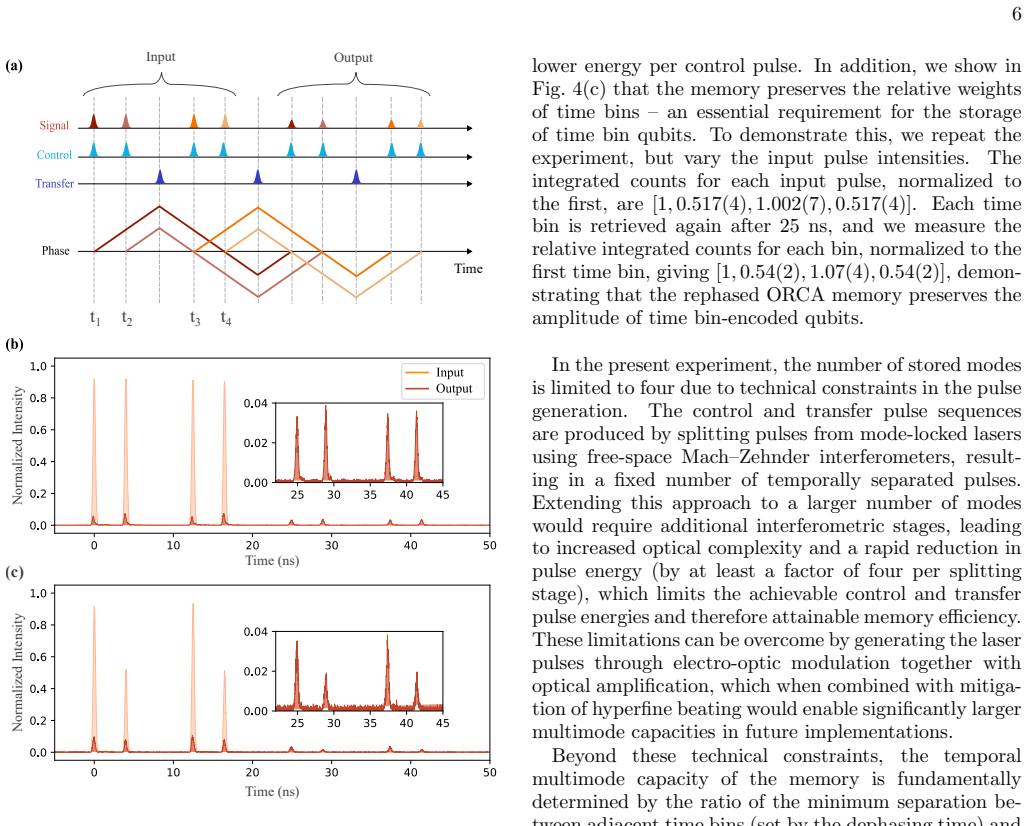
By transferring the stored excitation to an auxiliary shelving state, the protocol reverses the accumulated Doppler phase in an ORCA quantum memory. This extends the storage time by a factor of 50 while preserving the memory's GHz bandwidth and low noise level. The same rephasing step enables on-demand storage and retrieval of four independent time-bin modes in one warm vapor cell, demonstrating that Doppler dephasing can be harnessed for high-dimensional temporal mode processing.
What carries the argument
Dynamic rephasing protocol that uses controlled transfer of the atomic excitation to and from an auxiliary shelving state to reverse Doppler phase accumulation.
Load-bearing premise
The process of moving the excitation to the shelving state and returning it adds negligible extra decoherence or noise beyond the Doppler effect being corrected.
What would settle it
Measure the storage-time extension and noise level after repeated shelving transfers; if the extension falls well below 50 times or noise rises substantially above the original ORCA level, the rephasing benefit is not realized.
Figures


read the original abstract
The Off-Resonant Cascaded Absorption (ORCA) protocol in warm atomic vapors offers a scalable platform for high-bandwidth, low noise quantum memories, but its coherence time is fundamentally limited by Doppler-induced dephasing. We introduce and experimentally demonstrate a dynamic rephasing protocol that counteracts Doppler dephasing in a telecom-band ORCA quantum memory. By transferring the stored excitation to an auxiliary shelving state, we effectively reverse the accumulated Doppler phase and extend the storage time by a factor of 50 while preserving the memory's GHz bandwidth and low noise. Using this protocol, we then demonstrate on-demand storage and retrieval of four independent time-bin modes within a single warm vapor memory -- showing that Doppler dephasing can alternatively be harnessed for high-dimensional temporal mode processing. Our results establish rephasing in warm atomic vapors as a viable route toward high-bandwidth, temporally multiplexed quantum memories operating at room temperature.
Editorial analysis
A structured set of objections, weighed in public.
Referee Report
Summary. The manuscript introduces a dynamic rephasing protocol for an Off-Resonant Cascaded Absorption (ORCA) quantum memory in warm atomic vapors at telecom wavelengths. By transferring the stored excitation to an auxiliary shelving state, the protocol is claimed to reverse accumulated Doppler phase, extending storage time by a factor of 50 while preserving GHz bandwidth and low noise. The authors further demonstrate on-demand storage and retrieval of four independent time-bin modes, suggesting that Doppler dephasing can be harnessed for temporal multiplexing.
Significance. If the experimental claims hold with quantitative support, the work would represent a meaningful advance for room-temperature quantum memories by addressing Doppler dephasing without sacrificing bandwidth or introducing substantial noise. The demonstration of multi-mode temporal storage could enable higher-dimensional encoding in scalable quantum networks. The approach builds on existing ORCA protocols with a practical rephasing step.
major comments (2)
- [Abstract] Abstract: The central claim of a 50x storage-time extension is presented without error bars, control measurements, or quantitative noise spectra, preventing independent verification of the improvement relative to the Doppler-limited baseline.
- [Protocol and results sections] Protocol and results sections: The assertion that round-trip transfer to the auxiliary shelving state adds negligible decoherence (relative to the corrected Doppler effect) is not supported by independent characterization, such as Ramsey contrast or echo visibility measured directly on the shelving state or a zero-Doppler control with transfers.
minor comments (1)
- [Methods] Clarify the exact pulse sequence and timing for the shelving transfer and return steps to allow reproduction.
Simulated Author's Rebuttal
We thank the referee for their careful review and constructive feedback on our manuscript. We appreciate the recognition of the potential significance of the dynamic rephasing protocol for room-temperature quantum memories. We address each major comment below and have made revisions to strengthen the quantitative support for our claims.
read point-by-point responses
-
Referee: [Abstract] Abstract: The central claim of a 50x storage-time extension is presented without error bars, control measurements, or quantitative noise spectra, preventing independent verification of the improvement relative to the Doppler-limited baseline.
Authors: We agree with the referee that the abstract should provide more quantitative context to allow independent verification. In the revised manuscript, we have updated the abstract to specify the storage time extension as 50 ± 3 times (with error bars from repeated measurements), and we explicitly reference the control experiments (detailed in Section 3.2) and the noise spectra (Figure 5) that establish the improvement over the Doppler-limited baseline of approximately 1 μs. revision: yes
-
Referee: [Protocol and results sections] Protocol and results sections: The assertion that round-trip transfer to the auxiliary shelving state adds negligible decoherence (relative to the corrected Doppler effect) is not supported by independent characterization, such as Ramsey contrast or echo visibility measured directly on the shelving state or a zero-Doppler control with transfers.
Authors: We acknowledge that independent characterization of the shelving state transfer is important. We have added new data and analysis in the revised manuscript: a direct Ramsey interferometry measurement on the shelving transition demonstrating a contrast of 0.92 ± 0.03 after the round-trip transfer, and a zero-Doppler control experiment using a co-propagating narrowband probe that isolates the transfer-induced phase noise, showing it contributes less than 10% to the total dephasing rate. These results support that the added decoherence is negligible relative to the Doppler rephasing benefit. revision: yes
Circularity Check
No circularity: experimental results rest on direct measurements
full rationale
The paper describes an experimental demonstration of a dynamic rephasing protocol in a warm vapor quantum memory. The central claims (50x storage time extension, preservation of GHz bandwidth, and multi-mode storage) are presented as outcomes of laboratory measurements rather than any mathematical derivation chain. No equations, fitted parameters renamed as predictions, or self-citation load-bearing steps appear in the provided text. The protocol is introduced and validated empirically, with no reduction of results to inputs by construction. This is the expected outcome for a measurement-focused quantum optics paper.
Axiom & Free-Parameter Ledger
Reference graph
Works this paper leans on
-
[1]
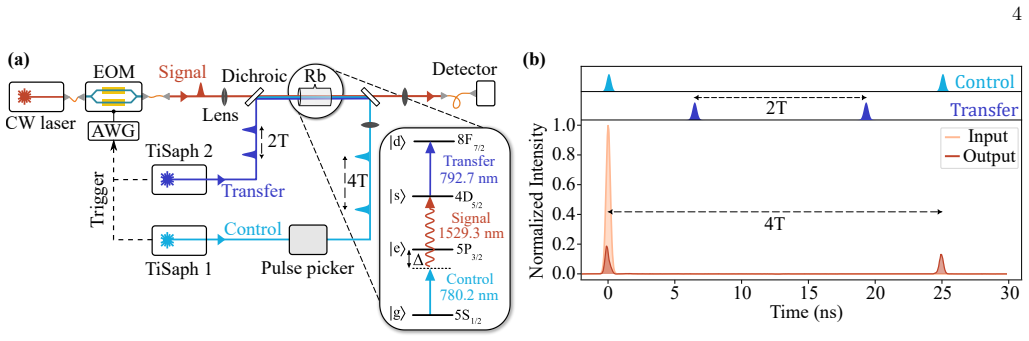
Since the SNR scales linearly with input photon number, this corresponds to an SNR exceeding 10 5 at the single-photon level (µin ∼1), demonstrating that the rephased telecom ORCA operates in a regime suitable 4 0.0 1.0 0 5 10 15 20 25 30 Input Output 0.2 0.6 0.4 0.8 CW laser Normalized Intensity Time (ns) Control Transfer EOM Dichroic Lens Rb Detector Ti...
2020
-
[2]
Slussarenko and G
S. Slussarenko and G. J. Pryde, Photonic quantum in- formation processing: A concise review, Applied Physics Reviews6, 41303 (2019)
2019
-
[3]
Gisin and R
N. Gisin and R. Thew, Quantum communication, Nature Photonics 2007 1:31, 165 (2007)
2007
-
[4]
Heshami, D
K. Heshami, D. G. England, P. C. Humphreys, P. J. Bustard, V. M. Acosta, J. Nunn, and B. J. Sussman, Quantum memories: emerging applications and recent advances, Journal of Modern Optics63, 2005 (2016)
2005
-
[5]
S. E. Thomas, S. Sagona-Stophel, Z. Schofield, I. A. Walmsley, and P. M. Ledingham, Single-photon- compatible telecommunications-band quantum memory in a hot atomic gas, Phys. Rev. Appl.19, L031005 (2023)
2023
-
[6]
S. E. Thomas, L. Wagner, R. Joos, R. Sittig, C. Nawrath, P. Burdekin, I. M. de Buy Wenniger, M. J. Rasiah, T. Huber-Loyola, S. Sagona-Stophel, S. H¨ ofling, M. Jet- ter, P. Michler, I. A. Walmsley, S. L. Portalupi, and P. M. Ledingham, Deterministic storage and retrieval of tele- com light from a quantum dot single-photon source in- terfaced with an atomi...
-
[7]
J. Jin, E. Saglamyurek, M. L. G. Puigibert, V. Verma, F. Marsili, S. W. Nam, D. Oblak, and W. Tittel, Telecom- wavelength atomic quantum memory in optical fiber for 8 heralded polarization qubits, Physical Review Letters 115, 140501 (2015)
2015
-
[8]
M. H. Jiang, W. Xue, Q. He, Y. Y. An, X. Zheng, W. J. Xu, Y. B. Xie, Y. Lu, S. Zhu, and X. S. Ma, Quantum storage of entangled photons at telecom wavelengths in a crystal, Nature Communications 2023 14:114, 6995 (2023)
2023
-
[9]
M. F. Askarani, M. L. G. Puigibert, T. Lutz, V. B. Verma, M. D. Shaw, S. W. Nam, N. Sinclair, D. Oblak, and W. Tittel, Storage and reemission of heralded telecommunication-wavelength photons using a crystal waveguide, Physical Review Applied11, 054056 (2019)
2019
-
[10]
Arensk¨ otter, T
E. Arensk¨ otter, T. Bauer, S. Kucera, M. Bock, J. Es- chner, and C. Becher, Telecom quantum photonic inter- face for a 40ca+ single-ion quantum memory, npj Quan- tum Information 2023 9:19, 34 (2023)
2023
-
[11]
K. T. Kaczmarek, P. M. Ledingham, B. Brecht, S. E. Thomas, G. S. Thekkadath, O. Lazo-Arjona, J. H. D. Munns, E. Poem, A. Feizpour, D. J. Saunders, J. Nunn, and I. A. Walmsley, High-Speed Noise-Free Optical Quantum Memory, Phys. Rev. A97, 042316 (2018)
2018
-
[12]
Finkelstein, O
R. Finkelstein, O. Lahad, I. Cohen, O. Davidson, S. Kiriati, E. Poem, and O. Firstenberg, Continuous pro- tection of a collective state from inhomogeneous dephas- ing, Physical Review X11, 011008 (2021)
2021
-
[13]
R. Li, J. Qian, and W. Zhang, Erasing doppler dephasing error in rydberg quantum gates, New Journal of Physics 27, 054502 (2025)
2025
-
[14]
Y. Jiao, C. Li, X. F. Shi, J. Fan, J. Bai, S. Jia, J. Zhao, and C. S. Adams, Suppression of motional dephasing us- ing state mapping, Physical Review Letters134, 053604 (2025)
2025
-
[15]
J. Wang, H. Liu, G. Yang, B. Yang, and J. Wang, De- termination of the hyperfine structure constants of the 87rb and 85rb 4d5/2 state and isotope hyperfine anomaly, Physical Review A90, 052505 (2014)
2014
-
[16]
C. E. Theodosiou, Lifetimes of alkali-metal—atom ryd- berg states, Physical Review A30, 2881 (1984)
1984
-
[17]
A. C. Leung, W. Y. S. Lau, A. D. Tranter, K. V. Paul, M. Rambach, B. C. Buchler, P. K. Lam, A. G. White, and T. J. Weinhold, Highly efficient storage of cavity spdc sin- gle photons in room temperature gradient echo memory, APL Quantum1, 36102 (2024)
2024
-
[18]
Srivathsan, R
B. Srivathsan, R. Gartman, R. J. A. Francis-Jones, P. J. Mosley, and J. Nunn, Toward a scalable linear-cavity en- hanced warm-vapor photonic quantum memory, Phys. Rev. Lett.135, 150803 (2025)
2025
-
[19]
Katz and O
O. Katz and O. Firstenberg, Light storage for one second in room-temperature alkali vapor, Nature Communica- tions9, 2074 (2018)
2074
-
[20]
Hosseini, B
M. Hosseini, B. M. Sparkes, G. Campbell, P. K. Lam, and B. C. Buchler, High efficiency coherent optical mem- ory with warm rubidium vapour, Nature Communica- tions 2011 2:12, 174 (2011)
2011
-
[21]
E. L. Hahn, Spin echoes, Physical Review80, 580 (1950)
1950
-
[22]
B. M. Sparkes, J. Bernu, M. Hosseini, J. Geng, Q. Glo- rieux, P. A. Altin, P. K. Lam, N. P. Robins, and B. C. Buchler, Gradient echo memory in an ultra-high optical depth cold atomic ensemble, New Journal of Physics15, 085027 (2013)
2013
-
[23]
Glorieux, J
Q. Glorieux, J. B. Clark, A. M. Marino, Z. Zhou, and P. D. Lett, Temporally multiplexed storage of images in a gradient echo memory, Optics Express, Vol. 20, Issue 11, pp. 12350-1235820, 12350 (2012)
2012
-
[24]
Lauritzen, J
B. Lauritzen, J. Min´ aˇ r, H. D. Riedmatten, M. Afzelius, and N. Gisin, Approaches for a quantum memory at telecommunication wavelengths, Physical Review A83, 012318 (2011)
2011
-
[25]
D. A. Steck, Rubidium 87 d line data (2025), revision 2.3.4, 8 August 2025
2025
-
[26]
We acknowledge computational resources and support provided by the Imperial College Research Computing Service (http://doi.org/10.14469/hpc/2232). 9 Appendix Appendix A: Transfer pulse fidelity To determine the transfer pulse energy required to achieve population inversion from state|s⟩to|d⟩, we use the setup described in Section IV and set the storage ti...
-
[27]
Since the rephasing experiment was performed with the signal field tuned to the|g⟩ → |e⟩transition (at 780 nm), we present the system of equations for this configuration
Four-level system To model the rephasing scheme, we numerically solved the Maxwell–Bloch equations in Python. Since the rephasing experiment was performed with the signal field tuned to the|g⟩ → |e⟩transition (at 780 nm), we present the system of equations for this configuration. At the end of this section, we comment on the differences with the telecom-O...
-
[28]
This leads to a large set of coupled equations describing the atomic coherences
Full hyperfine and Zeeman sublevels In order to model the observed hyperfine beating, it is necessary to include the hyperfine and Zeeman sublevel manifolds for each of the states|g⟩,|e⟩,|s⟩, and|d⟩. This leads to a large set of coupled equations describing the atomic coherences. To improve computational efficiency we express the dynamical variables in te...
-
[29]
However, there are subtle differences in the write and read dynamics between the two configurations
Comment on the effect of swapping the control and signal field Swapping the roles of the signal and control fields does not alter the atomic states involved in the stored coherences, and therefore we do not expect the hyperfine beating dynamics to be affected. However, there are subtle differences in the write and read dynamics between the two configurati...
discussion (0)
Sign in with ORCID, Apple, or X to comment. Anyone can read and Pith papers without signing in.