Recognition: unknown
Resonance- and Width-aware Parton Shower Evolution and NLO Matching
Pith reviewed 2026-05-10 13:21 UTC · model grok-4.3
The pith
A modified parton shower and matching technique allows next-to-leading order simulations of top-quark pair production to respect resonances and finite widths near threshold.
A machine-rendered reading of the paper's core claim, the machinery that carries it, and where it could break.
Core claim
By making the parton-shower evolution, infrared subtraction, and NLO matching resonance- and width-aware, next-to-leading order accurate simulations of the e+e−→W+W−b b-bar process become possible while respecting the resonant nature of the process above and near the top-quark pair production threshold, including finite width effects beyond the Breit-Wigner structure.
What carries the argument
Resonance- and width-aware modifications to the parton-shower evolution, infrared subtraction, and NLO matching that treat finite widths consistently.
If this is right
- The method produces NLO-accurate predictions for the process above and near the top-pair threshold without artificial resonance approximations.
- Phenomenological results become available that are relevant for studies at future electron-positron colliders.
- The technique extends standard resonance-aware approaches by consistently incorporating finite width effects in the shower and matching.
- Public implementation allows repeated use of the simulation for top-quark physics studies.
Where Pith is reading between the lines
- Similar width-aware adjustments could be applied to other multi-resonance processes in perturbative simulations.
- Validation against data from a future collider would test whether the consistent treatment removes previous discrepancies near threshold.
- The approach hints at a general way to reduce double-counting in resonant QCD calculations when widths are kept finite.
- Extension to hadron-collider environments might require analogous changes to initial-state showers for comparable accuracy.
Load-bearing premise
The new modifications to the parton shower, infrared subtraction, and NLO matching can be combined consistently without introducing uncontrolled approximations or double-counting when finite widths are included beyond the Breit-Wigner form.
What would settle it
A comparison near the top threshold in which the new simulation yields cross sections or kinematic distributions that differ from exact NLO fixed-order results or from collider measurements by more than the expected perturbative uncertainties.
Figures



read the original abstract
We introduce a technique for the next-to-leading order accurate simulation of $e^+e^-\to W^+W^-b\bar{b}$ that respects the resonant nature of the process above and near the top-quark pair production threshold. The parton-shower evolution, infrared subtraction and NLO matching account in particular for finite width effects beyond the Breit-Wigner structure considered in resonance-aware approaches. We present first phenomenological results relevant to a potential future electron-positron collider and provide a publicly available simulator based on the ALARIC parton shower and the SHERPA event generator.
Editorial analysis
A structured set of objections, weighed in public.
Referee Report
Summary. The manuscript introduces a resonance- and width-aware technique for next-to-leading order (NLO) accurate parton-shower simulations of the process e⁺e⁻ → W⁺W⁻b¯b near the top-quark pair production threshold. It modifies the parton-shower evolution kernels, infrared subtraction terms, and NLO matching procedure to incorporate finite width effects beyond the standard Breit-Wigner approximation using width-dependent propagators and resonance-aware phase-space mappings. The method is implemented in the ALARIC parton shower within SHERPA, and first phenomenological results are provided for a potential future electron-positron collider.
Significance. If the central construction holds, this advances precision Monte Carlo tools for resonant processes with finite widths, enabling consistent NLO accuracy near thresholds without double-counting. This is relevant for top-quark studies at future e⁺e⁻ colliders. The public availability of the ALARIC+SHERPA implementation and the absence of visible internal inconsistencies in the re-derived kernels and modified POWHEG-style matching are strengths.
minor comments (2)
- The abstract states that finite-width effects are accounted for beyond Breit-Wigner but does not quantify the size of the corrections or the kinematic range where they become relevant; adding a short statement on the expected numerical impact would improve clarity.
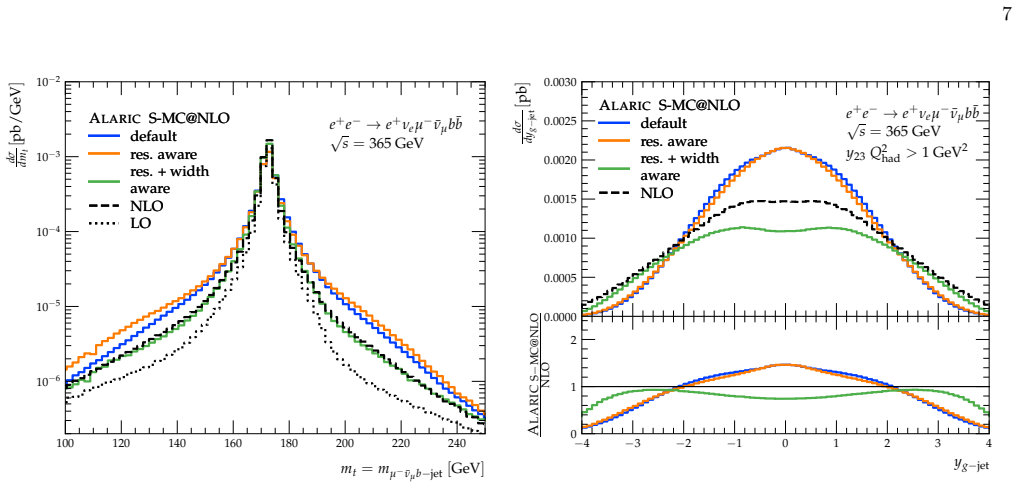
- In the phenomenological results, the plots demonstrate the expected threshold behavior, but inclusion of scale-variation bands or a direct comparison to a standard resonance-aware implementation would make the improvement more evident.
Simulated Author's Rebuttal
We thank the referee for the positive summary, significance assessment, and recommendation of minor revision. No specific major comments were raised in the report.
Circularity Check
No significant circularity in derivation chain
full rationale
The manuscript re-derives the parton-shower evolution kernels, infrared subtraction terms, and NLO matching coefficients from first principles using width-dependent propagators and resonance-aware phase-space mappings, then implements a modified POWHEG-style matching. No load-bearing step reduces by construction to a fitted parameter, self-defined quantity, or unverified self-citation; the central claims remain independent of the input data and prior resonance-aware results referenced only for context. Numerical results for e+e- -> W+W-bbbar are presented as external validation rather than tautological output.
Axiom & Free-Parameter Ledger
Reference graph
Works this paper leans on
-
[1]
Cabibbo, L
N. Cabibbo, L. Maiani, G. Parisi, and R. Petronzio, Nucl. Phys. B 158, 295 (1979)
1979
-
[2]
P. Q. Hung, Phys. Rev. Lett. 42, 873 (1979)
1979
-
[3]
Lindner, Z
M. Lindner, Z. Phys. C 31, 295 (1986)
1986
-
[4]
Sher, Phys
M. Sher, Phys. Rept. 179, 273 (1989)
1989
-
[5]
S. Alekhin, A. Djouadi, and S. Moch, Phys. Lett. B 716, 214 (2012), arXiv:1207.0980 [hep-ph]
-
[6]
Higgs mass and vacuum stability in the Standard Model at NNLO
G. Degrassi, S. Di Vita, J. Elias-Miro, J. R. Espinosa, G. F. Giudice, G. Isidori, and A. Strumia, JHEP 08, 098 (2012), arXiv:1205.6497 [hep-ph]
work page Pith review arXiv 2012
-
[7]
M. Benedikt et al. (FCC), Eur. Phys. J. C 85, 1468 (2025), arXiv:2505.00272 [hep-ex]
-
[8]
M. Benedikt et al. (FCC), Eur. Phys. J. ST 234, 5713 (2025), arXiv:2505.00274 [physics.acc-ph]
-
[9]
M. Benedikt et al. (FCC), Eur. Phys. J. ST 234, 5113 (2025), [Erratum: Eur.Phys.J.ST 234, 33–44 (2025)], arXiv:2505.00273 [physics.acc-ph]
-
[10]
M. Narain et al. , (2022), 10.2172/1908199, arXiv:2211.11084 [hep-ex]
- [11]
-
[12]
On the Treatment of Resonances in Next-to-Leading Order Calculations Matched to a Parton Shower
T. Jeˇ zo and P. Nason, JHEP12, 065 (2015), arXiv:1509.09071 [hep-ph]
work page Pith review arXiv 2015
- [13]
-
[14]
S. Ferrario Ravasio, T. Jeˇ zo, P. Nason, and C. Oleari, Eur. Phys. J. C 78, 458 (2018), [Addendum: Eur.Phys.J.C 79, 859 (2019)], arXiv:1906.09166 [hep-ph]
- [15]
- [16]
-
[17]
S. H¨ oche, S. Liebschner, and F. Siegert, Eur. Phys. J. C 79, 728 (2019), arXiv:1807.04348 [hep-ph]
-
[18]
S. Catani and M. H. Seymour, Nucl. Phys. B 485, 291 (1997), [Erratum: Nucl.Phys.B 510, 503–504 (1998)], arXiv:hep- ph/9605323
-
[19]
G. V. Jikia, Phys. Lett. B 257, 196 (1991)
1991
-
[20]
V. A. Khoze, W. J. Stirling, and L. H. Orr, Nucl. Phys. B 378, 413 (1992)
1992
- [21]
- [22]
- [23]
-
[24]
B. Assi and S. H¨ oche, Phys. Rev. D109, 114008 (2024), arXiv:2307.00728 [hep-ph]
-
[25]
S. H¨ oche, F. Krauss, and D. Reichelt, Phys. Rev. D 111, 094032 (2025), arXiv:2404.14360 [hep-ph]
-
[26]
S. H¨ oche, F. Krauss, P. Meinzinger, and D. Reichelt, (2025), arXiv:2507.22837 [hep-ph]
-
[27]
S. H¨ oche, M. Hoppe, and D. Reichelt, (2025), arXiv:2508.19018 [hep-ph]
-
[28]
T. Gleisberg, S. H¨ oche, F. Krauss, A. Sch¨ alicke, S. Schumann, and J.-C. Winter, JHEP 02, 056 (2004), arXiv:hep- ph/0311263
-
[29]
T. Gleisberg, S. H¨ oche, F. Krauss, M. Sch¨ onherr, S. Schumann, F. Siegert, and J. Winter, JHEP 02, 007 (2009), arXiv:0811.4622 [hep-ph]
-
[30]
E. Bothmann et al. (Sherpa), SciPost Phys. 7, 034 (2019), arXiv:1905.09127 [hep-ph]
-
[31]
E. Bothmann et al. (Sherpa), JHEP 12, 156 (2024), arXiv:2410.22148 [hep-ph]
- [32]
- [33]
-
[34]
S. H¨ oche, M. LeBlanc, J. Roloff, and G. Whitman, Phys. Rev. D 113, 054009 (2026), arXiv:2512.07025 [hep-ph]
-
[35]
Gell-Mann and M
M. Gell-Mann and M. L. Goldberger, Phys. Rev. 96, 1433 (1954)
1954
-
[36]
L. S. Brown and R. L. Goble, Phys. Rev. 173, 1505 (1968). 12
1968
-
[37]
J. Andre and T. Sj¨ ostrand, Phys. Rev. D57, 5767 (1998), arXiv:hep-ph/9708390
- [38]
-
[39]
Matching NLO QCD computations and parton shower simulations
S. Frixione and B. R. Webber, JHEP 06, 029 (2002), arXiv:hep-ph/0204244
work page Pith review arXiv 2002
-
[40]
A critical appraisal of NLO+PS matching methods
S. H¨ oche, F. Krauss, M. Sch¨ onherr, and F. Siegert, JHEP09, 049 (2012), arXiv:1111.1220 [hep-ph]
work page Pith review arXiv 2012
-
[41]
S. H¨ oche and M. Sch¨ onherr, Phys. Rev. D86, 094042 (2012), arXiv:1208.2815 [hep-ph]
-
[42]
Catani, Y
S. Catani, Y. L. Dokshitzer, M. Olsson, G. Turnock, and B. R. Webber, Phys. Lett. B 269, 432 (1991)
1991
- [43]
-
[44]
W. L. van Neerven, Nucl. Phys. B 268, 453 (1986)
1986
-
[45]
Beenakker, H
W. Beenakker, H. Kuijf, W. L. van Neerven, and J. Smith, Phys. Rev. D 40, 54 (1989)
1989
-
[46]
G. Somogyi, J. Math. Phys. 52, 083501 (2011), arXiv:1101.3557 [hep-ph]
-
[47]
G. Isidori, S. Nabeebaccus, and R. Zwicky, JHEP 12, 104 (2020), arXiv:2009.00929 [hep-ph]
- [48]
discussion (0)
Sign in with ORCID, Apple, or X to comment. Anyone can read and Pith papers without signing in.