Recognition: unknown
RFID-based Real-Time Geriatric Gait Speed Monitoring System: Design, Implementation and Clinical Evaluation
Pith reviewed 2026-05-10 12:27 UTC · model grok-4.3
The pith
A passive RFID system measures geriatric gait speed in real time with 0.064 m/s mean error during routine clinical care.
A machine-rendered reading of the paper's core claim, the machinery that carries it, and where it could break.
Core claim
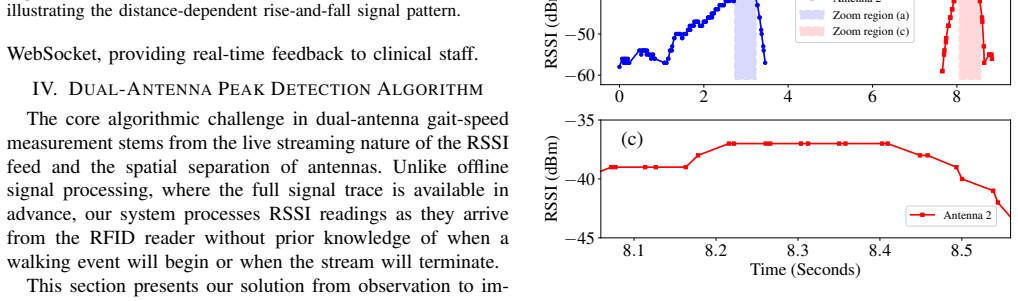
The system employs a dual-antenna configuration and an edge-based peak-detection algorithm to estimate gait speed in real time from received signal strength indicator (RSSI) streams. By leveraging antenna-beam symmetry and asymmetric signal processing, the method improves robustness to noise, plateau regions, and multiple local maxima. We evaluate the system during routine outpatient care across three clinical sites using 966 trials, achieving an 87.7% measurement success rate. Compared with concurrent stopwatch timing, the system attains a mean absolute error of 0.064 m/s, demonstrating reliable operation with accuracy suitable for clinical gait-speed assessment.
What carries the argument
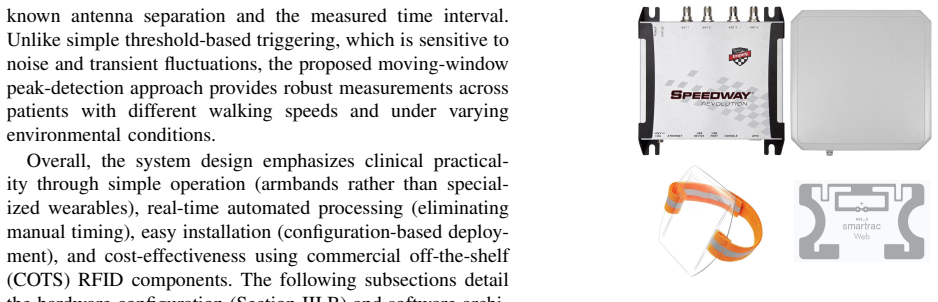
Dual-antenna UHF RFID configuration with edge-based peak-detection algorithm on RSSI streams that uses antenna-beam symmetry and asymmetric signal processing to estimate gait speed.
If this is right
- Gait speed assessments can occur more often in routine outpatient visits without requiring extra staff time or patient effort.
- Privacy is maintained because the system captures no video or biometric identifiers.
- No battery replacements or wearable devices are needed, removing ongoing maintenance.
- The reported accuracy level supports using the measurements to track mobility decline in geriatric care.
Where Pith is reading between the lines
- The same RFID infrastructure already present in many hospitals could support low-cost rollout beyond the three tested sites.
- Long-term trend data from repeated measurements might help predict mobility changes earlier than occasional manual checks.
- Similar signal-processing logic could be tested for detecting other gait irregularities such as asymmetry or slowing trends.
Load-bearing premise
The edge-based peak-detection algorithm applied to RSSI streams from the dual antennas accurately identifies actual gait events and computes speed even when patient movement, interference, or setup conditions vary in real clinics.
What would settle it
A follow-up set of clinical trials at similar sites that yields a mean absolute error above 0.1 m/s or a success rate below 70% under standard outpatient conditions would show the system does not meet the claimed reliability.
Figures








read the original abstract
Gait speed is a widely used indicator of functional health and mobility decline, yet in clinical practice it is commonly measured manually using a stopwatch, which limits scalability and measurement frequency. Privacy-preserving and maintenance-free sensing approaches can enable more routine and less burdensome assessments in real-world care settings. This paper presents the design, implementation, and real-world deployment of a fully passive, battery-free gait-speed monitoring system based on ultra-high-frequency (UHF) RFID. Compared with camera- and wearable-based approaches, the proposed system preserves patient privacy by avoiding video capture and biometric data, while eliminating battery maintenance. The system employs a dual-antenna configuration and an edge-based peak-detection algorithm to estimate gait speed in real time from received signal strength indicator (RSSI) streams. By leveraging antenna-beam symmetry and asymmetric signal processing, the method improves robustness to noise, plateau regions, and multiple local maxima. We evaluate the system during routine outpatient care across three clinical sites using 966 trials, achieving an 87.7% measurement success rate. Compared with concurrent stopwatch timing, the system attains a mean absolute error of 0.064 $m/s$, demonstrating reliable operation with accuracy suitable for clinical gait-speed assessment.
Editorial analysis
A structured set of objections, weighed in public.
Referee Report
Summary. The paper presents the design, implementation, and real-world clinical evaluation of a fully passive UHF RFID-based system for real-time geriatric gait speed monitoring. It uses a dual-antenna configuration with an edge-based peak-detection algorithm on RSSI streams, leveraging antenna-beam symmetry and asymmetric processing for robustness. The system is evaluated in 966 trials across three outpatient sites, reporting an 87.7% measurement success rate and 0.064 m/s mean absolute error relative to concurrent stopwatch timing.
Significance. If the reported accuracy and success rate hold under broader conditions, the system could enable scalable, privacy-preserving, battery-free gait speed assessments in routine clinical care, addressing the limitations of manual stopwatch methods for monitoring mobility decline. The multi-site deployment with nearly 1000 trials provides direct evidence of practical viability.
major comments (1)
- The central performance claims (87.7% success rate and 0.064 m/s MAE) rest on the assumption that the edge-based peak-detection algorithm reliably maps RSSI features to gait events across varied clinical conditions. However, the manuscript provides insufficient detail on how the algorithm handles specific confounders such as patient use of walking aids, clothing variations, or antenna placement inconsistencies, which could affect the correspondence between detected peaks and actual gait speed.
minor comments (2)
- The abstract omits key specifics on the exact peak-detection implementation, error analysis methods, patient demographics, and potential confounding factors, which would improve standalone readability and allow quicker assessment of the claims.
- Figure captions and the methods description should explicitly state the sampling rate of the RSSI streams and the precise definition of 'edge-based' detection to support reproducibility.
Simulated Author's Rebuttal
We thank the referee for the constructive comment regarding the robustness of our peak-detection algorithm. We agree that additional detail on handling clinical confounders will strengthen the manuscript and will revise accordingly.
read point-by-point responses
-
Referee: The central performance claims (87.7% success rate and 0.064 m/s MAE) rest on the assumption that the edge-based peak-detection algorithm reliably maps RSSI features to gait events across varied clinical conditions. However, the manuscript provides insufficient detail on how the algorithm handles specific confounders such as patient use of walking aids, clothing variations, or antenna placement inconsistencies, which could affect the correspondence between detected peaks and actual gait speed.
Authors: We agree that the current manuscript provides insufficient explicit detail on these specific confounders. The dual-antenna configuration and asymmetric processing are intended to focus on the timing of symmetric RSSI peaks rather than absolute signal strength, which provides inherent robustness to amplitude variations from clothing or walking aids; antenna placement is addressed through the beam-symmetry assumption used in peak pairing. Our 966-trial evaluation was conducted in real outpatient settings that included patients using walking aids and varied clothing, contributing to the reported success rate. To address the comment directly, we will expand the Methods section with a new subsection (and accompanying pseudocode or flow diagram) that explicitly describes the algorithm's handling of these cases, including any adaptive thresholding or filtering steps. We will also add a brief limitations paragraph noting that while the multi-site data provide empirical support, controlled ablation studies on each confounder were not performed. revision: yes
Circularity Check
Empirical system evaluation with no derivation chain
full rationale
The paper describes the design and real-world clinical evaluation of an RFID-based gait speed monitoring system. Its central claims rest on direct comparison of the system's RSSI peak-detection output to concurrent stopwatch measurements across 966 trials at three sites, yielding reported MAE of 0.064 m/s and 87.7% success rate. No equations, fitted parameters, predictions, or first-principles derivations are present that could reduce to their own inputs. Self-citations, if any, are not load-bearing for the accuracy claims, which are externally validated by stopwatch ground truth.
Axiom & Free-Parameter Ledger
Reference graph
Works this paper leans on
-
[1]
Walking speed: the func- tional vital sign,
A. Middleton, S. L. Fritz, and M. Lusardi, “Walking speed: the func- tional vital sign,”Journal of aging and physical activity, vol. 23, no. 2, pp. 314–322, 2015
2015
-
[2]
Gait speed and survival in older adults,
S. Studenski, S. Perera, K. Patel, C. Rosano, K. Faulkner, M. Inzitari, J. Brach, J. Chandler, P. Cawthon, E. B. Connoret al., “Gait speed and survival in older adults,”JAMA, vol. 305, no. 1, pp. 50–58, 2011
2011
-
[3]
Walking speed measurement technology: a review,
Y . MejiaCruz, J. Franco, G. Hainline, S. Fritz, Z. Jiang, J. M. Caicedo, B. Davis, and V . Hirth, “Walking speed measurement technology: a review,”Current geriatrics reports, vol. 10, no. 1, pp. 32–41, 2021
2021
-
[4]
Validity of the kinect for gait assessment: A focused review,
S. Springer and G. Yogev Seligmann, “Validity of the kinect for gait assessment: A focused review,”Sensors, vol. 16, no. 2, p. 194, 2016
2016
-
[5]
A validation study demonstrating portable motion capture cameras accurately characterize gait metrics when compared to a pressure- sensitive walkway,
K. A. Mazurek, L. Barnard, H. Botha, T. Christianson, J. Graff-Radford, R. Petersen, P. Vemuri, B. G. Windham, D. T. Jones, and F. Ali, “A validation study demonstrating portable motion capture cameras accurately characterize gait metrics when compared to a pressure- sensitive walkway,”Scientific reports, vol. 14, no. 1, p. 17464, 2024
2024
-
[6]
Gait analysis methods: An overview of wearable and non-wearable systems, highlighting clinical applications,
A. Muro-De-La-Herran, B. Garcia-Zapirain, and A. Mendez-Zorrilla, “Gait analysis methods: An overview of wearable and non-wearable systems, highlighting clinical applications,”Sensors, vol. 14, no. 2, pp. 3362–3394, 2014
2014
-
[7]
Overview of radar-based gait parameter estimation techniques for fall risk assess- ment,
S. Z. Gurbuz, M. M. Rahman, Z. Bassiri, and D. Martelli, “Overview of radar-based gait parameter estimation techniques for fall risk assess- ment,”IEEE Open Journal of Engineering in Medicine and Biology, vol. 5, pp. 735–749, 2024
2024
-
[8]
Continuous non-invasive assessment of gait speed through bluetooth low energy,
E. Sansano-Sansano, R. Montoliu, ´O. Belmonte-Fern´andez, F. J. Aranda, and F. J. ´Alvarez, “Continuous non-invasive assessment of gait speed through bluetooth low energy,”IEEE Sensors Journal, vol. 22, no. 8, pp. 8183–8195, 2022
2022
-
[9]
Gaitway: Monitoring and recognizing gait speed through the walls,
C. Wu, F. Zhang, Y . Hu, and K. R. Liu, “Gaitway: Monitoring and recognizing gait speed through the walls,”IEEE Transactions on Mobile Computing, vol. 20, no. 6, pp. 2186–2199, 2020
2020
-
[10]
Design and validation of a radio-frequency identification-based device for routinely assessing gait speed in a geriatrics clinic,
L. C. Barry, L. Hatchman, Z. Fan, J. M. Guralnik, R. X. Gao, and G. A. Kuchel, “Design and validation of a radio-frequency identification-based device for routinely assessing gait speed in a geriatrics clinic,”Journal of the American Geriatrics Society, vol. 66, no. 5, pp. 982–986, 2018
2018
-
[11]
Taking the next step: Increasing gait speed assessment in primary care,
L. Barry, K. Callahan, M. Wingood, R. Fortinsky, K. Berg, N. Lin, S. Han, and N. Pajewski, “Taking the next step: Increasing gait speed assessment in primary care,”Innovation in Aging, vol. 9, no. Supple- ment 2, pp. igaf122–119, 2025
2025
-
[12]
The validity and reliability of the gaitrite system’s measurements: A pre- liminary evaluation,
A. L. McDonough, M. Batavia, F. C. Chen, S. Kwon, and J. Ziai, “The validity and reliability of the gaitrite system’s measurements: A pre- liminary evaluation,”Archives of physical medicine and rehabilitation, vol. 82, no. 3, pp. 419–425, 2001
2001
-
[13]
What is the relationship between orthostatic blood pressure and spatiotemporal gait in later life?
R. Briggs, O. A. Donoghue, D. Carey, M. D. O’Connell, L. Newman, and R. A. Kenny, “What is the relationship between orthostatic blood pressure and spatiotemporal gait in later life?”Journal of the American Geriatrics Society, vol. 68, no. 6, pp. 1286–1292, 2020
2020
-
[14]
Dual-task gait assessment and machine learning for early-detection of cognitive decline,
L. N. Boettcher, M. Hssayeni, A. Rosenfeld, M. I. Tolea, J. E. Galvin, and B. Ghoraani, “Dual-task gait assessment and machine learning for early-detection of cognitive decline,” in2020 42nd Annual International Conference of the IEEE Engineering in Medicine & Biology Society (EMBC). IEEE, 2020, pp. 3204–3207
2020
-
[15]
Relia- bility and validity of the protokinetics movement analysis software in measuring center of pressure during walking,
R. C. Lynall, L. A. Zukowski, P. Plummer, and J. P. Mihalik, “Relia- bility and validity of the protokinetics movement analysis software in measuring center of pressure during walking,”Gait & posture, vol. 52, pp. 308–311, 2017
2017
-
[16]
The effects of cognition and vision while walking in younger and older adults,
T. Pham, M. Suen, Y .-H. Cho, and V . Krishnan, “The effects of cognition and vision while walking in younger and older adults,”Sensors, vol. 24, no. 23, p. 7789, 2024
2024
-
[17]
The effects of gait speed on plantar pressure variables in individuals with normal foot posture and flatfoot,
M. Kirmizi, Y . S. Sengul, and S. Angin, “The effects of gait speed on plantar pressure variables in individuals with normal foot posture and flatfoot,”Acta of Bioengineering and Biomechanics, vol. 22, no. 3, pp. 161–168, 2020
2020
-
[18]
Estimation of foot trajectory during human walking by a wearable inertial measurement unit mounted to the foot,
N. Kitagawa and N. Ogihara, “Estimation of foot trajectory during human walking by a wearable inertial measurement unit mounted to the foot,”Gait & posture, vol. 45, pp. 110–114, 2016
2016
-
[19]
Validity and repeatability of inertial measurement units for measuring gait parameters,
E. P. Washabaugh, T. Kalyanaraman, P. G. Adamczyk, E. S. Claflin, and C. Krishnan, “Validity and repeatability of inertial measurement units for measuring gait parameters,”Gait & posture, vol. 55, pp. 87–93, 2017
2017
-
[20]
Hemodialysis impact on motor function beyond aging and diabetes—objectively assessing gait and balance by wearable technology,
H. Zhou, F. Al-Ali, H. Rahemi, N. Kulkarni, A. Hamad, R. Ibrahim, T. K. Talal, and B. Najafi, “Hemodialysis impact on motor function beyond aging and diabetes—objectively assessing gait and balance by wearable technology,”Sensors, vol. 18, no. 11, p. 3939, 2018
2018
-
[21]
Validity of accelerometry in step detection and gait speed measurement in orthogeriatric patients,
A. M. Keppler, T. Nuritidinow, A. Mueller, H. Hoefling, M. Schieker, I. Clay, W. B ¨ocker, and J. F ¨urmetz, “Validity of accelerometry in step detection and gait speed measurement in orthogeriatric patients,”PloS one, vol. 14, no. 8, p. e0221732, 2019
2019
-
[22]
Real-world gait speed estimation using wrist sensor: A personalized approach,
A. Soltani, H. Dejnabadi, M. Savary, and K. Aminian, “Real-world gait speed estimation using wrist sensor: A personalized approach,”IEEE journal of biomedical and health informatics, vol. 24, no. 3, pp. 658– 668, 2019
2019
-
[23]
Feetme® monitor-connected insoles are a valid and reliable alternative for the evaluation of gait speed after stroke,
L. Farid, D. Jacobs, J. Do Santos, O. Simon, J.-M. Gracies, and E. Hutin, “Feetme® monitor-connected insoles are a valid and reliable alternative for the evaluation of gait speed after stroke,”Topics in stroke rehabilitation, vol. 28, no. 2, pp. 127–134, 2021
2021
-
[24]
Kinematic validation of a multi-kinect v2 instrumented 10-meter walkway for quantitative gait assessments,
D. J. Geerse, B. H. Coolen, and M. Roerdink, “Kinematic validation of a multi-kinect v2 instrumented 10-meter walkway for quantitative gait assessments,”PloS one, vol. 10, no. 10, p. e0139913, 2015
2015
-
[25]
Gait speed assessment in confined spaces: Development of a novel automated 4-m static-start test to measure dynamic-start gait speed,
Y .-H. Pua, R. A. Clark, L. Tay, Y .-S. Ng, J. T.-T. Poh, S. B. M. Ibrahim, W.-C. Cheong, H.-H. Tan, and J. Thumboo, “Gait speed assessment in confined spaces: Development of a novel automated 4-m static-start test to measure dynamic-start gait speed,”Geriatrics & Gerontology International, vol. 25, no. 3, pp. 449–453, 2025
2025
-
[26]
Wifi-csi difference paradigm: Achieving efficient doppler speed estimation for passive tracking,
W. Li, R. Gao, J. Xiong, J. Zhou, L. Wang, X. Mao, E. Yi, and D. Zhang, “Wifi-csi difference paradigm: Achieving efficient doppler speed estimation for passive tracking,”Proceedings of the ACM on Interactive, Mobile, Wearable and Ubiquitous Technologies, vol. 8, no. 2, pp. 1–29, 2024
2024
-
[27]
Indotrack: Device-free indoor human tracking with commodity wi- fi,
X. Li, D. Zhang, Q. Lv, J. Xiong, S. Li, Y . Zhang, and H. Mei, “Indotrack: Device-free indoor human tracking with commodity wi- fi,”Proceedings of the ACM on Interactive, Mobile, Wearable and Ubiquitous Technologies, vol. 1, no. 3, pp. 1–22, 2017
2017
-
[28]
Widar: Decimeter- level passive tracking via velocity monitoring with commodity wi-fi,
K. Qian, C. Wu, Z. Yang, Y . Liu, and K. Jamieson, “Widar: Decimeter- level passive tracking via velocity monitoring with commodity wi-fi,” inProceedings of the 18th ACM international symposium on mobile ad hoc networking and computing, 2017, pp. 1–10
2017
-
[29]
Widar2. 0: Passive human tracking with a single wi-fi link,
K. Qian, C. Wu, Y . Zhang, G. Zhang, Z. Yang, and Y . Liu, “Widar2. 0: Passive human tracking with a single wi-fi link,” inProceedings of the 16th annual international conference on mobile systems, applications, and services, 2018, pp. 350–361
2018
-
[30]
Wivelo: Fine-grained walking velocity estimation for wi-fi passive tracking,
C. Li, L. Liu, Z. Cao, and M. Zhang, “Wivelo: Fine-grained walking velocity estimation for wi-fi passive tracking,” in2022 19th Annual IEEE International Conference on Sensing, Communication, and Networking (SECON). IEEE, 2022, pp. 172–180
2022
-
[31]
Extraction and validation of biome- chanical gait parameters with contactless fmcw radar,
L. Wang, Z. Ni, and B. Huang, “Extraction and validation of biome- chanical gait parameters with contactless fmcw radar,”Sensors, vol. 24, no. 13, p. 4184, 2024
2024
-
[32]
Rfid based gait speed measurement using doppler shift,
K. Huang, J. Zhang, Y . Chu, and Y . Ma, “Rfid based gait speed measurement using doppler shift,” in2022 IEEE 12th International Conference on RFID Technology and Applications (RFID-TA). IEEE, 2022, pp. 13–16
2022
-
[33]
Novel use of radio frequency identification (rfid) provides a valid measure of indoor stair-based physical activity,
J. L. Gay, K. E. Carmichael, C. C. LaFlamme, and P. J. O’Connor, “Novel use of radio frequency identification (rfid) provides a valid measure of indoor stair-based physical activity,”Applied Ergonomics, vol. 95, p. 103431, 2021
2021
-
[34]
A study of walking speed measurement for elderly health assessment using ultrahigh-frequency radio-frequency identification tags
L. Mo, C. Li, H. Huang, and Y . Dong, “A study of walking speed measurement for elderly health assessment using ultrahigh-frequency radio-frequency identification tags.”Sensors & Materials, vol. 30, 2018
2018
-
[35]
Reader Modes (RF Modes) Made Easy,
James Skinner, “Reader Modes (RF Modes) Made Easy,” Impinj, Inc., Apr. 2022. [Online]. Available: https://support.impinj.com/hc/en-us/ articles/360000046899-Reader-Modes-RF-Modes-Made-Easy
-
[36]
EPC® Radio-Frequency Identity Generation-2 UHF RFID Standard,
GS1, “EPC® Radio-Frequency Identity Generation-2 UHF RFID Standard,” GS1, Standard Version 3, Jan. 2024. [Online]. Available: https://www.gs1.org/standards/rfid/uhf-air-interface-protocol
2024
-
[37]
Vulcan RFID S9028PC RFID Panel Antenna Datasheet,
Atlas RFID Store / Vulcan RFID, “Vulcan RFID S9028PC RFID Panel Antenna Datasheet,” 2025, https://rfid.atlasrfidstore.com/hubfs/ 1 Tech Spec Sheets/Vulcan%20RFID/ATLAS%20Vulcan%20RFID% 20S9028PC%20RFID%20Panel%20Antenna.pdf
2025
-
[38]
Instrumental and non-instrumental evaluation of 4-meter walking speed in older individuals,
M. Maggio, G. P. Ceda, A. Ticinesi, F. De Vita, G. Gelmini, C. Costantino, T. Meschi, R. W. Kressig, M. Cesari, M. Fabiet al., “Instrumental and non-instrumental evaluation of 4-meter walking speed in older individuals,”PloS one, vol. 11, no. 4, p. e0153583, 2016
2016
-
[39]
Statistical methods for assessing agreement between two methods of clinical measurement,
J. M. Bland and D. G. Altman, “Statistical methods for assessing agreement between two methods of clinical measurement,”International journal of nursing studies, vol. 47, no. 8, pp. 931–936, 2010. 12
2010
discussion (0)
Sign in with ORCID, Apple, or X to comment. Anyone can read and Pith papers without signing in.