Recognition: unknown
Parity-mixing interference in laser-assisted photoionization
Pith reviewed 2026-05-10 11:47 UTC · model grok-4.3
The pith
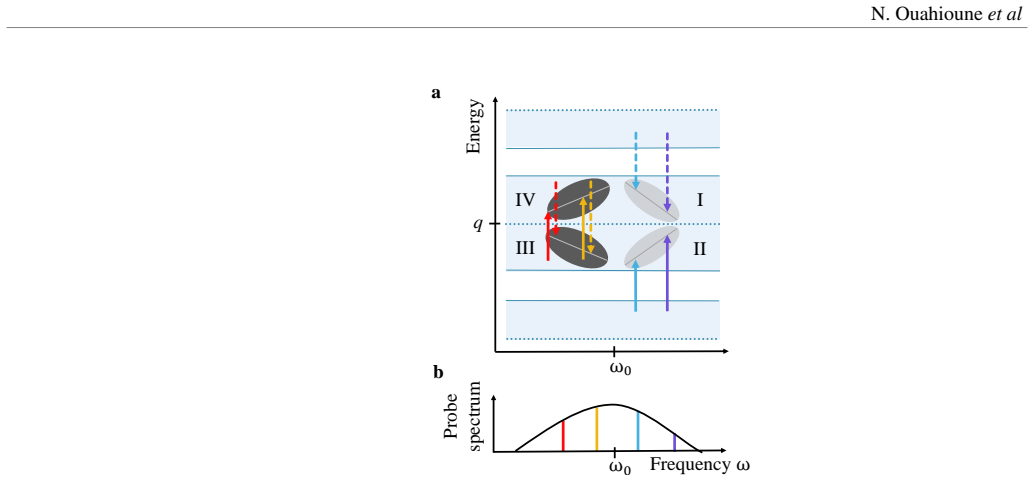
Interference between one- and two-photon transitions in helium photoionization allows parity mixing via four distinct pathways.
A machine-rendered reading of the paper's core claim, the machinery that carries it, and where it could break.
Core claim
Photoionization of atoms by high-order harmonics in the presence of a laser may lead to quantum interference from which information about the photoionization dynamics or the light fields can be extracted. In this work, interference between one- and two-photon transitions in helium is investigated, where parity is not conserved. Four parity-mixing interference pathways are identified, involving two different harmonic fields or a single harmonic, together with absorption or emission of a probe photon.
What carries the argument
Four parity-mixing interference pathways arising from competition between one-photon absorption of a harmonic and two-photon processes involving harmonic and probe laser photons.
If this is right
- Quantum interference signals can be used to extract information about photoionization dynamics without requiring parity conservation.
- Properties of the light fields, including the high-order harmonics, can be characterized using these parity-mixing effects.
- The use of 3D electron detection enables resolution of the interference patterns in momentum space for helium.
Where Pith is reading between the lines
- These pathways might enable more sensitive probes of electron correlation effects in helium by isolating parity-violating contributions in the interference.
- Extension to other atoms could reveal how nuclear charge influences the strength of parity-mixing interferences.
- This could connect to attosecond pulse characterization techniques by providing additional interference channels for phase retrieval.
Load-bearing premise
The detected interference signals in the three-dimensional electron momentum distributions can be unambiguously attributed to the four parity-mixing pathways without contamination from other processes or experimental artifacts.
What would settle it
If the angular distributions or energy spectra of photoelectrons show no distinct interference patterns at the positions predicted for the parity-mixing pathways, or if those patterns cannot be separated from parity-conserving ones using the 3D detection.
Figures


read the original abstract
Photoionization of atoms by high-order harmonics in the presence of a laser may lead to quantum interference from which information about the photoionization dynamics or the light fields can be extracted. Traditionally, this interference arises from two-photon transitions involving the absorption of consecutive harmonics combined with the absorption and stimulated emission of a laser photon. In this process, parity is conserved. Here, we investigate interference between one- and two-photon transitions in helium using high-order harmonics generated by a few-cycle laser and three-dimensional electron detection. In this case, parity is not conserved. We identify four parity-mixing interference pathways, involving two different harmonic fields or a single harmonic, together with absorption or emission of a probe photon.
Editorial analysis
A structured set of objections, weighed in public.
Referee Report
Summary. The manuscript reports an experimental study of parity-mixing interference during laser-assisted photoionization of helium. High-order harmonics generated by a few-cycle driver are combined with a probe field, and three-dimensional photoelectron momentum distributions are recorded. The central claim is the identification of four distinct parity-mixing pathways (two-harmonic plus probe absorption/emission, and single-harmonic plus probe absorption/emission) that violate parity conservation, in contrast to conventional parity-conserving two-photon interferences.
Significance. If the pathway assignments hold, the work would extend interference-based metrology of photoionization and light fields into the parity-mixing regime, potentially enabling new diagnostics of atomic dynamics. The use of 3D electron detection is a methodological strength that allows angular and energy resolution not available in 1D spectrometers.
major comments (1)
- [results section] The identification of the four parity-mixing pathways (abstract and results section) is load-bearing for the central claim, yet the manuscript provides no quantitative forward model of the 3D momentum distributions that incorporates finite harmonic bandwidth, probe intensity, and spectrometer resolution to demonstrate that cross-talk between pathways is negligible. Without such a decomposition or a control experiment (e.g., harmonic suppression scan), the assignment remains under-constrained.
minor comments (2)
- [figures] Figure captions should explicitly state the normalization procedure and any background subtraction applied to the 3D spectra.
- [abstract] The abstract would benefit from a brief mention of the specific harmonic orders and probe intensity range used.
Simulated Author's Rebuttal
We thank the referee for their positive assessment of the work's significance and for the detailed comment on pathway validation. We respond to the major comment below.
read point-by-point responses
-
Referee: [results section] The identification of the four parity-mixing pathways (abstract and results section) is load-bearing for the central claim, yet the manuscript provides no quantitative forward model of the 3D momentum distributions that incorporates finite harmonic bandwidth, probe intensity, and spectrometer resolution to demonstrate that cross-talk between pathways is negligible. Without such a decomposition or a control experiment (e.g., harmonic suppression scan), the assignment remains under-constrained.
Authors: We agree that a quantitative forward model would provide stronger confirmation that cross-talk between the four pathways is negligible. The pathways are assigned on the basis of energy conservation and the distinct angular distributions arising from the parity-mixing interference terms, which are resolved in the 3D momentum maps. The two-harmonic pathways produce interference at different kinetic energies than the single-harmonic pathways, and the absorption versus emission of the probe photon further separates the features. Nevertheless, we acknowledge that the manuscript does not contain an explicit numerical decomposition that folds in the measured harmonic spectrum, probe intensity, and detector resolution. In the revised version we will add a dedicated paragraph and supplementary figure that presents a simplified forward model of the expected 3D distributions for each pathway, demonstrating that overlap is minimal under the experimental conditions. A full end-to-end simulation remains computationally demanding but is not required to establish the central claim given the clear separation visible in the data. revision: partial
Circularity Check
No circularity: experimental identification of pathways rests on direct 3D momentum detection, not on derivations or self-referential fits.
full rationale
The manuscript is an experimental observation paper. It reports measured 3D photoelectron spectra from helium ionized by high-order harmonics plus a probe laser, then assigns features to four parity-mixing pathways on the basis of energy and angular distributions. No equations are presented that derive a 'prediction' from a fitted parameter taken from the same dataset, no self-citation chain is invoked to justify a uniqueness theorem or ansatz, and no quantity is renamed as a new result. The central claim is therefore independent of its own inputs and does not reduce by construction to any fitted or assumed element inside the paper.
Axiom & Free-Parameter Ledger
axioms (1)
- standard math Standard quantum mechanical parity selection rules apply to one- and two-photon transitions in helium photoionization
Reference graph
Works this paper leans on
-
[1]
Observation of Laser-Assisted Auger Decay in Argon
Schins JM, Breger P, Agostini P, Constantinescu RC, Muller HG, Grillon G, et al. Observation of Laser-Assisted Auger Decay in Argon. Phys Rev Lett. 1994 Oct;73:2180-3
1994
-
[2]
Observation of Laser Assisted Photoelectric Effect and Femtosecond High Order Harmonic Radiation
Glover TE, Schoenlein RW, Chin AH, Shank CV. Observation of Laser Assisted Photoelectric Effect and Femtosecond High Order Harmonic Radiation. Phys Rev Lett. 1996 Apr;76:2468-71
1996
-
[3]
Isolated Single-Cycle Attosecond Pulses
Sansone G, Benedetti E, Calegari F, Vozzi C, Avaldi L, Flammini R, et al. Isolated Single-Cycle Attosecond Pulses. Science. 2006;314(5798):443-6
2006
-
[4]
Attosecond metrology
Hentschel M, Kienberger R, Spielmann C, Reider GA, Milosevic N, Brabec T, et al. Attosecond metrology. Nature. 2001 11;414(6863):509-13
2001
-
[5]
Single-Cycle Nonlinear Optics
Goulielmakis E, Schultze M, Hofstetter M, Yakovlev VS, Gagnon J, Uiberacker M, et al. Single-Cycle Nonlinear Optics. Science. 2008;320(5883):1614-7
2008
-
[6]
Observation of a Train of Attosecond Pulses from High Harmonic Generation
Paul PM, Toma ES, Breger P, Mullot G, Augé F, Balcou P, et al. Observation of a Train of Attosecond Pulses from High Harmonic Generation. Science. 2001 6;292(5522):1689-92
2001
-
[7]
Amplitude and phase control of attosecond light pulses
Lopez-Martens R, Varjú K, Johnsson P, Mauritsson J, Mairesse Y, Salieres P, et al. Amplitude and phase control of attosecond light pulses. Phys Rev Lett. 2005 1;94(3):033001
2005
-
[8]
Attosecond Synchronization of High-Harmonic Soft X-rays
Mairesse Y, de Bohan A, Frasinski LJ, Merdji H, Dinu LC, Monchicourt P, et al. Attosecond Synchronization of High-Harmonic Soft X-rays. Science. 2003;302(5650):1540-3
2003
-
[9]
Probing Single-Photon Ionization on the Attosecond Time Scale
Klünder K, Dahlström JM, Gisselbrecht M, Fordell T, Swoboda M, Guénot D, et al. Probing Single-Photon Ionization on the Attosecond Time Scale. Phys Rev Lett. 2011 4;106:143002. 6 REFERENCES N. Ouahiouneet al
2011
-
[10]
Photoionization in the time and frequency domain
Isinger M, Squibb RJ, Busto D, Zhong S, Harth A, Kroon D, et al. Photoionization in the time and frequency domain. Science. 2017 11;358(6365):893-6
2017
-
[11]
Powerful 170-attosecond XUV pulses generated with few-cycle laser pulses and broadband multilayer optics
Schultze M, Goulielmakis E, Uiberacker M, Hofstetter M, Kim J, Kim D, et al. Powerful 170-attosecond XUV pulses generated with few-cycle laser pulses and broadband multilayer optics. New J Phys. 2007 7;9(7):243
2007
-
[12]
Attosecond Control of Orbital Parity Mix Interferences and the Relative Phase of Even and Odd Harmonics in an Attosecond Pulse Train
Laurent G, Cao W, Li H, Wang Z, Ben-Itzhak I, Cocke CL. Attosecond Control of Orbital Parity Mix Interferences and the Relative Phase of Even and Odd Harmonics in an Attosecond Pulse Train. Phys Rev Lett. 2012 8;109:083001
2012
-
[13]
High harmonic generation-2𝜔 attosecond stereo-photoionization interferometry in N2
Loriot V, Marciniak A, Nandi S, Karras G, Hervé M, Constant E, et al. High harmonic generation-2𝜔 attosecond stereo-photoionization interferometry in N2. J Phys Photonics. 2020 3;2:024003
2020
-
[14]
Towards the complete phase profiling of attosecond wave packets
Fuchs J, Douguet N, Donsa S, Martín F, Burgdörfer J, Argenti L, et al. Towards the complete phase profiling of attosecond wave packets. Phys Rev Res. 2021 2;3:013195
2021
-
[15]
Coherent control with a short-wavelength free-electron laser
Prince KC, Allaria E, Callegari C, Cucini R, De Ninno G, Di Mitri S, et al. Coherent control with a short-wavelength free-electron laser. Nature Photonics. 2016 3;10(3):176-9
2016
-
[16]
New Method for Measuring Angle-Resolved Phases in Photoemission
You D, Ueda K, Gryzlova EV, Grum-Grzhimailo AN, Popova MM, Staroselskaya EI, et al. New Method for Measuring Angle-Resolved Phases in Photoemission. Phys Rev X. 2020 9;10:031070
2020
-
[17]
Attosecond pulse shaping using a seeded free-electron laser
Maroju PK, Grazioli C, Di Fraia M, Moioli M, Ertel D, Ahmadi H, et al. Attosecond pulse shaping using a seeded free-electron laser. Nature. 2020 2;578(7795):386-91
2020
-
[18]
Velocity map imaging of ions and electrons using electrostatic lenses: Application in photoelectron and photofragment ion imaging of molecular oxygen
Eppink ATJB, Parker DH. Velocity map imaging of ions and electrons using electrostatic lenses: Application in photoelectron and photofragment ion imaging of molecular oxygen. Rev Sci Instrum. 1997 09;68(9):3477-84
1997
-
[19]
Recoil-ion and electron momentum spectroscopy: reaction-microscopes
Ullrich J, Moshammer R, Dorn A, Dörner R, Schmidt LPH, Schmidt-Böcking H. Recoil-ion and electron momentum spectroscopy: reaction-microscopes. Rep Prog Phys. 2003 aug;66(9):1463
2003
-
[20]
A high-repetition rate attosecond light source for time-resolved coincidence spectroscopy
Mikaelsson S, Vogelsang J, Guo C, Sytcevich I, Viotti AL, Langer F, et al. A high-repetition rate attosecond light source for time-resolved coincidence spectroscopy. J Nanophotonics. 2021;10(1):117-28
2021
-
[21]
Single-shot carrier–envelope phase measurement of few-cycle laser pulses
Wittmann T, Horvath B, Helml W, Schätzel MG, Gu X, Cavalieri AL, et al. Single-shot carrier–envelope phase measurement of few-cycle laser pulses. Nat Phys. 2009 5;5(5):357-62
2009
-
[22]
Optimization of momentum imaging systems using electric and magnetic fields
Gisselbrecht M, Huetz A, Lavollée M, Reddish TJ, Seccombe DP. Optimization of momentum imaging systems using electric and magnetic fields. Rev Sci Instrum. 2005 12;76(1):013-105
2005
-
[23]
Attosecond Electron Spectroscopy Using a Novel Interferometric Pump-Probe Technique
Mauritsson J, Remetter T, Swoboda M, Klünder K, L’Huillier A, Schafer KJ, et al. Attosecond Electron Spectroscopy Using a Novel Interferometric Pump-Probe Technique. Phys Rev Lett. 2010 7;105:053001
2010
-
[24]
Anisotropic emission in quantum-beat spectroscopy of helium excited states
Lucchini M, Ludwig A, Zimmermann T, Kasmi L, Herrmann J, Scrinzi A, et al. Anisotropic emission in quantum-beat spectroscopy of helium excited states. Phys Rev A. 2015 6;91:063406
2015
-
[25]
Attosecond quantum-beat spectroscopy in helium
Shivaram N, Tong XM, Timmers H, Sandhu A. Attosecond quantum-beat spectroscopy in helium. Journal of Physics B: Atomic, Molecular and Optical Physics. 2016 feb;49(5):055601
2016
-
[26]
Reconstruction of attosecond beating by interference of two-photon transitions with higher-order processes
Roantree L, van der Hart HW, Brown AC. Reconstruction of attosecond beating by interference of two-photon transitions with higher-order processes. Phys Rev A. 2025 7;112:013118
2025
-
[27]
Configuration-interaction-based time-dependent orbital approach for ab initio treatment of electronic dynamics in a strong optical laser field
Rohringer N, Gordon A, Santra R. Configuration-interaction-based time-dependent orbital approach for ab initio treatment of electronic dynamics in a strong optical laser field. Phys Rev A. 2006 10;74:043420
2006
-
[28]
Quantum coherence in photo-ionisation with tailored XUV pulses
Carlström S, Mauritsson J, Schafer KJ, L’Huillier A, Gisselbrecht M. Quantum coherence in photo-ionisation with tailored XUV pulses. Journal of Physics B: Atomic, Molecular and Optical Physics. 2017 11;51(1):015201
2017
-
[29]
General time-dependent configuration-interaction singles
Carlström S, Spanner M, Patchkovskii S. General time-dependent configuration-interaction singles. I. Molecular case. Phys Rev A. 2022 10;106:043104. 7 REFERENCES N. Ouahiouneet al
2022
-
[30]
General time-dependent configuration-interaction singles
Carlström S, Bertolino M, Dahlström JM, Patchkovskii S. General time-dependent configuration-interaction singles. II. Atomic case. Phys Rev A. 2022 10;106:042806
2022
-
[31]
Multiphoton interaction phase shifts in attosecond science
Bertolino M, Dahlström JM. Multiphoton interaction phase shifts in attosecond science. Phys Rev Res. 2021 3;3:013270. 8
2021
discussion (0)
Sign in with ORCID, Apple, or X to comment. Anyone can read and Pith papers without signing in.