Recognition: unknown
Non-Gaussian fluctuations in relativistic hydrodynamics: Confluent equations for three-point correlations
Pith reviewed 2026-05-10 11:47 UTC · model grok-4.3
The pith
Relativistic stochastic hydrodynamics yields deterministic equations for three-point correlations of non-Gaussian fluctuations once an average local Landau frame is defined.
A machine-rendered reading of the paper's core claim, the machinery that carries it, and where it could break.
Core claim
Deterministic confluent equations are obtained for the time evolution of three-point correlators of all hydrodynamic fields by first constructing the average local Landau frame and the associated fluctuating variables; the stochastic hydrodynamics is then rewritten in a manifestly covariant, multi-component matrix representation that remains valid under local SO(3) rotations of the spatial basis.
What carries the argument
The average local Landau frame, which supplies a covariant definition of fluctuating hydrodynamic variables and permits a unified matrix form for fully nonlinear stochastic hydrodynamics.
If this is right
- The equations supply a closed, deterministic system for the three-point functions of energy density, momentum density, and velocity fluctuations.
- The matrix representation automatically incorporates the covariance requirements under local rotations of the spatial basis.
- Correlators involving the fluctuating velocity become accessible, removing a longstanding obstacle in relativistic stochastic hydrodynamics.
- The same construction extends in principle to higher-order correlators beyond three points.
Where Pith is reading between the lines
- The equations could be discretized and solved numerically to predict measurable non-Gaussian cumulants in heavy-ion data.
- The formalism may be combined with hydrodynamic simulations that already include stochastic noise to generate event-by-event fluctuations.
- Because the frame choice is local and covariant, the same approach might be adapted to other relativistic dissipative systems such as viscous fluids in curved spacetime.
Load-bearing premise
The average local Landau frame and its fluctuating variables remain well-defined and covariant when the underlying stochastic noise is allowed to be fully nonlinear.
What would settle it
A demonstration that the Landau-frame construction becomes frame-dependent or loses covariance once the stochastic terms are kept nonlinear would invalidate the derived equations.
Figures

read the original abstract
We derive deterministic equations for the evolution of non-Gaussian fluctuations in relativistic stochastic hydrodynamics. This is achieved by defining the average local Landau frame and corresponding fluctuating hydrodynamic variables. Fully nonlinear stochastic hydrodynamics is expressed in a unified multi-component matrix form. A novel relativistic formalism, also manifestly covariant under SO(3) rotations of the local spatial basis in the average local Landau frame, is introduced. The equations describe correlators of all hydrodynamic variables, including fluctuating velocity (or momentum density) -- a nontrivial problem in relativistic hydrodynamics.
Editorial analysis
A structured set of objections, weighed in public.
Referee Report
Summary. The paper derives deterministic equations for the evolution of non-Gaussian fluctuations, specifically three-point correlations, in relativistic stochastic hydrodynamics. It achieves this by defining the average local Landau frame and fluctuating hydrodynamic variables, expressing the fully nonlinear stochastic hydrodynamics in a unified multi-component matrix form, and introducing a novel relativistic formalism covariant under SO(3) rotations of the local spatial basis in the average local Landau frame. The equations cover correlators of all hydrodynamic variables, including fluctuating velocity or momentum density.
Significance. If valid, this provides a framework for computing higher-order fluctuations in relativistic hydrodynamics, which is significant for modeling non-Gaussian observables in heavy-ion collisions. The ability to include fluctuating velocity fields addresses a nontrivial aspect not covered in prior scalar-only approaches. The manifest covariance under local SO(3) is a strength of the formalism.
major comments (1)
- [Main derivation (as per abstract)] The central construction of the average local Landau frame for fully nonlinear stochastic noise requires explicit demonstration that it remains well-defined and covariant. The stochastic terms couple to velocity fluctuations, and it is not clear from the provided outline whether the averaging operation commutes with the nonlinearities while preserving the claimed SO(3) covariance. This assumption is load-bearing for the matrix form and the subsequent confluent equations; a concrete verification or limit check (e.g., against known non-relativistic cases or linear noise limits) is needed in the text.
minor comments (1)
- The abstract is dense; consider breaking down the key steps more clearly for readers unfamiliar with stochastic hydrodynamics.
Simulated Author's Rebuttal
We thank the referee for their positive assessment of the significance of our work and for the constructive comment on the central construction in the manuscript. We address the concern below and have incorporated the requested clarifications and verifications into the revised version.
read point-by-point responses
-
Referee: [Main derivation (as per abstract)] The central construction of the average local Landau frame for fully nonlinear stochastic noise requires explicit demonstration that it remains well-defined and covariant. The stochastic terms couple to velocity fluctuations, and it is not clear from the provided outline whether the averaging operation commutes with the nonlinearities while preserving the claimed SO(3) covariance. This assumption is load-bearing for the matrix form and the subsequent confluent equations; a concrete verification or limit check (e.g., against known non-relativistic cases or linear noise limits) is needed in the text.
Authors: We agree that an explicit verification is valuable for clarity. In the revised manuscript we have expanded Section II.B with a step-by-step construction of the average local Landau frame. We demonstrate that the frame remains well-defined by showing that the ensemble-averaged momentum density vanishes identically after the stochastic noise is integrated, even when velocity fluctuations are retained at nonlinear order. The averaging operation commutes with the nonlinear terms because the noise correlators are delta-correlated in time and the Ito–Stratonovich conversion terms are absorbed into the deterministic matrix evolution. SO(3) covariance under local spatial-basis rotations is verified by explicit transformation of the multi-component vector and tensor blocks, confirming invariance of the confluent equations. As concrete checks we have added Appendix A, which recovers the known non-relativistic three-point equations in the appropriate limit, and Appendix B, which shows that the three-point correlators vanish in the linear-noise (Gaussian) limit as required by fluctuation-dissipation relations. These additions directly address the load-bearing assumptions. revision: yes
Circularity Check
Derivation from stochastic hydrodynamics to confluent correlator equations is self-contained
full rationale
The paper starts from standard relativistic stochastic hydrodynamics, introduces the average local Landau frame to define fluctuating variables, rewrites the fully nonlinear equations in a unified multi-component matrix form, and derives deterministic evolution equations for three-point correlators. No step reduces by construction to a fitted input, self-defined output, or load-bearing self-citation chain; the matrix formalism and SO(3) covariance are presented as novel but derived from the starting stochastic equations rather than presupposing the final correlator results. The central claim therefore has independent content beyond its inputs.
Axiom & Free-Parameter Ledger
axioms (2)
- domain assumption Stochastic hydrodynamics can be formulated with additive noise whose statistics are known and can be averaged to produce closed deterministic equations for correlators.
- domain assumption The average local Landau frame can be defined such that fluctuating velocity remains consistently treatable while preserving relativistic covariance.
Forward citations
Cited by 1 Pith paper
-
Non-Gaussian hydrodynamic fluctuations in an expanding relativistic fluid
In Bjorken flow, non-Gaussian velocity fluctuations evolve with nonlinear coupling between two- and three-point correlators and memory effects, best analyzed in the average Landau frame which coincides with the density frame.
Reference graph
Works this paper leans on
-
[1]
(1.1) it is convenient to represent the hydrodynamic correlators eH(N) using their Fourier-Wigner transform,W (N), with respect to the spatial coordinatesy i
WIGNER TRANSFORM To take full advantage of the separation of scales given by Eq. (1.1) it is convenient to represent the hydrodynamic correlators eH(N) using their Fourier-Wigner transform,W (N), with respect to the spatial coordinatesy i. Such a generalized Wigner transform was introduced in Ref. [14]: W(N) x;{q i}N i=1 ≡ Z eH(N) x;{y i}N i=1 δ(3) 1 N NX...
-
[2]
+ 1 2 e∇ ⊗1 − ∂ ∂q1λ K µ λ −q′ 2µ b,c a1 W (−q′ 2,q′ 2) ba2 , W(−q′ 3,q′ 3) ca3 , (4.11b) where theq ′ i can be set toq i only afterthe derivative with respect toq 1 has been taken, since bothq ′ 2 andq ′ 3 depend onq 1:∂q ′ 2µ/∂q1λ =∂q ′ 3µ/∂q1λ =−(1/3)δ λ µ, according to Eq. (4.4). The operator ˆD(3) in ˆΓ(3) is given by ˆD bc a1 W (−q′ 2,q′ 2) ba2 , W(...
-
[3]
+ ˜D bc a1 (q′ 3, q′ 2) W (−q′ 2,q′ 2) ba2 , W(−q′ 3,q′ 3) ca3 ,(4.11c) while ˆQ b a1a2 W (−q′ 3,q′ 3) ba3 ≡ Q b a1a2(q′ 2, q′
-
[4]
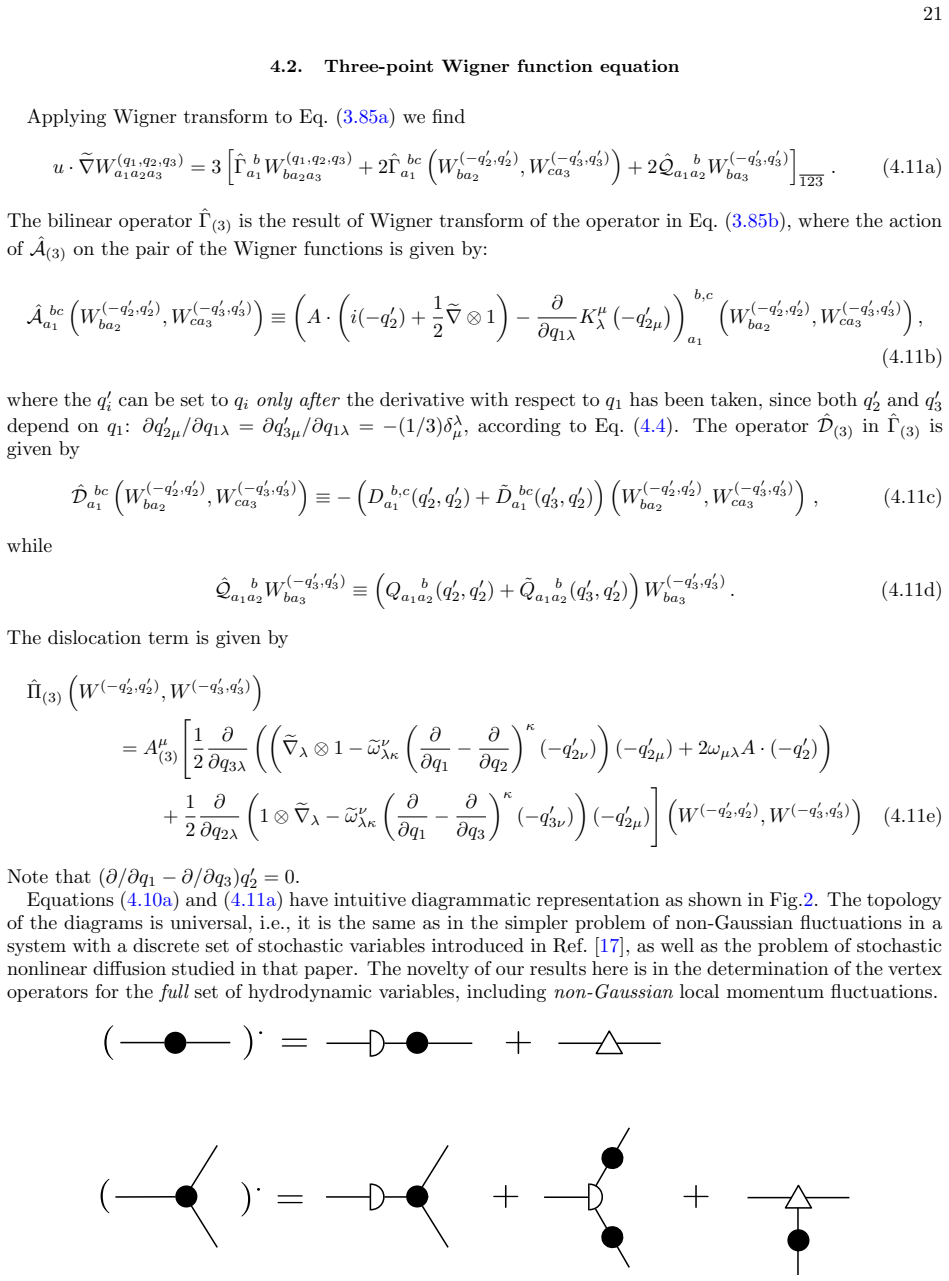
Equations (4.10a) and (4.11a) have intuitive diagrammatic representation as shown in Fig.2
+ ˜Q b a1a2(q′ 3, q′ 2) W (−q′ 3,q′ 3) ba3 .(4.11d) The dislocation term is given by ˆΠ(3) W (−q′ 2,q′ 2), W(−q′ 3,q′ 3) =A µ (3) " 1 2 ∂ ∂q3λ e∇λ ⊗1−eω ν λκ ∂ ∂q1 − ∂ ∂q2 κ (−q′ 2ν) (−q′ 2µ) + 2ωµλA·(−q ′ 2) + 1 2 ∂ ∂q2λ 1⊗ e∇λ −eων λκ ∂ ∂q1 − ∂ ∂q3 κ (−q′ 3ν) (−q′ 2µ) # W (−q′ 2,q′ 2), W(−q′ 3,q′ 3) (4.11e) Note that (∂/∂q 1 −∂/∂q 3)q′ 2 = 0. Equations ...
-
[5]
diagonal
EQUILIBRIUM CONDITIONS The essential property of dissipative hydrodynamics is the relaxation of the fluid it describes to equilibrium. We would like to make sure that this property is reflected in the equations for the correlators we derived from the stochastic equation (2.18). As we shall see, the existence of an equilibrium solution requires that the co...
-
[6]
A· iq1 + 1 3 e∇ − ∂ ∂q1λ K µ λ q1µ +B−D(q 1, q1) b a1 W (q1,q2,q3) ba2a3 +
THE SECOND LAW OF THERMODYNAMICS AND EQUILIBRIUM The purpose of this section is to show that, in hydrodynamics, the equilibrium conditions derived in the previous section follow from the two defining properties of hydrodynamics. The first property is that the variables used in hydrodynamic equations areconserveddensities. The second is that the evolution ...
-
[7]
(3.60) or, more precisely, its Wigner transform given by Eqs
PHONON KINETICS The purpose of this section is to elucidate the physical significance of the operator ˆΓ, defined in Eqs. (3.60) or, more precisely, its Wigner transform given by Eqs. (4.10), which is a major building block of the fluc- tuation evolution equations. In particular, we shall show that, when restricted to the sector of longitudinal (sound) fl...
-
[8]
equal time
SUMMARY AND CONCLUSIONS In this paper we introduced a novel formalism for describing fluctuations inrelativistichydrodynamics. The focus of this formalism is onnon-Gaussianityof fluctuations, which is of primary interest in the search for the QCD critical point in heavy-ion collisions. Below we briefly outline the main ingredients of the formalism we intr...
2020
-
[9]
Landau and E
L. Landau and E. Lifshitz,Fluid Mechanics, vol. 6 ofCourse of Theoretical Physics. Elsevier Science, 2013
2013
-
[10]
P. Romatschke and U. Romatschke,Relativistic Fluid Dynamics In and Out of Equilibrium – Ten Years of Progress in Theory and Numerical Simulations of Nuclear Collisions. Cambridge University Press, 2019. arXiv:1712.05815 [nucl-th]
work page Pith review arXiv 2019
-
[11]
W. Florkowski, M. P. Heller, and M. Spalinski, “New theories of relativistic hydrodynamics in the LHC era,” Rept. Prog. Phys.81no. 4, (2018) 046001,arXiv:1707.02282 [hep-ph]
-
[12]
Signatures of the tricritical point in QCD,
M. Stephanov, K. Rajagopal, and E. Shuryak, “Signatures of the tricritical point in QCD,”Phys.Rev.Lett.81 (1998) 4816–4819,arXiv:hep-ph/9806219 [hep-ph]
-
[13]
M. Stephanov, K. Rajagopal, and E. Shuryak, “Event-by-event fluctuations in heavy ion collisions and the QCD critical point,”Phys. Rev. D60(1999) 114028,arXiv:hep-ph/9903292. [6]STARCollaboration, M. M. Aggarwalet al., “An Experimental Exploration of the QCD Phase Diagram: The Search for the Critical Point and the Onset of De-confinement,”arXiv:1007.2613 ...
- [14]
-
[15]
X. Anet al., “The BEST framework for the search for the QCD critical point and the chiral magnetic effect,” Nucl. Phys. A1017(2022) 122343,arXiv:2108.13867 [nucl-th]
-
[16]
M. Stephanov, “QCD critical point: Recent developments,”EPJ Web Conf.314(2024) 00042, arXiv:2410.02861 [nucl-th]
-
[17]
Corrections to the hydrodynamics of liquids,
A. Andreev, “Corrections to the hydrodynamics of liquids,”Zh. Ehksp. Teor. Fiz.75no. 3, (1978) 1132–1139
1978
-
[18]
Kinetic regime of hydrodynamic fluctuations and long time tails for a bjorken expansion,
Y. Akamatsu, A. Mazeliauskas, and D. Teaney, “Kinetic regime of hydrodynamic fluctuations and long time tails for a bjorken expansion,”Phys. Rev. C95(Jan, 2017) 014909. 38
2017
-
[19]
Bulk viscosity from hydrodynamic fluctuations with relativistic hydrokinetic theory,
Y. Akamatsu, A. Mazeliauskas, and D. Teaney, “Bulk viscosity from hydrodynamic fluctuations with relativistic hydrokinetic theory,”Phys. Rev. C97(Feb, 2018) 024902
2018
-
[20]
Stochastic hydrodynamics and long time tails of an expanding conformal charged fluid,
M. Martinez and T. Sch¨ afer, “Stochastic hydrodynamics and long time tails of an expanding conformal charged fluid,”Phys. Rev. C99no. 5, (2019) 054902,arXiv:1812.05279 [hep-th]
-
[21]
Relativistic Hydrodynamic Fluctuations,
X. An, G. Ba¸ sar, M. Stephanov, and H.-U. Yee, “Relativistic Hydrodynamic Fluctuations,”Phys. Rev. C100 (2019) 024910,arXiv:1902.09517 [hep-th]
-
[22]
Fluctuation dynamics in a relativistic fluid with a critical point,
X. An, G. Ba¸ sar, M. Stephanov, and H.-U. Yee, “Fluctuation dynamics in a relativistic fluid with a critical point,”Phys. Rev. C102(2020) 034901,arXiv:1912.13456 [hep-th]
-
[23]
Non-Gaussian fluctuations near the QCD critical point,
M. Stephanov, “Non-Gaussian fluctuations near the QCD critical point,”Phys. Rev. Lett.102(2009) 032301, arXiv:0809.3450 [hep-ph]
-
[24]
Evolution of non-gaussian hydrodynamic fluctuations,
X. An, G. Ba¸ sar, M. Stephanov, and H.-U. Yee, “Evolution of non-gaussian hydrodynamic fluctuations,”Phys. Rev. Lett.127(2021) 072301,arXiv:2009.10742 [hep-th]
-
[25]
Non-Gaussian fluctuation dynamics in relativistic fluids,
X. An, G. Ba¸ sar, M. Stephanov, and H.-U. Yee, “Non-Gaussian fluctuation dynamics in relativistic fluids,” Phys. Rev. C108no. 3, (2023) 034910,arXiv:2212.14029 [hep-th]. [19]STARCollaboration, B. E. Aboonaet al., “Precision Measurement of Net-Proton-Number Fluctuations in Au+Au Collisions at RHIC,”Phys. Rev. Lett.135no. 14, (2025) 142301,arXiv:2504.00817...
-
[26]
J. Armas and A. Jain, “Effective field theory for hydrodynamics without boosts,”SciPost Phys.11no. 3, (2021) 054,arXiv:2010.15782 [hep-th]
-
[27]
Stochastic relativistic advection diffusion equation from the Metropolis algorithm,
G. Ba¸ sar, J. Bhambure, R. Singh, and D. Teaney, “Stochastic relativistic advection diffusion equation from the Metropolis algorithm,”Phys. Rev. C110no. 4, (2024) 044903,arXiv:2403.04185 [nucl-th]
-
[28]
Relativistic viscous hydrodynamics in the density frame: Numerical tests and comparisons,
J. Bhambure, A. Mazeliauskas, J.-F. Paquet, R. Singh, M. Singh, D. Teaney, and F. Zhou, “Relativistic viscous hydrodynamics in the density frame: Numerical tests and comparisons,”Phys. Rev. C111no. 6, (2025) 064910,arXiv:2412.10303 [nucl-th]
-
[29]
J. Bhambure, R. Singh, and D. Teaney, “Stochastic relativistic viscous hydrodynamics from the Metropolis algorithm,”Phys. Rev. C111no. 6, (2025) 064909,arXiv:2412.10306 [nucl-th]
-
[30]
Maximum Entropy Freeze-Out of Hydrodynamic Fluctuations,
M. S. Pradeep and M. Stephanov, “Maximum Entropy Freeze-Out of Hydrodynamic Fluctuations,”Phys. Rev. Lett.130no. 16, (2023) 162301,arXiv:2211.09142 [hep-ph]
discussion (0)
Sign in with ORCID, Apple, or X to comment. Anyone can read and Pith papers without signing in.