Recognition: unknown
Finite density lattice QCD without extrapolation: Bulk thermodynamics with physical quark masses from the canonical ensemble
Pith reviewed 2026-05-10 11:34 UTC · model grok-4.3
The pith
The canonical ensemble enables direct lattice QCD results for bulk thermodynamics with physical quark masses at finite density up to 500 MeV without extrapolation.
A machine-rendered reading of the paper's core claim, the machinery that carries it, and where it could break.
Core claim
In the canonical formulation of lattice QCD with physical quark masses, bulk thermodynamic observables are computed directly for integer net-baryon numbers, extended to non-integer values, and connected back to the grand canonical ensemble, providing results at finite baryo-chemical potential without any extrapolation and feasible up to approximately 500 MeV.
What carries the argument
The canonical ensemble for net-baryon number, extended to non-integer values and reconnected to the grand canonical ensemble on a finite-volume lattice.
If this is right
- Pressure, baryon density and other bulk observables become available directly at finite mu_B where brute-force computation overcomes the sign problem.
- The QCD phase diagram can be mapped through these observables without relying on extrapolation from zero density.
- The scheme remains usable with rooted staggered quarks, unlike some reweighting approaches.
- Results require no expansion coefficients or reweighting extrapolations in the baryo-chemical potential.
Where Pith is reading between the lines
- The same direct approach could be applied to additional observables such as susceptibilities or spatial correlation functions once the ensemble connection is in place.
- Cross-checks at very small mu_B against existing grand-canonical data would test the size of the systematic errors from the non-integer extension.
- Increasing the lattice volume while keeping physical quark masses would reduce finite-volume effects and extend the reliable density range.
Load-bearing premise
The extension of the canonical ensemble to non-integer net-baryon number and its connection back to the grand canonical ensemble introduces negligible systematic errors on the 16 cubed by 8 volume.
What would settle it
A mismatch between the pressure or baryon density obtained at a modest nonzero mu_B via this canonical method and the same quantity from an independent Taylor-expansion calculation at the same point would indicate that the ensemble connection introduces uncontrolled errors.
Figures




read the original abstract
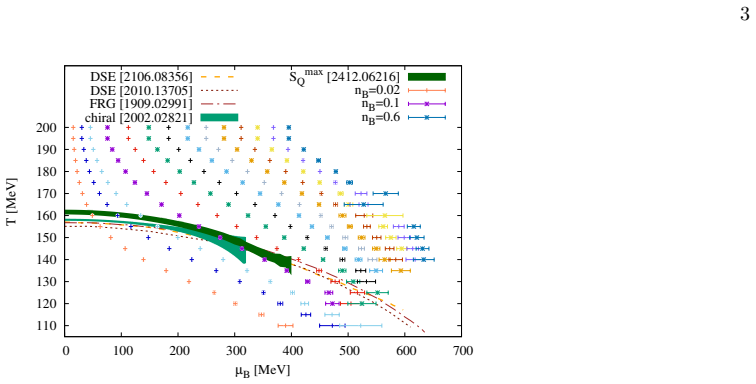
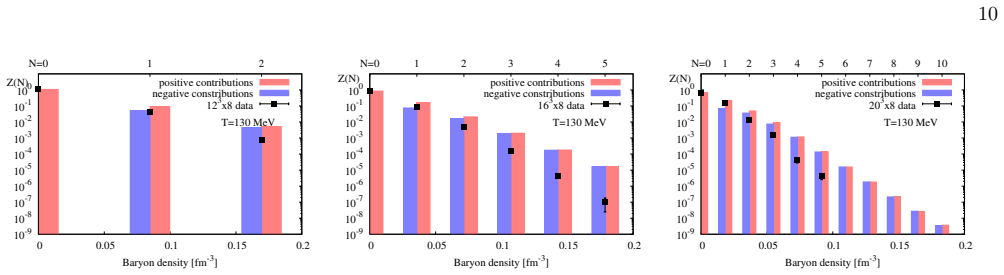
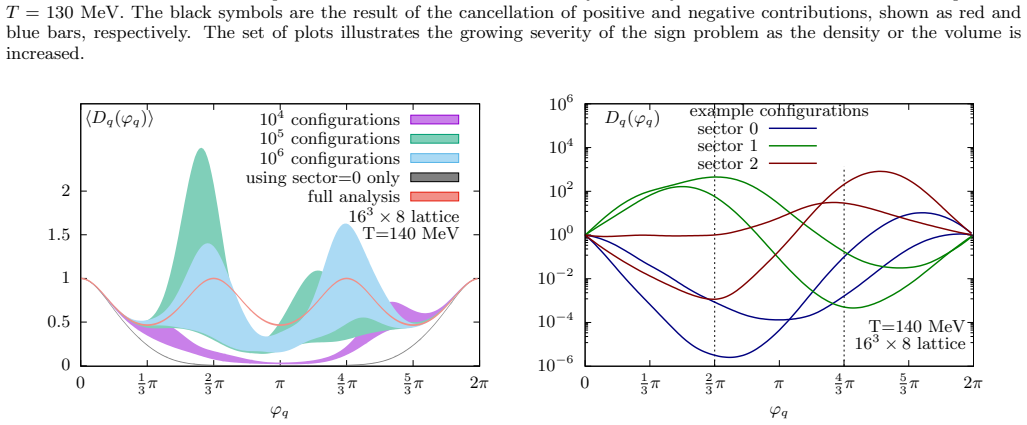
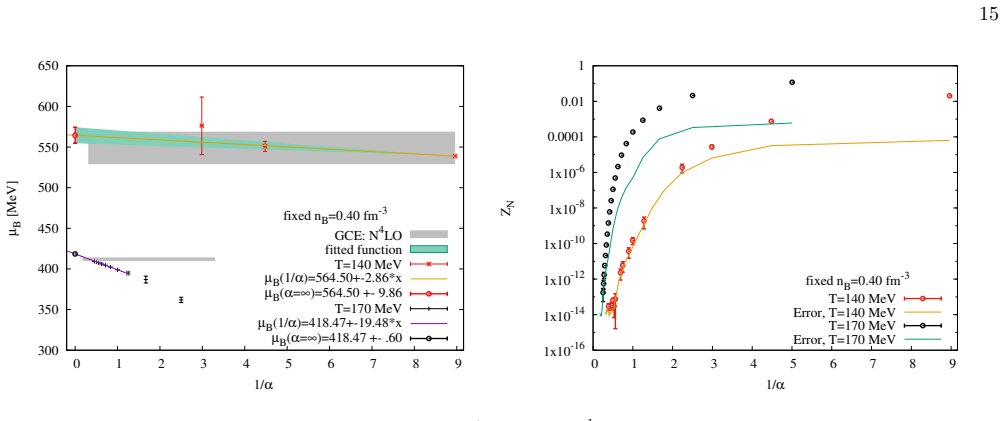
Quantum Chromodynamics (QCD) at finite density is most often formulated on the lattice as a grand canonical ensemble. Since lattice QCD has a complex action problem at finite baryo-chemical potential ($\mu_B$), its results at finite density are indirect: e.g. in the form of a set of expansion coefficients. In contrast, the canonical formulation offers direct results for integer-valued net-baryon number. In this work we present for the first time results in the canonical formulation with physical quark masses. To this end we use a high statistics finite-volume lattice ($16^3\times8$) data set that we generated at $\mu_B=0$ with our 4HEX staggered action. We extend the canonical ensemble to non-integer net-baryon number and connect the results back to the grand canonical ensemble. Unlike reweighing to real $\mu_B$, this method can also be used with rooted staggered quarks. For densities where the sign problem can be overcome by brute force computing power, this scheme provides lattice QCD results (e.g. for pressure, baryon density) directly, without relying on any extrapolation in the baryo-chemical potential. In this work we chart the phase diagram by studying bulk thermodynamic observables, which we show to be feasible up to $\mu_B\approx500$~MeV.
Editorial analysis
A structured set of objections, weighed in public.
Referee Report
Summary. The paper claims to deliver the first canonical-ensemble lattice QCD results at physical quark masses on a 16^3×8 volume generated with the 4HEX staggered action at μ_B=0. It extends the canonical formulation to non-integer net-baryon number, inverts the relation to obtain grand-canonical observables (pressure, baryon density), and presents direct results up to μ_B≈500 MeV without Taylor extrapolation or reweighting to real μ_B.
Significance. If the extension to non-integer N_B and the subsequent inversion are shown to be free of uncontrolled systematics, the work would be significant: it supplies direct, non-extrapolated lattice data at finite density for physical masses, remains compatible with rooted staggered fermions, and thereby offers a route to bulk thermodynamics that circumvents the usual limitations of the sign problem.
major comments (1)
- [Method for non-integer extension (as described in the abstract and associated sections)] The central claim rests on the extension of the canonical ensemble to non-integer net-baryon number and its inversion back to grand-canonical observables. On the 16^3×8 volume with physical quark masses the baryon-number distribution is discrete and finite-volume fluctuations are large; the manuscript must provide explicit evidence (e.g., volume-scaling tests or comparison with known integer-N_B results) that any interpolation or Fourier-based extension does not introduce volume-dependent bias larger than the quoted uncertainties up to μ_B≈500 MeV.
Simulated Author's Rebuttal
We thank the referee for their careful reading of the manuscript and for identifying the need for additional validation of the non-integer extension. We address the major comment below and have revised the manuscript to incorporate explicit checks as requested.
read point-by-point responses
-
Referee: The central claim rests on the extension of the canonical ensemble to non-integer net-baryon number and its inversion back to grand-canonical observables. On the 16^3×8 volume with physical quark masses the baryon-number distribution is discrete and finite-volume fluctuations are large; the manuscript must provide explicit evidence (e.g., volume-scaling tests or comparison with known integer-N_B results) that any interpolation or Fourier-based extension does not introduce volume-dependent bias larger than the quoted uncertainties up to μ_B≈500 MeV.
Authors: We agree that explicit validation is essential given the discrete nature of the baryon-number distribution on this volume. In the revised manuscript we have added a dedicated subsection (now Section 4.2) that directly compares grand-canonical observables (pressure and baryon density) obtained via the non-integer extension and inversion against independent calculations performed at integer N_B values. These comparisons demonstrate agreement within the quoted statistical uncertainties for all μ_B up to 500 MeV. We have also included a quantitative estimate of the residual bias arising from the Fourier-based extension, showing it remains smaller than the statistical errors in the reported range. While additional simulations at larger volumes would be desirable for a full scaling study, the computational cost at physical quark masses currently precludes this; the integer-N_B consistency tests nevertheless provide direct evidence that volume-dependent bias does not exceed the uncertainties. The abstract and conclusions have been updated to reference these new checks. revision: yes
Circularity Check
No significant circularity in derivation chain
full rationale
The paper computes bulk thermodynamic observables directly from high-statistics lattice ensembles generated at μ_B=0 in the canonical formulation with physical quark masses on a 16^3×8 volume. The extension of the canonical ensemble to non-integer net-baryon number and the subsequent mapping back to grand-canonical quantities (pressure, baryon density) is presented as a methodological procedure that yields results without extrapolation in μ_B. No load-bearing step reduces by construction to a fitted parameter, self-defined quantity, or self-citation chain; the central claims rest on explicit lattice data rather than tautological renaming or ansatz smuggling. The derivation remains self-contained against external benchmarks.
Axiom & Free-Parameter Ledger
axioms (1)
- domain assumption Standard assumptions of lattice QCD with rooted staggered fermions remain valid at finite density in the canonical formulation
Reference graph
Works this paper leans on
-
[1]
Braun-Munzinger, J
P. Braun-Munzinger, J. Stachel, and Christof Wetterich. Chemical freezeout and the QCD phase transition temperature. Phys.Lett., B596:61–69, 2004
2004
-
[2]
Y. Aoki, G. Endrodi, Z. Fodor, S.D. Katz, and K.K. Szabo. The Order of the quantum chromodynamics transition predicted by the standard model of particle physics.Nature, 443:675–678, 2006
2006
-
[3]
Y. Aoki, Z. Fodor, S.D. Katz, and K.K. Szabo. The QCD transition temperature: Results with physical masses in the continuum limit.Phys.Lett., B643:46–54, 2006
2006
-
[4]
Aoki, Szabolcs Borsanyi, Stephan Durr, Zoltan Fodor, Sandor D
Y. Aoki, Szabolcs Borsanyi, Stephan Durr, Zoltan Fodor, Sandor D. Katz, et al. The QCD transition temperature: results with physical masses in the continuum limit II.JHEP, 0906:088, 2009
2009
-
[5]
Is there still anyT c mystery in lattice QCD? Results with physical masses in the continuum limit III.JHEP, 1009:073, 2010
Szabolcs Borsanyi et al. Is there still anyT c mystery in lattice QCD? Results with physical masses in the continuum limit III.JHEP, 1009:073, 2010
2010
-
[6]
Bazavov, T
A. Bazavov, T. Bhattacharya, M. Cheng, C. DeTar, H.T. Ding, et al. The chiral and deconfinement aspects of the QCD transition.Phys.Rev., D85:054503, 2012
2012
-
[7]
Curvature of the chiral pseudocritical line in QCD: Continuum extrapolated results.Phys
Claudio Bonati, Massimo D’Elia, Marco Mariti, Michele Mesiti, Francesco Negro, and Francesco Sanfilippo. Curvature of the chiral pseudocritical line in QCD: Continuum extrapolated results.Phys. Rev., D92(5):054503, 2015
2015
-
[8]
Bellwied, S
R. Bellwied, S. Borsanyi, Z. Fodor, J. G¨ unther, S. D. Katz, C. Ratti, and K. K. Szabo. The QCD phase diagram from analytic continuation.Phys. Lett., B751:559–564, 2015
2015
-
[9]
Bazavov et al
A. Bazavov et al. Chiral crossover in QCD at zero and non-zero chemical potentials.Physics Letters B, 795:15–21, Aug 2019
2019
-
[10]
Guenther, Ruben Kara, Sandor D
Szabolcs Borsanyi, Zoltan Fodor, Jana N. Guenther, Ruben Kara, Sandor D. Katz, Paolo Parotto, Attila Pasztor, Claudia Ratti, and Kalman K. Szabo. The QCD crossover at finite chemical potential from lattice simulations.Phys. Rev. Lett., 125:052001, 2020
2020
-
[11]
Christian S. Fischer. QCD at finite temperature and chemical potential from DysonSchwinger equations.Prog. Part. Nucl. Phys., 105:1–60, 2019
2019
-
[12]
Pawlowski
Fei Gao and Jan M. Pawlowski. Chiral phase structure and critical end point in QCD.Phys. Lett. B, 820:136584, 2021
2021
-
[13]
Gunkel and Christian S
Pascal J. Gunkel and Christian S. Fischer. Locating the critical endpoint of QCD: Mesonic backcoupling effects.Phys. Rev. D, 104(5):054022, 2021
2021
-
[14]
Pawlowski, and Fabian Rennecke
Wei-jie Fu, Jan M. Pawlowski, and Fabian Rennecke. QCD phase structure at finite temperature and density.Phys. Rev. D, 101(5):054032, 2020
2020
-
[15]
Stephanov, K
Misha A. Stephanov, K. Rajagopal, and Edward V. Shuryak. Signatures of the tricritical point in QCD.Phys. Rev. Lett., 81:4816–4819, 1998
1998
-
[16]
Fischer and Jan M
Christian S. Fischer and Jan M. Pawlowski. Phase structure and observables at high densities from first principles QCD. 3 2026
2026
-
[17]
Gavai, J
R.V. Gavai, J. Potvin, and S. Sanielevici. Quark Number Susceptibility in Quenched Quantum Chromodynamics. Phys.Rev., D40:2743, 1989
1989
-
[18]
Allton, S
C.R. Allton, S. Ejiri, S.J. Hands, O. Kaczmarek, F. Karsch, et al. The QCD thermal phase transition in the presence of a small chemical potential.Phys.Rev., D66:074507, 2002
2002
-
[19]
Alford, Anton Kapustin, and Frank Wilczek
Mark G. Alford, Anton Kapustin, and Frank Wilczek. Imaginary chemical potential and finite fermion density on the lattice.Phys. Rev., D59:054502, 1999
1999
-
[20]
The QCD phase diagram for small densities from imaginary chemical potential
Philippe de Forcrand and Owe Philipsen. The QCD phase diagram for small densities from imaginary chemical potential. Nucl.Phys., B642:290–306, 2002. 22
2002
-
[21]
Finite density QCD via imaginary chemical potential.Phys
Massimo D’Elia and Maria-Paola Lombardo. Finite density QCD via imaginary chemical potential.Phys. Rev., D67:014505, 2003
2003
-
[22]
Katz, Stefan Krieg, Claudia Ratti, et al
Szabolcs Borsanyi, Zoltan Fodor, Sandor D. Katz, Stefan Krieg, Claudia Ratti, et al. Fluctuations of conserved charges at finite temperature from lattice QCD.JHEP, 1201:138, 2012
2012
-
[23]
Bazavov et al
A. Bazavov et al. Fluctuations and Correlations of net baryon number, electric charge, and strangeness: A comparison of lattice QCD results with the hadron resonance gas model.Phys.Rev., D86:034509, 2012
2012
-
[24]
Bollweg, J
D. Bollweg, J. Goswami, O. Kaczmarek, F. Karsch, Swagato Mukherjee, P. Petreczky, C. Schmidt, and P. Scior. Second order cumulants of conserved charge fluctuations revisited: Vanishing chemical potentials.Phys. Rev. D, 104(7), 2021
2021
-
[25]
Bellwied, S
R. Bellwied, S. Borsanyi, Z. Fodor, S. D. Katz, A. Pasztor, C. Ratti, and K. K. Szabo. Fluctuations and correlations in high temperature QCD.Phys. Rev., D92(11):114505, 2015
2015
-
[26]
H. T. Ding, Swagato Mukherjee, H. Ohno, P. Petreczky, and H. P. Schadler. Diagonal and off-diagonal quark number susceptibilities at high temperatures.Phys. Rev., D92(7):074043, 2015
2015
-
[27]
Guenther, Sandor D
Szabolcs Borsanyi, Zoltan Fodor, Jana N. Guenther, Sandor D. Katz, Paolo Parotto, Attila Pasztor, David Pesznyak, Kalman K. Szabo, and Chik Him Wong. Continuum-extrapolated high-order baryon fluctuations.Phys. Rev. D, 110(1):L011501, 2024
2024
-
[28]
Bollweg, D
D. Bollweg, D. A. Clarke, J. Goswami, O. Kaczmarek, F. Karsch, Swagato Mukherjee, P. Petreczky, C. Schmidt, and Sipaz Sharma. Equation of state and speed of sound of (2+1)-flavor QCD in strangeness-neutral matter at nonvanishing net baryon-number density.Phys. Rev. D, 108(1):014510, 2023
2023
-
[29]
Guenther, Sandor K
Szabolcs Borsanyi, Zoltan Fodor, Jana N. Guenther, Sandor K. Katz, Kalman K. Szabo, Attila Pasztor, Israel Portillo, and Claudia Ratti. Higher order fluctuations and correlations of conserved charges from lattice QCD.JHEP, 10:205, 2018
2018
-
[30]
Bollweg, J
D. Bollweg, J. Goswami, O. Kaczmarek, F. Karsch, Swagato Mukherjee, P. Petreczky, C. Schmidt, and P. Scior. Taylor expansions and Pad´ e approximants for cumulants of conserved charge fluctuations at nonvanishing chemical potentials. Phys. Rev. D, 105(7):074511, 2022
2022
-
[31]
Guenther, Piyush Kumar, Paolo Parotto, Attila P´ asztor, and Chik Him Wong
Alexander Adam, Szabolcs Bors´ anyi, Zoltan Fodor, Jana N. Guenther, Piyush Kumar, Paolo Parotto, Attila P´ asztor, and Chik Him Wong. High-precision baryon number cumulants from lattice qcd in a finite box: cumulant ratios, lee-yang zeros and critical endpoint predictions. 07 2025
2025
-
[32]
Barbour, Susan E
Ian M. Barbour, Susan E. Morrison, Elyakum G. Klepfish, John B. Kogut, and Maria-Paola Lombardo. Results on finite density QCD.Nucl. Phys. Proc. Suppl., 60A:220–234, 1998. [,220(1997)]
1998
-
[33]
Fodor and S.D
Z. Fodor and S.D. Katz. A New method to study lattice QCD at finite temperature and chemical potential.Phys.Lett., B534:87–92, 2002
2002
-
[34]
Fodor and S.D
Z. Fodor and S.D. Katz. Lattice determination of the critical point of QCD at finite T and mu.JHEP, 0203:014, 2002
2002
-
[35]
Katz, and Christian Schmidt
Zoltan Fodor, Sandor D. Katz, and Christian Schmidt. The Density of states method at non-zero chemical potential. JHEP, 0703:121, 2007
2007
-
[36]
Guenther, Sandor D
Szabolcs Borsanyi, Zoltan Fodor, Matteo Giordano, Jana N. Guenther, Sandor D. Katz, Attila Pasztor, and Chik Him Wong. Equation of state of a hot-and-dense quark gluon plasma: Lattice simulations at realµB vs extrapolations.Phys. Rev. D, 107(9):L091503, 2023
2023
-
[37]
Katz, Daniel Nogradi, and Attila Pasztor
Matteo Giordano, Kornel Kapas, Sandor D. Katz, Daniel Nogradi, and Attila Pasztor. New approach to lattice QCD at finite density; results for the critical end point on coarse lattices.JHEP, 05:088, 2020
2020
-
[38]
Katz, Daniel Nogradi, Attila Pasztor, and Chik Him Wong
Szabolcs Borsanyi, Zoltan Fodor, Matteo Giordano, Sandor D. Katz, Daniel Nogradi, Attila Pasztor, and Chik Him Wong. Lattice simulations of the QCD chiral transition at real baryon density.Phys. Rev. D, 105(5):L051506, 2022
2022
-
[39]
Breakdown of staggered fermions at nonzero chemical poten- tial.Phys
Maarten Golterman, Yigal Shamir, and Benjamin Svetitsky. Breakdown of staggered fermions at nonzero chemical poten- tial.Phys. Rev., D74:071501, 2006
2006
-
[40]
Barbour, Susan E
Ian M. Barbour, Susan E. Morrison, Elyakum G. Klepfish, John B. Kogut, and Maria-Paola Lombardo. The Critical points of strongly coupled lattice QCD at nonzero chemical potential.Phys. Rev. D, 56:7063–7072, 1997
1997
-
[41]
Guenther, Sandor D
Szabolcs Borsanyi, Zoltan Fodor, Matteo Giordano, Jana N. Guenther, Sandor D. Katz, Attila Pasztor, and Chik Him Wong. Can rooted staggered fermions describe nonzero baryon density at low temperatures?Phys. Rev. D, 109(5):054509, 2024
2024
-
[42]
Hasenfratz and F
P. Hasenfratz and F. Karsch. Chemical Potential on the Lattice.Phys.Lett., B125:308, 1983
1983
-
[43]
Gattringer, H
Andrei Alexandru, C. Gattringer, H. P. Schadler, K. Splittorff, and J.J.M. Verbaarschot. Distribution of Canonical Determinants in QCD.Phys.Rev., D91(7):074501, 2015
2015
-
[44]
QCD at zero baryon density and the Polyakov loop paradox.Phys
Slavo Kratochvila and Philippe de Forcrand. QCD at zero baryon density and the Polyakov loop paradox.Phys. Rev. D, 73:114512, 2006
2006
-
[45]
Finite density QCD with a canonical approach.Nucl
Philippe de Forcrand and Slavo Kratochvila. Finite density QCD with a canonical approach.Nucl. Phys. B Proc. Suppl., 153:62–67, 2006
2006
-
[46]
Lattice QCD at finite density via a new canonical approach.Phys
Andrei Alexandru, Manfried Faber, Ivan Horvath, and Keh-Fei Liu. Lattice QCD at finite density via a new canonical approach.Phys. Rev., D72:114513, 2005
2005
-
[47]
Finite density phase transition of QCD withN f = 4 and Nf = 2 using canonical ensemble method.Phys
Anyi Li, Andrei Alexandru, Keh-Fei Liu, and Xiangfei Meng. Finite density phase transition of QCD withN f = 4 and Nf = 2 using canonical ensemble method.Phys. Rev. D, 82:054502, 2010
2010
-
[48]
Critical point ofN f = 3 QCD from lattice simulations in the canonical ensemble.Phys
Anyi Li, Andrei Alexandru, and Keh-Fei Liu. Critical point ofN f = 3 QCD from lattice simulations in the canonical ensemble.Phys. Rev. D, 84:071503, 2011
2011
-
[49]
Hasenfratz and D
A. Hasenfratz and D. Toussaint. Canonical ensembles and nonzero density quantum chromodynamics.Nucl. Phys., B371:539–549, 1992
1992
-
[50]
Canonical approach to finite density QCD with multiple precision computation.Phys
Ryutaro Fukuda, Atsushi Nakamura, and Shotaro Oka. Canonical approach to finite density QCD with multiple precision computation.Phys. Rev., D93(9):094508, 2016. 23
2016
-
[51]
Properties of canonical determinants and a test of fugacity expansion for finite density lattice QCD with Wilson fermions.Phys.Rev., D86:014502, 2012
Julia Danzer and Christof Gattringer. Properties of canonical determinants and a test of fugacity expansion for finite density lattice QCD with Wilson fermions.Phys.Rev., D86:014502, 2012
2012
-
[52]
Guenther, Paolo Parotto, Attila Pasztor, Ludovica Pirelli, Kalman K
Szabolcs Borsanyi, Zoltan Fodor, Jana N. Guenther, Paolo Parotto, Attila Pasztor, Ludovica Pirelli, Kalman K. Szabo, and Chik Him Wong. QCD deconfinement transition line up toµB=400 MeV from finite volume lattice simulations.Phys. Rev. D, 110(11):114507, 2024
2024
-
[53]
Gauge Theories With Imaginary Chemical Potential and the Phases of QCD.Nucl.Phys., B275:734, 1986
Andre Roberge and Nathan Weiss. Gauge Theories With Imaginary Chemical Potential and the Phases of QCD.Nucl.Phys., B275:734, 1986
1986
-
[54]
Guenther, Sandor D
Rene Bellwied, Szabolcs Borsanyi, Zoltan Fodor, Jana N. Guenther, Sandor D. Katz, Paolo Parotto, Attila Pasztor, David Pesznyak, Claudia Ratti, and Kalman K. Szabo. Corrections to the hadron resonance gas from lattice QCD and their effect on fluctuation-ratios at finite density.Phys. Rev. D, 104(9):094508, 2021
2021
-
[55]
The Magma algebra system
Wieb Bosma, John Cannon, and Catherine Playoust. The Magma algebra system. I. The user language.J. Symbolic Comput., 24(3-4):235–265, 1997. Computational algebra and number theory (London, 1993)
1997
-
[56]
Katz, Daniel Nogradi, and Attila Pasztor
Matteo Giordano, Kornel Kapas, Sandor D. Katz, Daniel Nogradi, and Attila Pasztor. Radius of convergence in lattice QCD at finiteµ B with rooted staggered fermions.Phys. Rev. D, 101(7):074511, 2020
2020
-
[57]
Yaffe and B
L.G. Yaffe and B. Svetitsky. First Order Phase Transition in the SU(3) Gauge Theory at Finite Temperature.Phys.Rev., D26:963, 1982
1982
-
[58]
Moore, Adam Pieczynski, and Alessandro Sciarra
Gergely Endrodi, Guy D. Moore, Adam Pieczynski, and Alessandro Sciarra. Exact center symmetry and first-order phase transition in QCD with three degenerate dynamical quarks. 3 2026
2026
-
[59]
Thermal-FIST: A package for heavy-ion collisions and hadronic equation of state.Comput
Volodymyr Vovchenko and Horst Stoecker. Thermal-FIST: A package for heavy-ion collisions and hadronic equation of state.Comput. Phys. Commun., 244:295–310, 2019
2019
-
[60]
Bors´ anyi, Z
S. Bors´ anyi, Z. Fodor, J. N. Guenther, R. Kara, S. D. Katz, P. Parotto, A. P´ asztor, C. Ratti, and K. K. Szab´ o. Lattice QCD equation of state at finite chemical potential from an alternative expansion scheme.Phys. Rev. Lett., 126(23):232001, 2021
2021
-
[61]
Higher order quark number fluctuations via imaginary chemical potentials inN f = 2 + 1 QCD.Phys
Massimo D’Elia, Giuseppe Gagliardi, and Francesco Sanfilippo. Higher order quark number fluctuations via imaginary chemical potentials inN f = 2 + 1 QCD.Phys. Rev., D95(9):094503, 2017
2017
-
[62]
D. T. Son and Misha A. Stephanov. QCD at finite isospin density.Phys. Rev. Lett., 86:592–595, 2001
2001
-
[63]
Canonical partition function and finite density phase transition in lattice QCD.Phys.Rev., D78:074507, 2008
Shinji Ejiri. Canonical partition function and finite density phase transition in lattice QCD.Phys.Rev., D78:074507, 2008
2008
-
[64]
Topological susceptibility of pure gauge theory using Density of States.Phys
Szablocs Borsanyi and D´ enes Sexty. Topological susceptibility of pure gauge theory using Density of States.Phys. Lett. B, 815:136148, 2021
2021
-
[65]
First-order phase transitions in Yang-Mills theories and the density of state method.Phys
Biagio Lucini, David Mason, Maurizio Piai, Enrico Rinaldi, and Davide Vadacchino. First-order phase transitions in Yang-Mills theories and the density of state method.Phys. Rev. D, 108(7):074517, 2023
2023
-
[66]
Katz, and Horst Stoecker
Volodymyr Vovchenko, Attila Pasztor, Zoltan Fodor, Sandor D. Katz, and Horst Stoecker. Repulsive baryonic interactions and lattice QCD observables at imaginary chemical potential.Phys. Lett., B775:71–78, 2017
2017
-
[67]
Hadron Resonance Gas with Repulsive Interactions and Fluctuations of Conserved Charges.Phys
Pasi Huovinen and Peter Petreczky. Hadron Resonance Gas with Repulsive Interactions and Fluctuations of Conserved Charges.Phys. Lett., B777:125–130, 2018
2018
-
[68]
Stegun Milton Abramowitz.Handbook of Mathematical Functions
Irene A. Stegun Milton Abramowitz.Handbook of Mathematical Functions. National Bureau of Standards, 1972
1972
-
[69]
Acceptance dependence of factorial cumulants, long-range corre- lations, and the antiproton puzzle.Phys
Adam Bzdak, Volker Koch, and Volodymyr Vovchenko. Acceptance dependence of factorial cumulants, long-range corre- lations, and the antiproton puzzle.Phys. Rev. C, 112(2):024901, 2025
2025
discussion (0)
Sign in with ORCID, Apple, or X to comment. Anyone can read and Pith papers without signing in.