Recognition: unknown
Scrambling of Entanglement from Integrability to Chaos: Bootstrapped Time-Integrated Spread Complexity
Pith reviewed 2026-05-10 15:11 UTC · model grok-4.3
The pith
A time-integrated spread complexity measure distinguishes levels of quantum ergodicity in entangled-state scrambling.
A machine-rendered reading of the paper's core claim, the machinery that carries it, and where it could break.
Core claim
The central claim is that the time-integrated spread complexity, obtained by bootstrapping an ensemble of Hamiltonians drawn from the Rosenzweig-Porter family, supplies a fine-grained diagnostic of quantum ergodicity. When applied to the scrambling of maximally entangled states, this single integrated quantity resolves distinct regimes of unitary evolution that range from integrability to chaos and remains informative from early to late times.
What carries the argument
The time-integrated spread complexity, computed by accumulating the spread-complexity growth along numerically bootstrapped unitary paths generated from Rosenzweig-Porter ensemble Hamiltonians.
If this is right
- The measure remains informative across the entire time evolution rather than being limited to early or late regimes.
- Different ergodic regimes become distinguishable by a single integrated number instead of separate short-time and long-time diagnostics.
- The same numerical bootstrapping procedure can be reused to compare scrambling in other ensembles or initial states.
- Quantum chaos diagnostics gain a tool that bridges integrability and full randomness without requiring exact diagonalization of large systems.
Where Pith is reading between the lines
- The same integration technique could be applied to other random-matrix ensembles or to Floquet systems to test whether the fine-grained resolution persists.
- Experimental quantum simulators with tunable disorder could directly measure the integrated spread complexity by tracking state-space spreading of prepared entangled states.
- If the measure correlates with other indicators such as spectral statistics or out-of-time-order correlators, it would strengthen the case for using complexity growth as a practical proxy for ergodicity.
Load-bearing premise
The bootstrapped realizations of the Hamiltonian ensemble faithfully reproduce the scrambling dynamics of maximally entangled states without introducing systematic biases from the sampling or integration procedure.
What would settle it
Compute the integrated spread complexity for a concrete many-body spin chain at several values of the Rosenzweig-Porter parameter and observe that the resulting values remain statistically indistinguishable across the full range of ergodicity parameters.
Figures


read the original abstract
A time-integrated measure of complexity is proposed for diagnosing the degree of quantum ergodicity. The scrambling dynamics of maximally entangled states within the ensemble of unitary evolutions are quantified by applying numerical bootstrapped realizations of an ensemble of Hamiltonians, probing different unitary paths. Using Rosenzweig-Porter ensembles, we show that the integrated spread complexity provides a fine-grained resolution across different ergodic regimes. This approach offers a robust method for diagnosing quantum chaos from early to late times.
Editorial analysis
A structured set of objections, weighed in public.
Referee Report
Summary. The manuscript proposes a time-integrated spread complexity as a diagnostic for the degree of quantum ergodicity. It applies numerical bootstrapping to realizations of Rosenzweig-Porter Hamiltonian ensembles to quantify scrambling dynamics of maximally entangled states and claims that the resulting integrated measure resolves distinct ergodic regimes from integrability to chaos.
Significance. If the numerical evidence is robust, the approach could provide a practical tool for distinguishing ergodic regimes across time scales in quantum many-body systems. The use of bootstrapped ensembles and spread complexity builds on existing diagnostics but requires validation against potential sampling artifacts to establish its advantage over standard level statistics or entanglement measures.
major comments (2)
- [Section 3] Section 3 (Bootstrapping Procedure): The description of the numerical bootstrapping does not include explicit checks for convergence with respect to the number of realizations or the choice of integration window; without these, it is unclear whether the reported fine-grained resolution between intermediate ergodic regimes is free of sampling bias, as the time integration can amplify early-time discrepancies in operator growth.
- [Section 4, Figure 4] Figure 4 and associated text in Section 4: The plots of integrated spread complexity versus the ergodicity parameter lack error bars, baseline comparisons to exact diagonalization or other ensembles (e.g., GOE), and quantitative measures of separation between regimes; this weakens the central claim that the method provides resolution beyond what is already visible in level statistics.
minor comments (2)
- [Abstract and Section 1] The abstract and introduction use 'bootstrapped realizations' without a precise definition of the resampling protocol; a brief clarification of the base distribution and resampling method would improve reproducibility.
- [Section 2] Notation for the time-integrated quantity is introduced without an explicit equation number in the main text; adding an equation label would aid cross-referencing.
Simulated Author's Rebuttal
We thank the referee for the careful reading and constructive comments on our manuscript. We address each major point below and will revise the manuscript to incorporate additional validation where appropriate, strengthening the presentation of the bootstrapped time-integrated spread complexity as a diagnostic for ergodic regimes.
read point-by-point responses
-
Referee: [Section 3] Section 3 (Bootstrapping Procedure): The description of the numerical bootstrapping does not include explicit checks for convergence with respect to the number of realizations or the choice of integration window; without these, it is unclear whether the reported fine-grained resolution between intermediate ergodic regimes is free of sampling bias, as the time integration can amplify early-time discrepancies in operator growth.
Authors: We agree that explicit convergence tests are necessary to rule out sampling artifacts. In the revised manuscript we will add a dedicated paragraph (and supplementary figures) in Section 3 showing that the integrated spread complexity stabilizes for bootstrap ensemble sizes N_real ≥ 2000 and that results are insensitive to the precise choice of integration cutoff (within the window where operator growth has saturated but before finite-size recurrence). These checks will be performed for representative values of the ergodicity parameter, confirming that the reported separation between regimes is not driven by early-time fluctuations. revision: yes
-
Referee: [Section 4, Figure 4] Figure 4 and associated text in Section 4: The plots of integrated spread complexity versus the ergodicity parameter lack error bars, baseline comparisons to exact diagonalization or other ensembles (e.g., GOE), and quantitative measures of separation between regimes; this weakens the central claim that the method provides resolution beyond what is already visible in level statistics.
Authors: We acknowledge that the current Figure 4 does not display bootstrap-derived error bars or direct baselines. In revision we will (i) add shaded error bands obtained from the bootstrap ensemble, (ii) overlay results for the GOE limit of the Rosenzweig-Porter model (and, where computationally feasible, small-system exact-diagonalization data), and (iii) include a quantitative metric (e.g., the normalized separation between regime curves together with a statistical test). We emphasize, however, that the primary advantage of the time-integrated measure lies in its ability to resolve dynamical distinctions across the full time evolution, which level statistics alone cannot capture; the added comparisons will make this distinction explicit. revision: partial
Circularity Check
No significant circularity; proposal and numerical demonstration are independent
full rationale
The paper proposes a time-integrated spread complexity measure and applies it numerically to Rosenzweig-Porter ensemble realizations to distinguish ergodic regimes. No step reduces a claimed prediction or result to a fitted parameter or self-referential definition by construction. The central claim rests on explicit numerical computation of the defined quantity across ensemble trajectories, without self-citation chains or ansatz smuggling that would make the outcome tautological. This is a standard proposal-plus-simulation structure that remains self-contained.
Axiom & Free-Parameter Ledger
Reference graph
Works this paper leans on
-
[1]
The Krylov subspace is defined by the orthonormal basis vectors|K n⟩
have comprehensively covered developments in this field, we provide here a concise summary of our specific implementation. The Krylov subspace is defined by the orthonormal basis vectors|K n⟩. Here,nis the index of the basis vec- tor within the subspace. Its dimension can grow up to the Hilbert space dimension of the system acted upon by operatorH. Follow...
-
[2]
We start withH(Hamiltonian matrix) and initial stateψ(0). Atn= 0, b0 = 0.(9) |K0⟩=|ψ(0)⟩,(10) a0 =⟨K 0|H|K 0⟩.(11) The next step forn= 1 is written as follows, |A1⟩= (H−a 0I)|K 0⟩(12) b1 =⟨A 1|A1⟩1/2 (13) |K1⟩=b −1 1 |A1⟩(14) a1 =⟨K 1|H|K 1⟩(15) 4 Similarly but with a minor tweak, the expressions for n >1 read, |An+1⟩= (H−a nI)|K n⟩ −b n|Kn−1⟩(16) bn =⟨A ...
2000
-
[3]
The behavior of spread complexity at fast scrambling atγ= 0.1 for 20 realizations are shown in Figure 3
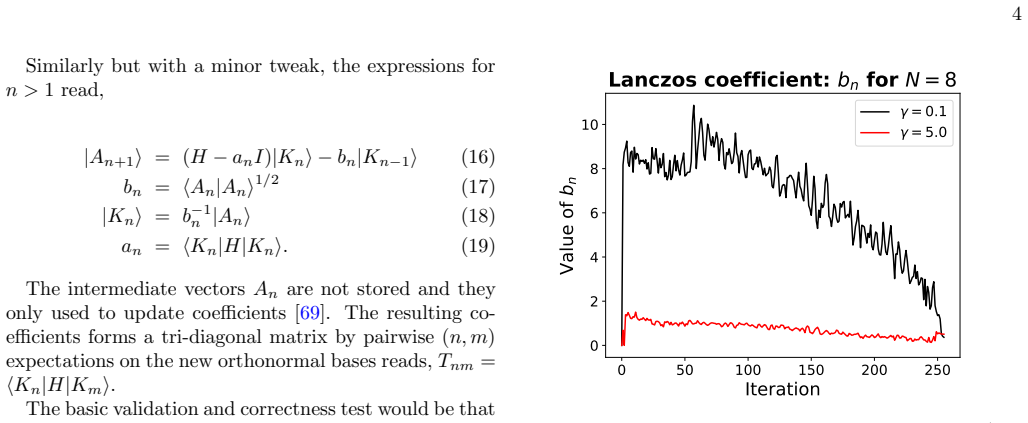
is observed in highly complex regions and then com- plexity remain small for fully integrable regions. The behavior of spread complexity at fast scrambling atγ= 0.1 for 20 realizations are shown in Figure 3. As we have discrete steps, we simply sum the fidelity and spread complexity values and scale withδτ /steps. Lanc- zos coefficientb n trends are shown...
-
[4]
Einstein, B
A. Einstein, B. Podolsky, and N. Rosen, Can quantum- mechanical description of physical reality be considered complete?, Physical Review47, 777 (1935)
1935
-
[5]
J. S. Bell,Speakable and unspeakable in quantum mechan- ics(Cambridge University Press, 2004)
2004
-
[6]
Horodecki, P
R. Horodecki, P. Horodecki, M. Horodecki, and K. Horodecki, Quantum entanglement, Rev. Mod. Phys. 81, 865 (2009)
2009
-
[7]
Susskind and A
L. Susskind and A. Friedman,Quantum mechanics: the theoretical minimum(Penguin, 2015)
2015
-
[8]
W. W. Ho and D. A. Abanin, Entanglement dynamics in quantum many-body systems, Phys. Rev. B95, 094302 (2017)
2017
-
[9]
M. A. Nielsen and I. L. Chuang,Quantum computation and quantum information(Cambridge University Press, 2010)
2010
-
[10]
Hayden and J
P. Hayden and J. Preskill, Black holes as mirrors: quan- tum information in random subsystems, Journal of High Energy Physics2007, 120 (2007)
2007
-
[11]
Sekino and L
Y. Sekino and L. Susskind, Fast scramblers, Journal of High Energy Physics2008, 065 (2008)
2008
-
[12]
J. M. Deutsch, Quantum statistical mechanics in a closed system, Phys. Rev. A43, 2046 (1991)
2046
-
[13]
Srednicki, Chaos and quantum thermalization, Phys- ical Review E50, 888 (1994)
M. Srednicki, Chaos and quantum thermalization, Phys- ical Review E50, 888 (1994)
1994
-
[14]
Srednicki, Thermal fluctuations in quantized chaotic systems, Journal of Physics A: Mathematical and Gen- eral29, L75 (1996)
M. Srednicki, Thermal fluctuations in quantized chaotic systems, Journal of Physics A: Mathematical and Gen- eral29, L75 (1996)
1996
-
[15]
Berry, Quantum chaology, not quantum chaos, Phys- ica Scripta40, 335 (1989)
M. Berry, Quantum chaology, not quantum chaos, Phys- ica Scripta40, 335 (1989)
1989
-
[16]
Nakamura,Quantum chaos: a new paradigm of non- linear dynamics, Vol
K. Nakamura,Quantum chaos: a new paradigm of non- linear dynamics, Vol. 3 (CUP Archive, 1994)
1994
-
[17]
W. H. Zurek and J. P. Paz, Quantum chaos: a decoher- ent definition, Physica D: Nonlinear Phenomena83, 300 (1995)
1995
-
[18]
M. C. Gutzwiller,Chaos in Classical and Quantum Me- chanics(Springer Science & Business Media, 2013)
2013
-
[19]
Potters and J.-P
M. Potters and J.-P. Bouchaud,A first course in random matrix theory(Cambridge University Press, 2020)
2020
-
[20]
E. P. Wigner, On the statistical distribution of the widths and spacings of nuclear resonance levels, Mathematical Proceedings of the Cambridge Philosophical Society47, 790 (1951)
1951
-
[21]
F. J. Dyson, Statistical theory of the spectrum of complex systems, Journal of Mathematical Physics3, 1199 (1962). 6
1962
-
[22]
M. V. Berry, Regular and irregular semiclassical wave- functions, Journal of Physics A: Mathematical and Gen- eral10, 2083 (1977)
2083
-
[23]
Bohigas, M.-J
O. Bohigas, M.-J. Giannoni, and C. Schmit, Charac- terization of chaotic quantum spectra and universality of level fluctuation laws, Physical Review Letters52, 1 (1984)
1984
-
[24]
M. V. Berry and M. Robnik, Semiclassical level spac- ings when regular and chaotic orbits coexist, Journal of Physics A: Mathematical and General17, 2413 (1984)
1984
-
[25]
Maldacena, S
J. Maldacena, S. H. Shenker, and D. Stanford, A bound on chaos, Journal of High Energy Physics2016, 106 (2016)
2016
-
[26]
Cotler, N
J. Cotler, N. Hunter-Jones, J. Liu, and B. Yoshida, Chaos, complexity, and random matrices, Journal of High Energy Physics , 48 (2017)
2017
-
[27]
D. E. Parker, X. Cao, A. Avdoshkin, T. Scaffidi, and E. Altman, A universal operator growth hypothesis, Phys. Rev. X9, 041017 (2019)
2019
-
[28]
Rabinovici, A
E. Rabinovici, A. S´ anchez-Garrido, R. Shir, and J. Son- ner, Krylov complexity from integrability to chaos, Jour- nal of High Energy Physics2022, 151 (2022)
2022
-
[29]
Balasubramanian, P
V. Balasubramanian, P. Caputa, J. M. Magan, and Q. Wu, Quantum chaos and the complexity of spread of states, Phys. Rev. D106, 046007 (2022)
2022
-
[30]
Hashimoto, K
K. Hashimoto, K. Murata, N. Tanahashi, and R. Watan- abe, Krylov complexity and chaos in quantum mechanics, Journal of High Energy Physics2023, 40 (2023)
2023
-
[31]
H. A. Camargo, K.-B. Huh, V. Jahnke, H.-S. Jeong, K.- Y. Kim, and M. Nishida, Spread and spectral complex- ity in quantum spin chains: from integrability to chaos, Journal of High Energy Physics2024, 241 (2024)
2024
-
[32]
Caputa, H.-S
P. Caputa, H.-S. Jeong, S. Liu, J. F. Pedraza, and L.- C. Qu, Krylov complexity of density matrix operators, Journal of High Energy Physics , 337 (2024)
2024
-
[33]
J. B. Kannan, S. PG, S. Paul, S. H. Tekur, and M. S. San- thanam, Probing the localization effects in krylov basis, Phys. Rev. E112, 044203 (2025)
2025
-
[34]
Erdmenger, S.-K
J. Erdmenger, S.-K. Jian, and Z.-Y. Xian, Universal chaotic dynamics from krylov space, Journal of High En- ergy Physics2023, 176 (2023)
2023
-
[35]
Bhattacharjee and P
B. Bhattacharjee and P. Nandy, Krylov fractality and complexity in generic random matrix ensembles, Phys. Rev. B111, L060202 (2025)
2025
-
[36]
Baggioli, K.-B
M. Baggioli, K.-B. Huh, H.-S. Jeong, K.-Y. Kim, and J. F. Pedraza, Krylov complexity as an order parameter for quantum chaotic-integrable transitions, Phys. Rev. Res.7, 023028 (2025)
2025
-
[37]
Seetharaman, C
S. Seetharaman, C. Singh, and R. Nath, Properties of krylov state complexity in qubit dynamics, Phys. Rev. D 111, 076014 (2025)
2025
-
[38]
Craps, O
B. Craps, O. Evnin, and G. Pascuzzi, A relation be- tween krylov and nielsen complexity, Phys. Rev. Lett. 132, 160402 (2024)
2024
-
[39]
Susskind,Three Lectures on Complexity and Black Holes, SpringerBriefs in Physics (Springer International Publishing, 2020)
L. Susskind,Three Lectures on Complexity and Black Holes, SpringerBriefs in Physics (Springer International Publishing, 2020)
2020
-
[40]
L. F. Santos, Integrability of a disordered heisenberg spin-1/2 chain, Journal of Physics A: Mathematical and General37, 4723 (2004)
2004
-
[41]
Gubin and L
A. Gubin and L. F. Santos, Quantum chaos: An introduc- tion via chains of interacting spins 1/2, American Journal of Physics80, 246 (2012)
2012
-
[42]
A. K. Das, C. Cianci, D. G. A. Cabral, D. A. Zarate-Herrada, P. Pinney, S. Pilatowsky-Cameo, A. S. Matsoukas-Roubeas, V. S. Batista, A. del Campo, E. J. Torres-Herrera, and L. F. Santos, Proposal for many- body quantum chaos detection, Phys. Rev. Res.7, 013181 (2025)
2025
-
[43]
Lo Monaco, L
G. Lo Monaco, L. Innocenti, D. Cilluffo, D. A. Chisholm, S. Lorenzo, and G. Massimo Palma, An operational defi- nition of quantum information scrambling, Quantum Sci- ence and Technology10, 015055 (2024)
2024
-
[44]
A. I. Larkin and Y. N. Ovchinnikov, Quasiclassical method in the theory of superconductivity, Soviet Physics JETP28, 1200 (1969)
1969
-
[45]
Swingle, G
B. Swingle, G. Bentsen, M. Schleier-Smith, and P. Hay- den, Measuring the scrambling of quantum information, Phys. Rev. A94, 040302 (2016)
2016
-
[46]
P. G. Wolynes and M. Gruebele, Quantum scrambling across an energy barrier, Proceedings of the National Academy of Sciences120, e2319705120 (2023)
2023
-
[47]
Sahu, Information scrambling in quantum walks: Discrete-time formulation of krylov complexity, Phys
H. Sahu, Information scrambling in quantum walks: Discrete-time formulation of krylov complexity, Phys. Rev. A110, 052405 (2024)
2024
-
[48]
Iyoda and T
E. Iyoda and T. Sagawa, Scrambling of quantum infor- mation in quantum many-body systems, Phys. Rev. A 97, 042330 (2018)
2018
-
[49]
R. J. Lewis-Swan, A. Safavi-Naini, A. M. Kaufman, and A. M. Rey, Dynamics of quantum information, Nature Reviews Physics1, 627 (2019)
2019
-
[50]
B. Yan, L. Cincio, and W. H. Zurek, Information scram- bling and loschmidt echo, Phys. Rev. Lett.124, 160603 (2020)
2020
-
[51]
X. M. et al., Information scrambling in quantum circuits, Science374, 1479 (2021)
2021
-
[52]
Google Quantum AI Team, Observation of constructive interference at the edge of quantum ergodicity, Nature 646, 825 (2025)
2025
-
[53]
M. Y. Abd-Rabbou, A. A. Zahia, A. ur Rahman, and C. Feng Qiao, The limits of quantum information scram- bling, Journal of Physics A: Mathematical and Theoret- ical58, 255301 (2025)
2025
-
[54]
Shekhar and P
D. Shekhar and P. Shukla, Edge of entanglement in nonergodic states: A complexity parameter formulation, Phys. Rev. E112, 024122 (2025)
2025
-
[55]
R. J. Solomonoff, A formal theory of inductive inference, Parts I and II, Information and Control7, 1 (1964)
1964
-
[56]
A. N. Kolmogorov, Three approaches to the quantita- tive definition of information, Problems of Information Transmission1, 1 (1965), english translation: Problems of Information Transmission, 1, 1–7, 1965
1965
-
[57]
G. J. Chaitin, On the length of programs for comput- ing finite binary sequences, Journal of the ACM13, 547 (1966)
1966
-
[58]
W. H. Zurek, Algorithmic randomness and physical en- tropy, Phys. Rev. A40, 4731 (1989)
1989
-
[59]
E. Rabinovici, A. S´ anchez-Garrido, R. Shir, and J. Son- ner, Krylov Complexity, arXiv preprint arXiv:2507.06286 , 90 (2025), 2507.06286 [hep-th]
work page internal anchor Pith review arXiv 2025
-
[60]
Nandy, A
P. Nandy, A. S. Matsoukas-Roubeas, P. Mart´ ınez- Azcona, A. Dymarsky, and A. del Campo, Quantum dynamics in krylov space: Methods and applications, Physics Reports1125-1128, 1 (2025)
2025
-
[61]
Baiguera, V
S. Baiguera, V. Balasubramanian, P. Caputa, S. Chap- man, J. Haferkamp, M. P. Heller, and N. Y. Halpern, Quantum complexity in gravity, quantum field theory, 7 and quantum information science, Physics Reports1159, 1 (2026)
2026
-
[62]
A. C. Davison and D. V. Hinkley,Bootstrap methods and their application, 1 (Cambridge University Press, 1997)
1997
-
[63]
R. J. Tibshirani and B. Efron,An introduction to the bootstrap, Vol. 57 (Chapman and Hall/CRC, 1993) pp. 1–436
1993
-
[64]
Kleiner, A
A. Kleiner, A. Talwalkar, P. Sarkar, and M. I. Jordan, A scalable bootstrap for massive data, Journal of the Royal Statistical Society Series B: Statistical Methodology76, 795 (2014)
2014
-
[65]
Berenstein and G
D. Berenstein and G. Hulsey, Bootstrapping more qm systems, Journal of Physics A: Mathematical and Theo- retical55, 275304 (2022)
2022
-
[66]
S. H. Shenker and D. Stanford, Black holes and the but- terfly effect, Journal of High Energy Physics2014, 67 (2014)
2014
-
[67]
Gharibyan, M
H. Gharibyan, M. Hanada, B. Swingle, and M. Tezuka, Quantum Lyapunov Spectrum, Journal of High Energy Physics2019, 82 (2019)
2019
-
[68]
H. Q. Lin, Exact diagonalization of quantum-spin mod- els, Phys. Rev. B42, 6561 (1990)
1990
-
[69]
Strang,Introduction to linear algebra(SIAM, 2022)
G. Strang,Introduction to linear algebra(SIAM, 2022)
2022
-
[70]
J. J. Sakurai and J. Napolitano,Modern quantum me- chanics(Cambridge University Press, 2020)
2020
-
[71]
Liesen and Z
J. Liesen and Z. Strakoˇ s,Krylov Subspace Methods: Prin- ciples and Analysis, Numerical Mathematics and Sci- entific Computation (Oxford University Press, Oxford, 2012)
2012
-
[72]
C. Lanczos, An iteration method for the solution of the eigenvalue problem of linear differential and integral op- erators, Journal of Research of the National Bureau of Standards45, 255 (1950)
1950
-
[73]
Rosenzweig and C
N. Rosenzweig and C. E. Porter, ”repulsion of energy levels” in complex atomic spectra, Phys. Rev.120, 1698 (1960)
1960
-
[74]
V. E. Kravtsov, I. M. Khaymovich, E. Cuevas, and M. Amini, A random matrix model with localization and ergodic transitions, New Journal of Physics17, 122002 (2015)
2015
-
[75]
P. W. Anderson, Absence of diffusion in certain random lattices, Phys. Rev.109, 1492 (1958)
1958
-
[76]
Lagendijk, B
A. Lagendijk, B. v. Tiggelen, and D. S. Wiersma, Fifty years of Anderson localization, Physics Today62, 24 (2009)
2009
-
[77]
M. Pino, J. Tabanera, and P. Serna, From ergodic to non-ergodic chaos in rosenzweig-porter model, Journal of Physics A: Mathematical and Theoretical52, 475101 (2019)
2019
-
[78]
Jahnke, P
V. Jahnke, P. Nandy, K. Pal, H. A. Camargo, and K.-Y. Kim, Free probability approach to spectral and operator statistics in rosenzweig-porter random matrix ensembles, Journal of High Energy Physics2025, 2 (2025)
2025
-
[79]
Tarzia, Many-body localization transition in hilbert space, Phys
M. Tarzia, Many-body localization transition in hilbert space, Phys. Rev. B102, 014208 (2020)
2020
-
[80]
G. D. Tomasi, M. Amini, S. Bera, I. M. Khaymovich, and V. E. Kravtsov, Survival probability in General- ized Rosenzweig-Porter random matrix ensemble, SciPost Phys.6, 014 (2019)
2019
discussion (0)
Sign in with ORCID, Apple, or X to comment. Anyone can read and Pith papers without signing in.