Recognition: unknown
A Busy Higgs Signal
Pith reviewed 2026-05-10 12:38 UTC · model grok-4.3
The pith
Higher-order Higgs couplings can selectively amplify Higgs-rich final states to become the leading discovery channels for new resonances.
A machine-rendered reading of the paper's core claim, the machinery that carries it, and where it could break.
Core claim
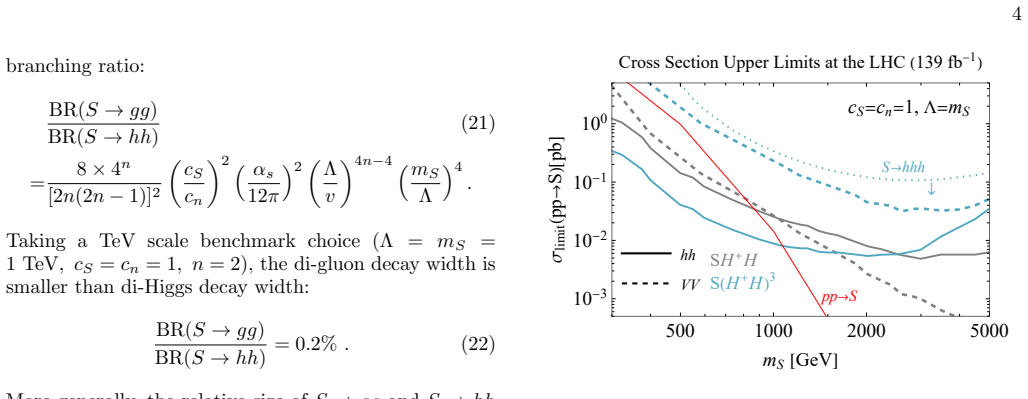
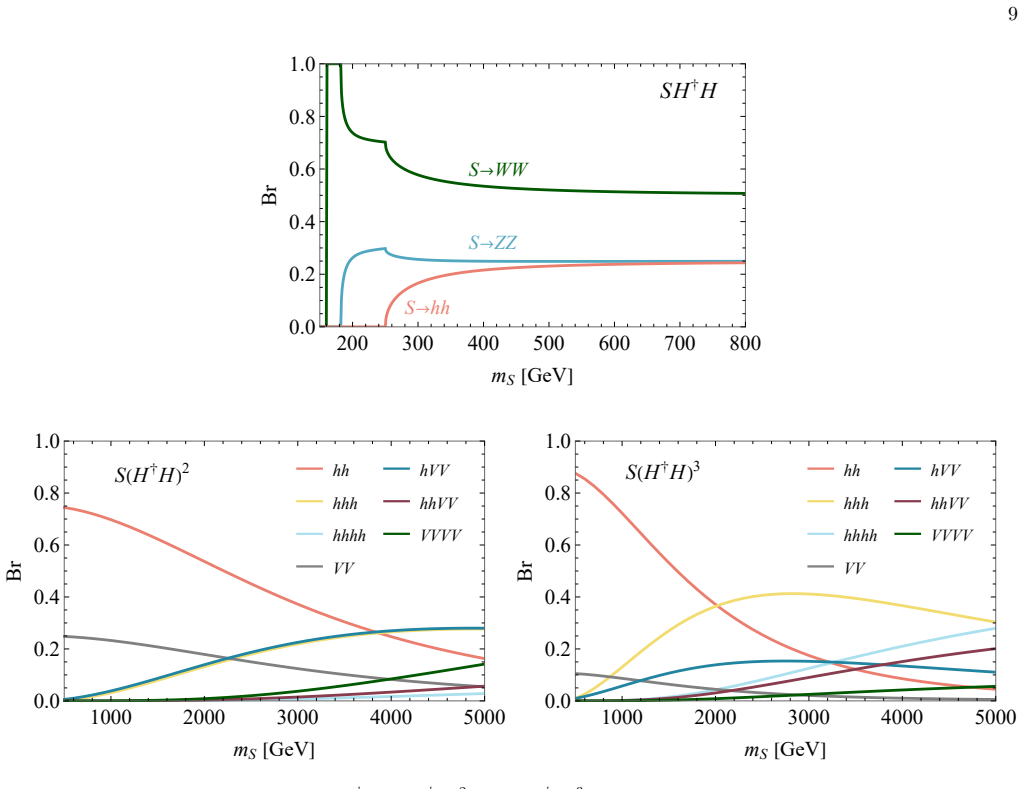
In the conventional picture, SU(2) symmetry together with the Goldstone Equivalence Theorem correlates Higgs and gauge-boson final states, implying comparable sensitivity in channels such as hh, ZZ, and WW for heavy resonances. Higher-order Higgs couplings can induce an electroweak-symmetry-breaking enhancement that selectively amplifies Higgs-rich final states, allowing them to become the leading discovery channels of new resonances. For scalar resonances, this can make di-Higgs the dominant bosonic signal. For resonance masses higher than a couple of TeV, it also opens resonant tri-Higgs and four-Higgs channels as well-motivated search targets. The same underlying mechanism extends toheavy
What carries the argument
The electroweak-symmetry-breaking enhancement induced by higher-order Higgs couplings in an effective field theory, which parametrically violates the usual correlation between Higgs and gauge-boson rates.
If this is right
- For scalar resonances, di-Higgs production becomes the dominant bosonic signal instead of ZZ or WW.
- Resonant tri-Higgs and four-Higgs production open as viable search targets once resonance masses exceed roughly 2 TeV.
- The enhancement applies equally to heavy fermionic resonances, boosting ht final states, and to vector resonances, boosting Zh and γh channels.
- Collider search strategies should be redesigned to prioritize Higgs-rich final states when hunting for these resonances.
Where Pith is reading between the lines
- Existing limits on heavy resonances derived only from gauge-boson channels may need re-interpretation if the enhancement operates.
- Dedicated multi-Higgs resonance searches at the LHC and future colliders could uncover signals missed by conventional analyses.
- The mechanism offers a concrete way to test higher-dimensional Higgs operators through resonance phenomenology.
Load-bearing premise
The higher-order Higgs couplings are large enough and remain inside a valid effective field theory regime without violating unitarity or other constraints at the relevant energies.
What would settle it
Observation of a heavy resonance decaying into gauge bosons at rates matching standard predictions while showing no corresponding excess in di-Higgs or multi-Higgs channels would indicate the enhancement is absent.
Figures






read the original abstract
Higgs final states are prime targets in the search for physics beyond the Standard Model. In the conventional picture, $SU(2)$ symmetry together with the Goldstone Equivalence Theorem correlates Higgs and gauge-boson final states, implying comparable sensitivity in channels such as $hh$, $ZZ$, and $WW$ in searches for heavy resonances. In this work, we identify a mechanism to parametrically violate this expectation. We show that higher-order Higgs couplings can induce an electroweak-symmetry-breaking enhancement that selectively amplifies Higgs-rich final states, allowing them to become the leading discovery channels of new resonances. For scalar resonances, this can make di-Higgs the dominant bosonic signal. For resonance masses higher than a couple of TeV, it also opens resonant tri-Higgs and four-Higgs channels as well-motivated search targets. The same underlying mechanism extends to heavy fermionic and vector resonances, where it can similarly enhance channels such as $ht$, $Zh$, and $\gamma h$. We present this framework in effective field theory, demonstrate possible UV completions, and discuss its implications for collider searches.
Editorial analysis
A structured set of objections, weighed in public.
Referee Report
Summary. The paper claims that higher-order Higgs couplings in an EFT framework can induce an electroweak-symmetry-breaking enhancement that selectively amplifies Higgs-rich final states for heavy resonances, violating the conventional Goldstone Equivalence Theorem expectation of comparable Higgs and gauge-boson sensitivities. For scalar resonances this can make di-Higgs the dominant bosonic decay mode, with resonant tri-Higgs and four-Higgs channels becoming viable above a couple of TeV; the mechanism extends analogously to fermionic and vector resonances (e.g., enhancing ht, Zh, γh). The work presents the EFT construction, possible UV completions, and implications for collider searches.
Significance. If the required parameter regime can be shown to be consistent with unitarity and existing constraints, the result would meaningfully alter BSM resonance search strategies at the LHC and future colliders by elevating multi-Higgs channels over traditional VV modes. The explicit EFT formulation together with UV-completion examples is a positive feature that makes the proposal falsifiable and directly usable for phenomenology.
major comments (2)
- [§3–4] The central claim that O(1) or larger Wilson coefficients for higher-dimensional Higgs operators can produce the selective EWSB enhancement while preserving EFT validity for resonances ≳2 TeV is load-bearing, yet the manuscript does not provide explicit partial-wave unitarity bounds on the multi-Higgs scattering amplitudes in the relevant kinematic regime (see the discussion following Eq. (12) and the parameter-space plots in §4).
- [§5] Existing Higgs and electroweak precision constraints on the same higher-dimensional operators are not quantitatively confronted with the benchmark values needed for di-Higgs dominance; a dedicated scan or exclusion plot is required to demonstrate that the proposed regime remains viable.
minor comments (2)
- [§2] Notation for the higher-dimensional operators is introduced without a compact summary table; adding one would improve readability when comparing to standard Higgs EFT bases.
- [Introduction] The abstract states that the mechanism 'parametrically violates' the GET expectation, but the text does not clarify whether this is a strict parametric violation or a numerical enhancement within a limited energy window.
Simulated Author's Rebuttal
We thank the referee for their careful reading of the manuscript and for the constructive comments, which have helped us clarify the robustness of the proposed mechanism. We address each major comment below and have revised the manuscript to incorporate additional material where needed.
read point-by-point responses
-
Referee: [§3–4] The central claim that O(1) or larger Wilson coefficients for higher-dimensional Higgs operators can produce the selective EWSB enhancement while preserving EFT validity for resonances ≳2 TeV is load-bearing, yet the manuscript does not provide explicit partial-wave unitarity bounds on the multi-Higgs scattering amplitudes in the relevant kinematic regime (see the discussion following Eq. (12) and the parameter-space plots in §4).
Authors: We agree that explicit partial-wave unitarity bounds strengthen the central claim. In the revised manuscript we have added a new subsection (now §4.3) together with Appendix B that computes the leading partial-wave amplitudes for the relevant multi-Higgs channels (hh→hh, hhh→hhh, etc.) in the high-energy limit. For the benchmark values of the Wilson coefficients used in our plots, the s-wave amplitudes remain below the unitarity bound |a_0|<1/2 up to scales well above 3 TeV, confirming that the EFT remains valid in the kinematic regime of the resonances considered. These bounds are shown explicitly as functions of the Wilson coefficients and resonance mass. revision: yes
-
Referee: [§5] Existing Higgs and electroweak precision constraints on the same higher-dimensional operators are not quantitatively confronted with the benchmark values needed for di-Higgs dominance; a dedicated scan or exclusion plot is required to demonstrate that the proposed regime remains viable.
Authors: We thank the referee for this suggestion. The revised manuscript now includes a new figure (Fig. 7) and accompanying text in §5 that overlays the benchmark parameter space required for di-Higgs dominance with the current 95% CL constraints from Higgs signal-strength measurements and electroweak precision observables (using the latest global fits). The scan shows that the O(1) Wilson-coefficient values needed for the selective EWSB enhancement lie comfortably inside the allowed regions. We have also added a short discussion of how future precision data could further test the scenario. revision: yes
Circularity Check
No circularity detected in the EFT mechanism for Higgs-rich resonance signals
full rationale
The paper's derivation introduces higher-order Higgs couplings as an independent EFT effect that parametrically violates the conventional GET correlation between Higgs and gauge-boson channels. This is presented via the structure of the effective Lagrangian without any reduction to self-definitional parameters, fitted inputs renamed as predictions, or load-bearing self-citations. UV completions are shown separately as external support. No steps match the enumerated circularity patterns; the central claim remains a self-contained theoretical possibility rather than a tautology or statistical artifact. This is the expected honest non-finding for a proposal paper whose framework is not derived from its own outputs.
Axiom & Free-Parameter Ledger
free parameters (1)
- coefficients of higher-order Higgs couplings
axioms (1)
- domain assumption Validity of the effective field theory expansion at resonance masses of a few TeV
Reference graph
Works this paper leans on
-
[1]
G. Aadet al.(ATLAS), Phys. Lett. B716, 1 (2012), arXiv:1207.7214 [hep-ex]
work page internal anchor Pith review arXiv 2012
-
[2]
Observation of a new boson at a mass of 125 GeV with the CMS experiment at the LHC
S. Chatrchyanet al.(CMS), Phys. Lett. B716, 30 (2012), arXiv:1207.7235 [hep-ex]
work page Pith review arXiv 2012
- [3]
-
[4]
A. Tumasyanet al.(CMS), Nature607, 60 (2022), [Er- ratum: Nature 623, (2023)], arXiv:2207.00043 [hep-ex]
- [5]
-
[6]
F. Anet al., Chin. Phys. C43, 043002 (2019), arXiv:1810.09037 [hep-ex]
-
[7]
J. Tian and K. Fujii (ILD), PoSEPS-HEP2013, 316 (2013), arXiv:1311.6528 [hep-ph]
-
[8]
T. Barklow, K. Fujii, S. Jung, R. Karl, J. List, T. Ogawa, M. E. Peskin, and J. Tian, Phys. Rev. D97, 053003 (2018), arXiv:1708.08912 [hep-ph]
-
[9]
d’Enterria,Higgs physics at the Future Circular Collider,PoSICHEP2016(2017) 434 [1701.02663]
D. d’Enterria, PoSICHEP2016, 434 (2017), arXiv:1701.02663 [hep-ex]
-
[10]
V. Maura, B. A. Stefanek, and T. You, Phys. Rev. Lett. 135, 141802 (2025), arXiv:2503.13719 [hep-ph]
-
[11]
J. de Blas, J. Gu, and Z. Liu, Phys. Rev. D106, 073007 (2022), arXiv:2203.04324 [hep-ph]
-
[12]
M. Forslund and P. Meade, JHEP08, 185 (2022), arXiv:2203.09425 [hep-ph]
-
[13]
M. Forslund and P. Meade, JHEP01, 182 (2024), arXiv:2308.02633 [hep-ph]
- [14]
-
[15]
S. Di Vita, G. Durieux, C. Grojean, J. Gu, Z. Liu, G. Panico, M. Riembau, and T. Vantalon, JHEP02, 178 (2018), arXiv:1711.03978 [hep-ph]
-
[16]
Higgs Physics at the HL-LHC and HE-LHC
M. Cepedaet al., CERN Yellow Rep. Monogr.7, 221 (2019), arXiv:1902.00134 [hep-ph]
work page Pith review arXiv 2019
-
[17]
J. Alisonet al., Rev. Phys.5, 100045 (2020), arXiv:1910.00012 [hep-ph]
-
[18]
F. Maltoni, G. Ventura, and E. Vryonidou, JHEP12, 183 (2024), arXiv:2406.06670 [hep-ph]
-
[19]
Aadet al.[CMS and ATLAS], [arXiv:2602.23991]
G. Aadet al.(CMS, ATLAS), (2026), arXiv:2602.23991 [hep-ex]
-
[20]
A. Hayrapetyanet al.(CMS), Phys. Rept.1115, 368 (2025), arXiv:2403.16926 [hep-ex]
-
[21]
G. Aadet al.(ATLAS), Phys. Rev. Lett.132, 231801 (2024), arXiv:2311.15956 [hep-ex]
-
[22]
G. Aadet al.(ATLAS), Eur. Phys. J. C80, 1165 (2020), arXiv:2004.14636 [hep-ex]
- [23]
-
[24]
J. A. Aguilar-Saavedra, R. Benbrik, S. Heinemeyer, and M. P´ erez-Victoria, Phys. Rev. D88, 094010 (2013), arXiv:1306.0572 [hep-ph]
work page Pith review arXiv 2013
-
[25]
A First Top Partner Hunter's Guide
A. De Simone, O. Matsedonskyi, R. Rattazzi, and A. Wulzer, JHEP04, 004 (2013), arXiv:1211.5663 [hep- ph]
work page Pith review arXiv 2013
-
[26]
M.-L. Xiao and J.-H. Yu, Phys. Rev. D90, 014007 (2014), [Addendum: Phys.Rev.D 90, 019901 (2014)], arXiv:1404.0681 [hep-ph]
-
[27]
Heavy Vector Triplets: Bridging Theory and Data
D. Pappadopulo, A. Thamm, R. Torre, and A. Wulzer, JHEP09, 060 (2014), arXiv:1402.4431 [hep-ph]
work page Pith review arXiv 2014
-
[28]
O. Antipin, D. Atwood, and A. Soni, Phys. Lett. B666, 155 (2008), arXiv:0711.3175 [hep-ph]
- [29]
- [30]
- [31]
- [32]
-
[33]
A. V. Kotwal, M. J. Ramsey-Musolf, J. M. No, and P. Winslow, Phys. Rev. D94, 035022 (2016), arXiv:1605.06123 [hep-ph]
work page Pith review arXiv 2016
- [34]
-
[35]
Kumar, Phys
R. Kumar, Phys. Rev.185, 1865 (1969)
1969
-
[36]
Aadet al.(ATLAS), JHEP09, 091 (2019), [Erratum: JHEP 06, 042 (2020)], arXiv:1906.08589 [hep-ex]
G. Aadet al.(ATLAS), JHEP09, 091 (2019), [Erratum: JHEP 06, 042 (2020)], arXiv:1906.08589 [hep-ex]
-
[37]
M. Aaboudet al.(ATLAS), Eur. Phys. J. C78, 293 (2018), arXiv:1712.06386 [hep-ex]
-
[38]
A. Tumasyanet al.(CMS), Phys. Lett. B844, 137813 (2023), arXiv:2210.00043 [hep-ex]
- [39]
-
[40]
CMS Collaboration,Search for nonresonant triple Higgs boson production in the six b-quark final state in proton- proton collisions at 13 TeV, Tech. Rep. CMS-PAS-HIG- 24-012 (CERN, 2025)
2025
-
[41]
G. Aadet al.(ATLAS), Phys. Rev. D111, 032006 (2025), arXiv:2411.02040 [hep-ex]
-
[42]
Tumasyanet al.(CMS), JHEP07, 020 (2023), arXiv:2209.07327 [hep-ex]
A. Tumasyanet al.(CMS), JHEP07, 020 (2023), arXiv:2209.07327 [hep-ex]
-
[43]
M. Aaboudet al.(ATLAS), Phys. Rev. Lett.121, 211801 (2018), arXiv:1808.02343 [hep-ex]
-
[44]
Aadet al.(ATLAS), JHEP06, 016 (2023), arXiv:2207.00230 [hep-ex]
G. Aadet al.(ATLAS), JHEP06, 016 (2023), arXiv:2207.00230 [hep-ex]
-
[45]
G. Aadet al.(ATLAS), Phys. Rev. Lett.125, 251802 (2020), arXiv:2008.05928 [hep-ex]
-
[46]
Hayrapetyanet al.(CMS), JHEP02, 089 (2025), arXiv:2411.00202 [hep-ex]
A. Hayrapetyanet al.(CMS), JHEP02, 089 (2025), arXiv:2411.00202 [hep-ex]
-
[47]
Hayrapetyanet al.(CMS), (2025), arXiv:2511.14583 [hep-ex]
A. Hayrapetyanet al.(CMS), (2025), arXiv:2511.14583 [hep-ex]
- [48]
- [49]
- [50]
- [51]
- [52]
-
[53]
G. Buchalla, O. Cata, A. Celis, and C. Krause, Nucl. Phys. B917, 209 (2017), arXiv:1608.03564 [hep-ph]
-
[54]
G. Buchalla, O. Cat` a, and C. Krause, Nucl. Phys. B 880, 552 (2014), [Erratum: Nucl.Phys.B 913, 475–478 (2016)], arXiv:1307.5017 [hep-ph]
- [55]
- [56]
-
[57]
J. Hisano and K. Tsumura, Phys. Rev. D87, 053004 (2013), arXiv:1301.6455 [hep-ph]
-
[58]
C. Alvarado, L. Lehman, and B. Ostdiek, JHEP05, 150 (2014), arXiv:1404.3208 [hep-ph]
-
[59]
S. Dawson and C. W. Murphy, Phys. Rev. D96, 015041 (2017), arXiv:1704.07851 [hep-ph]
-
[60]
C. D. Froggatt and H. B. Nielsen, Nucl. Phys. B147, 277 (1979). 8 Appendix A: Branching Ratio of the Busy Scalar In this section, we present the tree-level branching ratios generated by the busy-scalar operatorS(H †H) n, including final states up to four-body decays. Higher-multiplicity modes can be considered, but form S around the TeV scale, they are mo...
1979
-
[61]
Calculation in Goldstone Basis The relevant interactions follow from L ⊃ cn Λ2n−3 S(H †H) n (A1) = cn 2nΛ2n−3 S " (v+h) 2 + 2X i−0 a2 i #n = cn 2nΛ2n−3 S nX j=0 n j (Σia2 i )j(v+h) 2(n−j) (A2) ⊃ cn 2nΛ2n−3 S 2n 2 h2v2n−2 + 2n 3 h3v2n−3 + 2n 4 h4v2n−4 +· · · +n(Σ ia2 i )v2n−2 + 2n(n−1)(Σ ia2 i )hv2n−3 +n 2n−2 2 (Σia2 i )h2v2n−4 +· · · + n 2 (Σia2 i...
-
[62]
flavoron
Cross-check in Unitary Gauge It is also useful to estimate the amplitudes directly in unitary gauge. In unitary gauge, H= 1√ 2 0 v+h , H †H= (v+h) 2 2 ,(A6) so that L ⊃ cn Λ2n−3 S(H †H) n = cn 2nΛ2n−3 S(v+h) 2n.(A7) Expanding the operator gives L ⊃ cn 2nΛ2n−3 (2n)v2n−1Sh+ 2n 2 v2n−2Sh2 + 2n 3 v2n−3Sh3 +· · · .(A8) 3 One needs to suma 1a1 anda 2a2 partial ...
2000
discussion (0)
Sign in with ORCID, Apple, or X to comment. Anyone can read and Pith papers without signing in.