Recognition: unknown
Scalable quantum error correction tailored for a heavy-hex qubit array
Pith reviewed 2026-05-10 13:10 UTC · model grok-4.3
The pith
A dynamic compass code on heavy-hex hardware cuts logical errors by up to 38.3 percent with noise-informed decoding.
A machine-rendered reading of the paper's core claim, the machinery that carries it, and where it could break.
Core claim
The dynamic compass code is a subsystem code with a novel syndrome extraction cycle that fits the heavy-hex lattice. Implementing a distance-5 instance on a superconducting qubit array and using averaged circuit eigenvalue sampling to obtain context-dependent error rates for every element of the syndrome extraction, together with soft measurement information to detect and post-select out leakage errors, yields up to 38.3 percent improvement in the logical error rate.
What carries the argument
The dynamic compass code, a subsystem code with a novel syndrome extraction cycle for heavy-hex lattices, paired with a decoder that uses context-dependent error rates and soft measurement data.
Load-bearing premise
The error rates obtained from averaged circuit eigenvalue sampling must accurately represent the full syndrome extraction cycle, and post-selection to remove leakage events must not introduce unacceptable bias into the logical error rate figures.
What would settle it
Re-running the identical distance-5 experiment with a standard decoder that assumes uniform error rates and finding that the logical error rate is no higher than the noise-informed result.
Figures



read the original abstract
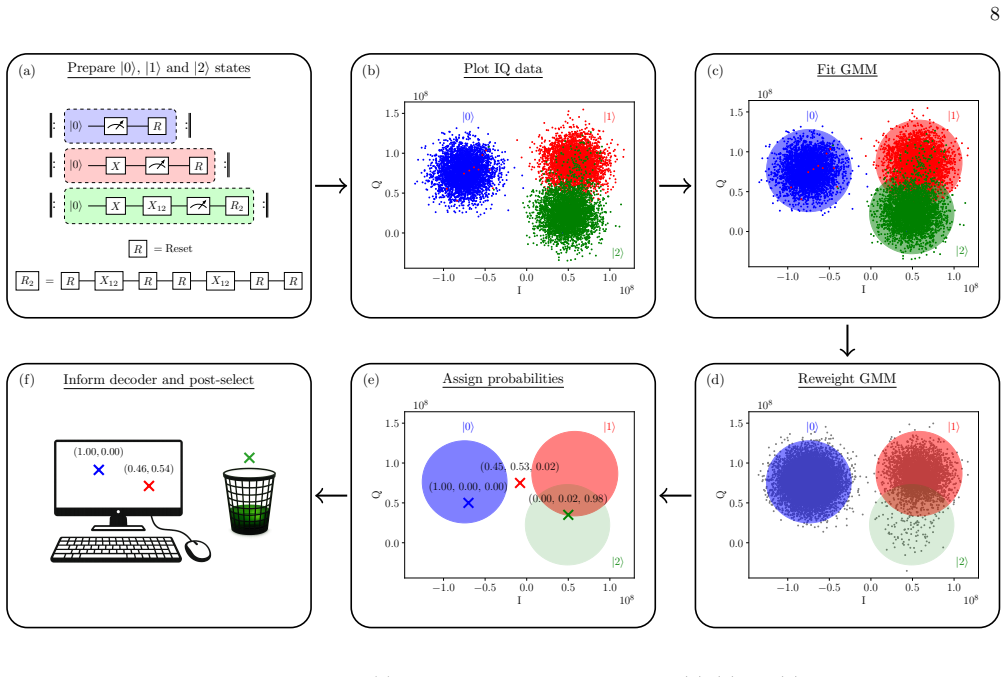
To produce an operable quantum computer that is made with imperfect hardware, we must design and test scalable quantum error correcting codes that are suited for the devices we can build and, in unison, develop decoding strategies that accommodate device-specific noise characteristics. Here, we introduce the \emph{dynamic compass code}, a subsystem code with a novel syndrome extraction cycle, that has a competitive threshold while making efficient use of qubits arranged on a heavy-hex lattice. We use a superconducting qubit array to implement a distance-5 instance of this code, and demonstrate how detailed noise characterisation can boost decoder performance to yield significant improvements in logical error rates. We perform averaged circuit eigenvalue sampling (ACES) to acquire detailed context-dependent error information on all elements of the syndrome extraction process. Furthermore, we leverage soft information produced from measurement devices to augment the decoder with measurement error information and detect leakage errors for exclusion through post-selection. Our noise-informed approach yields up to 38.3\% improvement in the logical error rate of a distance-5 implementation of the dynamic compass code in experiment.
Editorial analysis
A structured set of objections, weighed in public.
Referee Report
Summary. The manuscript introduces the dynamic compass code, a subsystem code with a novel syndrome extraction cycle tailored to heavy-hex lattices. It reports an experimental distance-5 implementation on a superconducting qubit array, using averaged circuit eigenvalue sampling (ACES) to obtain context-dependent error rates for the full syndrome cycle, combined with soft-information leakage detection and post-selection to augment a noise-informed decoder. The central claim is that this approach yields up to 38.3% improvement in logical error rate relative to standard decoding.
Significance. If the experimental results are robust, the work demonstrates that device-specific noise modeling via ACES and leakage-aware post-selection can deliver substantial gains in logical performance for distance-5 codes on real superconducting hardware. This is a meaningful step toward scalable, hardware-tailored QEC, particularly for heavy-hex architectures, and highlights the value of detailed context-dependent error characterization over generic decoders.
major comments (3)
- [Abstract] Abstract: the reported 38.3% logical error rate improvement is presented without error bars, acceptance fractions for the post-selection step, or direct comparison of filtered versus unfiltered logical error rates, leaving open whether the gain reflects operational performance or a conditional metric after leakage exclusion.
- [Experimental results (distance-5 implementation section)] Experimental results (distance-5 implementation section): the assumption that ACES accurately captures joint error statistics across the full syndrome extraction cycle (including gate-measurement-reset correlations) is central to the noise-informed decoder, yet no cross-validation against observed syndrome statistics or syndrome histogram comparisons is described to confirm predictive accuracy.
- [Decoder and post-selection description] Decoder and post-selection description: without quantified acceptance rates or a side-by-side logical error rate comparison on the same dataset with and without leakage post-selection, it is unclear whether the 38.3% figure is load-bearing or could be materially altered by the filtering bias.
minor comments (2)
- Clarify the precise definition of the dynamic compass code's syndrome extraction cycle relative to standard compass or surface-code cycles, including any additional reset or measurement operations.
- Ensure all experimental figures report the number of shots, circuit repetitions, and any statistical uncertainties on the logical error rates.
Simulated Author's Rebuttal
We thank the referee for their constructive comments, which have helped us improve the clarity of our presentation regarding the experimental results and the validation of our noise-informed decoding approach. We address each major comment below and have revised the manuscript accordingly to provide the requested details and comparisons.
read point-by-point responses
-
Referee: [Abstract] Abstract: the reported 38.3% logical error rate improvement is presented without error bars, acceptance fractions for the post-selection step, or direct comparison of filtered versus unfiltered logical error rates, leaving open whether the gain reflects operational performance or a conditional metric after leakage exclusion.
Authors: We agree that the abstract would benefit from greater transparency on these points. The 38.3% figure is the improvement delivered by the complete noise-informed decoder, which incorporates both ACES-derived error rates and leakage post-selection via soft information. In the revised manuscript we have added error bars to the reported improvement, stated the post-selection acceptance fraction, and included a direct side-by-side comparison of logical error rates on the same dataset with and without the leakage-exclusion step. This shows that the gain arises from the combined effect of context-dependent noise modeling and soft-information augmentation rather than filtering alone. revision: yes
-
Referee: [Experimental results (distance-5 implementation section)] Experimental results (distance-5 implementation section): the assumption that ACES accurately captures joint error statistics across the full syndrome extraction cycle (including gate-measurement-reset correlations) is central to the noise-informed decoder, yet no cross-validation against observed syndrome statistics or syndrome histogram comparisons is described to confirm predictive accuracy.
Authors: The referee is correct that explicit validation of the ACES model against experimental syndrome statistics strengthens the claim. Although ACES is constructed to extract context-dependent error rates for the entire syndrome cycle, we did not include a direct comparison of predicted versus observed syndrome histograms in the original submission. We have now added this cross-validation in the revised experimental results section, demonstrating quantitative agreement between the ACES-inferred error model and the measured syndrome distributions. revision: yes
-
Referee: [Decoder and post-selection description] Decoder and post-selection description: without quantified acceptance rates or a side-by-side logical error rate comparison on the same dataset with and without leakage post-selection, it is unclear whether the 38.3% figure is load-bearing or could be materially altered by the filtering bias.
Authors: We acknowledge that the original text did not quantify the acceptance rate or present an explicit with/without comparison for the leakage post-selection step. The 38.3% improvement is obtained with the full pipeline, but to address the concern we have added the measured acceptance fraction and a direct comparison of logical error rates (on identical experimental shots) with and without the post-selection filter in the revised decoder and post-selection description. This clarifies the relative contributions of the noise-informed decoder and the leakage-exclusion step. revision: yes
Circularity Check
No circularity: experimental results from independent hardware measurements and ACES sampling
full rationale
The paper reports an experimental implementation of a distance-5 dynamic compass code on superconducting hardware. The claimed 38.3% logical error rate improvement is obtained directly from measured syndrome statistics after ACES-based noise characterization and soft-information post-selection. No equations, derivations, or predictions are presented that reduce by construction to fitted parameters, self-definitions, or self-citation chains. The central result is an empirical outcome on physical hardware rather than a mathematical reorganization of inputs. Any prior self-citations on code construction or ACES methodology are non-load-bearing for the reported experimental improvement.
Axiom & Free-Parameter Ledger
axioms (1)
- domain assumption The physical qubit array follows heavy-hex lattice connectivity.
Reference graph
Works this paper leans on
-
[1]
M. B. Hastings and J. Haah, Dynamically Generated Logical Qubits, Quantum5, 564 (2021)
2021
-
[2]
C. Gidney and D. Bacon, Less bacon more threshold (2023), arXiv:2305.12046 [quant-ph]
- [3]
-
[4]
Chamberland, G
C. Chamberland, G. Zhu, T. J. Yoder, J. B. Hertzberg, and A. W. Cross, Topological and subsystem codes on low-degree graphs with flag qubits, Phys. Rev. X10, 011022 (2020)
2020
-
[5]
J. Zen, X. C. Kolesnikow, C. K. McLauchlan, G. M. Nixon, T. R. Scruby, S.-H. Lee, S. D. Bartlett, B. J. Brown, and R. Harper, Low-valency scalable quantum error correction with a dynamic compass code (2026), arXiv:2604.xxxxx [quant-ph]
2026
-
[6]
Higgott and C
O. Higgott and C. Gidney, Sparse Blossom: correcting a million errors per core second with minimum-weight matching, Quantum9, 1600 (2025)
2025
-
[7]
Higgott, T
O. Higgott, T. C. Bohdanowicz, A. Kubica, S. T. Flam- mia, and E. T. Campbell, Improved decoding of circuit noise and fragile boundaries of tailored surface codes, Phys. Rev. X13, 031007 (2023)
2023
-
[8]
E. T. Hockings, A. C. Doherty, and R. Harper, Scal- able noise characterization of syndrome-extraction cir- cuits with averaged circuit eigenvalue sampling, PRX Quantum6, 010334 (2025)
2025
- [9]
-
[10]
H. Ali, J. Marques, O. Crawford, J. Majaniemi, M. Serra- Peralta, D. Byfield, B. Varbanov, B. M. Terhal, L. Di- Carlo, and E. T. Campbell, Reducing the error rate of a superconducting logical qubit using analog readout in- formation, Phys. Rev. Appl.22, 044031 (2024)
2024
-
[11]
J. Majaniemi and E. S. Matekole, Reducing quantum error correction overhead using soft information (2025), arXiv:2504.03504 [quant-ph]
-
[12]
Sundaresan, T
N. Sundaresan, T. J. Yoder, Y. Kim, M. Li, E. H. Chen, G. Harper, T. Thorbeck, A. W. Cross, A. D. C´ orcoles, and M. Takita, Demonstrating multi-round subsystem quantum error correction using matching and maximum likelihood decoders, Nature Communications14, 2852 (2023)
2023
- [13]
- [14]
-
[15]
B. M. Varbanov, M. Serra-Peralta, D. Byfield, and B. M. Terhal, Neural network decoder for near-term surface- code experiments, Phys. Rev. Res.7, 013029 (2025)
2025
-
[16]
M. D. Hanisch, B. Het´ enyi, and J. R. Wootton, Soft in- formation decoding with superconducting qubits (2025), arXiv:2411.16228 [quant-ph]
work page internal anchor Pith review arXiv 2025
-
[17]
Neural and Computational Mechanisms Underlying One -Shot Perceptual Learning in Humans
R. Harper, C. Lain´ e, E. Hockings, C. McLauchlan, G. M. Nixon, B. J. Brown, and S. D. Bartlett, Characteris- ing the failure mechanisms of error-corrected quantum logic gates, Nature Communications 10.1038/s41467-026- 71773-6 (2026), arXiv:2504.07258
-
[18]
Bacon, Operator quantum error-correcting subsys- tems for self-correcting quantum memories, Phys
D. Bacon, Operator quantum error-correcting subsys- tems for self-correcting quantum memories, Phys. Rev. A73, 012340 (2006)
2006
-
[19]
Aliferis and A
P. Aliferis and A. W. Cross, Subsystem fault tolerance with the bacon-shor code, Phys. Rev. Lett.98, 220502 (2007)
2007
-
[20]
M. Li, D. Miller, M. Newman, Y. Wu, and K. R. Brown, 2d compass codes, Phys. Rev. X9, 021041 (2019)
2019
-
[21]
E. T. Hockings, QuantumACES.jl: design noise charac- terisation experiments for quantum computers, Journal of Open Source Software10, 7707 (2025)
2025
-
[22]
Bausch, A
J. Bausch, A. W. Senior, F. J. H. Heras, T. Edlich, A. Davies, M. Newman, C. Jones, K. Satzinger, M. Y. Niu, S. Blackwell, G. Holland, D. Kafri, J. Atalaya, C. Gidney, D. Hassabis, S. Boixo, H. Neven, and P. Kohli, Learning high-accuracy error decoding for quantum pro- cessors, Nature635, 834–840 (2024)
2024
-
[23]
Https://quantum.cloud.ibm.com/docs/en/guides/calibration- jobs
-
[24]
K. C. Miaoet al., Overcoming leakage in quantum error correction, Nature Physics19, 1780 (2023)
2023
-
[25]
Lacroix, L
N. Lacroix, L. Hofele, A. Remm, O. Benhayoune- Khadraoui, A. McDonald, R. Shillito, S. Lazar, C. Hellings, F. m. c. Swiadek, D. Colao-Zanuz, A. Flasby, M. B. Panah, M. Kerschbaum, G. J. Norris, A. Blais, A. Wallraff, and S. Krinner, Fast flux-activated leakage reduction for superconducting quantum circuits, Phys. Rev. Lett.134, 120601 (2025)
2025
-
[26]
T. M. Stace, S. D. Barrett, and A. C. Doherty, Thresholds for topological codes in the presence of loss, Phys. Rev. Lett.102, 200501 (2009)
2009
-
[27]
J. M. Auger, H. Anwar, M. Gimeno-Segovia, T. M. Stace, and D. E. Browne, Fault-tolerance thresholds for the surface code with fabrication errors, Phys. Rev. A96, 042316 (2017)
2017
-
[28]
Strikis, S
A. Strikis, S. C. Benjamin, and B. J. Brown, Quantum computing is scalable on a planar array of qubits with fabrication defects (2021)
2021
-
[29]
Siegel, A
A. Siegel, A. Strikis, T. Flatters, and S. Benjamin, Adap- tive surface code for quantum error correction in the presence of temporary or permanent defects, Quantum 7, 1065 (2023)
2023
-
[30]
S. F. Lin, J. Viszlai, K. N. Smith, G. S. Ravi, C. Yuan, F. T. Chong, and B. J. Brown, Codesign of quantum error-correcting codes and modular chiplets in the pres- ence of defects, inProceedings of the 29th ACM Interna- tional Conference on Architectural Support for Program- ming Languages and Operating Systems, Volume 2, AS- PLOS ’24 (Association for Com...
2024
-
[31]
McLauchlan, G
C. McLauchlan, G. P. Geh´ er, and A. E. Moylett, Ac- commodating Fabrication Defects on Floquet Codes with Minimal Hardware Requirements, Quantum8, 1562 (2024). 10
2024
-
[32]
Z. Wei, T. He, Y. Ye, D. Wu, Y. Zhang, Y. Zhao, W. Lin, H.-L. Huang, X. Zhu, and J.-W. Pan, Low-overhead defect-adaptive surface code with bandage-like super- stabilizers, npj Quantum Information11, 75 (2025)
2025
-
[33]
Leroux, S
C. Leroux, S. F. Lin, P. Bienias, K. R. Sankar, A. Ben- hemou, A. Kubica, and J. K. Iverson, Snakes and ladders: Adapting the surface code to defects, PRX Quantum6, 040302 (2025)
2025
-
[34]
D. M. Debroy, M. McEwen, C. Gidney, N. Shutty, and A. Zalcman, LUCI in the Surface Code with Dropouts, Quantum9, 1936 (2025)
1936
-
[35]
S. Wolanski, Automated compilation including dropouts: Tolerating defective components in stabiliser codes (2026), arXiv:2512.01943 [quant-ph]
-
[36]
Adaptive Deformation of Color Code in Square Lattices with Defects
T.-H. Wei, J.-X. Zhang, J.-N. Li, W.-C. Kong, Y.-C. Wu, and G.-P. Guo, Adaptive deformation of color code in square lattices with defects (2026), arXiv:2604.05874 [quant-ph]
work page internal anchor Pith review Pith/arXiv arXiv 2026
-
[37]
Handling fabrication de- fects in hex-grid surface codes
O. Higgott, B. Anker, M. McEwen, and D. M. Debroy, Handling fabrication defects in hex-grid surface codes (2025), arXiv:2508.08116 [quant-ph]
-
[38]
N. T. Bronn, B. Abdo, K. Inoue, S. Lekuch, A. D. C´ orcoles, J. B. Hertzberg, M. Takita, L. S. Bishop, J. M. Gambetta, and J. M. Chow, Fast, high-fidelity readout of multiple qubits, Journal of Physics: Conference Series 834, 012003 (2017)
2017
-
[39]
H. M. Wiseman and R. B. Killip, Adaptive single-shot phase measurements: The full quantum theory, Phys. Rev. A57, 2169 (1998)
1998
-
[40]
T. E. O’Brien, B. Tarasinski, and L. DiCarlo, Density- matrix simulation of small surface codes under current and projected experimental noise, npj Quantum Inf.3, 39 (2017)
2017
-
[41]
Google Quantum AIet al., Exponential suppression of bit or phase errors with cyclic error correction, Nature 595, 383 (2021)
2021
-
[42]
Gidney, Stability Experiments: The Overlooked Dual of Memory Experiments, Quantum6, 786 (2022)
C. Gidney, Stability Experiments: The Overlooked Dual of Memory Experiments, Quantum6, 786 (2022). V. ACKNOWLEDGMENTS We thank Andrew Doherty for useful discussions about the interpretation of IQ data, and we thank the organ- isers of the Quantum Error Correction Workshop 2025 at the Yukawa Institute for Theoretical Physics where the initial ideas for thi...
2022
discussion (0)
Sign in with ORCID, Apple, or X to comment. Anyone can read and Pith papers without signing in.