Recognition: unknown
Cell-Dependent Criticality for Quantum Metrology
Pith reviewed 2026-05-10 12:58 UTC · model grok-4.3
The pith
Fock-space lattices achieve cell-dependent criticality by imprinting the sensing parameter onto a topological zero-energy mode, enabling tunable scaling of quantum Fisher information.
A machine-rendered reading of the paper's core claim, the machinery that carries it, and where it could break.
Core claim
In the two-mode Jaynes-Cummings-type model for Fock-space lattices, bosonic matrix elements make hopping cell-dependent, so the sensing parameter imprints onto a topological zero-energy mode and traces a curve through the topological phase diagram. Cell-dependent criticality occurs when this curve crosses or nears a phase boundary without global lattice tuning. An external control continuously adjusts the curve to tune quantum Fisher information scaling while maintaining wide sensing range and reduced gap cost.
What carries the argument
The Fock-space lattice (FSL) in the two-mode Jaynes-Cummings model, where bosonic ladder-operator matrix elements create cell-dependent hopping, so that the sensing parameter approaches topological phase boundaries locally rather than globally.
If this is right
- Quantum Fisher information scaling is continuously tunable from the standard quantum limit to the Heisenberg limit by an external control that reshapes the parameter curve.
- Broad sensing coverage is retained while the gap cost of criticality is reduced.
- A local photon-number measurement on one cavity saturates the quantum Fisher information.
- Fock-space lattices provide a scalable route to criticality-based quantum metrology that sidesteps homogeneous-lattice bottlenecks.
Where Pith is reading between the lines
- The same cell-dependent mechanism could be tested in superconducting circuit implementations of the Jaynes-Cummings model to check whether the predicted scaling holds under realistic noise.
- If zero modes remain protected, the approach might allow sensing while using the same mode for error suppression in larger bosonic systems.
- Similar inhomogeneity from matrix elements could be engineered in other platforms such as trapped ions to extend the method beyond cavity QED.
Load-bearing premise
The two-mode Jaynes-Cummings-type model accurately captures the Fock-space lattice dynamics and allows the sensing parameter to be imprinted onto the topological zero-energy mode without unaccounted costs or decoherence.
What would settle it
An experiment in which the quantum Fisher information fails to reach the predicted Heisenberg scaling, or in which critical slowing down and a shrinking sensing window persist, would falsify the claimed advantage.
Figures



read the original abstract
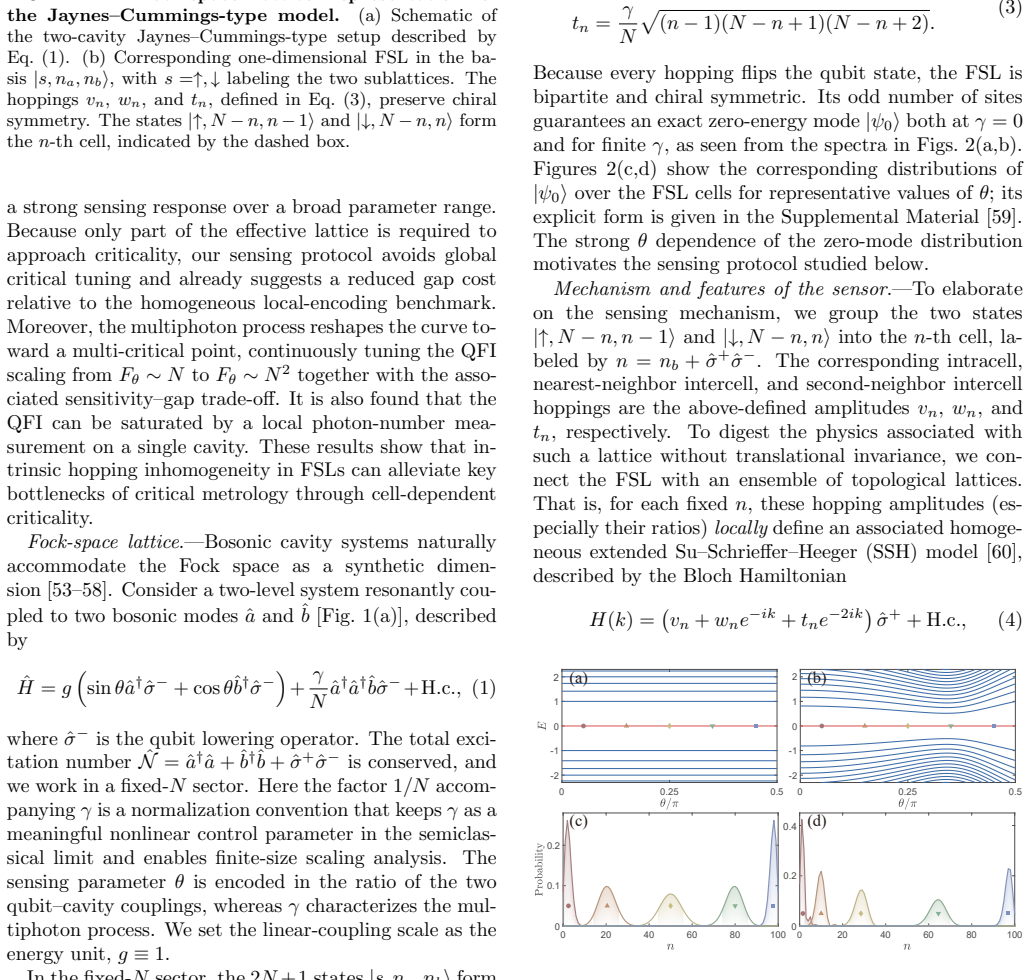
Exploiting enhanced sensitivity of a system in the vicinity of a phase transition boundary, critical quantum metrology to date still suffers from gap-closure related bottleneck effects, namely, critical slowing down of the sensing dynamics and a drastic shrinking of the parameter sensing window. To alleviate the said bottleneck inherent to any homogeneous lattice used for sensing, here we propose to leverage the intrinsic hopping inhomogeneity arising from bosonic ladder-operator matrix elements in Fock-space lattices (FSLs). Specifically, using a two-mode Jaynes--Cummings-type model, we show that the sensing parameter can be imprinted onto a topological zero-energy mode of the FSL. The key system parameters thus become cell dependent, effectively tracing out a curve in a topological phase diagram. Cell-dependent criticality emerges when this curve crosses or approaches a topological phase boundary, without globally tuning the lattice close to criticality. An external control parameter reshapes this curve, continuously tuning the scaling of the quantum Fisher information from the standard to the Heisenberg scaling while maintaining broad sensing coverage and a reduced gap cost. Furthermore, a local photon-number measurement on a single cavity saturates the quantum Fisher information. These results identify FSLs as a scalable and practical route to criticality-based quantum metrology.
Editorial analysis
A structured set of objections, weighed in public.
Referee Report
Summary. The manuscript proposes using Fock-space lattices (FSLs) generated by a two-mode Jaynes-Cummings model to realize cell-dependent criticality for quantum metrology. By exploiting bosonic ladder-operator inhomogeneity, the sensing parameter is imprinted on a topological zero-energy mode, tracing a curve in the phase diagram that approaches the boundary locally. An external control tunes the QFI scaling continuously from standard quantum limit to Heisenberg scaling while preserving a broad sensing window and reduced gap cost; a local photon-number measurement on one cavity is shown to saturate the QFI.
Significance. If the central claims are substantiated, the work would provide a concrete route to mitigate the critical-slowing-down and narrow-window bottlenecks that have limited criticality-enhanced metrology in homogeneous systems. The combination of topological protection, cell-dependent tuning, and local saturation of the QFI could make FSL-based sensors more scalable in cavity-QED platforms, representing a genuine advance over global-tuning approaches.
major comments (2)
- [Model Hamiltonian and FSL construction] The two-mode Jaynes-Cummings Hamiltonian is asserted to map the sensing parameter onto the protected zero-energy mode without extra gap-closing terms or decoherence channels. This mapping is load-bearing for the reduced-gap-cost and Heisenberg-scaling claims, yet the derivation does not explicitly bound the size of neglected higher-order interactions or cavity-loss contributions that would shift the effective curve away from the topological boundary.
- [QFI saturation and measurement section] The statement that a local photon-number measurement saturates the QFI is presented as a key practical advantage. No explicit optimality proof or comparison against the full symmetric logarithmic derivative is supplied, leaving open whether the saturation holds only for the ideal JC matrix elements or survives realistic imperfections.
minor comments (1)
- [Notation and definitions] Notation for the cell index and the control parameter that reshapes the phase-diagram curve should be introduced once and used consistently; several passages reuse symbols without redefinition.
Simulated Author's Rebuttal
We thank the referee for their detailed and constructive report. We address each major comment below and will revise the manuscript to incorporate the suggested improvements.
read point-by-point responses
-
Referee: [Model Hamiltonian and FSL construction] The two-mode Jaynes-Cummings Hamiltonian is asserted to map the sensing parameter onto the protected zero-energy mode without extra gap-closing terms or decoherence channels. This mapping is load-bearing for the reduced-gap-cost and Heisenberg-scaling claims, yet the derivation does not explicitly bound the size of neglected higher-order interactions or cavity-loss contributions that would shift the effective curve away from the topological boundary.
Authors: The referee is correct that the manuscript does not provide explicit bounds on neglected higher-order terms. The two-mode Jaynes-Cummings model is treated under the rotating-wave approximation, which is standard and valid when the coupling strength is much smaller than the cavity and atomic frequencies. To address this, we will add an appendix in the revised manuscript that derives perturbative bounds on counter-rotating terms and provides estimates for cavity-loss rates, showing that they do not close the gap or shift the effective curve away from the topological boundary within the relevant parameter regime. This will strengthen the claims on reduced gap cost and Heisenberg scaling. revision: yes
-
Referee: [QFI saturation and measurement section] The statement that a local photon-number measurement saturates the QFI is presented as a key practical advantage. No explicit optimality proof or comparison against the full symmetric logarithmic derivative is supplied, leaving open whether the saturation holds only for the ideal JC matrix elements or survives realistic imperfections.
Authors: We acknowledge that the manuscript demonstrates saturation numerically for the ideal case but lacks an explicit optimality proof against the symmetric logarithmic derivative (SLD) and analysis of imperfections. In the revised version, we will include an analytical comparison showing that the local photon-number measurement achieves the QFI bound for this model, together with numerical simulations under realistic cavity losses and dephasing to confirm robustness. This will substantiate the practical advantage while clarifying the conditions under which saturation holds. revision: yes
Circularity Check
No significant circularity; derivation introduces independent model-based mechanism
full rationale
The paper's central derivation starts from the standard two-mode Jaynes-Cummings Hamiltonian applied to Fock-space lattices, uses the bosonic ladder-operator matrix elements to generate cell-dependent parameters, and then maps those parameters onto a topological phase diagram to obtain cell-dependent criticality and tunable QFI scaling. None of these steps reduce to a self-definition, a fitted parameter renamed as a prediction, or a load-bearing self-citation; the topological zero-mode imprinting and local-measurement saturation follow directly from the model's spectrum and the definition of the quantum Fisher information within the same Hamiltonian. The proposal therefore remains self-contained against external benchmarks and does not rely on any of the enumerated circular patterns.
Axiom & Free-Parameter Ledger
Reference graph
Works this paper leans on
-
[1]
Pezze, A
L. Pezze, A. Smerzi, M. K. Oberthaler, R. Schmied, and P. Treutlein, Quantum metrology with nonclassical states of atomic ensembles, Reviews of Modern Physics 90, 035005 (2018)
2018
-
[2]
Braun, G
D. Braun, G. Adesso, F. Benatti, R. Floreanini, U. Mar- zolino, M. W. Mitchell, and S. Pirandola, Quantum- enhanced measurements without entanglement, Reviews of Modern Physics90, 035006 (2018)
2018
-
[3]
Montenegro, C
V. Montenegro, C. Mukhopadhyay, R. Yousefjani, S. Sarkar, U. Mishra, M. G. Paris, and A. Bayat, Quan- tum metrology and sensing with many-body systems, Physics Reports1134, 1 (2025)
2025
-
[4]
Ye and P
J. Ye and P. Zoller, Essay: Quantum sensing with atomic, molecular, and optical platforms for fundamental physics, Physical Review Letters132, 190001 (2024)
2024
-
[5]
D. J. Wineland, J. J. Bollinger, W. M. Itano, F. Moore, and D. J. Heinzen, Spin squeezing and reduced quan- tum noise in spectroscopy, Physical Review A46, R6797 (1992)
1992
-
[6]
Kitagawa and M
M. Kitagawa and M. Ueda, Squeezed spin states, Physical Review A47, 5138 (1993)
1993
-
[7]
H. Lee, P. Kok, and J. P. Dowling, A quantum Rosetta stone for interferometry, Journal of Modern Optics49, 2325 (2002)
2002
-
[8]
Giovannetti, S
V. Giovannetti, S. Lloyd, and L. Maccone, Quantum- enhanced measurements: beating the standard quantum limit, Science306, 1330 (2004)
2004
-
[9]
J. Ma, X. Wang, C.-P. Sun, and F. Nori, Quantum spin squeezing, Physics Reports509, 89 (2011)
2011
-
[10]
J. Ma, J. Zhou, J. Huang, and C. Lee, Phase am- plification via synthetic two-axis-twisting echo from interaction-fixed one-axis twisting, Physical Review A 110, 022407 (2024)
2024
-
[11]
S. F. Huelga, C. Macchiavello, T. Pellizzari, A. K. Ekert, M. B. Plenio, and J. I. Cirac, Improvement of frequency standards with quantum entanglement, Physical Review Letters79, 3865 (1997)
1997
-
[12]
Ko lody´ nski and R
J. Ko lody´ nski and R. Demkowicz-Dobrza´ nski, Phase esti- mation without a priori phase knowledge in the presence of loss, Physical Review A—Atomic, Molecular, and Op- tical Physics82, 053804 (2010)
2010
-
[13]
Escher, R
B. Escher, R. L. de Matos Filho, and L. Davidovich, Gen- eral framework for estimating the ultimate precision limit in noisy quantum-enhanced metrology, Nature Physics7, 406 (2011)
2011
-
[14]
Chaves, J
R. Chaves, J. Brask, M. Markiewicz, J. Ko lody´ nski, and A. Ac´ ın, Noisy metrology beyond the standard quantum limit, Physical Review Letters111, 120401 (2013)
2013
-
[15]
J. Ma, Y. Shen, J. Huang, and C. Lee, Quantum metrol- ogy via Floquet-engineered two-axis twisting and turning dynamics, Physical Review A112, L040602 (2025)
2025
-
[16]
Campos Venuti and P
L. Campos Venuti and P. Zanardi, Quantum critical scal- ing of the geometric tensors, Physical Review Letters99, 095701 (2007)
2007
-
[17]
Zanardi, P
P. Zanardi, P. Giorda, and M. Cozzini, Information- theoretic differential geometry of quantum phase tran- sitions, Physical Review Letters99, 100603 (2007)
2007
-
[18]
Zanardi, M
P. Zanardi, M. G. Paris, and L. Campos Venuti, Quan- tum criticality as a resource for quantum estimation, Physical Review A—Atomic, Molecular, and Optical Physics78, 042105 (2008)
2008
-
[19]
Raghunandan, J
M. Raghunandan, J. Wrachtrup, and H. Weimer, High- density quantum sensing with dissipative first order tran- sitions, Physical Review Letters120, 150501 (2018)
2018
-
[20]
Yang and Z
L.-P. Yang and Z. Jacob, Quantum critical detector: am- plifying weak signals using discontinuous quantum phase transitions, Optics express27, 10482 (2019)
2019
-
[21]
Yang and Z
L.-P. Yang and Z. Jacob, Engineering first-order quantum phase transitions for weak signal detection, Journal of Applied Physics126(2019)
2019
-
[22]
Zanardi and N
P. Zanardi and N. Paunkovi´ c, Ground state over- lap and quantum phase transitions, Physical Review E—Statistical, Nonlinear, and Soft Matter Physics74, 031123 (2006)
2006
-
[23]
Zanardi, H
P. Zanardi, H. Quan, X. Wang, and C. Sun, Mixed- state fidelity and quantum criticality at finite temper- ature, Physical Review A—Atomic, Molecular, and Op- tical Physics75, 032109 (2007)
2007
-
[24]
Gu, H.-M
S.-J. Gu, H.-M. Kwok, W.-Q. Ning, and H.-Q. Lin, Fi- delity susceptibility, scaling, and universality in quan- tum critical phenomena, Physical Review B—Condensed Matter and Materials Physics77, 245109 (2008)
2008
-
[25]
Gammelmark and K
S. Gammelmark and K. Mølmer, Phase transitions and Heisenberg limited metrology in an Ising chain inter- acting with a single-mode cavity field, New Journal of Physics13, 053035 (2011)
2011
-
[26]
Skotiniotis, P
M. Skotiniotis, P. Sekatski, and W. D¨ ur, Quantum metrology for the Ising Hamiltonian with transverse mag- netic field, New Journal of Physics17, 073032 (2015)
2015
-
[27]
Y. Chu, S. Zhang, B. Yu, and J. Cai, Dynamic frame- work for criticality-enhanced quantum sensing, Physical Review Letters126, 010502 (2021)
2021
-
[28]
Montenegro, U
V. Montenegro, U. Mishra, and A. Bayat, Global sens- ing and its impact for quantum many-body probes with criticality, Physical Review Letters126, 200501 (2021)
2021
-
[29]
Di Candia, F
R. Di Candia, F. Minganti, K. Petrovnin, G. S. Paraoanu, and S. Felicetti, Critical parametric quantum sensing, npj Quantum Information9, 23 (2023)
2023
-
[30]
X. He, R. Yousefjani, and A. Bayat, Stark localization as a resource for weak-field sensing with super-Heisenberg precision, Physical Review Letters131, 010801 (2023)
2023
-
[31]
Sahoo, U
A. Sahoo, U. Mishra, and D. Rakshit, Localization-driven quantum sensing, Physical Review A109, L030601 (2024)
2024
-
[32]
Yousefjani, X
R. Yousefjani, X. He, A. Carollo, and A. Bayat, Nonlinearity-enhanced quantum sensing in Stark probes, Physical Review Applied23, 014019 (2025)
2025
-
[33]
Sahoo and D
A. Sahoo and D. Rakshit, Enhanced sensing of a weak Stark field under the influence of Aubry-Andr´ e-Harper criticality, Physical Review A113, 022601 (2026)
2026
-
[34]
Sarkar, C
S. Sarkar, C. Mukhopadhyay, A. Alase, and A. Bayat, Free-fermionic topological quantum sensors, Physical Re- view Letters129, 090503 (2022)
2022
-
[35]
Mukhopadhyay and A
C. Mukhopadhyay and A. Bayat, Modular many-body quantum sensors, Physical Review Letters133, 120601 (2024)
2024
- [36]
-
[37]
M. Yu, P. Yang, M. Gong, Q. Cao, Q. Lu, H. Liu, S. Zhang, M. B. Plenio, F. Jelezko, T. Ozawa,et al., Ex- perimental measurement of the quantum geometric ten- sor using coupled qubits in diamond, National science review7, 254 (2020)
2020
-
[38]
R. Liu, Y. Chen, M. Jiang, X. Yang, Z. Wu, Y. Li, H. Yuan, X. Peng, and J. Du, Experimental critical quan- tum metrology with the Heisenberg scaling, npj Quan- tum Information7, 170 (2021). 7
2021
-
[39]
Ding, Z.-K
D.-S. Ding, Z.-K. Liu, B.-S. Shi, G.-C. Guo, K. Mølmer, and C. S. Adams, Enhanced metrology at the critical point of a many-body Rydberg atomic system, Nature Physics18, 1447 (2022)
2022
-
[40]
M. Yu, X. Li, Y. Chu, B. Mera, F. N. ¨Unal, P. Yang, Y. Liu, N. Goldman, and J. Cai, Experimental demon- stration of topological bounds in quantum metrology, Na- tional Science Review11, nwae065 (2024)
2024
-
[41]
Ilias, D
T. Ilias, D. Yang, S. F. Huelga, and M. B. Plenio, Criticality-enhanced electric field gradient sensor with single trapped ions, npj Quantum Information10, 36 (2024)
2024
- [42]
-
[43]
Beaulieu, F
G. Beaulieu, F. Minganti, S. Frasca, M. Scigliuzzo, S. Felicetti, R. Di Candia, and P. Scarlino, Criticality- enhanced quantum sensing with a parametric supercon- ducting resonator, PRX Quantum6, 020301 (2025)
2025
-
[44]
J.-H. L¨ u, W. Ning, F. Wu, R.-H. Zheng, K. Chen, X. Zhu, Z.-B. Yang, H.-Z. Wu, and S.-B. Zheng, Critical quantum metrology robust against dissipation and nonadiabatic- ity, Science Advances12, eady2358 (2026)
2026
-
[45]
S. L. Braunstein and C. M. Caves, Statistical distance and the geometry of quantum states, Physical Review Letters72, 3439 (1994)
1994
-
[46]
Cram´ er,Mathematical methods of statistics, Vol
H. Cram´ er,Mathematical methods of statistics, Vol. 9 (Princeton university press, 1999)
1999
-
[47]
M. M. Rams, P. Sierant, O. Dutta, P. Horodecki, and J. Zakrzewski, At the limits of criticality-based quantum metrology: Apparent super-Heisenberg scaling revisited, Physical Review X8, 021022 (2018)
2018
-
[48]
Sachdev, Quantum phase transitions, Physics world 12, 33 (1999)
S. Sachdev, Quantum phase transitions, Physics world 12, 33 (1999)
1999
-
[49]
Dziarmaga, Dynamics of a quantum phase transition and relaxation to a steady state, Advances in Physics59, 1063 (2010)
J. Dziarmaga, Dynamics of a quantum phase transition and relaxation to a steady state, Advances in Physics59, 1063 (2010)
2010
-
[50]
Polkovnikov, K
A. Polkovnikov, K. Sengupta, A. Silva, and M. Vengalat- tore, Colloquium: Nonequilibrium dynamics of closed in- teracting quantum systems, Reviews of Modern Physics 83, 863 (2011)
2011
-
[51]
H. Xu, T. Xiao, J. Huang, M. He, J. Fan, and G. Zeng, Toward Heisenberg limit without critical slowing down via quantum reinforcement learning, Physical Review Letters134, 120803 (2025)
2025
-
[52]
G. Mihailescu and K. Gietka, Anti-critical quantum metrology, arXiv preprint arXiv:2602.03675 (2026)
-
[53]
Cai and D.-W
H. Cai and D.-W. Wang, Topological phases of quantized light, National science review8, nwaa196 (2021)
2021
-
[54]
J.-S. Pan, L. Li, and J. Gong, Point-gap topology with complete bulk-boundary correspondence and anomalous amplification in the Fock space of dissipative quantum systems, Physical Review B103, 205425 (2021)
2021
-
[55]
J. Deng, H. Dong, C. Zhang, Y. Wu, J. Yuan, X. Zhu, F. Jin, H. Li, Z. Wang, H. Cai,et al., Observing the quantum topology of light, Science378, 966 (2022)
2022
-
[56]
J. Yuan, J. Deng, X. Wei, and D.-W. Wang, Quantum phase transitions in driven Fock-state lattices with syn- thetic gauge fields, Physical Review Research7, 043191 (2025)
2025
-
[57]
Zhang, W
J. Zhang, W. Huang, J. Chu, J. Qiu, X. Sun, Z. Tao, J. Zhang, L. Zhang, Y. Zhou, Y. Chen,et al., Synthetic multidimensional Aharonov-Bohm cages in Fock state lattices, Physical Review Letters134, 070601 (2025)
2025
- [58]
-
[59]
See Supplemental Material for details on the zero-energy mode wavefunction, the analytic resultF θ = 4Nin the linear limit, further discussion of the sensing cov- erage, the circuit-QED implementation scheme, and the proof that local photon-number measurement saturates the quantum Fisher information
-
[60]
W.-P. Su, J. R. Schrieffer, and A. J. Heeger, Solitons in polyacetylene, Physical Review Letters42, 1698 (1979)
1979
-
[61]
S. Ryu, A. P. Schnyder, A. Furusaki, and A. W. Ludwig, Topological insulators and superconductors: tenfold way and dimensional hierarchy, New Journal of Physics12, 065010 (2010)
2010
-
[62]
C.-K. Chiu, J. C. Teo, A. P. Schnyder, and S. Ryu, Classi- fication of topological quantum matter with symmetries, Reviews of Modern Physics88, 035005 (2016)
2016
-
[63]
Cheng, Y.-C
J.-M. Cheng, Y.-C. Zhang, X.-F. Zhou, and Z.-W. Zhou, Super-Heisenberg scaling in a triple-point criticality, Physical Review Letters134, 190802 (2025)
2025
-
[64]
M. G. Paris, Quantum estimation for quantum technol- ogy, International Journal of Quantum Information7, 125 (2009)
2009
-
[65]
You, Y.-W
W.-L. You, Y.-W. Li, and S.-J. Gu, Fidelity, dynamic structure factor, and susceptibility in critical phenom- ena, Physical Review E—Statistical, Nonlinear, and Soft Matter Physics76, 022101 (2007)
2007
-
[66]
X. Deng, S. Li, Z.-J. Chen, Z. Ni, Y. Cai, J. Mai, L. Zhang, P. Zheng, H. Yu, C.-L. Zou,et al., Quantum- enhanced metrology with large Fock states, Nature Physics20, 1874 (2024)
2024
- [67]
- [68]
-
[69]
Zhao, Y.-L
Y.-J. Zhao, Y.-L. Liu, Y.-x. Liu, and F. Nori, Generat- ing nonclassical photon states via longitudinal couplings between superconducting qubits and microwave fields, Physical Review A91, 053820 (2015)
2015
-
[70]
Y.-J. Zhao, C. Wang, X. Zhu, and Y.-x. Liu, Engineering entangled microwave photon states through multiphoton interactions between two cavity fields and a supercon- ducting qubit, Scientific Reports6, 23646 (2016)
2016
-
[71]
D. I. Schuster, A. A. Houck, J. Schreier, A. Wallraff, J. M. Gambetta, A. Blais, L. Frunzio, J. Majer, B. Johnson, M. H. Devoret,et al., Resolving photon number states in a superconducting circuit, Nature445, 515 (2007)
2007
-
[72]
Cell-Dependent Criticality for Quantum Metrology
Y. Lu, M. Kudra, T. Hillmann, J. Yang, H.-X. Li, F. Qui- jandr´ ıa, and P. Delsing, Resolving Fock states near the kerr-free point of a superconducting resonator, npj Quan- tum Information9, 114 (2023). 8 Supplementary Material for “Cell-Dependent Criticality for Quantum Metrology” CONTENTS References 5 I. Derivation of the topological zero-energy mode 8 ...
2023
discussion (0)
Sign in with ORCID, Apple, or X to comment. Anyone can read and Pith papers without signing in.