Recognition: unknown
Logarithmic EW corrections at two-loop
Pith reviewed 2026-05-10 12:30 UTC · model grok-4.3
The pith
Two-loop electroweak virtual corrections at next-to-leading logarithmic accuracy are now implemented for automated computation.
A machine-rendered reading of the paper's core claim, the machinery that carries it, and where it could break.
Core claim
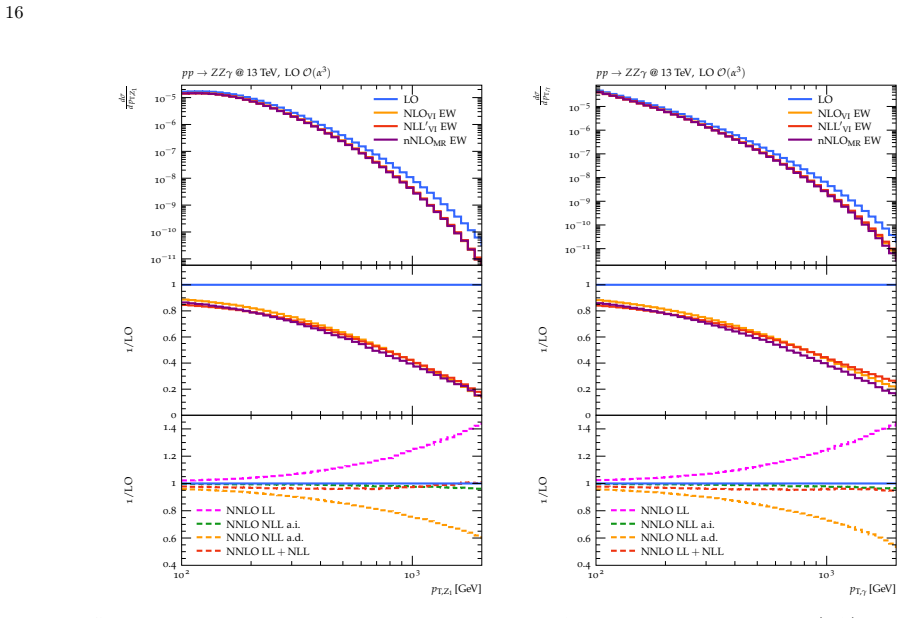
The central claim is that next-to-next-to-leading order electroweak virtual corrections can be computed at next-to-leading logarithmic accuracy in an automated manner for the specified class of processes. This has been validated against analytical results from the literature, and phenomenological results show the impact on high-energy processes by reducing uncertainties from unknown higher orders.
What carries the argument
The automated implementation of two-loop next-to-leading logarithmic electroweak virtual corrections for processes with massless fermions and transversely polarised vector bosons.
If this is right
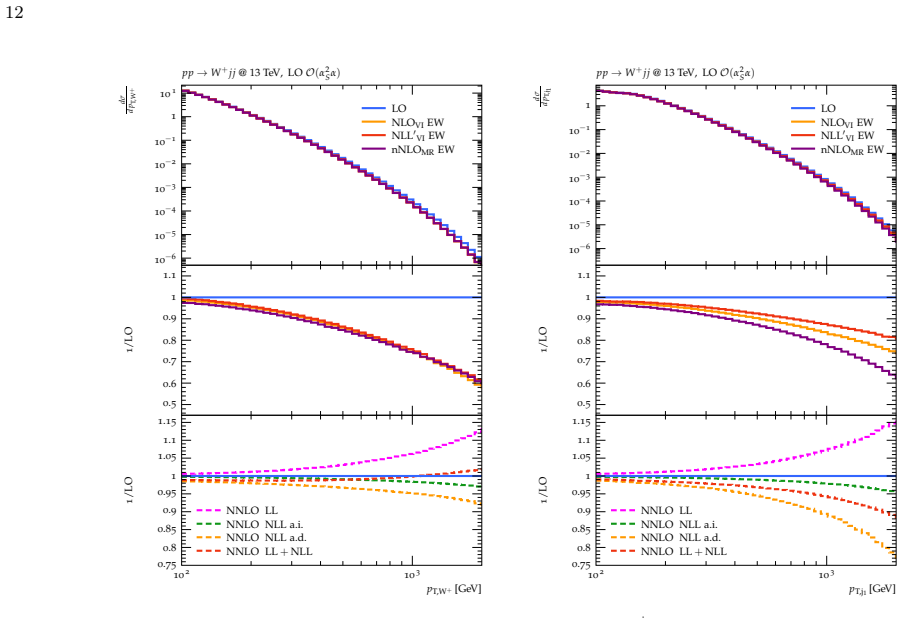
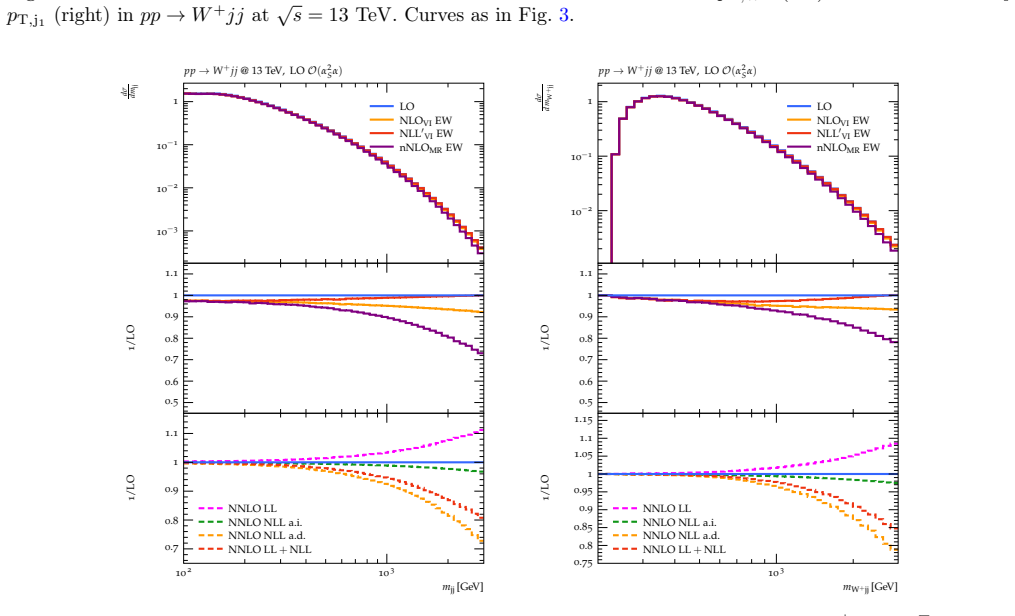
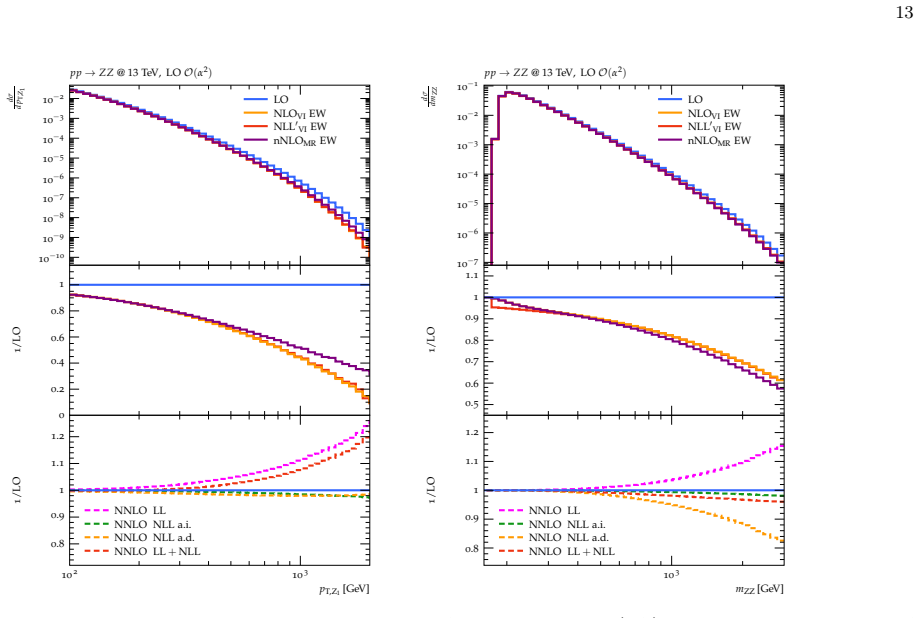
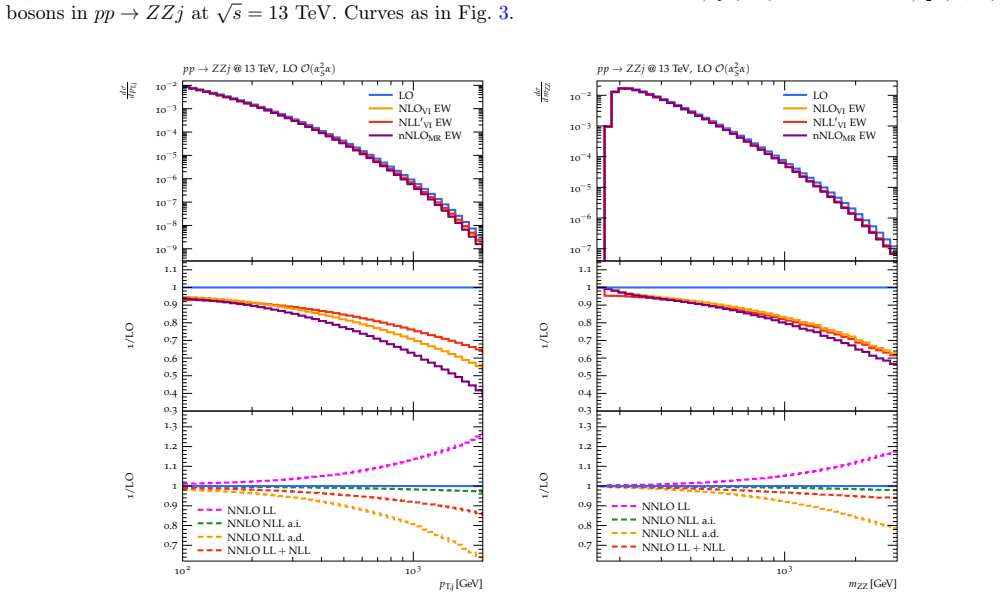
- Logarithmic electroweak corrections reach several percent in the high-energy tails of kinematic distributions.
- Theoretical uncertainties from missing higher-order contributions are reduced.
- The method applies to processes involving massless fermions and transversely polarised vector bosons.
- Validation against analytical results confirms the accuracy of the implementation.
Where Pith is reading between the lines
- Future work could extend this to higher logarithmic orders or additional process classes.
- Improved precision may aid in identifying potential new physics effects in extreme kinematic regions.
- The logarithmic structure could inform resummation techniques for even higher accuracy.
Load-bearing premise
The implementation accurately captures the next-to-leading logarithmic terms at two-loop order without missing significant contributions for the covered processes.
What would settle it
A calculation of the full two-loop electroweak corrections for a specific process at high energy that deviates substantially from the NLL result would falsify the sufficiency of the approximation.
Figures




read the original abstract
We present the implementation of next-to-next-to-leading order (NNLO) electroweak (EW) virtual corrections at next-to-leading logarithmic (NLL) accuracy in the amplitude generator OpenLoops. The implementation covers the automated computation of processes involving massless fermions and transversely polarised vector bosons. For energies above the EW scale, logarithmic EW corrections are strongly enhanced in the tails of kinematic distributions of key LHC processes, reaching several tens of percent at NLO and several percent at NNLO. The two-loop implementation is validated against analytical results from the literature. We present phenomenological results for representative LHC processes and discuss the role of two-loop EW corrections in reducing theoretical uncertainties from missing higher-order contributions.
Editorial analysis
A structured set of objections, weighed in public.
Referee Report
Summary. The manuscript presents the implementation of NNLO electroweak virtual corrections at NLL accuracy within the OpenLoops amplitude generator. The scope is restricted to processes involving massless fermions and transversely polarised vector bosons. The two-loop implementation is validated against existing analytical results in the literature, and phenomenological applications to representative LHC processes are provided to illustrate the impact on theoretical uncertainties.
Significance. If correct, the automated NLL-accurate NNLO EW implementation supplies a practical tool for evaluating the dominant high-energy logarithmic corrections that reach several percent in LHC tails. Explicit validation against analytical literature results is a clear strength, as is the restriction to a well-defined process class that avoids mass and longitudinal-polarization complications. This work directly supports efforts to reduce missing-higher-order uncertainties in precision phenomenology.
minor comments (2)
- [Abstract] Abstract: the statement that corrections reach 'several percent at NNLO' would be more informative if accompanied by a brief indication of the energy scale or process class for which this estimate holds.
- [Validation section] Validation discussion: while agreement with analytical results is stated, a compact table or set of relative-difference values for the tested amplitudes would make the numerical precision of the NLL implementation immediately verifiable.
Simulated Author's Rebuttal
We thank the referee for the positive assessment of our manuscript, the clear summary of its scope and strengths, and the recommendation for minor revision. We note that the report does not list any specific major comments.
Circularity Check
No significant circularity in the derivation or validation chain
full rationale
The paper presents an implementation of NNLO electroweak virtual corrections at NLL accuracy in OpenLoops for massless fermions and transversely polarized vector bosons. The central claim rests on automated computation of logarithmic terms and validation against external analytical results from the literature. No equations, predictions, or results are shown to reduce by construction to quantities defined via the authors' own prior fits, self-definitions, or load-bearing self-citations. The restricted process class and external validation benchmarks ensure the derivation chain is self-contained and independent of internal circular reductions.
Axiom & Free-Parameter Ledger
axioms (1)
- domain assumption Perturbative expansion of electroweak corrections remains valid and logarithmically enhanced at LHC energies above the electroweak scale.
Reference graph
Works this paper leans on
- [1]
- [2]
-
[3]
A. Denner and S. Pozzorini,One loop leading logarithms in electroweak radiative corrections. 1. Results, Eur. Phys. J. C18(2001) 461–480, [hep-ph/0010201]
-
[4]
A. Denner and S. Pozzorini,One loop leading logarithms in electroweak radiative corrections. 2. Factorization of collinear singularities,Eur. Phys. J. C21(2001) 63–79, [hep-ph/0104127]
-
[5]
M. Ciafaloni, P. Ciafaloni, and D. Comelli, Bloch-Nordsieck violating electroweak corrections to inclusive TeV scale hard processes,Phys. Rev. Lett. 84(2000) 4810–4813, [hep-ph/0001142]
-
[6]
Baur,Weak Boson Emission in Hadron Collider Processes,Phys
U. Baur,Weak Boson Emission in Hadron Collider Processes,Phys. Rev. D75(2007) 013005, [hep-ph/0611241]
-
[7]
K. Mishra et al.,Electroweak Corrections at High Energies, inSnowmass 2013: Snowmass on the Mississippi, 8, 2013. arXiv:1308.1430
-
[8]
Pozzorini,Electroweak radiative corrections at high-energies, other thesis, 2001
S. Pozzorini,Electroweak radiative corrections at high-energies, other thesis, 2001
2001
- [9]
-
[10]
E. Bothmann and D. Napoletano,Automated evaluation of electroweak Sudakov logarithms in Sherpa, Eur. Phys. J. C80(2020), no. 11 1024, [arXiv:2006.14635]
-
[11]
D. Pagani and M. Zaro,One-loop electroweak Sudakov logarithms: a revisitation and automation, JHEP02(2022) 161, [arXiv:2110.03714]
- [12]
-
[13]
Mai,Approximate and semi-numerical one-loop corrections for precision LHC phenomenology,PhD thesisSussex U(2024)
L. Mai,Approximate and semi-numerical one-loop corrections for precision LHC phenomenology,PhD thesisSussex U(2024)
2024
- [14]
-
[15]
H. El Faham, K. Mimasu, D. Pagani, C. Severi, E. Vryonidou, and M. Zaro,Electroweak corrections in the SMEFT: four-fermion operators at high energies, JHEP06(2025) 241, [arXiv:2412.16076]
-
[16]
Melles,Subleading Sudakov logarithms in electroweak high-energy processes to all orders,Phys
M. Melles,Subleading Sudakov logarithms in electroweak high-energy processes to all orders,Phys. Rev. D63(2001) 034003, [hep-ph/0004056]
-
[17]
M. Melles,Resummation of Yukawa enhanced and subleading Sudakov logarithms in longitudinal gauge boson and Higgs production,Phys. Rev. D64(2001) 014011, [hep-ph/0012157]
-
[18]
Melles,Electroweak renormalization group corrections in high-energy processes,Phys
M. Melles,Electroweak renormalization group corrections in high-energy processes,Phys. Rev. D 64(2001) 054003, [hep-ph/0102097]
-
[19]
Melles,Resummation of angular dependent corrections in spontaneously broken gauge theories, Eur
M. Melles,Resummation of angular dependent corrections in spontaneously broken gauge theories, Eur. Phys. J. C24(2002) 193–204, [hep-ph/0108221]
- [20]
- [21]
- [22]
- [23]
- [24]
- [25]
- [26]
-
[27]
B. Assi and B. A. Kniehl,Electroweak Form Factor in Sudakov and Threshold Regimes with Effective Field Theories,arXiv:2011.14933
-
[28]
A. Denner and S. Rode,Automated resummation of electroweak Sudakov logarithms in diboson production at future colliders,Eur. Phys. J. C84(2024), no. 5 542, [arXiv:2402.10503]
-
[29]
Melles,Mass gap effects and higher order electroweak Sudakov logarithms,Phys
M. Melles,Mass gap effects and higher order electroweak Sudakov logarithms,Phys. Lett. B495 (2000) 81–86, [hep-ph/0006077]
- [30]
-
[31]
W. Beenakker and A. Werthenbach,Electroweak two loop Sudakov logarithms for on-shell fermions and bosons, Nucl. Phys. B630(2002) 3–54, [hep-ph/0112030]
- [32]
- [33]
- [34]
-
[35]
F. Buccioni, J.-N. Lang, J. M. Lindert, P. Maierhöfer, S. Pozzorini, H. Zhang, and M. F. Zoller,OpenLoops 2, Eur. Phys. J. C79(2019), no. 10 866, [arXiv:1907.13071]
-
[36]
J. H. Kuhn and A. A. Penin,Sudakov logarithms in electroweak processes,hep-ph/9906545
work page internal anchor Pith review arXiv
-
[37]
M. Roth and A. Denner,High-energy approximation of one loop Feynman integrals,Nucl. Phys. B479 (1996) 495–514, [hep-ph/9605420]
-
[38]
Pozzorini,Next to leading mass singularities in two loop electroweak singlet form-factors,Nucl
S. Pozzorini,Next to leading mass singularities in two loop electroweak singlet form-factors,Nucl. Phys. B692(2004) 135–174, [hep-ph/0401087]
- [39]
- [40]
- [41]
-
[42]
S. Catani and M. H. Seymour,A General algorithm for calculating jet cross-sections in NLO QCD,Nucl. Phys. B485(1997) 291–419, [hep-ph/9605323]. [Erratum: Nucl.Phys.B 510, 503–504 (1998)]
- [43]
-
[44]
Dittmaier, A General approach to photon radiation off fermions , Nucl
S. Dittmaier,A General approach to photon radiation off fermions,Nucl. Phys. B565(2000) 69–122, [hep-ph/9904440]
-
[45]
S. Dittmaier, A. Kabelschacht, and T. Kasprzik, Polarized QED splittings of massive fermions and dipole subtraction for non-collinear-safe observables, Nucl. Phys. B800(2008) 146–189, [arXiv:0802.1405]
-
[46]
S. Kallweit, J. M. Lindert, S. Pozzorini, and M. Schönherr,NLO QCD+EW predictions for2ℓ2ν diboson signatures at the LHC,JHEP11(2017) 120, [arXiv:1705.00598]. 47.SherpaCollaboration, E. Bothmann et al.,Event Generation with Sherpa 2.2,SciPost Phys.7(2019), no. 3 034, [arXiv:1905.09127]. 48.NNPDFCollaboration, R. D. Ball et al.,Parton distributions for the ...
-
[47]
LHAPDF6: parton density access in the LHC precision era
A. Buckley, J. Ferrando, S. Lloyd, K. Nordström, B. Page, M. Rüfenacht, M. Schönherr, and G. Watt, LHAPDF6: parton density access in the LHC precision era,Eur. Phys. J. C75(2015) 132, [arXiv:1412.7420]
work page Pith review arXiv 2015
-
[48]
The anti-k_t jet clustering algorithm
M. Cacciari, G. P. Salam, and G. Soyez,The anti-kt jet clustering algorithm,JHEP04(2008) 063, [arXiv:0802.1189]. 21
work page internal anchor Pith review arXiv 2008
-
[49]
M. Cacciari, G. P. Salam, and G. Soyez,FastJet User Manual,Eur. Phys. J. C72(2012) 1896, [arXiv:1111.6097]
work page internal anchor Pith review arXiv 2012
-
[50]
C. Bierlich et al.,Robust Independent Validation of Experiment and Theory: Rivet version 3,SciPost Phys.8(2020) 026, [arXiv:1912.05451]
- [51]
- [52]
-
[53]
M. Grazzini, S. Kallweit, J. M. Lindert, S. Pozzorini, and M. Wiesemann,NNLO QCD + NLO EW with Matrix+OpenLoops: precise predictions for vector-boson pair production,JHEP02(2020) 087, [arXiv:1912.00068]. 56.ATLASCollaboration, G. Aad et al.,Evidence of ZZγproduction with the ATLAS detector, arXiv:2602.17165
discussion (0)
Sign in with ORCID, Apple, or X to comment. Anyone can read and Pith papers without signing in.