Recognition: unknown
Measurement of the Gerasimov-Drell-Hearn integrand for proton and deuteron from 200 to 1400 MeV
Pith reviewed 2026-05-10 11:18 UTC · model grok-4.3
The pith
New measurements of helicity-dependent cross sections verify the Gerasimov-Drell-Hearn sum rule for the proton, neutron, and deuteron.
A machine-rendered reading of the paper's core claim, the machinery that carries it, and where it could break.
Core claim
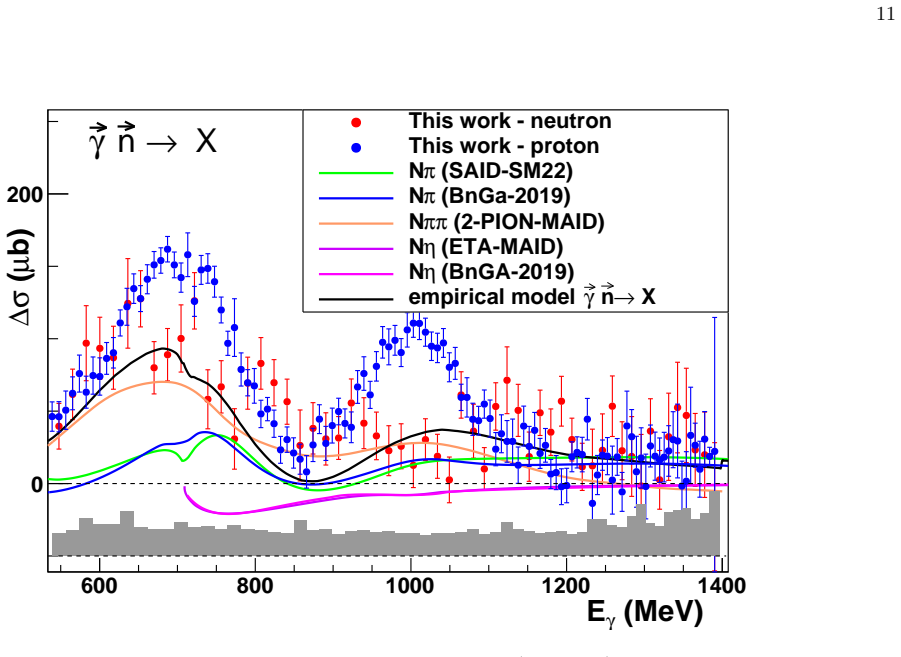
The experiment measured the helicity-dependent inclusive cross sections over 200-1400 MeV with high statistics and acceptance covering 97% of solid angle. Combining the deuteron and proton data extracts the free-neutron contribution. Integrating these results with model evaluations of the low- and high-energy tails verifies that the GDH sum rule is satisfied for the proton, the neutron, and the deuteron.
What carries the argument
The helicity-dependent total inclusive cross section (difference between parallel and antiparallel photon-nucleon helicity states), whose integral over photon energy tests the GDH sum rule.
If this is right
- The data set provides a precise experimental benchmark for theoretical calculations of nucleon spin structure both in free nucleons and inside the deuteron.
- Verification of the sum rule supports the consistency of low-energy nucleon properties with high-energy behavior described by QCD.
- The deuteron-proton difference supplies independent information on the neutron GDH integral.
- The fine energy binning enables detailed comparisons with resonance models and partial-wave analyses.
Where Pith is reading between the lines
- Similar measurements on heavier nuclei could test how nuclear binding modifies the GDH integral.
- Tighter constraints on the unmeasured tails would reduce the dominant uncertainty in the current test.
- The same technique could be applied to check related sum rules such as those for spin polarizabilities.
- These results strengthen the case for using GDH integrals as a probe of nucleon structure modifications in the nuclear medium.
Load-bearing premise
Existing theoretical models correctly estimate the missing contributions from unmeasured photon-energy regions below 200 MeV and above 1400 MeV without introducing significant bias into the integrated sum.
What would settle it
A new measurement of the helicity-dependent cross sections in the low-energy or high-energy tails that deviates substantially from the models used here would change the integrated value enough to violate the sum-rule verification.
Figures




read the original abstract
New data for the total inclusive helicity-dependent cross section for the proton and deuteron were obtained in the photon energy interval 200-1400 MeV. The experiment was performed at the A2 tagged-photon facility of the Mainz Microtron (MAMI) using a circularly polarized photon beam and longitudinally polarized proton and deuteron targets. The reaction products were detected using the large-acceptance Crystal Ball/TAPS calorimeter, which covers 97% of the full solid angle. These new results, obtained with fine energy binning, significantly expand both the quantity and the quality of the available data for these observables and enable a detailed comparison with state-of-the-art theoretical calculations. From the combination of the results for the deuteron and the proton, important information could also be extracted for the free neutron. Based on these data, and using existing models to evaluate the missing contributions from unmeasured photon energy regions, the validity of the Gerasimov-Drell-Hearn (GDH) sum rule has been verified for the proton, the neutron, and the deuteron. These new data provide a precise experimental benchmark for theoretical models used to study nucleons, both in their free state and when embedded in the nuclear medium.
Editorial analysis
A structured set of objections, weighed in public.
Referee Report
Summary. The manuscript reports new measurements of the helicity-dependent inclusive cross sections for proton and deuteron targets in the photon energy range 200-1400 MeV at the MAMI A2 facility using circularly polarized photons and longitudinally polarized targets, detected with the Crystal Ball/TAPS calorimeter. These data are combined with existing theoretical models for the unmeasured low-energy (below 200 MeV) and high-energy (above 1400 MeV) contributions to evaluate the Gerasimov-Drell-Hearn (GDH) integrals, leading to the claim that the GDH sum rule is verified for the proton, neutron (extracted via deuteron-proton subtraction), and deuteron.
Significance. If the model uncertainties for the tails are shown to be sub-dominant and properly propagated, the work supplies a high-statistics experimental benchmark in the resonance region that can test and constrain models of nucleon spin structure and the GDH sum rule, which is a fundamental low-energy theorem relating the integral to the anomalous magnetic moment.
major comments (2)
- [GDH sum-rule section] Section on GDH sum-rule evaluation (likely near the end of the results or discussion): the fractional contributions and associated uncertainties from the model-based tails below 200 MeV and above 1400 MeV are not quantified or propagated into the final integral values and their errors, even though these regions are required to close the integral from threshold to infinity; without this, the claimed verification cannot be assessed for statistical significance.
- [Results and discussion] Results section (comparison with models): the paper states that the new data enable detailed comparison with state-of-the-art calculations, but does not provide a quantitative breakdown of how much the measured 200-1400 MeV interval contributes to the total GDH integral versus the tails, leaving open whether the agreement is driven by the new data or by the models.
minor comments (2)
- [Abstract and Introduction] The abstract and introduction should explicitly state the approximate percentage of the GDH integral covered by the new data versus the model tails for each target.
- [Neutron extraction subsection] Notation for the extracted neutron GDH integral should be clarified to distinguish it from direct neutron measurements.
Simulated Author's Rebuttal
We thank the referee for the careful review and for recognizing the significance of our new high-statistics measurements in the resonance region. We address each major comment below and have revised the manuscript to incorporate the requested quantitative information on the tail contributions.
read point-by-point responses
-
Referee: [GDH sum-rule section] Section on GDH sum-rule evaluation (likely near the end of the results or discussion): the fractional contributions and associated uncertainties from the model-based tails below 200 MeV and above 1400 MeV are not quantified or propagated into the final integral values and their errors, even though these regions are required to close the integral from threshold to infinity; without this, the claimed verification cannot be assessed for statistical significance.
Authors: We agree that explicit quantification of the tail contributions and propagation of their model uncertainties is required to substantiate the verification claim. In the revised manuscript we have added a dedicated table (new Table 3) that reports, for the proton, deuteron and neutron, the partial GDH integrals over the measured 200–1400 MeV interval, the model-based contributions below 200 MeV and above 1400 MeV, the associated model uncertainties, and the fully propagated total integral with its uncertainty. The table also lists the fractional contributions of each region, allowing direct assessment of the statistical significance of the agreement with the sum-rule prediction. revision: yes
-
Referee: [Results and discussion] Results section (comparison with models): the paper states that the new data enable detailed comparison with state-of-the-art calculations, but does not provide a quantitative breakdown of how much the measured 200-1400 MeV interval contributes to the total GDH integral versus the tails, leaving open whether the agreement is driven by the new data or by the models.
Authors: We accept the referee’s point that a quantitative breakdown is needed to demonstrate that the verification is not driven solely by the model tails. The revised manuscript now includes an additional paragraph in the GDH evaluation section together with the new Table 3, which explicitly states the percentage contributions: the measured 200–1400 MeV interval accounts for the dominant fraction of the integral in the resonance region, while the low- and high-energy tails are smaller but carry their own uncertainties that have been propagated. This makes clear that the agreement with the sum rule rests primarily on the new experimental data. revision: yes
Circularity Check
No circularity: direct experimental measurement supplemented by external models
full rationale
This is an experimental measurement paper reporting new data on helicity-dependent cross sections. The GDH sum-rule verification integrates the measured interval (200-1400 MeV) with evaluations of the low- and high-energy tails taken from existing external models. No equations in the paper define a quantity in terms of itself, no fitted parameters are relabeled as predictions, and no load-bearing steps reduce to self-citations or ansatzes introduced by the authors. The central claim remains an independent experimental benchmark against the sum-rule value fixed by the anomalous magnetic moment.
Axiom & Free-Parameter Ledger
axioms (1)
- domain assumption The GDH sum rule can be tested by integrating the measured helicity-dependent cross-section difference over the full energy range after supplementing missing regions with theoretical estimates.
Reference graph
Works this paper leans on
-
[1]
Gerasimov, Sov
S. Gerasimov, Sov. J. Nucl. Phys.2, 430 (1966)
1966
-
[2]
Drell and A
S. Drell and A. Hearn, Phys. Rev. Lett.16, 908 (1966)
1966
-
[3]
Drechsel and L
D. Drechsel and L. Tiator, Ann. Rev. Nucl. Part. Sci.54, 69 (2004)
2004
-
[4]
Helbing, Prog
K. Helbing, Prog. Part. Nucl. Phys.57, 45 (2006)
2006
-
[5]
Strakovsky, S
I. Strakovsky, S. ˇSirca, W. J. Briscoe, A. Deur, A. Schmidt, and R. L. Workman, Phys. Rev. C105, 045202 (2022)
2022
-
[6]
Ahrenset al., Phys
J. Ahrenset al., Phys. Rev. Lett.84, 5950 (2000)
2000
-
[7]
Ahrenset al., Phys
J. Ahrenset al., Phys. Rev. Lett.87, 022003 (2001)
2001
-
[8]
Dutzet al., Phys
H. Dutzet al., Phys. Rev. Lett.91, 192001 (2003)
2003
-
[9]
Dutzet al., Phys
H. Dutzet al., Phys. Rev. Lett.93, 032003 (2004)
2004
-
[10]
Dutzet al., Phys
H. Dutzet al., Phys. Rev. Lett.94, 162001 (2005)
2005
-
[11]
Ahrenset al., Phys
J. Ahrenset al., Phys. Rev. Lett.97, 202303 (2006)
2006
-
[12]
Ahrenset al., Phys
J. Ahrenset al., Phys. Lett. B672, 328 (2009)
2009
-
[13]
S. D. Bass, Acta Phys. Pol.B52, 43 (2021)
2021
-
[14]
S. D. Bass, P. Pedroni, and A. Thomas, Eur. Phys. J. A 59, 239 (2023)
2023
-
[15]
D.-H. Lu, K. Tsushima, A. W. Thomas, A. G. Williams, and K. Saito, Phys. Rev. C60, 068201 (1999)
1999
- [16]
- [17]
-
[18]
Dalton, A
M. Dalton, A. Deur, and C. Keith, A measurement of double-polarization photoproduction on various nu- clei. The real gamma GDH experiment on nuclei (REGGEON) (2024), letter of Intent for PAC 51 at JLab
2024
- [19]
-
[20]
Cividiniet al.(A2 collaboration at MAMI), Eur
F. Cividiniet al.(A2 collaboration at MAMI), Eur. Phys. J. A58, 113 (2022)
2022
-
[21]
Kaiseret al., Nucl
H. Kaiseret al., Nucl. Instrum. Methods A593, 159 (2008)
2008
-
[22]
E. Mornacchi, Ph.D. thesis, University of Mainz (2021), http://doi.org/10.25358/openscience-6051
-
[23]
Witthaueret al.(A2 Collaboration at MAMI), Eur
L. Witthaueret al.(A2 Collaboration at MAMI), Eur. Phys. J. A49, 154 (2013)
2013
-
[24]
Werthm¨ ulleret al.(A2 Collaboration at MAMI), Phys
D. Werthm¨ ulleret al.(A2 Collaboration at MAMI), Phys. Rev. C90, 015205 (2014)
2014
-
[25]
Dieterleet al.(A2 Collaboration at MAMI), Phys
M. Dieterleet al.(A2 Collaboration at MAMI), Phys. Lett. B770, 523 (2017)
2017
-
[26]
Witthaueret al.(A2 collaboration at MAMI), Phys
L. Witthaueret al.(A2 collaboration at MAMI), Phys. Rev. C95, 055201 (2017)
2017
-
[27]
Dieterleet al.(A2 collaboration at MAMI), Phys
M. Dieterleet al.(A2 collaboration at MAMI), Phys. Rev. C97, 065205 (2018)
2018
-
[28]
Tioukine, K
V. Tioukine, K. Aulenbacher, and N. Riehn, Rev.Sci. In- strum.82, 033303 (2011)
2011
-
[29]
J. C. McGeorgeet al., Eur. Phys. J. A37, 129 (2008)
2008
-
[30]
Olsen and L
H. Olsen and L. Maximon, Phys. Rev.114, 887 (1959)
1959
-
[31]
Rohlof and H
C. Rohlof and H. Dutz, Nucl. Instrum. Methods A436, 430 (1999)
1999
-
[32]
Goertzet al., Nucl
S. Goertzet al., Nucl. Instrum. Methods A526, 43 (2004)
2004
-
[33]
Bradtkeet al., Nucl
C. Bradtkeet al., Nucl. Instrum. Methods A436, 430 (1999)
1999
-
[34]
Paudyal, Ph.D
D. Paudyal, Ph.D. thesis, University of Regina (2017), http://wwwa2.kph.uni- mainz.de/images/publications/phd/Paudyal-PhD- thesis.pdf
2017
-
[35]
Paudyalet al.(A2 collaboration), Phys
D. Paudyalet al.(A2 collaboration), Phys. Rev. C102, 035205 (2020)
2020
-
[36]
Afzalet al.(A2 collaboration at MAMI), Phys
F. Afzalet al.(A2 collaboration at MAMI), Phys. Rev. Lett.132, 121902 (2024)
2024
-
[37]
Starostin, B
A. Starostin, B. M. K. Nefkens, E. Berger, M. Clajus, A. Marusic, S. McDonald, and N. Phaisangittisakulet al., Phys. Rev. C64, 055205 (2001)
2001
-
[38]
Novotnyet al., IEEE Trans
R. Novotnyet al., IEEE Trans. Nucl. Sci.38, 379 (1991)
1991
-
[39]
R. A. Gableret al., Nucl. Instrum. Methods A346, 168 (1994)
1994
-
[40]
Mornacchiet al., Phys
E. Mornacchiet al., Phys. Rev. C109, 055201 (2024)
2024
-
[41]
Agostinelliet al., Nucl
S. Agostinelliet al., Nucl. Instrum. Methods A506, 250 (2003)
2003
-
[42]
W. J. Briscoe, A. Schmidt, I. I. Strakovsky, R. L. Work- man, and A. Svarc, Phys. Rev. C108, 065205 (2023)
2023
-
[43]
Fix and H
A. Fix and H. Arenh¨ ovel, Eur. Phys. J. A25, 115 (2005)
2005
-
[44]
Arenhoevel, A
H. Arenhoevel, A. Fix, and M. Schwamb, Phys. Rev. Lett.93, 202301 (2003)
2003
-
[45]
A. V. Anisovichet al., Eur. Phys. J. A52, 284 (2016)
2016
-
[46]
MacCormicket al., Phys
M. MacCormicket al., Phys. Rev. C53, 41 (1996)
1996
-
[47]
Armstronget al., Phys
T. Armstronget al., Phys. Rev. D5, 1640 (1972)
1972
-
[48]
Matveev, A
M. Matveev, A. V. Sarantsev, V. A. Nikonov, A. V. Anisovich, U. Thoma, and E. Klempt, Eur. Phys. J. A 55, 179 (2019)
2019
-
[49]
A. V. Sarantsev, M. Matveev, V. A. Nikonov, A. V. Anisovich, U. Thoma, and E. Klempt, Eur. Phys. J. A 55, 180 (2019)
2019
-
[50]
Schneider, D
C. Schneider, D. R¨ onchen, C. Hanhart, and U.-G. Meißner, Eur. Phys. J. A61, 241 (2025)
2025
-
[51]
Tiator, M
L. Tiator, M. Gorchtein, V. L. Kashevarov, K. Nikonov, M. Ostrick, M. Hadˇ zimehmedovi´ c, R. Omerovi´ c, H. Os- manovi´ c, J. Stahov, and A. ˇSvarc, Eur. Phys. J. A54, 210 (2018)
2018
-
[52]
P. A. Zylaet al.(Particle Data Group), 2020 Review of Particle Physics, Prog. Theor. Exp. Phys.2020, 035205 (2020)
2020
-
[53]
M. S. Guenther (A2), PoSHadron2017, 051 (2018)
2018
-
[54]
Ishikawaet al., Phys
T. Ishikawaet al., Phys. Lett. B789, 4133 (2019)
2019
-
[55]
Judeet al., Phys
T. Judeet al., Phys. Lett. B832, 137277 (2022)
2022
-
[56]
Ghosalet al.(A2), Phys
D. Ghosalet al.(A2), Phys. Lett. B847, 138273 (2023)
2023
-
[57]
Fix, Phys
A. Fix, Phys. Rev. C110, 064603 (2024)
2024
-
[58]
T. E. O. Ericson and W. Weise,Pions and Nuclei(Oxford University Press, 1988)
1988
-
[59]
Oset and L
E. Oset and L. L. Salcedo,468, 631 (1987)
1987
-
[60]
Garcia-Recio, E
C. Garcia-Recio, E. Oset, L. L. Salcedo, D. , Strottman, and M. J. Lopez,526, 685 (1991)
1991
-
[61]
Kruscheet al., Phys
B. Kruscheet al., Phys. Lett. B526, 287 (2002)
2002
-
[62]
Peters, H
W. Peters, H. Lenske, , and U. Mosel, Nucl. Phys. A640, 89 (1998)
1998
-
[63]
Drechsel, L
D. Drechsel, L. Tiator, S. S. Kamalov, and S. N. Yang, Nucl. Phys. A660, 423 (1999)
1999
-
[64]
Metag, Prog
V. Metag, Prog. Part. Nucl. Phys.30, 20 (1993)
1993
-
[65]
Rondon, Phys
O. Rondon, Phys. Rev. C60, 035201 (1999)
1999
-
[66]
Navas,et al.(Particle Data Group), Phys
S. Navas,et al.(Particle Data Group), Phys. Rev. D110, 030001 (2024)
2024
-
[67]
S. D. Bass, M. Skurzok, and P. Moskal, Phys. ReV. C 98, 025209 (2018)
2018
-
[68]
M. W. Ahmed, M. A. Blackston, B. A. Perdue, 16 W. Tornow, H. R. Weller, B. Norum, B. Sawatzky, R. M. Prior, and M. C. Spraker, Phys. Rev. C77, 044005 (2008)
2008
-
[69]
Bianchi and E
N. Bianchi and E. Thomas, Phys. Lett. B450, 439 (1999)
1999
-
[70]
Simulaet al., Phys
S. Simulaet al., Phys. Rev. D65, 034017 (2002)
2002
-
[71]
S. D. Bass and M. M. Brisudova, Eur. Phys. J. A , 251 (1999)
1999
-
[72]
Ciofi degli Attiet al., Phys.Lett.B376, 309 (1996)
C. Ciofi degli Attiet al., Phys.Lett.B376, 309 (1996)
1996
-
[73]
Deuret al., Phys
A. Deuret al., Phys. Rev. C111, 035202 (2025)
2025
discussion (0)
Sign in with ORCID, Apple, or X to comment. Anyone can read and Pith papers without signing in.