Recognition: unknown
Progressive Convex Hull Simplification
Pith reviewed 2026-05-10 11:13 UTC · model grok-4.3
The pith
Representing a convex hull in dual space lets a greedy algorithm simplify it to any number of half-spaces in O(n log n) time while minimizing added volume or area.
A machine-rendered reading of the paper's core claim, the machinery that carries it, and where it could break.
Core claim
By shifting to the dual representation, each candidate half-space becomes a point and the simplification task reduces to selecting a small subset of these points. A greedy ordering of the dual points yields a sequence of progressively simpler outer approximations whose added volume or area grows slowly. The algorithm therefore produces a safe, tight proxy of any desired complexity without enumerating combinations.
What carries the argument
The dual representation of the convex hull, where each half-space maps to a point and greedy selection of dual points directly controls the increase in enclosed volume or area.
If this is right
- A single preprocessing pass produces a family of nested outer approximations that can be swapped in at runtime to trade accuracy for speed.
- The O(n log n) bound makes the method practical for hulls containing thousands of faces in interactive graphics pipelines.
- Because the output is guaranteed to contain the input, the simplified hull can replace the full hull in any conservative query without introducing false negatives.
- The same dual greedy ordering can be stopped early to obtain a hierarchy of bounding volumes for level-of-detail collision or distance routines.
Where Pith is reading between the lines
- The dual greedy pattern may extend to simplifying other convex sets, such as intersections of balls or cylinders, where a similar point-plane duality exists.
- For extremely large inputs the preprocessing cost could be further reduced by first computing an approximate convex hull and then simplifying it.
- If the greedy choice property can be proved to yield a bounded approximation ratio, the method would become a drop-in replacement for slower exact optimization routines.
Load-bearing premise
That the greedy ordering of dual points will always produce a simplification whose added volume or area stays close to the best possible choice and never violates the outer-approximation guarantee on any input shape.
What would settle it
A small input hull for which an exhaustive search over all subsets of k half-spaces finds an outer approximation whose added volume is substantially smaller than the volume returned by the dual greedy method.
Figures




read the original abstract
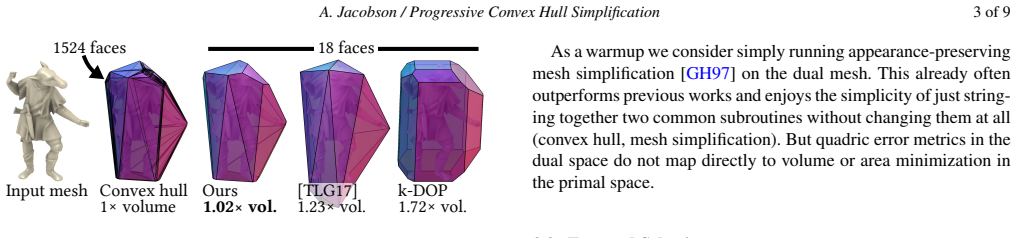
Convex hulls are useful as tight bounding proxies for a variety of tasks including collision detection, ray intersection, and distance computation. Unfortunately, the complexity of polyhedral convex hulls grows linearly with their input. We consider the problem of conservatively simplifying a convex hull to a specified number of half-spaces while minimizing added volume or surface area. By working in the dual representation, we propose an efficient $O(n \log n)$ greedy optimization. In comparisons, we show that existing methods either exhibit poor efficiency, tightness or safety. We demonstrate the success of our method on a variety of input shapes and downstream application domains.
Editorial analysis
A structured set of objections, weighed in public.
Referee Report
Summary. The paper addresses conservative simplification of convex hulls to a user-specified number of half-spaces while minimizing added volume or surface area. It introduces a dual-space representation that enables a greedy optimization algorithm claimed to run in O(n log n) time, and reports that this approach outperforms prior methods in efficiency, tightness, and safety. The method is demonstrated on diverse input shapes and applied to tasks including collision detection, ray intersection, and distance computation.
Significance. If the greedy dual-space selection reliably produces near-optimal conservative simplifications, the result would be useful for graphics and geometry applications that rely on tight bounding proxies, as it could reduce computational cost without introducing false negatives in intersection or distance queries. The O(n log n) scaling and explicit safety guarantee would be practical strengths if supported by analysis or extensive validation.
major comments (3)
- [Abstract] Abstract and method description: the central O(n log n) greedy claim rests on dual-space half-space selection minimizing added volume, yet no approximation ratio, local-optimality proof, or worst-case bound on the deviation from the global minimum k-subset is provided. This directly affects the claim that the method is both efficient and reliably tight.
- [Method] The safety argument (H' ⊇ H for all inputs) is asserted but not accompanied by a proof or exhaustive failure-case analysis; the dual mapping from primal volume increments to dual operations must be shown to preserve conservativeness on degenerate, high-curvature, or long-thin polyhedra, as a single bad removal order could violate the inclusion.
- [Experiments] Comparison section: the reported superiority in tightness and safety is presented without quantitative tables showing added-volume ratios or failure rates across a controlled benchmark set (e.g., varying aspect ratios or vertex counts), making it impossible to assess whether the greedy choice systematically outperforms alternatives.
minor comments (2)
- [Method] Notation for dual variables and the precise definition of the greedy selection criterion (volume vs. area) should be introduced with a small worked example early in the method section to improve readability.
- [Preliminaries] The manuscript would benefit from an explicit statement of the input assumptions (e.g., general position, manifold boundary) and a short discussion of how the algorithm behaves when these are violated.
Simulated Author's Rebuttal
We thank the referee for the constructive comments, which highlight important aspects of our claims on efficiency, safety, and evaluation. We address each major comment below and will incorporate revisions to strengthen the manuscript.
read point-by-point responses
-
Referee: [Abstract] Abstract and method description: the central O(n log n) greedy claim rests on dual-space half-space selection minimizing added volume, yet no approximation ratio, local-optimality proof, or worst-case bound on the deviation from the global minimum k-subset is provided. This directly affects the claim that the method is both efficient and reliably tight.
Authors: The O(n log n) bound describes the running time of the greedy algorithm, which uses a dual-space priority queue to select the half-space removal that minimizes the immediate added volume (or area) at each step. We do not claim global optimality or provide an approximation ratio, as selecting the exact minimum-volume k-subset appears combinatorially hard. In the revision we will explicitly distinguish the complexity claim from any optimality guarantee, add a brief discussion of the heuristic nature of greedy selection, and note that empirical results (rather than worst-case bounds) support its practical tightness. revision: partial
-
Referee: [Method] The safety argument (H' ⊇ H for all inputs) is asserted but not accompanied by a proof or exhaustive failure-case analysis; the dual mapping from primal volume increments to dual operations must be shown to preserve conservativeness on degenerate, high-curvature, or long-thin polyhedra, as a single bad removal order could violate the inclusion.
Authors: Conservativeness follows from the dual-space construction: a half-space is removed only when its supporting plane lies strictly outside the current hull, so the intersection of the remaining half-spaces cannot shrink. We acknowledge that a formal inductive proof and explicit handling of degeneracies are missing. In the revised manuscript we will supply a concise proof that the inclusion H' ⊇ H is invariant under the greedy removal order, together with a short analysis (and accompanying figures) for degenerate, high-curvature, and thin polyhedra. revision: yes
-
Referee: [Experiments] Comparison section: the reported superiority in tightness and safety is presented without quantitative tables showing added-volume ratios or failure rates across a controlled benchmark set (e.g., varying aspect ratios or vertex counts), making it impossible to assess whether the greedy choice systematically outperforms alternatives.
Authors: We agree that the current comparison lacks the quantitative detail needed for rigorous assessment. The revised manuscript will include tables that report added-volume ratios, surface-area increases, and safety indicators (including any observed violations of conservativeness) on a controlled benchmark suite that systematically varies vertex count and aspect ratio. These tables will be placed in the experimental section and will directly compare our method against the baselines mentioned in the paper. revision: yes
Circularity Check
No circularity: algorithmic construction is self-contained
full rationale
The paper proposes a direct algorithmic method for conservative convex hull simplification via dual-space greedy selection, claimed to run in O(n log n). No equations, parameters, or results are shown to reduce by construction to fitted inputs, self-definitions, or prior self-citations; the central claim is the construction and efficiency of the procedure itself, which stands independently of the target outputs.
Axiom & Free-Parameter Ledger
axioms (1)
- domain assumption Convex hulls admit an equivalent dual representation in which half-spaces become points and simplification becomes a covering problem.
Reference graph
Works this paper leans on
-
[1]
InIEEE/CVF Conference on Computer Vision and Pat- tern Recognition, CVPR 2022, New Orleans, LA, USA, June 18-24, 2022 (2022), IEEE, pp
[Ale22] ALEXAM.: Super-fibonacci spirals: Fast, low-discrepancy sam- pling of SO(3). InIEEE/CVF Conference on Computer Vision and Pat- tern Recognition, CVPR 2022, New Orleans, LA, USA, June 18-24, 2022 (2022), IEEE, pp. 8281–8290. 3 [BDH96] BARBERC. B., DOBKIND. P., HUHDANPAAH.: The quick- hull algorithm for convex hulls.ACM Trans. Math. Softw. 22, 4 (19...
2022
-
[2]
3, 5 [CGM11] CHANGC., GORISSENB., MELCHIORS.: Fast oriented bounding box optimization on the rotation groupSO(3,∖).ACM Trans
Blog post. 3, 5 [CGM11] CHANGC., GORISSENB., MELCHIORS.: Fast oriented bounding box optimization on the rotation groupSO(3,∖).ACM Trans. Graph. 30, 5 (2011), 122:1–122:16. 3 [CS89] CLARKSONK. L., SHORP. W.: Application of random sampling in computational geometry, II.Discret. Comput. Geom. 4(1989), 387–
2011
-
[3]
2 [GGM∗05] GANOVELLIP. C. F., GOBBETTIE., MARTONF., PONCHIO F., SCOPIGNOR.: Batched multi triangulation. In16th IEEE Visualiza- tion Conference, IEEE Vis 2005, Minneapolis, MN, USA, October 23-28, 2005, Proceedings(2005), IEEE Computer Society, pp. 207–214. 8 [GH97] GARLANDM., HECKBERTP. S.: Surface simplification using quadric error metrics. InProceeding...
2005
-
[4]
J., STOLFIJ.: Primitives for the manipulation of general subdivisions and computation of voronoi diagrams.ACM Trans
2 [GS85] GUIBASL. J., STOLFIJ.: Primitives for the manipulation of general subdivisions and computation of voronoi diagrams.ACM Trans. Graph. 4, 2 (1985), 74–123. 2 [Hop96] HOPPEH.: Progressive meshes. InProceedings of the 23rd Annual Conference on Computer Graphics and Interactive Techniques, SIGGRAPH 1996, New Orleans, LA, USA, August 4-9, 1996(1996), F...
1985
-
[5]
Visualization and Mathematics
https://libigl.github.io/. 5 [KRB21] KLIMENKOG., RAICHELB., BUSKIRKG. V.: Sparse convex hull coverage.Comput. Geom. 98(2021), 101787. 3 [LR00] LÓPEZM. A., REISNERS.: Efficient approximation of convex polygons.Int. J. Comput. Geom. Appl. 10, 5 (2000), 445–452. 1, 3, 7 [LR02] LÓPEZM. A., REISNERS.: Linear time approximation of 3d convex polytopes.Comput. Ge...
2021
-
[6]
1, 3, 7 [S∗19] SHARPN.,ET AL.: Polyscope,
7 [RSW01] REISNERS., SCHUETTC., WERNERE.: Dropping a vertex or a facet from a convex polytope.Forum Mathematicum 13(01 2001), 359–378. 1, 3, 7 [S∗19] SHARPN.,ET AL.: Polyscope,
2001
-
[7]
5 [Sei91] SEIDELR.: Small-dimensional linear programming and convex hulls made easy.Discret
www.polyscope.run. 5 [Sei91] SEIDELR.: Small-dimensional linear programming and convex hulls made easy.Discret. Comput. Geom. 6(1991), 423–434. 2 [SGG∗00] SANDERP. V., GUX., GORTLERS. J., HOPPEH., SNYDER J. M.: Silhouette clipping. InProceedings of the 27th Annual Conference on Computer Graphics and Interactive Techniques, SIGGRAPH 2000, New Orleans, LA, ...
1991
-
[8]
I.: Decomposing images into layers via rgb-space geometry.ACM Trans
3, 5, 6 [TLG17] TANJ., LIENJ., GINGOLDY. I.: Decomposing images into layers via rgb-space geometry.ACM Trans. Graph. 36, 1 (2017), 7:1– 7:14. 3, 5 [Wan22] WANGZ.: Sdlp,
2017
-
[9]
Actaeon”, “Hermanubis-Broken
https://github.com/ZJU-FAST- Lab/SDLP. 5 [WLLS22] WEIX., LIUM., LINGZ., SUH.: Approximate convex decomposition for 3d meshes with collision-aware concavity and tree search.ACM Transactions on Graphics (TOG) 41, 4 (2022), 1–18. 1, 3, 6, 7 [ZGZJ16] ZHOUQ., GRINSPUNE., ZORIND., JACOBSONA.: Mesh arrangements for solid geometry.ACM Transactions on Graphics (TO...
2022
discussion (0)
Sign in with ORCID, Apple, or X to comment. Anyone can read and Pith papers without signing in.