Recognition: unknown
Wave-envelope dark matter beyond the monochromatic paradigm
Pith reviewed 2026-05-10 12:19 UTC · model grok-4.3
The pith
Mixing between ultralight dark matter fields generates wave-envelope signals that carry slow modulation and sideband frequencies rather than pure monochromatic tones.
A machine-rendered reading of the paper's core claim, the machinery that carries it, and where it could break.
Core claim
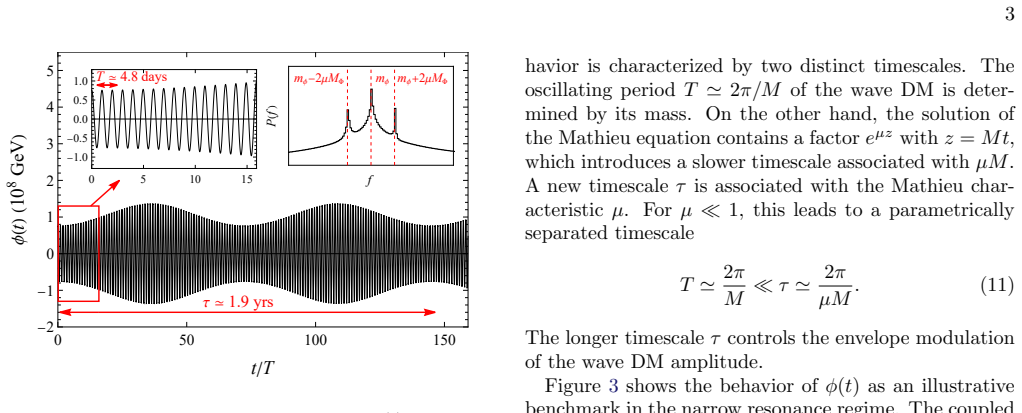
Ultralight dark matter searches widely assume that signals are monochromatic, with a single frequency set by the mass. This assumption is generally violated in the presence of field mixing, even when the constituent fields have similar frequencies. Instead, dark matter signals can exhibit a two-timescale structure with intrinsic slow modulation. Mixing between ultralight wave dark matter fields induces a parametric structure, leading to a scenario referred to as wave-envelope dark matter, in which a slow-beating envelope emerges alongside the primary oscillation. This results in distinctive features such as slow modulation and characteristic sideband structures in the frequency spectrum, as
What carries the argument
The wave-envelope structure produced by parametric mixing of two ultralight scalar fields with nearby masses, which superimposes a slow amplitude modulation on the rapid oscillation and splits the frequency spectrum into sidebands.
If this is right
- Direct-detection experiments must search for modulated signals rather than steady monochromatic power.
- Frequency spectra of candidate dark matter signals will contain symmetric sideband pairs separated by the beat frequency.
- Neutrino oscillation probabilities or fluxes can acquire additional time-dependent modulations from the dark matter envelope.
- Existing exclusion limits derived under the monochromatic assumption require re-evaluation when mixing is allowed.
- The envelope timescale provides a new handle for distinguishing wave dark matter from other ultralight candidates.
Where Pith is reading between the lines
- Laboratory or astrophysical probes sensitive to slow variations in particle masses or couplings could directly test the envelope modulation.
- Similar envelope structures might appear in other mixed scalar systems, such as axion-like particles or hidden-sector fields.
- Data analysis pipelines that assume stationary signals could miss or misclassify wave-envelope candidates as noise or backgrounds.
Load-bearing premise
Mixing between ultralight dark matter fields with similar frequencies occurs generically and produces an unsuppressed two-timescale envelope without extra tuning.
What would settle it
A search for ultralight dark matter that reports only a single narrow frequency line with no detectable sidebands or slow amplitude modulation at the expected beat frequency would contradict the generic presence of wave-envelope effects.
Figures


read the original abstract
Ultralight dark matter searches widely assume that signals are monochromatic, with a single frequency set by the mass. This assumption is generally violated in the presence of field mixing, even when the constituent fields have similar frequencies. Instead, dark matter signals can exhibit a two-timescale structure with intrinsic slow modulation. We demonstrate that mixing between ultralight wave dark matter fields induces a parametric structure, leading to a scenario we refer to as wave-envelope dark matter, in which a slow-beating envelope emerges alongside the primary oscillation. This results in distinctive features such as slow modulation and characteristic sideband structures in the frequency spectrum, beyond the conventional monochromatic expectation. As a representative example, we briefly discuss implications for neutrino observables.
Editorial analysis
A structured set of objections, weighed in public.
Referee Report
Summary. The manuscript argues that mixing between ultralight scalar dark matter fields with similar but non-identical masses violates the monochromatic assumption common in direct-detection searches. It introduces the concept of wave-envelope dark matter, in which linear superposition produces a fast carrier oscillation modulated by a slow beat envelope at frequency |m1−m2|/2, generating characteristic sidebands in the power spectrum and slow modulation in observables. A brief illustrative discussion of consequences for neutrino signals is provided.
Significance. If the parametric structure is derived rigorously, the work usefully reminds the community that the monochromatic idealization fails generically once mixing is allowed, even without additional tuning. The resulting two-timescale phenomenology and sideband pattern are falsifiable signatures that could affect template-based analyses in axion haloscopes or neutrino detectors. The absence of new free parameters or ad-hoc entities strengthens the claim.
major comments (2)
- [Abstract and §2] Abstract and §2: the central claim that mixing 'induces a parametric structure' leading to wave-envelope DM is presented conceptually, but the manuscript supplies no explicit Lagrangian, mixing matrix, or derivation showing how the envelope amplitude and frequency follow from the potential or portal terms. Without these equations the reader cannot verify that the two-timescale structure is not simply the standard beat note of two free fields with m1≈m2.
- [§3] §3 (neutrino example): the discussion of implications for neutrino observables is described as 'brief' and illustrative; no quantitative estimate of the modulation depth, sideband power, or required mixing angle is given, making it impossible to assess whether the effect is detectable or distinguishable from other time-dependent backgrounds.
minor comments (2)
- [Introduction] The manuscript should cite the classical and QFT literature on beat frequencies and modulated waves (e.g., standard treatments of two-tone interference) to clarify what is novel versus what is a re-derivation of a known superposition effect.
- [§2] Notation for the envelope frequency |m1−m2|/2 and carrier (m1+m2)/2 should be introduced with an explicit equation early in the text rather than left implicit.
Simulated Author's Rebuttal
We thank the referee for the constructive report and the recommendation of minor revision. The comments help clarify the presentation of the wave-envelope concept. We address each major comment below and will revise the manuscript accordingly by adding the requested explicit derivations and quantitative estimates.
read point-by-point responses
-
Referee: [Abstract and §2] Abstract and §2: the central claim that mixing 'induces a parametric structure' leading to wave-envelope DM is presented conceptually, but the manuscript supplies no explicit Lagrangian, mixing matrix, or derivation showing how the envelope amplitude and frequency follow from the potential or portal terms. Without these equations the reader cannot verify that the two-timescale structure is not simply the standard beat note of two free fields with m1≈m2.
Authors: We appreciate the referee's request for explicit equations. Although the manuscript emphasizes the conceptual consequences of mixing, we agree that including the underlying derivation will strengthen the paper. In the revised version we will add the two-field Lagrangian with a mixing portal, the diagonalization to mass eigenstates, and the explicit superposition of the two mass eigenstates that produces the slow envelope at frequency |m1−m2|/2. This will make clear that the two-timescale structure follows directly from the mixing-induced mass splitting rather than from an arbitrary choice of two independent free fields. revision: yes
-
Referee: [§3] §3 (neutrino example): the discussion of implications for neutrino observables is described as 'brief' and illustrative; no quantitative estimate of the modulation depth, sideband power, or required mixing angle is given, making it impossible to assess whether the effect is detectable or distinguishable from other time-dependent backgrounds.
Authors: We acknowledge that the neutrino discussion remains illustrative. To address this, the revised manuscript will expand §3 with quantitative estimates: the modulation depth as a function of the mixing angle and mass difference, the fractional power in the sidebands, and a short assessment of distinguishability from other time-dependent signals in neutrino detectors and haloscopes. These additions will allow readers to evaluate the phenomenological relevance without altering the illustrative character of the section. revision: yes
Circularity Check
No significant circularity; derivation is self-contained from standard superposition
full rationale
The paper derives the two-timescale envelope structure directly from the linear superposition of two ultralight scalar fields with close but distinct masses, as shown in the equations for the mixed field evolution and the resulting frequency spectrum with sidebands. This follows from the standard beat-note mathematics without any self-definitional loop, fitted inputs renamed as predictions, or load-bearing self-citations that reduce the central claim to prior unverified work by the same authors. The introduction of the 'wave-envelope dark matter' label is a descriptive naming of the parametric outcome rather than a renaming that substitutes for new content, and the implications for neutrino observables are presented as illustrative applications of the independent wave mechanics result.
Axiom & Free-Parameter Ledger
axioms (1)
- domain assumption Ultralight dark matter can be modeled as mixing wave-like fields whose frequencies are similar enough for mixing to generate observable two-timescale behavior.
invented entities (1)
-
wave-envelope dark matter
no independent evidence
Reference graph
Works this paper leans on
-
[1]
W. Hu, R. Barkana, and A. Gruzinov, Phys. Rev. Lett. 85, 1158 (2000), arXiv:astro-ph/0003365
work page Pith review arXiv 2000
-
[2]
L. Hui, Ann. Rev. Astron. Astrophys.59, 247 (2021), arXiv:2101.11735 [astro-ph.CO]
-
[3]
A. Arvanitaki, P. W. Graham, J. M. Hogan, S. Rajen- dran, and K. Van Tilburg, Phys. Rev. D97, 075020 (2018), arXiv:1606.04541 [hep-ph]
- [4]
-
[5]
T. Kobayashiet al., Phys. Rev. Lett.129, 241301 (2022), arXiv:2212.05721 [physics.atom-ph]
-
[6]
M. Filzinger, A. R. Caddell, D. Jani, M. Steinel, L. Giani, N. Huntemann, and B. M. Roberts, Phys. Rev. Lett. 134, 031001 (2025), arXiv:2312.13723 [hep-ph]
- [7]
-
[8]
K. Van Tilburg, N. Leefer, L. Bougas, and D. Budker, Phys. Rev. Lett.115, 011802 (2015), arXiv:1503.06886 [physics.atom-ph]
- [9]
- [10]
-
[11]
Berlin, Neutrino Oscillations as a Probe of Light Scalar Dark Matter, Phys
A. Berlin, Phys. Rev. Lett.117, 231801 (2016), arXiv:1608.01307 [hep-ph]
-
[12]
G. Krnjaic, P. A. N. Machado, and L. Necib, Phys. Rev. D97, 075017 (2018), arXiv:1705.06740 [hep-ph]
-
[13]
M. Losada, Y. Nir, G. Perez, I. Savoray, and Y. Shpil- man, JHEP03, 032 (2023), arXiv:2205.09769 [hep-ph]
- [14]
-
[15]
Neutrino meets ultralight dark matter: 0νββdecay and cosmology,
G.-y. Huang and N. Nath, JCAP05, 034 (2022), arXiv:2111.08732 [hep-ph]
- [16]
-
[17]
P. Mart´ ınez-Mirav´ e, Y. F. Perez-Gonzalez, and M. Sen, Phys. Rev. D110, 055005 (2024), arXiv:2406.01682 [hep- ph]
-
[18]
Y. Kim and H.-S. Lee, JHEP07, 269 (2025), arXiv:2503.04949 [hep-ph]
- [19]
- [20]
- [21]
- [22]
-
[23]
J. Soda and Y. Urakawa, Eur. Phys. J. C78, 779 (2018), arXiv:1710.00305 [astro-ph.CO]
-
[24]
H. Fukunaga, N. Kitajima, and Y. Urakawa, JCAP06, 055 (2019), arXiv:1903.02119 [astro-ph.CO]
- [25]
-
[26]
K. Nakayama and W. Yin, JHEP10, 026 (2021), arXiv:2105.14549 [hep-ph]
- [27]
- [28]
-
[29]
P. Carenza, A. Mirizzi, and G. Sigl, Phys. Rev. D101, 103016 (2020), arXiv:1911.07838 [hep-ph]
- [30]
-
[31]
N. Kitajima, J. Soda, and Y. Urakawa, JCAP10, 008 (2018), arXiv:1807.07037 [astro-ph.CO]
- [32]
-
[33]
B. Underwood and Y. Zhai, JCAP04, 002 (2014), arXiv:1312.3006 [hep-th]
-
[34]
H. Fukuda and K. Nakayama, JHEP01, 128 (2020), arXiv:1910.06308 [hep-ph]
- [35]
- [36]
-
[37]
M. S. Turner, Phys. Rev. D28, 1243 (1983)
1983
-
[38]
Constraints on the epoch of dark matter formation from Milky Way satellites,
S. Das and E. O. Nadler, Phys. Rev. D103, 043517 (2021), arXiv:2010.01137 [astro-ph.CO]
- [39]
- [40]
-
[41]
H. Koo and J.-W. Lee, JCAP01, 020 (2026), arXiv:2504.19219 [astro-ph.GA]
-
[42]
M. Doi, T. Kotani, H. Nishiura, and E. Takasugi, Prog. Theor. Phys.69, 602 (1983)
1983
-
[43]
Schechter and J
J. Schechter and J. W. F. Valle, Phys. Rev. D25, 2951 (1982)
1982
- [44]
discussion (0)
Sign in with ORCID, Apple, or X to comment. Anyone can read and Pith papers without signing in.