Recognition: unknown
Quantization of Spiking Neural Networks Beyond Accuracy
Pith reviewed 2026-05-10 12:44 UTC · model grok-4.3
The pith
Quantization of spiking networks can alter firing patterns even at unchanged accuracy
A machine-rendered reading of the paper's core claim, the machinery that carries it, and where it could break.
Core claim
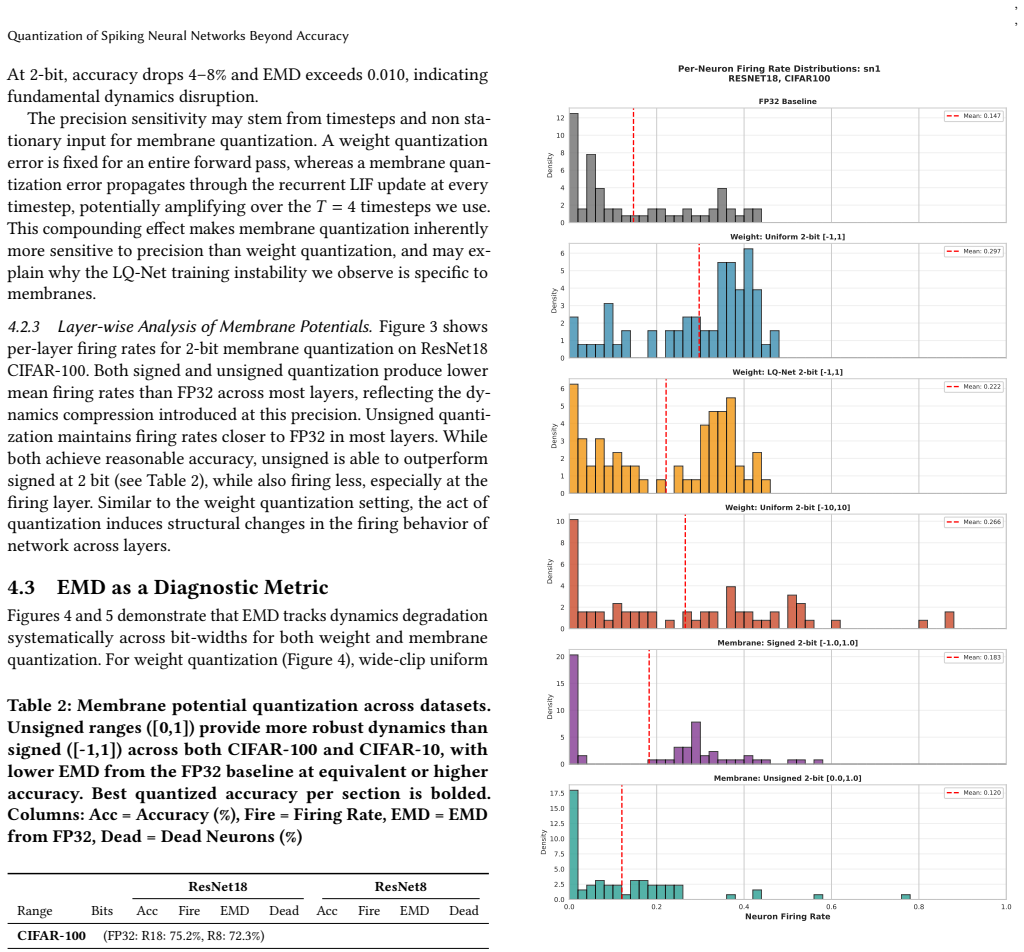
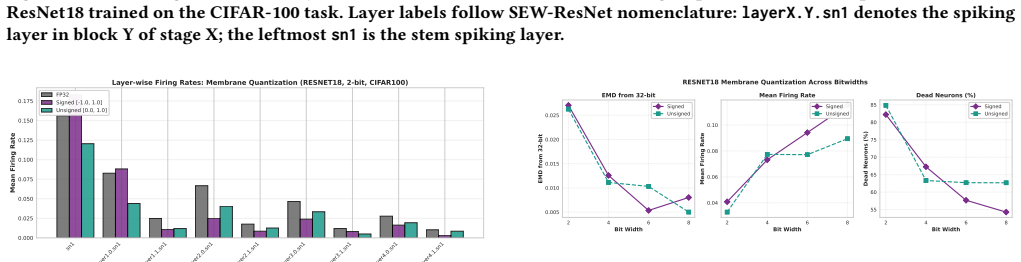
Quantization method, clipping range, and bit-width can produce substantially different firing distributions at equivalent accuracy, differences invisible to standard metrics but relevant to deployment, where firing activity governs effective sparsity, state storage, and event-processing load. Earth Mover's Distance is proposed as a diagnostic metric for firing distribution divergence. Uniform quantization induces distributional drift even when accuracy is preserved, while LQ-Net style learned quantization maintains firing behavior close to the full-precision baseline.
What carries the argument
Earth Mover's Distance applied to neuron firing rate distributions to measure behavioral divergence induced by different quantization schemes in spiking neural networks.
Load-bearing premise
That differences in firing distributions measured by Earth Mover's Distance correspond to practically relevant changes in deployment metrics such as sparsity and processing load.
What would settle it
An observation that quantized networks with high Earth Mover's Distance to the baseline show no increase in actual hardware energy use or latency compared to low-distance ones would falsify the practical importance of the metric.
Figures


read the original abstract
Quantization is a natural complement to the sparse, event-driven computation of Spiking Neural Networks, reducing memory bandwidth and arithmetic cost for deployment on resource-constrained hardware. However, existing SNN quantization evaluation focuses almost exclusively on accuracy, overlooking whether a quantized network preserves the firing behavior of its full-precision counterpart. We demonstrate that quantization method, clipping range, and bit-width can produce substantially different firing distributions at equivalent accuracy, differences invisible to standard metrics but relevant to deployment, where firing activity governs effective sparsity, state storage, and event-processing load. To capture this gap, we propose Earth Mover's Distance as a diagnostic metric for firing distribution divergence, and apply it systematically across weight and membrane quantization on SEW-ResNet architectures trained on CIFAR-10 and CIFAR-100. We find that uniform quantization induces distributional drift even when accuracy is preserved, while LQ-Net style learned quantization maintains firing behavior close to the full-precision baseline. Our results suggest that behavior preservation should be treated as an evaluation criterion alongside accuracy, and that EMD provides a principled tool for assessing it.
Editorial analysis
A structured set of objections, weighed in public.
Referee Report
Summary. The paper claims that quantization of spiking neural networks (SNNs) should be evaluated not only on accuracy but also on preservation of firing behavior, as different methods can induce distributional drift in spike rates even at matched accuracy. Using SEW-ResNet architectures on CIFAR-10 and CIFAR-100, systematic experiments compare uniform quantization against learned quantization (LQ-Net style) for both weights and membrane potentials. The authors propose Earth Mover's Distance (EMD) as a diagnostic metric and report that uniform quantization produces substantially larger EMD divergences from the full-precision baseline than learned quantization, while accuracies remain comparable. They conclude that behavior preservation merits consideration alongside accuracy for deployment on resource-constrained hardware.
Significance. If the central empirical findings hold, the work could usefully broaden SNN quantization evaluation beyond accuracy-centric benchmarks by highlighting how quantization choices affect the sparse, event-driven nature of SNN computation. The proposal of EMD as a principled, distribution-sensitive metric is a concrete contribution that could be adopted in future studies. The experiments are systematic across bit-widths and quantization targets, providing a useful reference point for the community.
major comments (1)
- [Abstract and Results] Abstract and Results section: The motivation that firing-distribution differences (via EMD) are relevant to deployment because 'firing activity governs effective sparsity, state storage, and event-processing load' is asserted but not supported by any direct measurements or correlations with concrete metrics such as average spike rate, layer-wise event density, effective sparsity, or simulated hardware event-processing cost. This leaves the practical significance of the reported EMD gaps dependent on an untested assumption.
minor comments (3)
- [Experimental evaluation] The manuscript should report error bars, standard deviations, or statistical significance tests for the EMD and accuracy values across multiple runs or seeds.
- [Methods] Clarify the precise construction of the firing distributions used for EMD (e.g., binning of spike times, normalization, or per-layer vs. network-wide aggregation).
- [Discussion] Add a short discussion of potential limitations in generalizing the SEW-ResNet/CIFAR results to other SNN architectures or larger-scale datasets.
Simulated Author's Rebuttal
We thank the referee for the careful and constructive review. The feedback identifies a valuable opportunity to strengthen the empirical grounding of our motivation. We address the comment in detail below and will revise the manuscript accordingly.
read point-by-point responses
-
Referee: [Abstract and Results] Abstract and Results section: The motivation that firing-distribution differences (via EMD) are relevant to deployment because 'firing activity governs effective sparsity, state storage, and event-processing load' is asserted but not supported by any direct measurements or correlations with concrete metrics such as average spike rate, layer-wise event density, effective sparsity, or simulated hardware event-processing cost. This leaves the practical significance of the reported EMD gaps dependent on an untested assumption.
Authors: We agree that the manuscript would benefit from explicit empirical support for the deployment relevance of the observed EMD differences. While the link between spike-rate distributions and hardware metrics such as effective sparsity and event-processing load is standard in the neuromorphic literature, we did not include direct correlations in the original submission. In the revised version we will add a dedicated analysis subsection that reports (i) layer-wise average spike rates and their standard deviations for each quantization method, (ii) the Pearson correlation between per-layer EMD and the resulting spike-rate shift, and (iii) a simple event-count-based estimate of processing load derived from the measured spike densities. These additions will make the practical significance of the EMD gaps concrete rather than assumed. revision: yes
Circularity Check
No circularity: purely empirical comparison of quantization methods via standard metrics
full rationale
The paper reports experimental results on SEW-ResNet models trained on CIFAR-10/100, comparing uniform vs. learned (LQ-Net) quantization for weights and membrane potentials. It measures accuracy and applies the standard Earth Mover's Distance (EMD) to observed spike-count histograms. No equations, derivations, or first-principles claims are present that could reduce to fitted parameters, self-definitions, or self-citations by construction. The EMD usage is a direct, non-circular diagnostic on empirical distributions; deployment relevance is asserted but not derived mathematically. This matches the expected non-circular outcome for an empirical evaluation paper.
Axiom & Free-Parameter Ledger
Reference graph
Works this paper leans on
-
[1]
Filipp Akopyan, Jun Sawada, Andrew Cassidy, Rodrigo Alvarez-Icaza, John Arthur, Paul Merolla, et al . 2015. TrueNorth: Design and Tool Flow of a 65 mW 1 Million Neuron Programmable Neurosynaptic Chip.IEEE Transactions on Computer-Aided Design of Integrated Circuits and Systems34, 10 (2015), 1537– 1557
2015
-
[2]
Yoshua Bengio, Nicholas Léonard, and Aaron Courville. 2013. Estimating or Propagating Gradients Through Stochastic Neurons for Conditional Computation. arXiv:1308.3432(2013)
work page internal anchor Pith review arXiv 2013
-
[3]
Andrea Castagnetti, Alain Pegatoquet, and Benoît Miramond. 2023. Trainable Quantization for Speedy Spiking Neural Networks.Frontiers in Neuroscience17 (2023), 1154241. doi:10.3389/fnins.2023.1154241
-
[4]
Mike Davies, Narayan Srinivasa, Tsung-Han Lin, Gautham Chinya, Yongqiang Cao, Sri Harsha Choday, et al. 2018. Loihi: A Neuromorphic Manycore Processor with On-Chip Learning.IEEE Micro38, 1 (2018), 82–99
2018
-
[5]
Steven K Esser, Jeffrey L McKinstry, Deepika Bablani, Rathinakumar Appuswamy, and Dharmendra S Modha. 2020. Learned Step Size Quantization. InInternational Conference on Learning Representations
2020
-
[6]
Wei Fang, Zhaofei Yu, Yanqi Chen, Tiejun Huang, Timothée Masquelier, and Yonghong Tian. 2021. Deep Residual Learning in Spiking Neural Networks. In Advances in Neural Information Processing Systems
2021
-
[7]
Ahmed Hasssan, Jian Meng, Anupreetham Anupreetham, and Jae-sun Seo. 2024. SpQuant-SNN: ultra-low precision membrane potential with sparse activations unlock the potential of on-device spiking neural networks applications.Frontiers in Neuroscience18 (2024). doi:10.3389/fnins.2024.1440000
-
[8]
Ivan Kartashov, Mariia Pushkareva, and Iakov Karandashev. 2025. SpikeFit: Towards Optimal Deployment of Spiking Networks on Neuromorphic Hardware. arXiv:2510.15542 (Oct. 2025). doi:10.48550/arXiv.2510.15542 arXiv:2510.15542
-
[9]
Chen Li, Lei Ma, and Steve Furber. 2022. Quantization Framework for Fast Spiking Neural Networks.Frontiers in Neuroscience16 (2022). doi:10.3389/fnins.2022. 918793
-
[10]
Yossi Rubner, Carlo Tomasi, and Leonidas J Guibas. 2000. The Earth Mover’s Distance as a Metric for Image Retrieval.International Journal of Computer Vision 40, 2 (2000), 99–121
2000
-
[11]
Eshraghian, Malu Zhang, and Haicheng Qu
Yimeng Shan, Xuerui Qiu, Rui jie Zhu, Jason K. Eshraghian, Malu Zhang, and Haicheng Qu. 2024. SynA-ResNet: Spike-driven ResNet Achieved through OR Residual Connection. arXiv:2311.06570 [cs.CV] https://arxiv.org/abs/2311.06570
-
[12]
Duho Sihn and Sung-Phil Kim. 2019. A Spike Train Distance Robust to Firing Rate Changes Based on the Earth Mover’s Distance.Frontiers in Computational Neuroscience13 (Dec. 2019). doi:10.3389/fncom.2019.00082
-
[13]
Wenjie Wei, Malu Zhang, Hong Qu, Ammar Belatreche, Jian Zhang, and Hong Chen. 2024. Q-SNNs: Quantized Spiking Neural Networks. InACM Multimedia
2024
- [14]
-
[15]
Dongqing Zhang, Jiaolong Yang, Dongqiangzi Ye, and Gang Hua. 2018. LQ-Net: Learned Quantization for Highly Accurate and Compact Deep Neural Networks. InEuropean Conference on Computer Vision
2018
discussion (0)
Sign in with ORCID, Apple, or X to comment. Anyone can read and Pith papers without signing in.