Recognition: unknown
Forecasting neutrino mass constraints from the Nancy Grace Roman Space Telescope
Pith reviewed 2026-05-10 10:41 UTC · model grok-4.3
The pith
Roman Space Telescope forecasts limit neutrino mass sum below 0.28 eV from galaxy clustering.
A machine-rendered reading of the paper's core claim, the machinery that carries it, and where it could break.
Core claim
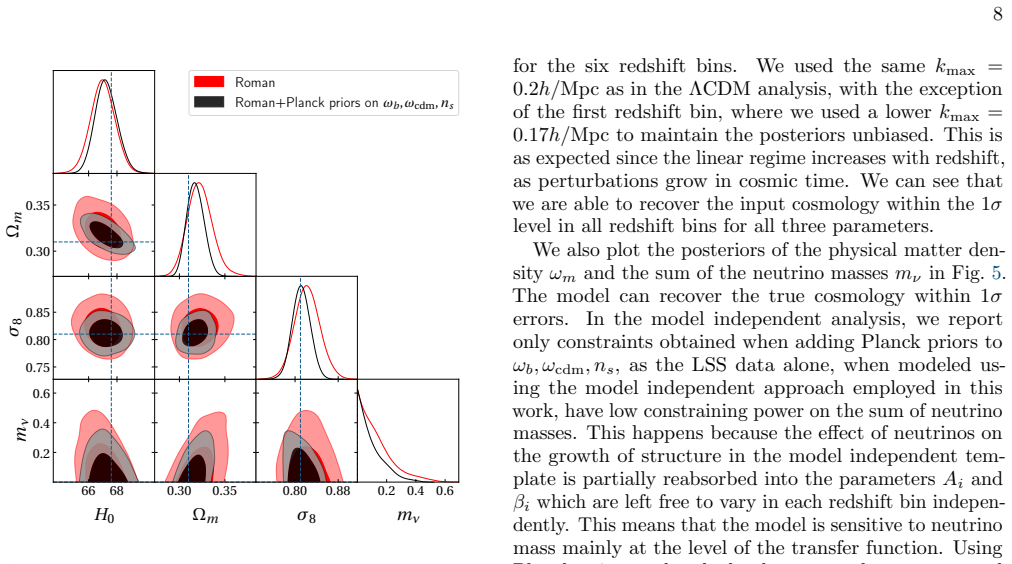
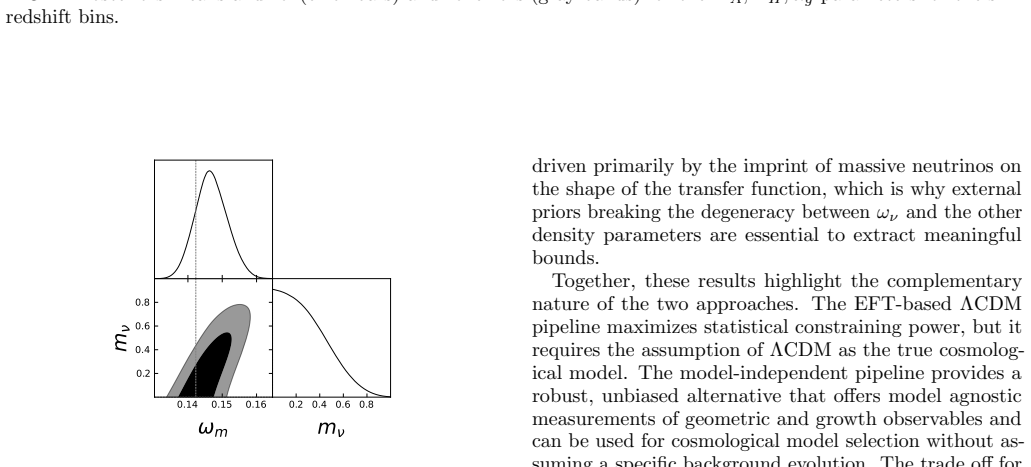
Using full-shape analyses of the galaxy power spectrum multipoles from simulated lightcone mock catalogs of H-alpha emission-line galaxies over 2400 square degrees and 0.5 < z < 2, the Lambda CDM analysis yields m_nu < 0.380 eV (0.162 eV) at 95% (68%) C.L. with BBN prior and broad n_s prior, tightening to m_nu < 0.276 eV (0.121 eV) with added Planck priors on omega_b, omega_cdm, and n_s; the same data also constrain H0 to 1.3%, Omega_m to 4.3%, and sigma_8 to 2.9%. The model-independent phenomenological approach recovers unbiased measurements of angular diameter distance, Hubble parameter, and growth of structure across redshift bins and produces m_nu < 0.63 eV (0.36 eV) at 95% (68%) C.L. in
What carries the argument
Full-shape analysis of galaxy power spectrum multipoles from simulated H-alpha galaxy lightcone mocks, performed via Effective Field Theory of Large-Scale Structure within Lambda CDM and via a model-independent phenomenological framework that fits angular diameter distance, Hubble parameter, and growth without assuming a background cosmology.
If this is right
- Roman data will constrain the Hubble constant to 1.3 percent precision, matter density to 4.3 percent, and sigma_8 to 2.9 percent.
- The sum of neutrino masses will be bounded at the level of 0.12 eV at 68 percent C.L. in the standard model when external priors are included.
- Unbiased measurements of angular diameter distance, Hubble parameter, and structure growth can be obtained across multiple redshift bins without assuming Lambda CDM.
- The resulting neutrino mass limits are comparable in strength to those expected from other Stage IV galaxy surveys.
Where Pith is reading between the lines
- These forecasts suggest that Roman measurements could be combined with CMB data to further tighten neutrino mass bounds and help address existing tensions in Hubble constant or sigma_8 values.
- The model-independent method opens a route to detect possible deviations from standard cosmology directly in the clustering statistics.
- Tighter neutrino mass limits from such surveys would narrow the allowed range for extensions of particle physics models involving massive neutrinos.
Load-bearing premise
The simulated lightcone mock catalogs must accurately reproduce the real properties, selection effects, and clustering of H-alpha galaxies in the actual Roman High Latitude Wide Area Spectroscopic Survey.
What would settle it
Analysis of real Roman telescope data yielding neutrino mass upper limits that differ substantially from the forecasted values of 0.276 eV or 0.63 eV at 68 percent C.L., or showing biased recovery of distance and growth parameters.
Figures



read the original abstract
We present realistic forecasts for the constraining power of the Nancy Grace Roman Space Telescope on fundamental cosmological parameters, with particular emphasis on the absolute neutrino mass scale, using full-shape analyzes of the galaxy power spectrum. We analyze simulated lightcone mock catalogs of H$\alpha$ emission-line galaxies spanning the redshift range $0.5 < z < 2$ over $2400\ \mathrm{deg}^2$, designed to reproduce the expected properties of the Roman High Latitude Wide Area Spectroscopic Survey. We perform parameter inference on the galaxy power spectrum multipoles using two complementary theoretical frameworks: a model-dependent approach based on the Effective Field Theory of Large-Scale Structure (EFT of LSS) within $\Lambda$CDM, and a model-independent phenomenological approach that makes no assumptions about the background cosmological model. In the $\Lambda$CDM analysis, we find $m_\nu < 0.380(0.162)\ \mathrm{eV}$ at $95(68)\%$ C.L. using Big Bang Nucleosynthesis (BBN) prior and a broad prior on $n_s$, which tightens to $m_\nu < 0.276(0.121)\ \mathrm{eV}$ when Planck priors on $\omega_b$, $\omega_\mathrm{cdm}$, and $n_s$ are added. Our forecasts show that Roman can additionally constrain $H_0$, $\Omega_m$, and $\sigma_8$ with precisions of $1.3\%$, $4.3\%$, and $2.9\%$ in line with Stage IV galaxy survey measurements and forecasts. In the model-independent analysis, we demonstrate that the phenomenological model can robustly recover unbiased measurements of the angular diameter distance, the Hubble parameter, and the growth of structure across all redshift bins, in the same range of scales as the EFT model, and obtain $m_\nu < 0.63(0.36)\ \mathrm{eV}$ at $95(68)\%$ C.L. when Planck priors are included.
Editorial analysis
A structured set of objections, weighed in public.
Referee Report
Summary. The manuscript presents forecasts for neutrino mass constraints from the Nancy Grace Roman Space Telescope's High Latitude Wide Area Spectroscopic Survey, using full-shape power spectrum multipole analysis of simulated Hα emission-line galaxy lightcone mocks spanning 0.5 < z < 2 over 2400 deg². It applies both an EFT-of-LSS model within ΛCDM (reporting m_ν < 0.380(0.162) eV at 95(68)% CL with BBN prior on ω_b and broad n_s prior, tightening to < 0.276(0.121) eV with added Planck priors) and a model-independent phenomenological approach (recovering unbiased DA(z), H(z), fσ8 and yielding m_ν < 0.63(0.36) eV with Planck priors), while also forecasting 1.3%, 4.3%, and 2.9% precision on H0, Ωm, and σ8.
Significance. If the mocks faithfully reproduce the survey's selection, redshift distribution, and clustering, the results would offer useful benchmarks for Roman's expected contribution to neutrino mass constraints alongside other Stage IV surveys, with the model-independent recovery providing a valuable cross-check on robustness without background cosmology assumptions.
major comments (2)
- [Mock catalog construction and validation] The central m_ν forecasts and parameter precisions are load-bearing on the fidelity of the simulated lightcone mock catalogs in reproducing the expected Hα luminosity function, completeness, redshift errors, scale-dependent bias, and clustering over 0.5 < z < 2. The manuscript should include quantitative validation (e.g., comparisons of monopole/quadrupole amplitudes or power spectrum residuals) to confirm the mocks match the Roman survey properties; without this, the reported limits such as m_ν < 0.380 eV cannot be considered fully reliable.
- [Power spectrum analysis and covariance estimation] The analysis applies specific scale cuts to the power spectrum multipoles and estimates the covariance from the mocks, but details on the exact k-range, justification for EFT validity, and covariance construction (including shot noise and fiber-collision effects) are insufficiently specified. These choices directly affect the posterior widths on m_ν, H0, Ωm, and σ8, and require explicit tests for robustness.
minor comments (2)
- [Abstract] The abstract could more clearly state the number of redshift bins used and the precise survey footprint to aid quick assessment of the forecast scope.
- [Notation and priors] Notation for parameters (e.g., ω_b, ω_cdm, n_s) and priors should be consistently defined and cross-referenced between text, tables, and figures.
Simulated Author's Rebuttal
We thank the referee for their detailed and constructive feedback on our manuscript forecasting neutrino mass constraints from the Roman Space Telescope. We address each of the major comments below and have revised the manuscript accordingly to enhance its clarity and robustness.
read point-by-point responses
-
Referee: [Mock catalog construction and validation] The central m_ν forecasts and parameter precisions are load-bearing on the fidelity of the simulated lightcone mock catalogs in reproducing the expected Hα luminosity function, completeness, redshift errors, scale-dependent bias, and clustering over 0.5 < z < 2. The manuscript should include quantitative validation (e.g., comparisons of monopole/quadrupole amplitudes or power spectrum residuals) to confirm the mocks match the Roman survey properties; without this, the reported limits such as m_ν < 0.380 eV cannot be considered fully reliable.
Authors: We acknowledge the importance of providing explicit validation for the mock catalogs to support the reliability of our forecasts. While the mocks were designed to reproduce the survey's Hα luminosity function, completeness, and clustering properties as detailed in the methods, we agree that quantitative comparisons were not sufficiently highlighted. In the revised manuscript, we will add a dedicated subsection presenting comparisons of the mock power spectrum multipoles (monopole and quadrupole) to theoretical expectations or survey requirements, including residuals and agreement metrics over the relevant scales and redshifts. This addition will directly address the concern and bolster confidence in the reported neutrino mass limits. revision: yes
-
Referee: [Power spectrum analysis and covariance estimation] The analysis applies specific scale cuts to the power spectrum multipoles and estimates the covariance from the mocks, but details on the exact k-range, justification for EFT validity, and covariance construction (including shot noise and fiber-collision effects) are insufficiently specified. These choices directly affect the posterior widths on m_ν, H0, Ωm, and σ8, and require explicit tests for robustness.
Authors: We appreciate this comment on the need for greater specificity in our analysis methodology. The scale cuts were set to k_max = 0.2 h Mpc^{-1} to remain within the regime where the EFT of LSS is valid, based on convergence tests from prior literature. The covariance matrix is computed directly from the ensemble of mock realizations, which inherently includes shot noise contributions, and fiber collisions are accounted for in the mock generation pipeline. To improve the manuscript, we will expand the 'Analysis' section with explicit statements of the k-range used (0.01 < k < 0.2 h/Mpc), additional justification for the EFT validity including references to perturbation theory scales, and a more detailed description of the covariance estimation procedure. We will also include a robustness test by varying the scale cuts and showing the impact on parameter constraints. revision: yes
Circularity Check
No significant circularity: forecasts are derived outputs from mock fitting, not inputs by construction
full rationale
The paper generates simulated lightcone mocks to match expected Roman Hα survey properties, measures power spectrum multipoles, and fits them with EFT-of-LSS (within ΛCDM) or a model-independent phenomenological framework to obtain neutrino mass upper limits and other parameter constraints. These bounds (e.g., m_ν < 0.380 eV at 95% CL) are statistical outputs of the inference step rather than equivalent to any input by definition or renaming. The model-independent recovery of DA(z), H(z), and fσ8 is presented as validation of unbiased recovery on the same mocks, but does not reduce the central claims to self-definition or fitted inputs called predictions. No self-citation chains, uniqueness theorems, or ansatzes are invoked in a load-bearing way that collapses the derivation. The analysis remains self-contained against external benchmarks of mock fidelity and survey expectations.
Axiom & Free-Parameter Ledger
free parameters (2)
- BBN prior on ω_b
- Planck priors on ω_b, ω_cdm, n_s
axioms (2)
- domain assumption Mock catalogs faithfully reproduce Roman survey properties including galaxy bias and selection
- domain assumption EFT of LSS is valid on the scales used for the power spectrum multipoles
Reference graph
Works this paper leans on
-
[1]
The DESI Experiment Part I: Science,Targeting, and Survey Design
A. Aghamousaet al.(DESI), The DESI Experiment Part I: Science,Targeting, and Survey Design (2016), arXiv:1611.00036 [astro-ph.IM]
work page internal anchor Pith review arXiv 2016
-
[2]
Y. Mellieret al.(Euclid), Euclid. I. Overview of the Euclid mission (2024), arXiv:2405.13491 [astro-ph.CO]
-
[3]
Wide-Field InfrarRed Survey Telescope-Astrophysics Focused Telescope Assets WFIRST-AFTA 2015 Report
D. Spergel, N. Gehrels, C. Baltay, D. Bennett, J. Breck- inridge, M. Donahue, A. Dressler, B. Gaudi, T. Greene, O. Guyon,et al., Wide-field infrarred survey telescope- astrophysics focused telescope assets wfirst-afta 2015 re- port, arXiv preprint arXiv:1503.03757 (2015)
work page internal anchor Pith review Pith/arXiv arXiv 2015
-
[4]
Y. Wanget al., The High Latitude Spectroscopic Survey on the Nancy Grace Roman Space Telescope, Astrophys. J.928, 1 (2022), arXiv:2110.01829 [astro-ph.CO]
-
[5]
Y. Fukudaet al.(Super-Kamiokande), Evidence for oscil- lation of atmospheric neutrinos, Phys. Rev. Lett.81, 1562 (1998), arXiv:hep-ex/9807003
- [6]
- [7]
-
[8]
DESI DR2 Results II: Measurements of Baryon Acoustic Oscillations and Cosmological Constraints
M. Abdul Karimet al.(DESI), DESI DR2 results. II. Measurements of baryon acoustic oscillations and cos- mological constraints, Phys. Rev. D112, 083515 (2025), arXiv:2503.14738 [astro-ph.CO]
work page Pith review arXiv 2025
- [9]
-
[10]
Cosmological Non-Linearities as an Effective Fluid
D. Baumann, A. Nicolis, L. Senatore, and M. Zaldarriaga, Cosmological Non-Linearities as an Effective Fluid, JCAP 07, 051, arXiv:1004.2488 [astro-ph.CO]
-
[11]
J. J. M. Carrasco, M. P. Hertzberg, and L. Senatore, The Effective Field Theory of Cosmological Large Scale Structures, JHEP09, 082, arXiv:1206.2926 [astro-ph.CO]
-
[12]
G. D’Amico, J. Gleyzes, N. Kokron, K. Markovic, L. Sen- atore, P. Zhang, F. Beutler, and H. Gil-Mar´ ın, The Cos- mological Analysis of the SDSS/BOSS data from the Effective Field Theory of Large-Scale Structure, JCAP 05, 005, arXiv:1909.05271 [astro-ph.CO]
- [13]
- [14]
- [15]
-
[16]
A. Chudaykin, M. M. Ivanov, and O. H. E. Philcox, Rean- alyzing DESI DR1. I. ΛCDM constraints from the power spectrum and bispectrum, Phys. Rev. D113, 063502 (2026), arXiv:2507.13433 [astro-ph.CO]
-
[17]
Large-Scale Structure of the Universe and Cosmological Perturbation Theory
F. Bernardeau, S. Colombi, E. Gaztanaga, and R. Scoc- cimarro, Large scale structure of the universe and cos- mological perturbation theory, Phys. Rept.367, 1 (2002), arXiv:astro-ph/0112551
work page Pith review arXiv 2002
-
[18]
J. Lesgourgues and S. Pastor, Massive neutrinos and cosmology, Phys. Rept.429, 307 (2006), arXiv:astro- ph/0603494
- [19]
-
[20]
M. Garny and P. Taule, Loop corrections to the power spectrum for massive neutrino cosmologies with full time- and scale-dependence, JCAP01, 020, arXiv:2008.00013 [astro-ph.CO]
-
[21]
M. Garny and P. Taule, Two-loop power spectrum with full time- and scale-dependence and EFT corrections: impact of massive neutrinos and going beyond EdS, JCAP 09, 054, arXiv:2205.11533 [astro-ph.CO]
- [22]
- [23]
-
[24]
M. Mauset al., A comparison of effective field theory models of redshift space galaxy power spectra for DESI 2024 and future surveys, JCAP01, 134, arXiv:2404.07272 [astro-ph.CO]
-
[25]
J. R. Bond, G. Efstathiou, and J. Silk, Massive Neutrinos and the Large Scale Structure of the Universe, Phys. Rev. Lett.45, 1980 (1980)
1980
-
[26]
V. Desjacques, D. Jeong, and F. Schmidt, Large-Scale Galaxy Bias, Phys. Rept.733, 1 (2018), arXiv:1611.09787 [astro-ph.CO]
work page Pith review arXiv 2018
- [27]
-
[28]
A. Raccanelli, L. Verde, and F. Villaescusa-Navarro, Bi- ases from neutrino bias: to worry or not to worry?, Mon. Not. Roy. Astron. Soc.483, 734 (2019), arXiv:1704.07837 [astro-ph.CO]
-
[29]
F. Villaescusa-Navarro, F. Marulli, M. Viel, E. Branchini, E. Castorina, E. Sefusatti, and S. Saito, Cosmology with massive neutrinos I: towards a realistic modeling of the relation between matter, haloes and galaxies, JCAP03, 011, arXiv:1311.0866 [astro-ph.CO]
-
[30]
E. Castorina, E. Sefusatti, R. K. Sheth, F. Villaescusa- Navarro, and M. Viel, Cosmology with massive neutrinos II: on the universality of the halo mass function and bias, JCAP02, 049, arXiv:1311.1212 [astro-ph.CO]
-
[31]
M. Costanzi, F. Villaescusa-Navarro, M. Viel, J.-Q. Xia, S. Borgani, E. Castorina, and E. Sefusatti, Cosmol- ogy with massive neutrinos III: the halo mass function and an application to galaxy clusters, JCAP12, 012, arXiv:1311.1514 [astro-ph.CO]
- [32]
- [33]
-
[34]
LoVerde, Spherical collapse inνΛCDM, Phys
M. LoVerde, Spherical collapse inνΛCDM, Phys. Rev. D 90, 083518 (2014), arXiv:1405.4858 [astro-ph.CO]
-
[35]
LoVerde, Neutrino mass without cosmic variance, Phys
M. LoVerde, Neutrino mass without cosmic variance, Phys. Rev. D93, 103526 (2016), arXiv:1602.08108 [astro- ph.CO]
-
[36]
LoVerde, Halo bias in mixed dark matter cosmologies, Phys
M. LoVerde, Halo bias in mixed dark matter cosmologies, Phys. Rev. D90, 083530 (2014), arXiv:1405.4855 [astro- ph.CO]
-
[37]
F. Verdiani, E. Bellini, C. Moretti, E. Sefusatti, C. Car- bone, and M. Viel, Redshift-space distortions in massive neutrinos cosmologies, Phys. Rev. D112, 043545 (2025), arXiv:2503.06655 [astro-ph.CO]
-
[38]
A. Chudaykin, M. M. Ivanov, O. H. E. Philcox, and M. Simonovi´ c, Nonlinear perturbation theory extension of the Boltzmann code CLASS, Phys. Rev. D102, 063533 (2020), arXiv:2004.10607 [astro-ph.CO]
-
[39]
The Effective Field Theory of Large-Scale Structure in the presence of Massive Neutrinos,
L. Senatore and M. Zaldarriaga, The Effective Field The- ory of Large-Scale Structure in the presence of Massive Neutrinos (2017), arXiv:1707.04698 [astro-ph.CO]
-
[40]
M. Schmittfull, M. Simonovi´ c, V. Assassi, and M. Zal- darriaga, Modeling Biased Tracers at the Field Level, Phys. Rev. D100, 043514 (2019), arXiv:1811.10640 [astro- ph.CO]
- [41]
-
[42]
On the IR-Resummation in the EFTofLSS,
L. Senatore and G. Trevisan, On the IR-Resummation in the EFTofLSS, JCAP05, 019, arXiv:1710.02178 [astro- ph.CO]
-
[43]
L. Senatore and M. Zaldarriaga, The IR-resummed Ef- fective Field Theory of Large Scale Structures, JCAP02, 013, arXiv:1404.5954 [astro-ph.CO]
- [44]
-
[45]
T. Baldauf, M. Mirbabayi, M. Simonovi´ c, and M. Zal- darriaga, Equivalence Principle and the Baryon Acoustic Peak, Phys. Rev. D92, 043514 (2015), arXiv:1504.04366 [astro-ph.CO]
-
[46]
T. Nishimichi, G. D’Amico, M. M. Ivanov, L. Senatore, M. Simonovi´ c, M. Takada, M. Zaldarriaga, and P. Zhang, Blinded challenge for precision cosmology with large- scale structure: results from effective field theory for the redshift-space galaxy power spectrum, Phys. Rev. D 102, 123541 (2020), arXiv:2003.08277 [astro-ph.CO]
-
[47]
G. D’Amico, L. Senatore, and P. Zhang, Limits onwCDM from the EFTofLSS with the PyBird code, JCAP01, 006, arXiv:2003.07956 [astro-ph.CO]
- [48]
- [49]
-
[50]
Accelerating Universes with Scaling Dark Matter
M. Chevallier and D. Polarski, Accelerating universes with scaling dark matter, Int. J. Mod. Phys. D10, 213 (2001), arXiv:gr-qc/0009008
work page Pith review arXiv 2001
- [51]
- [52]
-
[53]
Y. Wang, Modelling galaxy clustering on small scales to tighten constraints on dark energy and modified gravity, Mon. Not. Roy. Astron. Soc.464, 3005 (2017), arXiv:1606.08054 [astro-ph.CO]
-
[54]
Z. Zhai, C.-H. Chuang, Y. Wang, A. Benson, and G. Yepes, Clustering in the simulated Hαgalaxy redshift survey from Nancy Grace Roman Space Telescope, Mon. Not. Roy. Astron. Soc.501, 3490 (2021), arXiv:2008.09746 [astro-ph.CO]
- [55]
-
[56]
G. D’Amico, M. Marinucci, M. Pietroni, and F. Vernizzi, The large scale structure bootstrap: perturbation the- ory and bias expansion from symmetries, JCAP10, 069, arXiv:2109.09573 [astro-ph.CO]
-
[57]
M. Marinucci, K. Pardede, and M. Pietroni, Bootstrap- ping Lagrangian perturbation theory for the large scale structure, JCAP10, 051, arXiv:2405.08413 [astro-ph.CO]
- [58]
-
[59]
L. Amendola, M. Marinucci, M. Pietroni, and M. Quar- tin, Improving precision and accuracy in cosmology with model-independent spectrum and bispectrum, JCAP01, 001, arXiv:2307.02117 [astro-ph.CO]
-
[60]
S. Brieden, H. Gil-Mar´ ın, and L. Verde, ShapeFit: ex- tracting the power spectrum shape information in galaxy surveys beyond BAO and RSD, JCAP12(12), 054, arXiv:2106.07641 [astro-ph.CO]
-
[61]
S. Brieden, H. Gil-Mar´ ın, and L. Verde, PT challenge: validation of ShapeFit on large-volume, high-resolution mocks, JCAP06(06), 005, arXiv:2201.08400 [astro- ph.CO]
- [62]
- [63]
-
[64]
J. A. Peacock and M. J. West, The power spectrum of Abell cluster correlations., Mon. Not. Roy. Astron. Soc. 259, 494 (1992)
1992
- [65]
- [66]
-
[67]
Y. Wang, C.-H. Chuang, and C. M. Hirata, Towards more realistic forecasting of dark energy constraints from galaxy 12 redshift surveys, Mon. Not. Roy. Astron. Soc.430, 2446 (2013), arXiv:1211.0532 [astro-ph.CO]
- [68]
-
[69]
Alcock and B
C. Alcock and B. Paczynski, An evolution free test for non-zero cosmological constant, Nature281, 358 (1979)
1979
-
[70]
F. Beutleret al.(BOSS), The clustering of galaxies in the completed SDSS-III Baryon Oscillation Spectroscopic Sur- vey: Anisotropic galaxy clustering in Fourier-space, Mon. Not. Roy. Astron. Soc.466, 2242 (2017), arXiv:1607.03150 [astro-ph.CO]
-
[71]
S. Zaroubi and Y. Hoffman, Clustering in redshift space: Power spectrum (1993), arXiv:astro-ph/9311013
-
[72]
A. Raccanelli and Z. Vlah, Power spectrum in the cave (2023), arXiv:2305.16278 [astro-ph.CO]
-
[73]
A. Raccanelli and Z. Vlah, Observed power spectrum and frequency-angular power spectrum, Phys. Rev. D108, 043537 (2023), arXiv:2306.00808 [astro-ph.CO]
-
[74]
F. Spezzati, E. Vanzan, A. Raccanelli, Z. Vlah, and D. Bertacca, Observed unequal-time power spectrum, Phys. Rev. D112, 023530 (2025), arXiv:2503.09759 [astro- ph.CO]
-
[75]
F. Beutler and P. McDonald, Unified galaxy power spec- trum measurements from 6dFGS, BOSS, and eBOSS, JCAP11, 031, arXiv:2106.06324 [astro-ph.CO]
- [76]
-
[77]
F. Beutler, E. Castorina, and P. Zhang, Interpreting measurements of the anisotropic galaxy power spectrum, JCAP03, 040, arXiv:1810.05051 [astro-ph.CO]
- [78]
-
[79]
Heitmannet al., The Last Journey
K. Heitmannet al., The Last Journey. I. An Extreme- Scale Simulation on the Mira Supercomputer, Astrophys. J. Suppl.252, 19 (2021), arXiv:2006.01697 [astro-ph.CO]
-
[80]
Planck 2018 results. VI. Cosmological parameters
N. Aghanimet al.(Planck), Planck 2018 results. VI. Cosmological parameters, Astron. Astrophys.641, A6 (2020), [Erratum: Astron.Astrophys. 652, C4 (2021)], arXiv:1807.06209 [astro-ph.CO]
work page Pith review arXiv 2018
discussion (0)
Sign in with ORCID, Apple, or X to comment. Anyone can read and Pith papers without signing in.