Recognition: unknown
Bridging Standardized Codebook and Site-Specific Beamforming: A Unified Limited-Feedback Framework
Pith reviewed 2026-05-10 11:13 UTC · model grok-4.3
The pith
Embedding a learned site-specific propagation prior into Type-II CSI feedback lets the base station infer each user's dominant beam subspace from low-overhead RSRP data, so the user equipment reports only low-dimensional coefficients.
A machine-rendered reading of the paper's core claim, the machinery that carries it, and where it could break.
Core claim
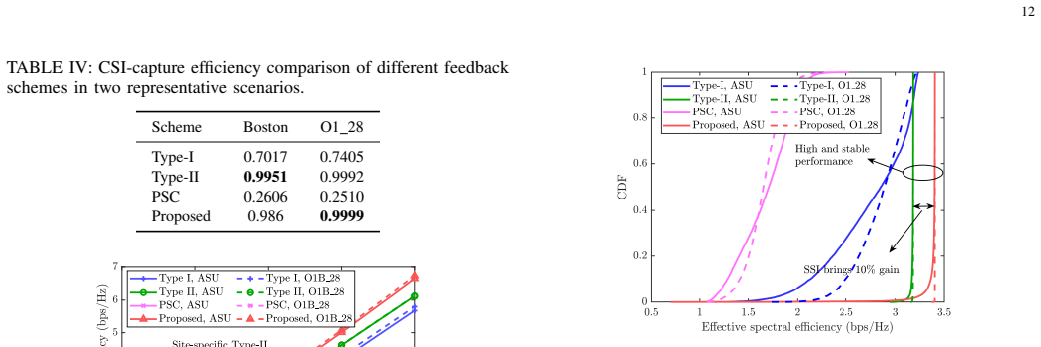
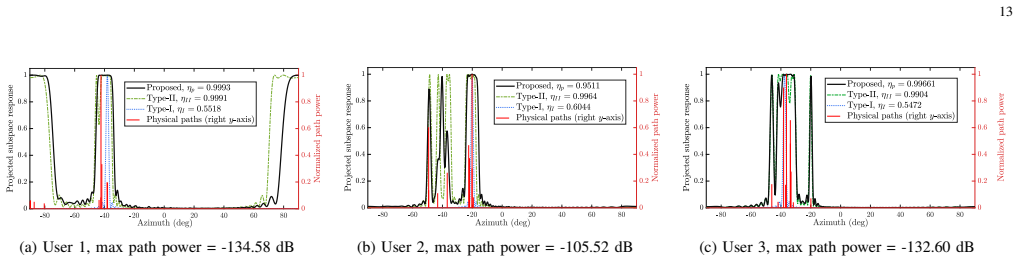
By using the RSRP fingerprint collected during SSB probing to infer a UE-dependent dominant beam subspace before explicit CSI acquisition, the UE can estimate and feed back only the low-dimensional effective channel coefficients within this inferred subspace, avoiding full-dimensional online subspace discovery while retaining a rich multi-beam representation; the unified subspace-projection framework shows that this yields Type-II-comparable CSI-capture capability with lower overhead and complexity, improving effective spectral efficiency.
What carries the argument
The unified subspace-projection framework that jointly characterizes CSI acquisition, UE-side compression, BS-side reconstruction, and effective spectral efficiency by interpreting each feedback scheme as a distinct way of inducing a representation subspace, together with the end-to-end optimization of the coupled probing codebook and BS-side subspace inference network.
If this is right
- The scheme retains rich multi-beam representation capability while avoiding full-dimensional online subspace discovery.
- It achieves Type-II-comparable CSI-capture capability with substantially lower online overhead and UE-side complexity.
- Effective spectral efficiency improves because the reduced feedback dimensionality frees resources for data transmission.
- Under the same unified framework, Type-I, Type-II, port-selection, and the proposed scheme appear as different choices of representation subspace.
Where Pith is reading between the lines
- The reduced UE-side complexity could allow simpler hardware implementations or lower power consumption at the user equipment.
- Frequent updates to the inferred subspaces using ongoing RSRP measurements might support higher mobility scenarios without re-triggering full CSI acquisition.
- The same subspace-inference idea could be tested in multi-cell coordinated beamforming settings where neighboring sites share propagation priors.
Load-bearing premise
A low-overhead RSRP fingerprint collected during SSB probing is sufficient to reliably infer a user-equipment-dependent dominant beam subspace before explicit CSI acquisition.
What would settle it
A measurement campaign in which the beamforming gain or effective spectral efficiency obtained from the RSRP-inferred subspace is markedly lower than that obtained from full Type-II feedback across multiple realistic site-specific channel traces.
Figures



read the original abstract
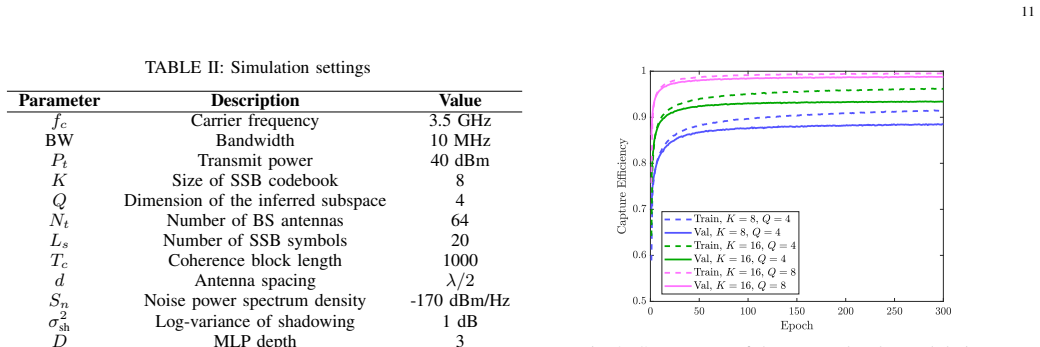
A site-specific Type-II codebook design is proposed for downlink massive multiple-input multiple-output (MIMO) limited-feedback beamforming. The key idea is to embed a learned site-specific propagation prior into the Type-II channel state information (CSI) feedback pipeline. Specifically, the base station (BS) uses a low-overhead reference signal received power (RSRP) fingerprint collected during synchronization signal block (SSB) probing to infer a user equipment (UE)-dependent dominant beam subspace before explicit CSI acquisition. The UE then estimates and feeds back only the low-dimensional effective channel coefficients within this inferred subspace, thereby avoiding full-dimensional online subspace discovery while retaining a rich multi-beam representation capability. To analyze the proposed design and compare it with standardized feedback mechanisms, a unified subspace-projection framework is developed by jointly characterizing CSI acquisition, UE-side compression, BS-side reconstruction, and effective spectral efficiency. Under this framework, Type-I, Type-II, port-selection feedback, and the proposed scheme are interpreted as different ways of inducing a feedback representation subspace. The probing codebook and the BS-side subspace inference network are then formulated as a coupled task-oriented design problem and are optimized end-to-end by maximizing the normalized CSI-capture efficiency. Extensive simulation results demonstrate that the proposed feedback scheme achieves Type-II-comparable CSI-capture capability with substantially lower online overhead and UE-side complexity, thereby improving the effective spectral efficiency.
Editorial analysis
A structured set of objections, weighed in public.
Referee Report
Summary. The manuscript proposes a site-specific Type-II codebook design for downlink massive MIMO limited-feedback beamforming. The BS infers a UE-dependent dominant beam subspace from low-overhead RSRP fingerprints collected during SSB probing; the UE then estimates and feeds back only the low-dimensional effective channel coefficients within this subspace. A unified subspace-projection framework is introduced to jointly characterize CSI acquisition, UE-side compression, BS-side reconstruction, and effective spectral efficiency, interpreting Type-I, Type-II, port-selection, and the proposed scheme as different subspace inductions. The probing codebook and BS-side inference network are formulated as a coupled task-oriented design problem and optimized end-to-end by maximizing normalized CSI-capture efficiency. Extensive simulations are reported to show that the scheme achieves Type-II-comparable CSI capture at substantially lower online overhead and UE-side complexity, thereby improving effective spectral efficiency.
Significance. If the inference reliability and performance claims hold under realistic conditions, the work provides a concrete bridge between standardized codebooks and site-specific beamforming. The unified subspace-projection framework offers a systematic way to compare feedback mechanisms and could inform future 3GPP enhancements. The end-to-end optimization of probing codebook and inference network is a notable technical contribution when accompanied by independent validation.
major comments (3)
- [Abstract / simulation results] Abstract and simulation results: the central performance claim that the scheme achieves 'Type-II-comparable CSI-capture capability' rests on the RSRP fingerprint reliably inferring the UE-specific dominant beam subspace. However, RSRP measurements are scalar power sums and are therefore sensitive to noise, small-scale fading, and propagation mismatch; the manuscript must quantify inference error rates (e.g., subspace overlap or missed-path probability) across SNR regimes and site variations, together with the resulting degradation in normalized CSI-capture efficiency, to substantiate the spectral-efficiency gain.
- [Abstract] Abstract: the end-to-end optimization maximizes normalized CSI-capture efficiency, which is defined in terms of the subspace projection produced by the scheme itself. This introduces circularity risk; the reported gains over Type-II may be inflated unless the paper provides an independent metric (e.g., ergodic rate on held-out channels or comparison against an oracle subspace) or an ablation study that isolates the contribution of the learned inference network from the subspace-projection framework.
- [unified subspace-projection framework] Unified subspace-projection framework: while the framework allows uniform comparison, the manuscript should explicitly state how the normalized CSI-capture efficiency is computed for the standardized Type-II baseline (including its codebook size and compression ratio) to ensure the overhead and complexity reductions claimed for the proposed scheme are measured on an apples-to-apples basis.
minor comments (2)
- [Abstract] The abstract refers to 'extensive simulation results' but does not specify the channel model, number of Monte-Carlo trials, or error-bar reporting; these details should be added for reproducibility.
- [unified framework / optimization] Notation for the subspace inference network parameters and the normalized CSI-capture efficiency metric should be introduced with explicit definitions before their use in the optimization formulation.
Simulated Author's Rebuttal
We thank the referee for the constructive and insightful comments, which help strengthen the validation of our claims. We address each major comment point by point below, indicating the revisions we will incorporate in the next version of the manuscript.
read point-by-point responses
-
Referee: [Abstract / simulation results] Abstract and simulation results: the central performance claim that the scheme achieves 'Type-II-comparable CSI-capture capability' rests on the RSRP fingerprint reliably inferring the UE-specific dominant beam subspace. However, RSRP measurements are scalar power sums and are therefore sensitive to noise, small-scale fading, and propagation mismatch; the manuscript must quantify inference error rates (e.g., subspace overlap or missed-path probability) across SNR regimes and site variations, together with the resulting degradation in normalized CSI-capture efficiency, to substantiate the spectral-efficiency gain.
Authors: We agree that explicit quantification of inference reliability is essential to substantiate the central claims. In the revised manuscript, we will add a dedicated subsection and accompanying figures that report subspace overlap ratios and missed-path probabilities as functions of SNR (across multiple regimes) and across different site configurations. We will also include plots showing the resulting degradation in normalized CSI-capture efficiency attributable to inference errors. These additions will directly demonstrate robustness to noise, small-scale fading, and propagation mismatch while preserving the reported spectral-efficiency gains. revision: yes
-
Referee: [Abstract] Abstract: the end-to-end optimization maximizes normalized CSI-capture efficiency, which is defined in terms of the subspace projection produced by the scheme itself. This introduces circularity risk; the reported gains over Type-II may be inflated unless the paper provides an independent metric (e.g., ergodic rate on held-out channels or comparison against an oracle subspace) or an ablation study that isolates the contribution of the learned inference network from the subspace-projection framework.
Authors: The referee correctly identifies a potential circularity risk. In the revision, we will augment the evaluation with independent metrics: (i) ergodic rate computed on held-out test channels using the reconstructed CSI, and (ii) a direct comparison against an oracle subspace that has perfect knowledge of the true dominant beams. We will also add an ablation study that isolates the learned inference network's contribution by comparing against a non-learned baseline subspace selection. These results will be presented alongside the original normalized CSI-capture efficiency curves to confirm that the reported gains are not artifacts of the optimization metric. revision: yes
-
Referee: [unified subspace-projection framework] Unified subspace-projection framework: while the framework allows uniform comparison, the manuscript should explicitly state how the normalized CSI-capture efficiency is computed for the standardized Type-II baseline (including its codebook size and compression ratio) to ensure the overhead and complexity reductions claimed for the proposed scheme are measured on an apples-to-apples basis.
Authors: We will revise the manuscript to explicitly detail the computation of normalized CSI-capture efficiency for the Type-II baseline. This includes specifying the exact codebook size (number of beams and feedback bits), the compression ratio employed, and confirming that the identical metric formula—derived from the unified subspace-projection framework—is applied uniformly to all schemes, including Type-I, port-selection, and the proposed method. A table summarizing these parameters will be added to ensure transparent, apples-to-apples comparisons. revision: yes
Circularity Check
Moderate self-referentiality in end-to-end optimization of subspace inference via CSI-capture efficiency
specific steps
-
self definitional
[Abstract (unified subspace-projection framework and optimization paragraph)]
"The probing codebook and the BS-side subspace inference network are then formulated as a coupled task-oriented design problem and are optimized end-to-end by maximizing the normalized CSI-capture efficiency. ... Under this framework, Type-I, Type-II, port-selection feedback, and the proposed scheme are interpreted as different ways of inducing a feedback representation subspace."
Normalized CSI-capture efficiency is defined inside the subspace-projection framework as the effectiveness of CSI acquisition, compression, and reconstruction within the induced feedback representation subspace. Because the proposed scheme's subspace is exactly the output of the inference network being optimized, the end-to-end maximization operates on a performance metric whose value is constructed from the same subspace the scheme itself selects, reducing the claimed performance gain to an optimization tautology for the proposed method.
full rationale
The paper's derivation proceeds from RSRP-based subspace inference to a unified projection framework that treats all feedback schemes as subspace inducers, then optimizes the probing codebook and inference network by maximizing normalized CSI-capture efficiency. This metric is defined directly on the quality of the induced subspace projection and effective channel coefficients within it. While simulations compare against Type-II under the same framework and the RSRP inference step has independent physical motivation, the optimization objective is constructed from the same subspace representation the network produces, creating partial self-definitional dependence. No load-bearing self-citations or imported uniqueness theorems appear; the central claim retains independent simulation validation.
Axiom & Free-Parameter Ledger
free parameters (1)
- subspace inference network parameters
axioms (1)
- domain assumption RSRP fingerprint collected during SSB probing reliably indicates the UE-dependent dominant beam subspace.
Reference graph
Works this paper leans on
-
[1]
An overview of signal processing techniques for millimeter wave mimo systems,
R. W. Heath, N. Gonz ´alez-Prelcic, S. Rangan, W. Roh, and A. M. Say- eed, “An overview of signal processing techniques for millimeter wave mimo systems,”IEEE Journal of Selected Topics in Signal Processing, vol. 10, no. 3, pp. 436–453, Apr. 2016
2016
-
[2]
How much training is needed in multiple-antenna wireless links?
B. Hassibi and B. M. Hochwald, “How much training is needed in multiple-antenna wireless links?”IEEE Trans. Inf. Theory, vol. 49, no. 4, pp. 951–963, Apr. 2003
2003
-
[3]
An overview of limited feedback in wireless commu- nication systems,
D. J. Love, R. W. Heath, V . K. N. Lau, D. Gesbert, B. D. Rao, and M. Andrews, “An overview of limited feedback in wireless commu- nication systems,”IEEE J. Sel. Areas Commun., vol. 26, no. 8, pp. 1341–1365, Oct. 2008
2008
-
[4]
NR; physical layer procedures for data,
3GPP, “NR; physical layer procedures for data,” 3rd Generation Part- nership Project (3GPP), Technical Specification TS 38.214, 2018
2018
-
[5]
A tutorial on beam management for 3GPP NR at mmwave frequencies,
M. Giordani, M. Polese, A. Roy, D. Castor, and M. Zorzi, “A tutorial on beam management for 3GPP NR at mmwave frequencies,”IEEE Commun. Surv. Tutorials, vol. 21, no. 1, pp. 173–196, Sep. 2019
2019
-
[6]
A tutorial on downlink precoder selection strategies for 3GPP MIMO codebooks,
X. Fu, D. Le Ruyet, R. Visoz, V . Ramireddy, M. Grossmann, M. Land- mann, and W. Quiroga, “A tutorial on downlink precoder selection strategies for 3GPP MIMO codebooks,”IEEE Access, vol. 11, pp. 138 897–138 922, Dec. 2023
2023
-
[7]
Machine learning codebook design for initial access and CSI type-II feedback in sub-6-GHz 5G NR,
R. M. Dreifuerst and R. W. Heath, “Machine learning codebook design for initial access and CSI type-II feedback in sub-6-GHz 5G NR,”IEEE Trans. Wireless Commun., vol. 23, no. 6, pp. 6411–6424, Jun. 2024
2024
-
[8]
Neural codebook design for MIMO network beam management,
——, “Neural codebook design for MIMO network beam management,” IEEE Trans. Wireless Commun., vol. 24, no. 5, pp. 3909–3922, May 2025
2025
-
[9]
Learning site-specific probing beams for fast mmwave beam alignment,
Y . Heng, J. Mo, and J. G. Andrews, “Learning site-specific probing beams for fast mmwave beam alignment,”IEEE Trans. Wireless Com- mun., vol. 21, no. 8, pp. 5785–5800, Jan. 2022
2022
-
[10]
Grid-free MIMO beam alignment through site-specific deep learning,
Y . Heng and J. G. Andrews, “Grid-free MIMO beam alignment through site-specific deep learning,”IEEE Trans. Wireless Commun., vol. 23, no. 2, pp. 908–921, Feb. 2024
2024
-
[11]
Learning beams adaptive to the environment: An RSRP-based code- book design,
X. Ning, S. Zhang, Y . Xue, X. Zheng, Q. Shi, and T.-H. Chang, “Learning beams adaptive to the environment: An RSRP-based code- book design,” inProc. IEEE Int. Workshop Signal Process. Adv. Wireless Commun. (SPAWC), 2023, pp. 521–525
2023
-
[12]
Environment-aware hybrid beamforming by leveraging channel knowledge map,
D. Wu, Y . Zeng, S. Jin, and R. Zhang, “Environment-aware hybrid beamforming by leveraging channel knowledge map,”IEEE Trans. Wireless Commun., vol. 23, no. 5, pp. 4990–5005, Oct. 2024
2024
-
[13]
Generative site-specific beam- forming via information-maximizing codebook,
C.-J. Zhao, Z. Wang, and Y . Liu, “Generative site-specific beam- forming via information-maximizing codebook,”arXiv preprint arXiv:2602.12552, 2026
-
[14]
Generative site-specific beamforming for next-generation spatial intelligence,
Z. Wang, Z. Zhou, C.-J. Zhao, and Y . Liu, “Generative site-specific beamforming for next-generation spatial intelligence,”arXiv preprint arXiv:2601.02301, 2026
-
[15]
Spatially sparse precoding in millimeter wave MIMO systems,
O. E. Ayach, S. Rajagopal, S. Abu-Surra, Z. Pi, and R. W. Heath, “Spatially sparse precoding in millimeter wave MIMO systems,”IEEE Trans. Wireless Commun., vol. 13, no. 3, pp. 1499–1513, Mar. 2014
2014
-
[16]
NR; physical channels and modulation,
3GPP, “NR; physical channels and modulation,” 3rd Generation Part- nership Project (3GPP), Technical Specification TS 38.211, 2018
2018
-
[17]
NR; physical layer measurements,
——, “NR; physical layer measurements,” 3rd Generation Partnership Project (3GPP), Technical Specification TS 38.215, 2018
2018
-
[18]
Massive MIMO for next generation wireless systems,
E. G. Larsson, O. Edfors, F. Tufvesson, and T. L. Marzetta, “Massive MIMO for next generation wireless systems,”IEEE Commun. Mag., vol. 52, no. 2, pp. 186–195, Feb. 2014
2014
-
[19]
J. L. Ba, J. R. Kiros, and G. E. Hinton, “Layer normalization,”arXiv preprint arXiv:1607.06450, 2016
work page internal anchor Pith review Pith/arXiv arXiv 2016
-
[20]
Gaussian Error Linear Units (GELUs)
D. Hendrycks and K. Gimpel, “Gaussian error linear units (GELUs),” arXiv preprint arXiv:1606.08415, 2016
work page Pith review arXiv 2016
-
[21]
Stochastic first- and zeroth-order methods for nonconvex stochastic programming,
S. Ghadimi and G. Lan, “Stochastic first- and zeroth-order methods for nonconvex stochastic programming,”SIAM J. Optim., vol. 23, no. 4, pp. 2341–2368, 2013
2013
-
[22]
DeepMIMO: A generic deep learning dataset for mil- limeter wave and massive MIMO applications,
A. Alkhateeb, “DeepMIMO: A generic deep learning dataset for mil- limeter wave and massive MIMO applications,” inProc. Inf. Theory Appl. Workshop (ITA), San Diego, CA, Feb. 2019, pp. 1–8
2019
discussion (0)
Sign in with ORCID, Apple, or X to comment. Anyone can read and Pith papers without signing in.