Recognition: unknown
Misaligned circumbinary discs around unequal-mass eccentric binaries: alignment, morphology, and binary accretion variability
Pith reviewed 2026-05-10 10:26 UTC · model grok-4.3
The pith
Initial tilt and mass ratio set which star accretes most from a misaligned circumbinary disc around an eccentric binary.
A machine-rendered reading of the paper's core claim, the machinery that carries it, and where it could break.
Core claim
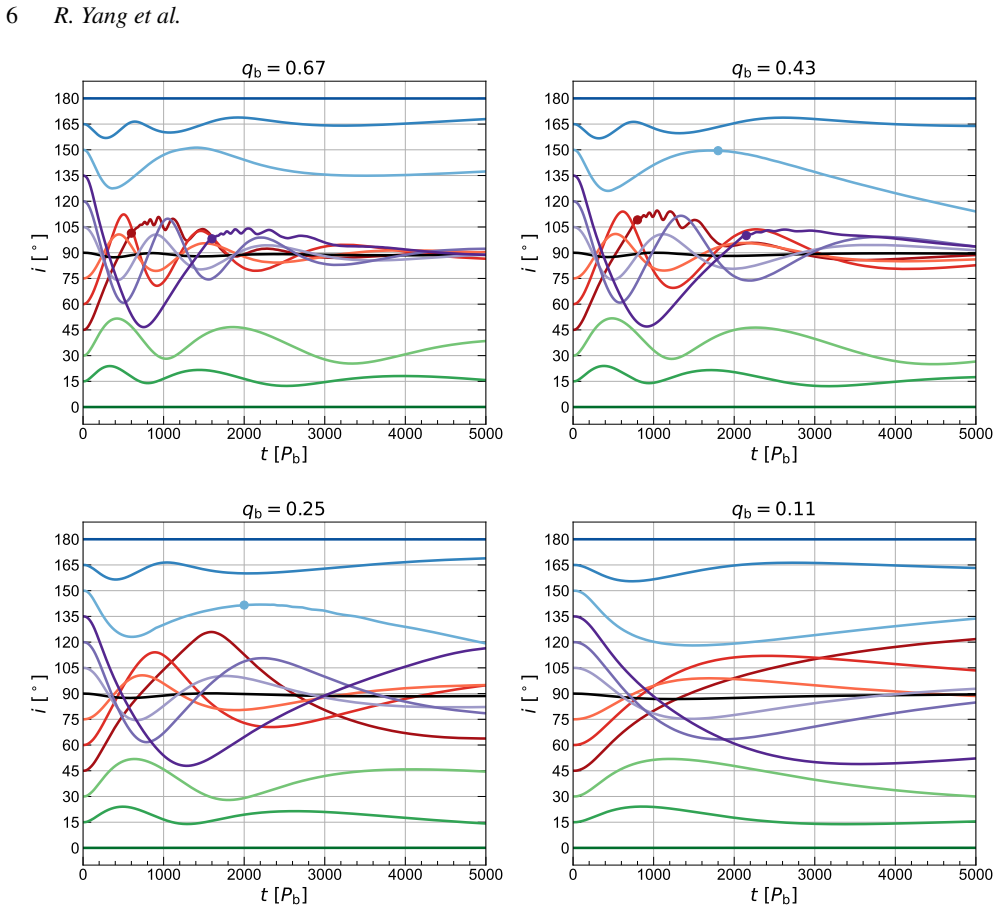
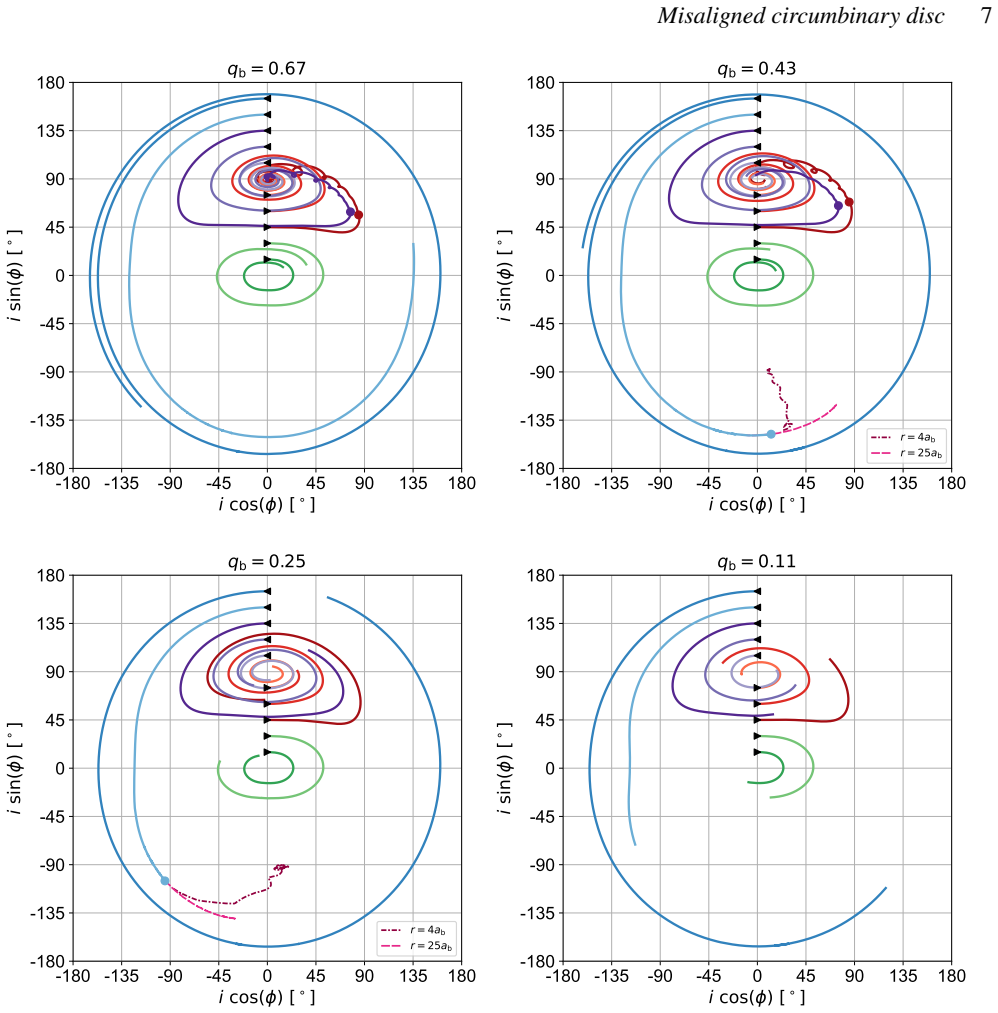
Simulations reveal that both initial disc tilt and binary mass ratio control long-term accretion variability: polar and coplanar retrograde alignments favor accretion onto the primary while coplanar prograde alignments favor the secondary, and the preferential accretion ratio η is a non-monotonic function of mass ratio that increases with decreasing mass ratio for near-prograde discs but decreases for intermediate tilts.
What carries the argument
3D hydrodynamical simulations that evolve disc tilt, morphology, and time-averaged mass accretion rates onto each binary component for varied initial tilts and mass ratios.
If this is right
- Discs near coplanar prograde alignment show stronger secondary accretion preference as the mass ratio decreases.
- Discs with initial tilts 30°–135° show weaker secondary preference at smaller mass ratios.
- Polar configurations produce the lowest overall disc mass-loss rates, slightly below those of prograde coplanar discs.
- Retrograde discs lose mass faster than prograde ones.
- Strong warping or breaking of the disc causes rapid mass loss.
Where Pith is reading between the lines
- The same tilt-dependent accretion rules could influence where planets form and grow in circumbinary systems.
- Changing the viscosity law or adding magnetic fields might shift the reported alignment endpoints and η values.
- Targeted observations of accretion signatures in known misaligned binaries could map tilt to dominant accretor.
Load-bearing premise
The alignment pathways and accretion preferences depend on the chosen initial disc conditions, binary eccentricity, and numerical hydrodynamical setup including viscosity.
What would settle it
Long-term monitoring of accretion rates onto each component in an eccentric binary with a measured disc tilt and mass ratio would test whether the predicted primary-versus-secondary preferences hold.
Figures



read the original abstract
Binary systems are ubiquitous in the Universe and often host circumbinary discs that are misaligned with the binary orbital plane. Such misalignments can affect disc evolution and binary accretion variability. We here present 3D hydrodynamical simulations of circumbinary discs with initial tilts $i_0$ from $0^\circ$ to $180^\circ$, around eccentric binaries with secondary-to-primary mass ratios of $0.11-0.67$. We find that both the initial tilt and mass ratio can affect the long-term accretion variability in our simulations. Discs evolving towards polar and coplanar retrograde generally favour accretion onto the primary star, while discs evolving towards coplanar prograde generally favour accretion onto the secondary. We find preferential accretion ratio $\eta=\langle\dot{M_2}\rangle/\langle\dot{M_\mathrm{b}}\rangle$ to be a non-monotonic function of the mass ratio. For discs close to coplanar prograde alignment, $\eta$ increases with decreasing mass ratio, whereas for discs with $30^\circ \le i_0 \le 135^\circ$, $\eta$ decreases for smaller mass ratios. Polar discs show the lowest mass loss rates, slightly lower than those of coplanar prograde discs, while retrograde discs lose mass faster than their prograde counterparts. Discs that undergo strong warping or breaking experience rapid mass loss. Our findings provide insights into observed circumbinary discs and have implications for circumbinary planet formation.
Editorial analysis
A structured set of objections, weighed in public.
Referee Report
Summary. The manuscript presents 3D hydrodynamical simulations of circumbinary discs with initial tilts i0 ranging from 0° to 180° around eccentric binaries with secondary-to-primary mass ratios q = 0.11–0.67. It reports that both initial tilt and mass ratio influence long-term alignment pathways (polar, coplanar prograde, or retrograde), which in turn produce distinct accretion biases: polar and retrograde discs favor the primary while prograde discs favor the secondary. The time-averaged preferential accretion ratio η = ⟨Ṁ₂⟩/⟨Ṁ_b⟩ is found to be non-monotonic in q, with opposite trends in the low-i0 and 30°–135° regimes; polar discs exhibit the lowest mass-loss rates and strongly warped discs the highest.
Significance. If the reported trends are numerically robust, the work supplies a concrete link between initial misalignment, alignment outcome, and accretion partitioning that is directly relevant to interpreting ALMA observations of misaligned circumbinary discs and to models of circumbinary planet formation. The non-monotonic η(q) behavior and the identification of distinct accretion preferences tied to alignment state constitute falsifiable predictions that could be tested against both observations and future simulations.
major comments (2)
- [Numerical methods and results] The central claims on accretion preferences and the non-monotonic dependence of η on mass ratio (abstract and results section) rest on a finite suite of 3D runs. The manuscript provides no convergence tests with respect to grid resolution, artificial viscosity coefficient, or sink-particle accretion radius. In circumbinary disc simulations these choices routinely affect cavity size, warp propagation speed, and time-averaged mass flux through the inner cavity; without such tests the robustness of the reported η values and the reversal of primary/secondary preference between tilt regimes cannot be verified.
- [Discussion] The discussion of limitations notes that long-term evolution depends on initial disc conditions, binary eccentricity, and hydrodynamical treatment, yet no quantitative sensitivity experiments (e.g., varying the viscosity prescription or adding magnetic fields) are shown. Because the headline non-monotonic η(q) result and the alignment–accretion mapping are extracted directly from the simulation outcomes, an explicit statement of the explored numerical parameter space or a brief resolution study is required to support the conclusions.
minor comments (2)
- [Abstract] The abstract states that polar discs show 'slightly lower' mass-loss rates than coplanar prograde discs; a quantitative comparison (e.g., a table of time-averaged Ṁ values) would make this statement more precise.
- [Notation] Notation for the total binary accretion rate is introduced as Ṁ_b in the abstract but is not defined in the text until the results section; a brief parenthetical definition on first use would improve readability.
Simulated Author's Rebuttal
We thank the referee for their thoughtful review and for highlighting the potential implications of our work for observations and planet formation. We address each major comment below and describe the revisions we will implement to improve the clarity and robustness of the numerical results.
read point-by-point responses
-
Referee: The central claims on accretion preferences and the non-monotonic dependence of η on mass ratio (abstract and results section) rest on a finite suite of 3D runs. The manuscript provides no convergence tests with respect to grid resolution, artificial viscosity coefficient, or sink-particle accretion radius. In circumbinary disc simulations these choices routinely affect cavity size, warp propagation speed, and time-averaged mass flux through the inner cavity; without such tests the robustness of the reported η values and the reversal of primary/secondary preference between tilt regimes cannot be verified.
Authors: We agree that dedicated convergence tests would strengthen confidence in the quantitative η values. Our simulations employed a uniform grid resolution, a fixed artificial viscosity coefficient, and a standard sink accretion radius chosen to be consistent with earlier circumbinary disc studies in the literature. Across the full suite of runs spanning q = 0.11–0.67 and i0 = 0°–180°, the qualitative trends in accretion preference (polar/retrograde favouring the primary, prograde favouring the secondary) and the non-monotonic behaviour of η(q) remain consistent, which we interpret as supporting robustness. Nevertheless, to directly address the concern we will add a dedicated subsection (or appendix) that (i) tabulates the exact numerical parameters used, (ii) reports a limited resolution study for two representative models (one polar, one prograde) run at 1.5× higher resolution, and (iii) discusses the impact on time-averaged mass fluxes. These additions will be included in the revised manuscript. revision: yes
-
Referee: The discussion of limitations notes that long-term evolution depends on initial disc conditions, binary eccentricity, and hydrodynamical treatment, yet no quantitative sensitivity experiments (e.g., varying the viscosity prescription or adding magnetic fields) are shown. Because the headline non-monotonic η(q) result and the alignment–accretion mapping are extracted directly from the simulation outcomes, an explicit statement of the explored numerical parameter space or a brief resolution study is required to support the conclusions.
Authors: We accept that the current discussion would benefit from a more explicit enumeration of the numerical parameter space that was actually explored. In the revised version we will expand the limitations paragraph to include a concise table or bullet list of the fixed and varied parameters (grid resolution, viscosity coefficient, sink radius, binary eccentricity held at the value used throughout, and the range of q and i0). We will also note that magnetic fields and alternative viscosity prescriptions lie outside the scope of the present hydrodynamical study but are natural extensions for future work. A brief resolution comparison (as described in response to the first comment) will be referenced here as well. These changes will better contextualise the reported η(q) behaviour without overstating the generality of the results. revision: yes
Circularity Check
No circularity: results are direct outputs of forward hydrodynamical simulations
full rationale
The paper reports outcomes from 3D hydrodynamical simulations initialized with specified tilts, mass ratios, and binary eccentricities. All reported alignment pathways, accretion variability, and the non-monotonic η function emerge from numerical evolution under standard hydro equations; no analytic derivation, parameter fitting to target data, or self-citation chain is used to obtain the central claims. The abstract and methods describe direct simulation results without reducing any prediction to its own inputs by construction.
Axiom & Free-Parameter Ledger
axioms (2)
- standard math The evolution of the disc is governed by the standard equations of hydrodynamics in three dimensions under the gravitational potential of the binary.
- domain assumption Initial disc conditions (surface density profile, temperature, tilt) remain representative of long-term behavior without additional physics such as magnetic fields or self-gravity.
Reference graph
Works this paper leans on
-
[1]
ALMA Partnership et al., 2015, @doi [ApJ] 10.1088/2041-8205/808/1/L3 , 808, L3
-
[2]
P., Chen, C., Smallwood, J., et al
Abod C. P., Chen C., Smallwood J., Rabago I., Martin R. G., Lubow S. H., 2022, @doi [MNRAS] 10.1093/mnras/stac2601 , 517, 732
-
[3]
Abuter R., et al., 2017, @doi [A&A] 10.1051/0004-6361/201730838 , 602, A94
-
[4]
Alencar S. H. P., Melo C. H. F., Dullemond C. P., Andersen J., Batalha C., Vaz L. P. R., Mathieu R. D., 2003, @doi [A&A] 10.1051/0004-6361:20031229 , 409, 1037
-
[5]
Aly H., Dehnen W., Nixon C., King A., 2015, @doi [MNRAS] 10.1093/mnras/stv128 , 449, 65
-
[6]
Amaro-Seoane P., Maureira-Fredes C., Dotti M., Colpi M., 2016, @doi [A&A] 10.1051/0004-6361/201526172 , 591, A114
-
[7]
Anthonioz F., et al., 2015, @doi [A&A] 10.1051/0004-6361/201424520 , 574, A41
-
[8]
H., 1994, @doi [ApJ] 10.1086/173679 , 421, 651
Artymowicz P., Lubow S. H., 1994, @doi [ApJ] 10.1086/173679 , 421, 651
-
[9]
H., Shi J., 2015, @doi [ApJ] 10.1088/0004-637X/801/2/114 , 801, 114
Bankert J., Krolik J. H., Shi J., 2015, @doi [ApJ] 10.1088/0004-637X/801/2/114 , 801, 114
-
[10]
E., Hernquist L., 1998, @doi [ApJ] 10.1086/305294 , 495, 187
Barnes J. E., Hernquist L., 1998, @doi [ApJ] 10.1086/305294 , 495, 187
-
[11]
Bate M. R., 2000, @doi [MNRAS] 10.1046/j.1365-8711.2000.03333.x , 314, 33
-
[12]
Monthly Notices of the Royal Astronomical Society475(4), 5618–5658 (2018)
Bate M. R., 2018, @doi [MNRAS] 10.1093/mnras/sty169 , 475, 5618
-
[13]
Bate M. R., Bonnell I. A., 1997, @doi [MNRAS] 10.1093/mnras/285.1.33 , 285, 33
-
[14]
Bate M. R., Bonnell I. A., Price N. M., 1995, @doi [MNRAS] 10.1093/mnras/277.2.362 , 277, 362
-
[15]
Bate M. R., Bonnell I. A., Bromm V., 2002, @doi [MNRAS] 10.1046/j.1365-8711.2002.05775.x , 336, 705
-
[16]
Bate M. R., Bonnell I. A., Bromm V., 2003, @doi [MNRAS] 10.1046/j.1365-8711.2003.06210.x , 339, 577
-
[17]
Baycroft T. A., Sairam L., Triaud A. H. M. J., Correia A. C. M., 2025, @doi [Sci. Adv.] 10.1126/sciadv.adu0627 , 11, eadu0627
-
[18]
Beuzit J.-L., et al., 2019, @doi [A&A] 10.1051/0004-6361/201935251 , 631, A155
-
[19]
Bi J., et al., 2020, @doi [ApJL] 10.3847/2041-8213/ab8eb4 , 895, L18
-
[20]
F., et al., 2005, @doi [ApJ] 10.1086/497328 , 635, 442
Boden A. F., et al., 2005, @doi [ApJ] 10.1086/497328 , 635, 442
-
[21]
Bonnell I. A., Bate M. R., 1994a, @doi [MNRAS] 10.1093/mnras/269.1.L45 , 269, L45
-
[22]
Bonnell Ian . A., Bate Matthew . R., 1994b, @doi [MNRAS] 10.1093/mnras/271.4.999 , 271, 999
-
[23]
P., 1986, @doi [ApJS] 10.1086/191150 , 62, 519
Boss A. P., 1986, @doi [ApJS] 10.1086/191150 , 62, 519
-
[24]
A., Fiacconi D., Sijacki D., Piotrowska J
Bourne M. A., Fiacconi D., Sijacki D., Piotrowska J. M., Koudmani S., 2024, @doi [MNRAS] 10.1093/mnras/stae2143 , 534, 3448
-
[25]
Brinch C., J rgensen J. K., Hogerheijde M. R., Nelson R. P., Gressel O., 2016, @doi [ApJL] 10.3847/2041-8205/830/1/L16 , 830, L16
-
[26]
Capelo H. L., Herbst W., Leggett S. K., Hamilton C. M., Johnson J. A., 2012, @doi [ApJL] 10.1088/2041-8205/757/1/L18 , 757, L18
-
[27]
Chiang E. I., Murray-Clay R. A., 2004, @doi [ApJ] 10.1086/383522 , 607, 913
-
[28]
Cocchiararo F., Franchini A., Lupi A., Sesana A., 2024, @doi [A&A] 10.1051/0004-6361/202449598 , 691, A250
-
[29]
Czekala I., Andrews S. M., Jensen E. L. N., Stassun K. G., Torres G., Wilner D. J., 2015, @doi [ApJ] 10.1088/0004-637X/806/2/154 , 806, 154
-
[30]
Czekala I., Andrews S. M., Torres G., Jensen E. L. N., Stassun K. G., Wilner D. J., Latham D. W., 2016, @doi [ApJ] 10.3847/0004-637X/818/2/156 , 818, 156
-
[31]
Czekala I., Chiang E., Andrews S. M., Jensen E. L. N., Torres G., Wilner D. J., Stassun K. G., Macintosh B., 2019, @doi [ApJ] 10.3847/1538-4357/ab287b , 883, 22
-
[32]
Czekala I., Ribas \'A ., Cuello N., Chiang E., Mac \'i as E., Duch \^e ne G., Andrews S. M., Espaillat C. C., 2021, @doi [ApJ] 10.3847/1538-4357/abebe3 , 912, 6
-
[33]
I., 2022, @doi [MNRAS] 10.1093/mnras/stac858 , 512, 6078
Deng H., Ogilvie G. I., 2022, @doi [MNRAS] 10.1093/mnras/stac858 , 512, 6078
-
[34]
Dittmann A. J., Dempsey A. M., Li H., 2025, @doi [ApJ] 10.3847/1538-4357/adea72 , 990, 137
-
[35]
Dogan S., Nixon C., 2020, @doi [MNRAS] 10.1093/mnras/staa1239 , 495, 1148
-
[36]
Do g an S., Nixon C. J., King A. R., Pringle J. E., 2018, @doi [MNRAS] 10.1093/mnras/sty155 , 476, 1519
-
[37]
Doolin S., Blundell K. M., 2011, @doi [MNRAS] 10.1111/j.1365-2966.2011.19657.x , 418, 2656
-
[38]
C., Cuadra J., Dougados C., 2015, @doi [MNRAS] 10.1093/mnras/stv284 , 448, 3545
Dunhill A. C., Cuadra J., Dougados C., 2015, @doi [MNRAS] 10.1093/mnras/stv284 , 448, 3545
-
[39]
Facchini S., Lodato G., Price D. J., 2013, @doi [MNRAS] 10.1093/mnras/stt877 , 433, 2142
-
[40]
Fairbairn C. W., Ogilvie G. I., 2021, @doi [MNRAS] 10.1093/mnras/stab2717 , 508, 2426
-
[41]
Farago F., Laskar J., 2010, @doi [MNRAS] 10.1111/j.1365-2966.2009.15711.x , 401, 1189
-
[42]
Farris B. D., Duffell P., MacFadyen A. I., Haiman Z., 2014, @doi [ApJ] 10.1088/0004-637X/783/2/134 , 783, 134
-
[43]
Foucart F., Lai D., 2013, @doi [ApJ] 10.1088/0004-637X/764/1/106 , 764, 106
-
[44]
Foucart F., Lai D., 2014, @doi [MNRAS] 10.1093/mnras/stu1869 , 445, 1731
-
[45]
Franchini A., Lubow S. H., Martin R. G., 2019, @doi [ApJL] 10.3847/2041-8213/ab2fd8 , 880, L18
-
[46]
Franchini A., Lupi A., Sesana A., Haiman Z., 2023, @doi [MNRAS] 10.1093/mnras/stad1070 , 522, 1569
-
[47]
Franchini A., Prato A., Longarini C., Sesana A., 2024, @doi [A&A] 10.1051/0004-6361/202449402 , 688, A174
-
[48]
C., et al., 2011, @doi [ApJ] 10.1088/0004-637X/744/1/60 , 744, 60
Green J. C., et al., 2011, @doi [ApJ] 10.1088/0004-637X/744/1/60 , 744, 60
-
[49]
G \"u nther H. M., Schmitt J. H. M. M., Robrade J., Liefke C., 2007, @doi [A&A] 10.1051/0004-6361:20065669 , 466, 1111
-
[50]
Harris C. R., et al., 2020, @doi [Nature] 10.1038/s41586-020-2649-2 , 585, 357
-
[51]
Hirsh K., Price D. J., Gonzalez J.-F., Ubeira-Gabellini M. G., Ragusa E., 2020, @doi [MNRAS] 10.1093/mnras/staa2536 , 498, 2936
-
[52]
Computing in Science and Engineering , keywords =
Hunter J. D., 2007, @doi [Comput. Sci. Eng.] 10.1109/MCSE.2007.55 , 9, 90
-
[53]
Jensen E. L. N., Dhital S., Stassun K. G., Patience J., Herbst W., Walter F. M., Simon M., Basri G., 2007, @doi [AJ] 10.1086/518408 , 134, 241
-
[54]
Kastner J. H., Huenemoerder D. P., Schulz N. S., Canizares C. R., Weintraub D. A., 2002, @doi [ApJ] 10.1086/338419 , 567, 434
-
[55]
Kennedy G. M., et al., 2012, @doi [MNRAS] 10.1111/j.1365-2966.2012.20448.x , 421, 2264
-
[56]
M., et al., 2019, @doi [Nature Astronomy] 10.1038/s41550-018-0667-x , 3, 230
Kennedy G. M., et al., 2019, @doi [Nature Astronomy] 10.1038/s41550-018-0667-x , 3, 230
-
[57]
Kley W., Nelson R. P., 2012, @doi [ARA&A] 10.1146/annurev-astro-081811-125523 , 50, 211
-
[58]
Kratter K. M., Matzner C. D., Krumholz M. R., 2008, @doi [ApJ] 10.1086/587543 , 681, 375
-
[59]
Kraus S., et al., 2020, @doi [Science] 10.1126/science.aba4633 , 369, 1233
-
[60]
J., 2023, @doi [ARA&A] 10.1146/annurev-astro-052622-022933 , 61, 517
Lai D., Mu \ n oz D. J., 2023, @doi [ARA&A] 10.1146/annurev-astro-052622-022933 , 61, 517
-
[61]
M., Li S., Li H., Li J., 2021, @doi [ApJ] 10.3847/1538-4357/abed48 , 911, 124
Li Y.-P., Dempsey A. M., Li S., Li H., Li J., 2021, @doi [ApJ] 10.3847/1538-4357/abed48 , 911, 124
-
[62]
M., Li H., Li S., Li J., 2022, @doi [ApJL] 10.3847/2041-8213/ac60fd , 928, L19
Li Y.-P., Dempsey A. M., Li H., Li S., Li J., 2022, @doi [ApJL] 10.3847/2041-8213/ac60fd , 928, L19
-
[63]
Lodato G., Facchini S., 2013, @doi [MNRAS] 10.1093/mnras/stt878 , 433, 2157
-
[64]
Lodato G., Price D. J., 2010, @doi [MNRAS] 10.1111/j.1365-2966.2010.16526.x
-
[65]
Lopez B., et al., 2022, @doi [A&A] 10.1051/0004-6361/202141785 , 659, A192
-
[66]
Lubow S. H., Martin R. G., 2018, @doi [MNRAS] 10.1093/mnras/stx2643 , 473, 3733
-
[67]
Lubow S. H., Ogilvie G. I., 2000, @doi [ApJ] 10.1086/309101 , 538, 326
-
[68]
I., Milosavljevi \'c M., 2008, @doi [ApJ] 10.1086/523869 , 672, 83
MacFadyen A. I., Milosavljevi \'c M., 2008, @doi [ApJ] 10.1086/523869 , 672, 83
-
[69]
Martin R. G., Lubow S. H., 2017, @doi [ApJL] 10.3847/2041-8213/835/2/L28 , 835, L28
-
[70]
Martin R. G., Lubow S. H., 2018, @doi [MNRAS] 10.1093/mnras/sty1648 , 479, 1297
-
[71]
Martin R. G., Lubow S. H., 2019, @doi [MNRAS] 10.1093/mnras/stz2670 , 490, 1332
-
[72]
Martin R. G., Lubow S. H., Vallet D., Anugu N., Gies D. R., 2023, @doi [ApJL] 10.3847/2041-8213/ad0730 , 957, L28
-
[73]
D., Stassun K., Basri G., Jensen E
Mathieu R. D., Stassun K., Basri G., Jensen E. L. N., Johns-Krull C. M., Valenti J. A., Hartmann L. W., 1997, @doi [AJ] 10.1086/118395 , 113, 1841
-
[74]
Miranda R., Lai D., 2015, @doi [MNRAS] 10.1093/mnras/stv1450 , 452, 2396
-
[75]
J., Lai D., 2017, @doi [MNRAS] 10.1093/mnras/stw3189 , 466, 1170
Miranda R., Mu \ n oz D. J., Lai D., 2017, @doi [MNRAS] 10.1093/mnras/stw3189 , 466, 1170
-
[76]
Moody M. S. L., Shi J.-M., Stone J. M., 2019, @doi [ApJ] 10.3847/1538-4357/ab09ee , 875, 66
-
[77]
J., Lai D., 2016, @doi [ApJ] 10.3847/0004-637X/827/1/43 , 827, 43
Mu \ n oz D. J., Lai D., 2016, @doi [ApJ] 10.3847/0004-637X/827/1/43 , 827, 43
-
[78]
J., Lai D., Kratter K., Miranda R., 2020, @doi [ApJ] 10.3847/1538-4357/ab5d33 , 889, 114
Mu \ n oz D. J., Lai D., Kratter K., Miranda R., 2020, @doi [ApJ] 10.3847/1538-4357/ab5d33 , 889, 114
-
[79]
Nealon R., Price D., 2024, Adaptive Particle Refinement for Compressible Smoothed Particle Hydrodynamics ( @eprint arXiv 2409.11470 ), @doi 10.48550/arXiv.2409.11470
-
[80]
Nixon C. J., 2012, @doi [MNRAS] 10.1111/j.1365-2966.2012.21072.x , 423, 2597
discussion (0)
Sign in with ORCID, Apple, or X to comment. Anyone can read and Pith papers without signing in.