Recognition: unknown
A Discrete Adjoint Gas-Kinetic Scheme for Aerodynamic Shape Optimization in Turbulent Continuum Flows
Pith reviewed 2026-05-10 10:41 UTC · model grok-4.3
The pith
A backward-mode discrete adjoint gas-kinetic scheme produces sensitivities that match a forward linearized solver and supports efficient shape optimization in turbulent continuum flows.
A machine-rendered reading of the paper's core claim, the machinery that carries it, and where it could break.
Core claim
The central claim is that a discrete adjoint gas-kinetic scheme, constructed using the backward mode of algorithmic differentiation, provides accurate sensitivities for shape optimization in turbulent continuum flows. This is established by rigorous verification against a duality-preserving linearized gas-kinetic scheme generated via forward-mode algorithmic differentiation, showing matching convergence behaviors and negligible discrepancies. The approach is demonstrated in fully turbulent optimizations using the Spalart-Allmaras model for inverse design of turbine blades, enhancement of lift-to-drag ratio, and reduction of shock strength on a NACA 0012 airfoil, where design objectives are 0
What carries the argument
The discrete adjoint solver for the gas-kinetic scheme obtained through backward-mode algorithmic differentiation, which ensures duality preservation and exact matching of sensitivities with the linearized forward solver.
Load-bearing premise
That the backward-mode algorithmic differentiation applied to the gas-kinetic scheme produces a duality-preserving adjoint whose sensitivities exactly match those obtained from the forward-mode linearized solver.
What would settle it
If a direct comparison of sensitivity values from the discrete adjoint and the linearized solver revealed discrepancies larger than numerical round-off error in the benchmark cases, or if the shape optimizations failed to improve the design objectives despite the predicted sensitivities.
Figures













read the original abstract
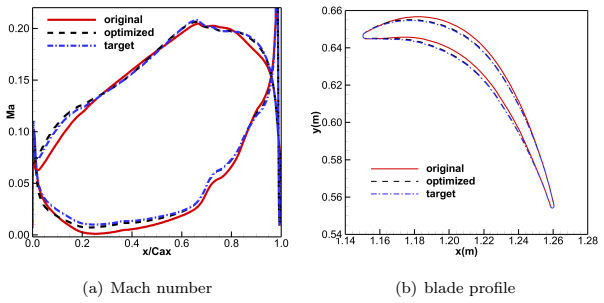
This study presents an efficient and accurate discrete adjoint gas-kinetic scheme (GKS) for sensitivity analysis and aerodynamic shape optimization in continuum flow regimes. Developed using the backward mode of algorithmic differentiation (AD), the adjoint solver is rigorously verified against a duality-preserving linearized GKS solver generated via forward-mode AD. The robustness and practical effectiveness of the solver are evaluated through three benchmark cases: the inverse design of turbine blades, lift-to-drag ratio enhancement, and shock-strength reduction for a NACA 0012 airfoil. To capture realistic flow physics, fully turbulent optimizations are conducted using the one-equation Spalart--Allmaras (SA) model. Numerical results demonstrate excellent agreement between the discrete adjoint and linearized solvers, exhibiting matching sensitivity convergence behaviors, identical asymptotic residual decay rates, and negligible discrepancies in final sensitivity predictions. Furthermore, the optimization studies confirm that targeted design objectives are consistently achieved within a limited number of design cycles, highlighting the solver's computational efficiency, accuracy, and suitability for complex aerodynamic geometries.
Editorial analysis
A structured set of objections, weighed in public.
Referee Report
Summary. The paper develops a discrete adjoint gas-kinetic scheme (GKS) for sensitivity analysis and aerodynamic shape optimization in turbulent continuum flows. The adjoint is constructed via backward-mode algorithmic differentiation and verified against a forward-mode linearized GKS solver, with the verification showing matching sensitivity convergence, residual decay rates, and final values. The method is demonstrated on three fully turbulent benchmark optimizations under the Spalart-Allmaras model: inverse design of turbine blades, lift-to-drag ratio maximization, and shock-strength reduction on a NACA 0012 airfoil. Results indicate that design objectives are achieved in a limited number of cycles.
Significance. If the reported numerical agreement holds, the work supplies a duality-preserving discrete adjoint for GKS that enables reliable gradient-based optimization in turbulent regimes. The use of algorithmic differentiation guarantees consistency between forward and adjoint operators, which is a strength for complex discretizations. The three benchmark cases provide concrete evidence of practical utility for aerodynamic design problems involving turbulence.
minor comments (3)
- The abstract states 'excellent agreement' and 'negligible discrepancies' but does not report quantitative measures such as L2 norms of sensitivity differences or maximum relative errors; adding these would strengthen the verification claim without altering the central result.
- Section 4 (or equivalent verification section) should explicitly state the mesh resolutions and iteration counts used for the sensitivity comparisons to allow direct reproduction of the reported residual decay rates.
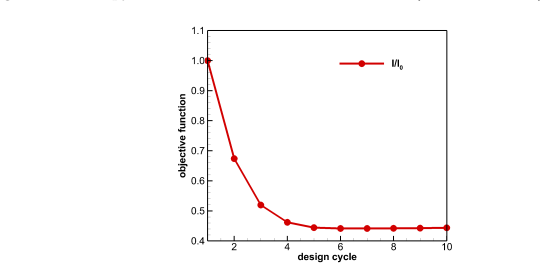
- Figure captions for the optimization histories could include the number of design variables and the final objective improvement percentages for each case.
Simulated Author's Rebuttal
We thank the referee for the positive assessment of our work on the discrete adjoint gas-kinetic scheme and for recommending minor revision. The recognition of the method's consistency via algorithmic differentiation and its utility for turbulent aerodynamic optimization is appreciated. No specific major comments were provided in the report.
Circularity Check
No significant circularity detected
full rationale
The paper derives a discrete adjoint GKS via backward-mode AD and verifies it directly against an independently implemented forward-mode linearized GKS solver, showing matching convergence, residual decay, and sensitivity values. This cross-check is external to the adjoint construction itself and does not reduce any claimed result to a tautology or fitted input. No load-bearing steps invoke self-citations, uniqueness theorems from prior author work, or ansatzes that loop back to the target sensitivities; the SA turbulence model and benchmark optimizations are standard and independently falsifiable. The derivation chain remains self-contained against the provided external verification benchmark.
Axiom & Free-Parameter Ledger
axioms (1)
- domain assumption The gas-kinetic scheme accurately represents continuum turbulent flows when coupled with the Spalart-Allmaras model.
Reference graph
Works this paper leans on
-
[1]
Z. Han, J. Qiao, L. Zhang, Q. Chen, H. Yang, Y. Ding, K. Zhang, W. Song, B. Song, Recent progress of efficient low-boom design and optimization methods, Progress in Aerospace Sciences 146 (2024) 101007.doi:doi. org/10.1016/j.paerosci.2024.101007
-
[2]
Y. Zhang, Z. H. Han, W. P. Song, Multi-fidelity expected improvement based on multi-level hierarchical Kriging model for efficient aerodynamic design optimization, Engineering Optimization 56 (12) (2024) 2408–2430. doi:doi.org/10.1080/0305215X.2024.2310182. 34
- [3]
-
[4]
S. Xu, D. Radford, M. Meyer, J.-D. Müller, Stabilisation of discrete steady adjointsolvers, JournalofComputationalPhysics299(2015)175–195.doi: doi.org/10.1016/j.jcp.2015.06.036
-
[5]
A. Jameson, Aerodynamic design via control theory, Journal of Scientific Computing 3 (1988) 233–260.doi:doi.org/10.1007/BF01061285
-
[6]
A. Jameson, L. Martinelli, N. Pierce, Optimum aerodynamic design using the Navier–Stokes equations, Theoretical and Computational Fluid Dy- namics 10 (1998) 213–237.doi:doi.org/10.1007/s001620050060
-
[7]
S. Vitale, M. Pini, P. Colonna, Multistage turbomachinery design using the discrete adjoint method within the open-source software SU2, Journal of Propulsion and Power 36 (3) (2020) 465–478.doi:doi.org/10.2514/1. B37685
work page doi:10.2514/1 2020
-
[8]
H. Wu, X. Da, D. Wang, X. Huang, Multi-row turbomachinery aerodynamic design optimization by an efficient and accurate dis- crete adjoint solver, Aerospace 10 (2) (2023).doi:doi.org/10.3390/ aerospace10020106
2023
-
[9]
C. Ma, X. Su, X. Yuan, An efficient unsteady adjoint optimization system for multistage turbomachinery, Journal of Turbomachinery 139 (1) (2016) 011003.doi:10.1115/1.4034185
-
[10]
A. Rubino, S. Vitale, P. Colonna, M. Pini, Fully-turbulent adjoint method for the unsteady shape optimization of multi-row turbomachin- ery, Aerospace Science and Technology 106 (2020) 106132.doi:doi.org/ 10.1016/j.ast.2020.106132. 35
-
[11]
H. Wu, D. Wang, X. Huang, Three-dimensional unsteady aerodynamic optimization of a transonic compressor stage using an implicit discrete ad- joint harmonic balance method, Journal of Turbomachinery 147 (7) (2024) 071016.doi:10.1115/1.4067290
-
[12]
L. He, D. X. Wang, Concurrent blade aerodynamic-aero-elastic design opti- mization using adjoint method, Journal of Turbomachinery 133 (1) (2010) 011021.doi:10.1115/1.4000544
-
[13]
M. C. Duta, M. S. Campobasso, M. B. Giles, L. B. Lapworth, Adjoint harmonic sensitivities for forced response minimization, Journal of En- gineering for Gas Turbines and Power 128 (1) (2003) 183–189.doi: 10.1115/1.2031227
-
[14]
H. Wu, D. Wang, X. Huang, Multi-objective aerodynamic and aeroelastic coupled design optimization using a full viscosity discrete adjoint harmonic balance method, Journal of Turbomachinery 145 (10) (2023) 101002.doi: 10.1115/1.4062803
-
[15]
H. Wu, M. Yang, D. Wang, X. Huang, Efficient forced response minimiza- tion using a full-viscosity discrete adjoint harmonic balance method, AIAA Journal 62 (10) (2024) 3644–3661.doi:10.2514/1.J063749
-
[16]
S. Nadarajah, A. Jameson, A comparison of the continuous and discrete ad- joint approach to automatic aerodynamic optimization, in: 38th Aerospace Sciences Meeting and Exhibit, 2000.doi:10.2514/6.2000-667
-
[17]
L. Hascoet, V. Pascual, The Tapenade automatic differentiation tool: prin- ciples, model, and specification 39 (3) (5 2013).doi:10.1145/2450153. 2450158
-
[18]
M. B. Giles, M. C. Duta, J.-D. Muller, N. A. Pierce, Algorithm develop- ments for discrete adjoint methods, AIAA Journal 41 (2) (2003) 198–205. doi:10.2514/2.1961. 36
-
[19]
D. X. Wang, L. He, Adjoint aerodynamic design optimization for blades in multistage turbomachines—part I: methodology and verification, Journal of Turbomachinery 132 (2) (2010) 021011.doi:10.1115/1.3072498
-
[20]
P. Roe, Approximate Riemann solvers, parameter vectors, and difference schemes, Journal of Computational Physics 135 (2) (1997) 250–258.doi: doi.org/10.1006/jcph.1997.5705
-
[21]
K. Xu, K. H. Prendergast, Numerical Navier-Stokes solutions from gas kinetic theory, Journal of Computational Physics 114 (1) (1994) 9–17.doi: doi.org/10.1006/jcph.1994.1145
- [22]
-
[24]
F. Zhao, X. Ji, W. Shyy, K. Xu, A compact high-order gas-kinetic scheme on unstructured mesh for acoustic and shock wave computations, Journal of Computational Physics 449 (2022) 110812.doi:doi.org/10.1016/j. jcp.2021.110812
work page doi:10.1016/j 2022
-
[25]
X. Ji, F. Zhao, W. Shyy, K. Xu, Compact high-order gas-kinetic scheme for three-dimensional flow simulations, AIAA Journal 59 (8) (2021) 2979–2996. doi:10.2514/1.J060208
-
[26]
L. Pan, K. Xu, Q. Li, J. Li, An efficient and accurate two-stage fourth-order gas-kinetic scheme for the Euler and Navier–Stokes equations, Journal of Computational Physics 326 (2016) 197–221.doi:https://doi.org/10. 1016/j.jcp.2016.08.054. 37
2016
-
[27]
X. Ji, L. Pan, W. Shyy, K. Xu, A compact fourth-order gas-kinetic scheme for the Euler and Navier–Stokes equations, Journal of Computational Physics 372 (2018) 446–472.doi:doi.org/10.1016/j.jcp.2018.06.034
-
[28]
R. Yuan, L. Wu, A design optimization method for rarefied and continuum gas flows, Journal of Computational Physics 517 (2024) 113366.doi:doi. org/10.1016/j.jcp.2024.113366
-
[29]
R. Yuan, L. Wu, Adjoint shape optimization from the continuum to free- molecular gas flows, Journal of Computational Physics 537 (2025) 114102. doi:doi.org/10.1016/j.jcp.2025.114102
-
[30]
R. Yuan, C. Zhong, A conservative implicit scheme for steady state solu- tions of diatomic gas flow in all flow regimes, Computer Physics Commu- nications 247 (2020) 106972.doi:doi.org/10.1016/j.cpc.2019.106972
-
[31]
Spalart, S
P. Spalart, S. Allmaras, A one-equation turbulence model for aerodynamic flows, in: 30th Aerospace Sciences Meeting and Exhibit, 1992.doi:10. 2514/6.1992-439
1992
-
[32]
H. Wu, S. Xu, X. Huang, D. Wang, The development and verification of a fully turbulent discrete adjoint solver using algorithmic differentiation, Vol. Volume 2C: Turbomachinery — Design Methods and CFD Modeling for Turbomachinery; Ducts, Noise, and Component Interactions of Turbo Expo, 2021, p. V02CT34A031.doi:10.1115/GT2021-59610. 38
discussion (0)
Sign in with ORCID, Apple, or X to comment. Anyone can read and Pith papers without signing in.