Recognition: unknown
Search for the Λ_cSigma_c and bar{Λ}_cSigma_c dibaryon structures via the QCD sum rules
Pith reviewed 2026-05-10 11:36 UTC · model grok-4.3
The pith
QCD sum rules calculations identify three possible molecular dibaryon states in the Lambda_c Sigma_c and bar-Lambda_c Sigma_c systems.
A machine-rendered reading of the paper's core claim, the machinery that carries it, and where it could break.
Core claim
We construct eight pairs of hexaquark currents to search the Lambda_c Sigma_c and bar-Lambda_c Sigma_c dibaryon states via QCD sum rules. The two currents of each pair are equivalent, and one is chosen to calculate the masses and pole residues. For either system, the J^P considered are 0^-, 0^+, 1^+ and 1^-. Three possible molecular states are found: the Lambda_c Sigma_c dibaryon with J^P=1^+ and the bar-Lambda_c Sigma_c dibaryons with J^P=0^- and 1^-. The other five are unlikely to form bound dibaryon states and are assigned as resonance states.
What carries the argument
The hexaquark currents that interpolate the molecular dibaryon configurations, from which QCD sum rules extract the ground state masses and pole residues.
If this is right
- If the predictions hold, experimental searches should target these specific J^P states in charm sector collisions.
- The assignments distinguish bound states from resonances based on whether the calculated masses fall below or above the threshold.
- Similar currents can be used to study other baryon pairs in the same framework.
- The stability of the results relies on appropriate choice of Borel parameters and continuum thresholds.
Where Pith is reading between the lines
- Observation of these states would support the molecular interpretation of some exotic hadrons in heavy flavor physics.
- The approach might be applied to predict structures in bottom sector dibaryons for comparison.
- Decay modes of these dibaryons could be calculated next to guide experimental detection.
Load-bearing premise
The chosen hexaquark currents correctly interpolate the molecular configurations and the Borel mass and continuum threshold windows can be chosen so the extracted masses are stable and physically meaningful.
What would settle it
An experimental search that fails to find signals at the predicted masses for the three claimed states, or finds bound states in the channels assigned as resonances, would falsify the conclusions.
Figures

read the original abstract
In this paper, we construct eight pairs of hexaquark currents to search the $\Lambda_c\Sigma_c$ and $\bar{\Lambda}_c\Sigma_c$ dibaryon states via QCD sum rules. We show that the two currents of each pair are equivalent and we choose one of them to calculate the masses and pole residues of ground states. For either $\Lambda_c\Sigma_c$ or $\bar{\Lambda}_c\Sigma_c$, the $J^P$ of the considered hexaquark currents are $0^-$, $0^+$, $1^+$ and $1^-$, respectively. We found three possible molecular states, they are $\Lambda_c\Sigma_c$ dibaryon with the $J^P=1^+$ and $\bar{\Lambda}_c\Sigma_c$ dibaryons with the $J^P=0^-$ and $1^-$. The other five are unlikely to form the bound dibaryon states, and we assign them as the resonance states.
Editorial analysis
A structured set of objections, weighed in public.
Referee Report
Summary. The paper constructs eight pairs of hexaquark currents for the Λ_c Σ_c and bar-Λ_c Σ_c systems with J^P quantum numbers 0^-, 0^+, 1^+, and 1^-. It demonstrates the equivalence of the two currents within each pair, then applies QCD sum rules to extract the masses and pole residues of the ground states. The authors conclude that three configurations form bound molecular dibaryons (Λ_c Σ_c with J^P=1^+ and bar-Λ_c Σ_c with J^P=0^- and 1^-), while the remaining five are resonances.
Significance. If the mass extractions prove robust and lie below the relevant thresholds with controlled uncertainties, the results would indicate possible exotic dibaryon states in the charm sector, adding to the catalog of molecular candidates and motivating experimental searches. The QCD sum-rule framework is a standard tool for such spectroscopy, but the claims rest on the molecular interpretation of the currents and the existence of stable Borel windows.
major comments (3)
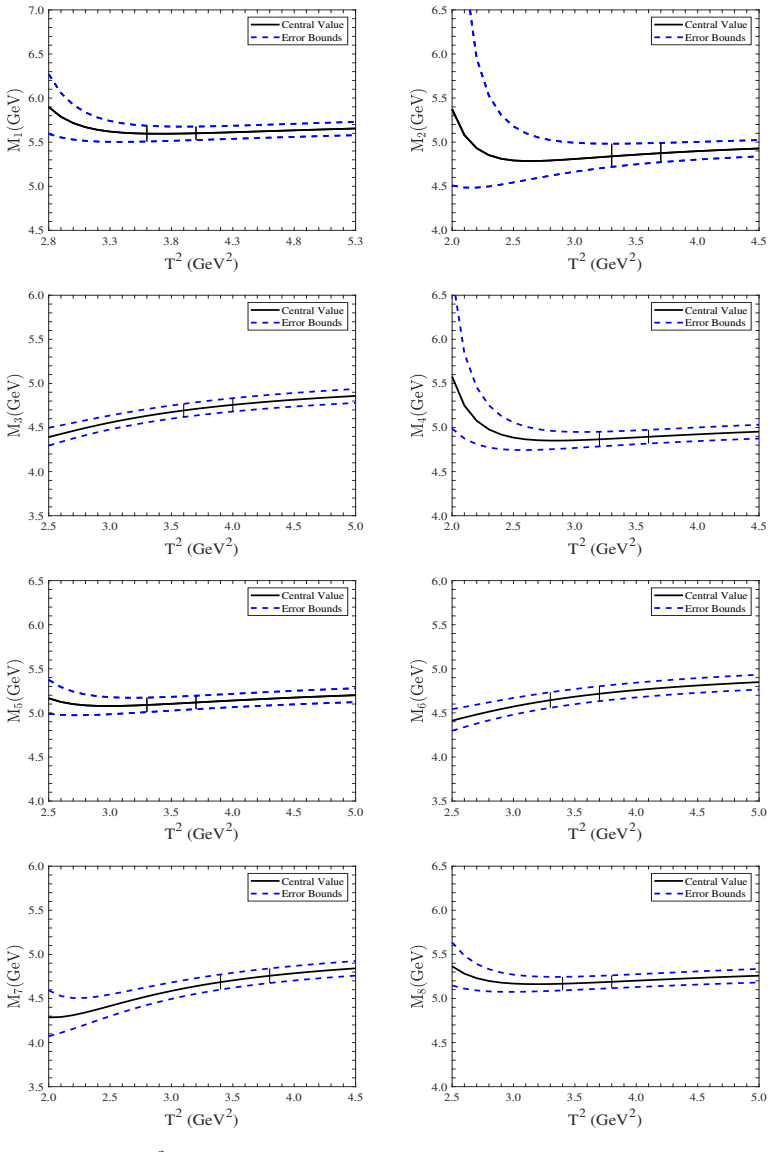
- [Numerical results] The manuscript reports masses below the Λ_c + Σ_c threshold for the three claimed bound states, but does not provide explicit Borel-window stability plots, quantitative pole-dominance ratios (e.g., >50% ground-state contribution), or OPE convergence checks across the chosen M^2 intervals. Without these, the distinction between bound states and resonances cannot be verified (see numerical analysis and results sections).
- [Current construction] The equivalence of the two currents per pair is shown algebraically, yet no additional arguments, decay-constant comparisons, or overlap calculations are given to establish that the chosen hexaquark currents preferentially interpolate the molecular Λ_c Σ_c (or bar-Λ_c Σ_c) configurations rather than compact or other structures.
- [Mass extraction and parameter choice] The extracted masses depend on the fitted Borel mass M^2 and continuum threshold s0 chosen to produce plateaus; no systematic error estimates from varying these parameters within the windows or full inclusion of higher-dimensional condensates are reported, weakening the bound-state assignments.
minor comments (1)
- [Introduction] The abstract and introduction would benefit from a brief comparison to prior QCD sum-rule or lattice studies of similar charmed dibaryon systems to contextualize the novelty.
Simulated Author's Rebuttal
We thank the referee for the thorough review and valuable comments on our manuscript. We have carefully considered each point and provide our responses below. We will incorporate several improvements in the revised version to address the concerns raised.
read point-by-point responses
-
Referee: The manuscript reports masses below the Λ_c + Σ_c threshold for the three claimed bound states, but does not provide explicit Borel-window stability plots, quantitative pole-dominance ratios (e.g., >50% ground-state contribution), or OPE convergence checks across the chosen M^2 intervals. Without these, the distinction between bound states and resonances cannot be verified (see numerical analysis and results sections).
Authors: We acknowledge that including the Borel stability plots, pole dominance ratios, and OPE convergence checks would enhance the transparency of our numerical analysis. In the revised manuscript, we will add these plots and report the quantitative values (such as the ground-state contribution percentages) for the selected Borel windows. This will allow readers to verify the stability and the validity of our mass extractions for the bound states versus resonances. revision: yes
-
Referee: The equivalence of the two currents per pair is shown algebraically, yet no additional arguments, decay-constant comparisons, or overlap calculations are given to establish that the chosen hexaquark currents preferentially interpolate the molecular Λ_c Σ_c (or bar-Λ_c Σ_c) configurations rather than compact or other structures.
Authors: The hexaquark currents are constructed by combining the interpolating currents for the Λ_c and Σ_c baryons (or their antiparticles) with appropriate Dirac and color structures to form molecular-type configurations. This is the conventional method used in QCD sum rule studies for loosely bound molecular states. The algebraic equivalence demonstrates that the two forms in each pair describe the same state. While we do not perform explicit overlap calculations with compact currents, the molecular interpretation is supported by the current structure and the resulting masses being close to the thresholds. We will add a short paragraph clarifying this construction rationale in the revised version. revision: partial
-
Referee: The extracted masses depend on the fitted Borel mass M^2 and continuum threshold s0 chosen to produce plateaus; no systematic error estimates from varying these parameters within the windows or full inclusion of higher-dimensional condensates are reported, weakening the bound-state assignments.
Authors: The values of M^2 and s0 were selected to ensure the existence of stable plateaus in the mass predictions while satisfying the criteria of sufficient pole contribution and OPE convergence. Although we did not explicitly tabulate the variations, the masses are robust within the windows. In the revision, we will provide estimates of the uncertainties arising from the choice of these parameters by varying them within reasonable ranges. Regarding higher-dimensional condensates, our OPE includes terms up to dimension 6, and higher terms are expected to be small in the Borel window; we will discuss the truncation effects more explicitly. revision: yes
Circularity Check
No significant circularity; standard QCD sum rules extraction remains self-contained
full rationale
The derivation constructs eight pairs of hexaquark currents, demonstrates their pairwise equivalence by direct calculation, and applies the QCD sum rules formalism to obtain masses and residues from the two-point correlation functions. The Borel parameter M^2 and continuum threshold s0 are selected according to the usual criteria (pole dominance >50%, OPE convergence, and stability of the mass plateau), but the mass itself is obtained from the ratio of moments of the spectral density derived from the OPE side, not inserted by hand or fitted to reproduce a pre-chosen value. No step reduces the reported masses to the input parameters by definition, and no load-bearing self-citation chain is invoked to justify uniqueness or forbid alternatives. The central claim therefore rests on the validity of the molecular current ansatz and the existence of acceptable windows, which are methodological assumptions rather than circular reductions.
Axiom & Free-Parameter Ledger
free parameters (2)
- Borel mass M^2
- Continuum threshold s0
axioms (2)
- standard math The operator product expansion converges sufficiently in the chosen Borel window.
- domain assumption The constructed hexaquark currents couple dominantly to the ground-state molecular configurations.
invented entities (1)
-
Λ_c Σ_c molecular dibaryon
no independent evidence
Reference graph
Works this paper leans on
-
[1]
Yukawa, Proc
H. Yukawa, Proc. Phys. Math. Soc. Jap. 17 (1935) 48
1935
-
[2]
Gell-Mann, Phys
M. Gell-Mann, Phys. Lett. 8 (1964) 214
1964
-
[3]
Zweig, Report No
G. Zweig, Report No. CERN-TH-401
-
[4]
S. K. Choi et al., Phys. Rev. Lett. 91 (2003) 262001
2003
-
[5]
Aaij et al., Nat
R. Aaij et al., Nat. Phys. 18 (2022) 751
2022
-
[6]
Z. G. Wang, Front. Phys. 21 (2026) 016300
2026
-
[7]
H. X. Chen, W. Chen, X. Liu and S. L. Zhu, Phys. Rept. 639 (2016 ) 1
2016
-
[8]
F. K. Guo, C. Hanhart, U. G. Meißner, Q. Wang, Q. Zhao and B. S. Zou, Rev. Mod. Phys. 90 (2018) 015004
2018
-
[9]
Altmannshofer et al., PTEP 2019 (2019) 123C01, [Erratum: PT EP 2020 (2020) 029201]
W. Altmannshofer et al., PTEP 2019 (2019) 123C01, [Erratum: PT EP 2020 (2020) 029201]
2019
-
[10]
Oset et al., EPJ Web Conf
E. Oset et al., EPJ Web Conf. 199 (2019) 01003
2019
-
[11]
J. M. Richard, Few Body Syst. 57 (2016) 1185
2016
-
[12]
F. K. Guo et al., Rev. Mod. Phys. 90 (2018) 015004
2018
-
[13]
Martinez Torres, K
A. Martinez Torres, K. P. Khemchandani, L. Roca and E. Oset, Few Body Syst. 61 (2020) 35
2020
-
[14]
X. K. Dong, F. K. Guo and B. S. Zou, Commun. Theor. Phys. 73 ( 2021) 125201
2021
-
[15]
Clement and T
H. Clement and T. Skorodko Chinese Phys. C45 (2021) 022001
2021
-
[16]
Strakovsky, AIP Conf
I. Strakovsky, AIP Conf. Proceeds. 221 (1991) 218; Echay a (Fiz. El. Chast. At. Yadra) 22 (1991) 615
1991
-
[17]
M. P. Locher, M. E. Sainio and A. Svarc, Advances in Nucl. Phys. 17 (1986) 47
1986
-
[18]
H. C. Urey, F. G. Brickwedde and G. M. Murphy, Phys. Rev. 39 ( 1932) 164
1932
-
[19]
Bashkanov et al., Phys
M. Bashkanov et al., Phys. Rev. Lett. 102 (2009) 052301. 11
2009
-
[20]
Adlarson et al., Phys
P. Adlarson et al., Phys. Rev. Lett. 106 (2011) 242302
2011
-
[21]
Adlarson et al., Phys
P. Adlarson et al., Phys. Lett. B721 (2013) 229
2013
-
[22]
Ikeno, R
N. Ikeno, R. Molina and E. Oset, Phys. Rev. C104 (2021) 014614
2021
-
[23]
Molina, N
R. Molina, N. Ikeno and E. Oset, Chin. Phys. C47 (2023) 041001
2023
-
[24]
Z. C. Xia, S. J. Fan, X. M. Zhu, H. X. Huang and J. L. Ping, Phys. Rev. C105 (2022) 025201
2022
- [25]
-
[26]
Z. T. Lu, H. Y. Jiang and J. He, Phys. Rev. C102 (2020) 045202
2020
-
[27]
J. T. Zhu, L. Q. Song and J. He, Phys. Rev. D103 (2021) 074007
2021
-
[28]
X. K. Dong, F. K. Guo and B. S. Zou, Progr. Phys. 41 (2021) 65
2021
- [29]
-
[30]
T. F. Carames and A. Valcarce, Phys. Rev. D92 (2015) 034015
2015
-
[31]
Morita, A
K. Morita, A. Ohnishi, F. Etminan and T. Hatsuda, Phys. Rev. C94 (2016) 031901(R)
2016
-
[32]
Morita, S
K. Morita, S. Gongyo, T. Hatsuda, T. Hyodo, Y. Kamiya and A. O hnishi, Phys. Rev. C101 (2020) 015201
2020
-
[33]
Kodama, M
N. Kodama, M. Oka and T. Hatsuda, Nucl. Phys. A580 (1994) 445
1994
-
[34]
H. X. Chen, E. L. Cui, W. Chen, T. G. Steele and S. L. Zhu, Phys. Rev. C91 (2015) 025204
2015
-
[35]
Z. G. Wang, Eur. Phys. J. C77 (2017) 642
2017
-
[36]
B. D. Wan, L. Tang and C. F. Qiao, Eur. Phys. J. C80 (2020) 121
2020
-
[37]
Z. G. Wang, Eur. Phys. J. C74 (2014) 2963
2014
-
[38]
Z. G. Wang, Eur. Phys. J. C74 (2014) 2874
2014
-
[39]
M. A. Shifman, A. I. Vainshtein and V. I. Zakharov, Nucl. Phys. B147 (1979) 385
1979
-
[40]
M. A. Shifman, A. I. Vainshtein and V. I. Zakharov, Nucl. Phys. B147 (1979) 448
1979
-
[41]
Agaev, K
S.S. Agaev, K. Azizi and H. Sundu, Phys. Rev. D96 (2017) 034026
2017
-
[42]
Chen and S.L
W. Chen and S.L. Zhu, Phys. Rev. D81 (2010) 105018
2010
-
[43]
Chen and S.L
W. Chen and S.L. Zhu, Phys. Rev. D83 (2011) 034010
2011
-
[44]
Ozdem and K
U. Ozdem and K. Azizi, Phys. Rev. D97 (2018) 014010
2018
-
[45]
S. H. Lee, M. Nielsen and U. Wiedner, J. Korean Phys. Soc. 55 (2 009) 424
-
[46]
J. R. Zhang and M. Q. Huang, Commun. Theor. Phys. 54 (2010) 1075
2010
-
[47]
J. R. Zhang, M. Zhong and M. Q. Huang, Phys. Lett. B704 (2011) 312
2011
-
[48]
R. D. Matheus, F. S. Navarra, M. Nielsen and C. M. Zanetti, Phy s. Rev. D80 (2009) 056002
2009
-
[49]
S. H. Lee, A. Mihara, F. S. Navarra and M. Nielsen, Phys. Lett. B28 (2008) 661
2008
-
[50]
R. M. Albuquerque and M. Nielsen, Nucl.Phys. A53 (2009) 815. 12
2009
-
[51]
R. M. Albuquerque and M. Nielsen, Erratum, Nucl. Phys. A48 (2011) 857
2011
-
[52]
Z. Y. Di, Z. G. Wang and G. L. Yu, Commun. Theor. Phys. 71 (201 9) 685
-
[53]
Z. G. Wang and T. Huang, Phys. Rev. D89 (2014) 054019
2014
-
[54]
Z. G. Wang and T. Huang, Eur. Phys. J. C74 (2014) 2891
2014
-
[55]
Z. G. Wang, Eur. Phys. J. C76 (2016) 387
2016
-
[56]
Z. G. Wang, Eur. Phys. J. C76 (2016) 70
2016
-
[57]
Z. G. Wang and T. huang, Eur. Phys. J. C76 (2016) 43
2016
-
[58]
Z. G. Wang, Phys. Rev. D102 (2020) 034008
2020
-
[59]
X. H. Zhang, S. Q. Zhang, C. F. Qiao, Eur. Phys. J. C85 (2025) 693
2025
-
[60]
H. X. Chen, D. Zhou, W. Chen, X. Liu and S. L. Zhu, Eur. Phys. J . C76 (2016) 602
2016
-
[61]
X. H. Zhang, C. F. Qiao, arXiv:2512.22019
work page internal anchor Pith review Pith/arXiv arXiv
-
[62]
Ablikim et al., Phys
M. Ablikim et al., Phys. Rev. Lett. 131 (2023) 151901
2023
-
[63]
X. W. Wang, Z. G. Wang and G. L. Yu, Eur. Phys. J. A57 (2021) 275
2021
-
[64]
X. W. Wang and Z. G. Wang, Adv. High Energy Phys. 2022 (2022) 6224597
2022
- [65]
- [66]
-
[67]
L. J. Reinders, H. Rubinstein and S. Yazaki, Phys. Rept. 127 (1 985) 1
-
[68]
QCD: Renormalization for the pra ctitioner
P. Pascual and R. Tarrach, “QCD: Renormalization for the pra ctitioner”, Springer Berlin Heidelberg (1984)
1984
-
[69]
Z. G. Wang, Phys. Lett. B819 (2021) 136464
2021
-
[70]
Z. G. Wang, Int. J. Mod. Phys. A35 (2020) 2050073
2020
-
[71]
Z. G. Wang, Int. J. Mod. Phys. A34 (2019) 1950097
2019
-
[72]
Z. G. Wang, Chin. Phys. C41 (2017) 083103
2017
-
[73]
Patrignani et al., Chin
C. Patrignani et al., Chin. Phys. C40 (2016) 100001
2016
-
[74]
P. A. Zyla et al., Prog. Theor. Exp. Phys. (2020) 083C01
2020
-
[75]
Narison and R
S. Narison and R. Tarrach, Phys. Lett. B125 (1983) 217. 13
1983
discussion (0)
Sign in with ORCID, Apple, or X to comment. Anyone can read and Pith papers without signing in.