Recognition: unknown
Quantum Landscape of Superconducting Diodes
Pith reviewed 2026-05-10 10:14 UTC · model grok-4.3
The pith
Superconducting diodes supply built-in nonlinearity and nonreciprocity for on-chip quantum circuit integration.
A machine-rendered reading of the paper's core claim, the machinery that carries it, and where it could break.
Core claim
The built-in nonlinearity, nonreciprocity, and quantum functionalities of superconducting diodes enable scalable on-chip integration in circuit quantum electrodynamics, supporting noise-resilient qubits and interfaces for power delivery, coherent control, memory, high-fidelity readout, and quantum-limited amplification while allowing thermodynamic constraints to create thermal compatibility between classical and quantum workflows.
What carries the argument
Superconducting diodes as nonlinear and nonreciprocal circuit elements that carry quantum functionalities into c-QED platforms.
If this is right
- Nonlinear and nonreciprocal elements become compact and integrable rather than bulky and dissipative.
- Temperature gradients between classical control electronics and quantum processors can be eliminated through isothermal all-electrical control.
- Noise-resilient qubits and qubit-interfaces become feasible for efficient power delivery and coherent operations.
- High-fidelity readout and quantum-limited amplification can be realized within the same on-chip architecture.
- Thermodynamic constraints can be turned into advantages for hybrid classical-quantum workflows.
Where Pith is reading between the lines
- This approach could reduce the overall footprint and heat load of quantum control systems by embedding classical functions directly in the cryogenic chip.
- It opens a path to test whether superconducting diodes can serve as universal building blocks across different qubit modalities.
- Experimental mapping of diode performance under combined DC bias and microwave drive would clarify the practical limits of the proposed integration.
Load-bearing premise
The established properties of superconducting diodes can be directly harnessed in quantum platforms to achieve thermal compatibility and scalability without introducing new losses or technical barriers.
What would settle it
Fabrication and measurement of a superconducting-diode-based interface circuit that maintains quantum coherence at millikelvin temperatures while performing classical control functions without measurable added dissipation.
Figures




read the original abstract
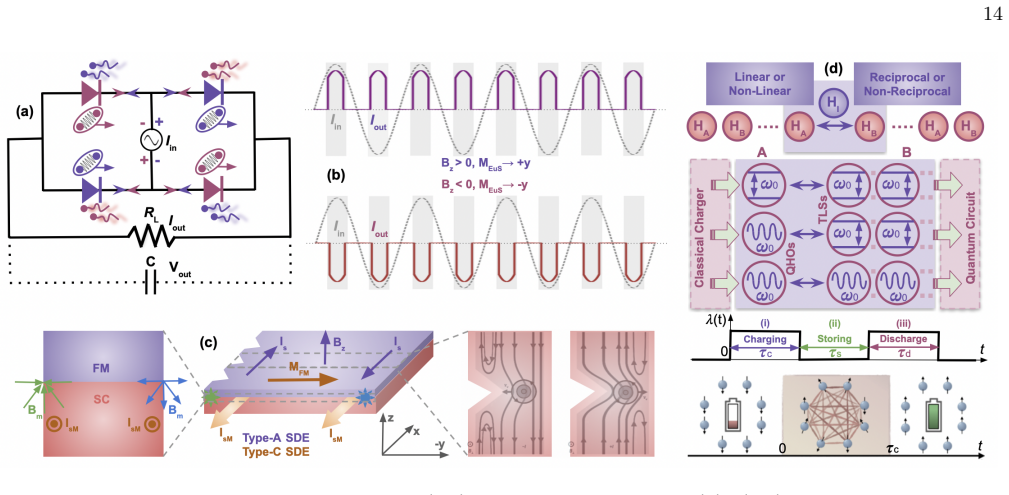
This study maps the quantum landscape of superconducting diodes (SDs) \cite{nadeem23} onto the quantum technology architecture, which is currently constrained by fundamental challenges in control and scalability. In the existing non-integrated quantum technology hardware, control and scalability related issues emerge at two fronts: First, nonlinear and nonreciprocal circuit elements, which are essential building blocks for quantum processors, are often complex, bulky, and dissipative. Second, the temperature gradient between classical control electronics ($T_C\gtrsim$ K), which is also dissipative, and the quantum processor at cryogenic temperatures ($T_Q\sim$ mK) makes scalability even more challenging. The main focus is to reveal how the built-in nonlinearity, nonreciprocity, and quantum functionalities of SDs are significant for on-chip integrated circuit quantum electrodynamics (c-QED), enabling scalable integration of noise-resilient qubit and qubit-interfaces for efficient power delivery, coherent control and memory, high-fidelity readout, and quantum-limited amplification. To this end, this study will also shed light on how thermodynamic constraints and field effects can be harnessed within a quantum-enhanced SD platform, thereby enabling thermal compatibility between classical and quantum workflows, isothermal all-electrical control, and on-chip scalability. This perspective is expected to play a pivotal role in the advancement of superconducting circuit-based quantum hardware with temperature-matched classical, quantum, and hybrid workflows.
Editorial analysis
A structured set of objections, weighed in public.
Referee Report
Summary. This perspective maps the nonlinearity, nonreciprocity, and quantum functionalities of superconducting diodes (SDs) onto circuit quantum electrodynamics (c-QED) architectures. It claims these properties can enable scalable on-chip integration of noise-resilient qubits, qubit interfaces, efficient power delivery, coherent control, memory, high-fidelity readout, and quantum-limited amplification, while addressing thermal gradients between classical (T_C ≳ K) and quantum (T_Q ∼ mK) regimes through thermodynamic constraints and field effects for isothermal all-electrical control.
Significance. If the proposed mappings hold and can be realized without new dissipation channels, the perspective could guide development of hybrid classical-quantum superconducting hardware, potentially improving scalability and reducing reliance on bulky dissipative elements. As a qualitative mapping without new calculations, its immediate impact is prospective rather than transformative.
major comments (2)
- [Abstract] Abstract: The central claim that built-in SD properties 'directly enable' noise-resilient qubits, quantum-limited amplification, and isothermal control rests on qualitative translation of classical diode behavior; no Hamiltonians, circuit diagrams, noise spectra, or thermodynamic calculations are supplied to show that these properties survive in the mK quantum regime without introducing new loss mechanisms between T_C and T_Q.
- [Main text] Main text (sections discussing c-QED integration and thermodynamic constraints): The assertions regarding 'scalable integration' and 'thermal compatibility' lack any concrete device proposals, parameter estimates, or comparisons to existing nonreciprocal elements (e.g., circulators or isolators) that would demonstrate reduced footprint or dissipation; the mapping therefore remains speculative and does not address potential barriers such as quasiparticle generation or flux noise in SDs at millikelvin temperatures.
Simulated Author's Rebuttal
We thank the referee for their insightful comments on our perspective manuscript. We address each major comment below, clarifying the qualitative nature of the work while incorporating revisions to address concerns about specificity and potential limitations.
read point-by-point responses
-
Referee: [Abstract] Abstract: The central claim that built-in SD properties 'directly enable' noise-resilient qubits, quantum-limited amplification, and isothermal control rests on qualitative translation of classical diode behavior; no Hamiltonians, circuit diagrams, noise spectra, or thermodynamic calculations are supplied to show that these properties survive in the mK quantum regime without introducing new loss mechanisms between T_C and T_Q.
Authors: As this is a perspective article, our goal is to provide a conceptual mapping of SD properties to c-QED applications rather than to derive new theoretical models. The claims are grounded in the established nonlinear and nonreciprocal behaviors of SDs reported in the literature, which we propose can translate to the quantum regime. We agree that explicit calculations are absent, and we have revised the abstract to use more cautious language such as 'potential to enable' instead of 'directly enable'. We have also added a sentence noting that detailed modeling of the mK regime, including possible loss mechanisms, is an important direction for future work. revision: partial
-
Referee: [Main text] Main text (sections discussing c-QED integration and thermodynamic constraints): The assertions regarding 'scalable integration' and 'thermal compatibility' lack any concrete device proposals, parameter estimates, or comparisons to existing nonreciprocal elements (e.g., circulators or isolators) that would demonstrate reduced footprint or dissipation; the mapping therefore remains speculative and does not address potential barriers such as quasiparticle generation or flux noise in SDs at millikelvin temperatures.
Authors: We acknowledge that the manuscript does not provide concrete device proposals or quantitative parameter estimates, consistent with its perspective format. To address this, we have expanded the discussion on thermodynamic constraints to include a qualitative comparison of potential advantages over traditional circulators in terms of on-chip integration and reduced dissipation. We have also added a paragraph discussing possible barriers, including quasiparticle generation and flux noise at millikelvin temperatures, citing relevant literature on SD behavior at low temperatures. However, full quantitative comparisons would require new calculations outside the scope of this work. revision: partial
Circularity Check
No circularity: perspective offers qualitative mapping without any derivation chain or self-referential predictions
full rationale
This is a perspective article whose central content is a qualitative discussion of how properties of superconducting diodes (cited from prior work) might map onto c-QED benefits. No equations, fitted parameters, predictions, uniqueness theorems, or ansatzes are introduced in the provided text. The single self-citation supplies background properties but is not used to derive or force any new result within this manuscript; the mapping itself is presented as interpretive rather than deductive. Consequently there is no load-bearing step that reduces by construction to the paper's own inputs, and the analysis remains self-contained as a forward-looking discussion piece.
Axiom & Free-Parameter Ledger
axioms (1)
- domain assumption Superconducting diodes inherently provide nonlinearity, nonreciprocity, and quantum functionalities suitable for c-QED integration
Forward citations
Cited by 1 Pith paper
-
Perfect spin nonreciprocity in gated superconducting altermagnetic heterostructures
Gating a finite normal region between a superconducting altermagnet and a metallic reservoir produces perfect nonreciprocal spin and charge currents with tunable polarity via gate voltage and region length.
Reference graph
Works this paper leans on
-
[1]
Nadeem, M
M. Nadeem, M. S. Fuhrer, and X. Wang, The super- conducting diode effect, Nature Reviews Physics5, 558 (2023)
2023
-
[2]
Xiang, S
Z.-L. Xiang, S. Ashhab, J. You, and F. Nori, Hybrid quantum circuits: Superconducting circuits interact- ing¡? format?¿ with other quantum systems, Reviews of Modern Physics85, 623 (2013)
2013
-
[3]
Blais, A
A. Blais, A. L. Grimsmo, S. M. Girvin, and A. Wallraff, Circuit quantum electrodynamics, Reviews of Modern Physics93, 025005 (2021)
2021
- [4]
-
[5]
A. I. Braginski, Superconductor electronics: status and outlook, Journal of superconductivity and novel mag- netism32, 23 (2019)
2019
-
[6]
Farrah, K
D. Farrah, K. E. Smith, D. Ardila, C. M. Bradford, M. J. DiPirro, C. Ferkinhoff, J. Glenn, P. F. Goldsmith, D. T. Leisawitz, T. Nikola,et al., Far-infrared instrumenta- tion and technological development for the next decade, Journal of Astronomical Telescopes, Instruments, and Systems5, 020901 (2019)
2019
-
[7]
E. Cam, Z. Hungerford, N. Schoch, F. P. Miranda, and C. D. Y. de Le´on, Electricity 2024 analysis and fore- cast to 2026, INTERNATIONAL ENERGY AGENCY (2024)
2024
-
[8]
SRC, Decadal plan for semiconduc- tors, Semiconductor Research Corporation, https://www.src.org/about/decadal-plan/ (2021)
2021
-
[9]
Tinkham,Introduction to Superconductivity, Dover Books on Physics Series (Dover Publications, 2004)
M. Tinkham,Introduction to Superconductivity, Dover Books on Physics Series (Dover Publications, 2004)
2004
-
[10]
Radebaugh, Cryocoolers: the state of the art and re- cent developments, Journal of Physics: Condensed Mat- ter21, 164219 (2009)
R. Radebaugh, Cryocoolers: the state of the art and re- cent developments, Journal of Physics: Condensed Mat- ter21, 164219 (2009)
2009
-
[11]
Anders, M
S. Anders, M. Blamire, F.-I. Buchholz, D.-G. Cr´ et´ e, R. Cristiano, P. Febvre, L. Fritzsch, A. Herr, E. Il’Ichev, J. Kohlmann,et al., European roadmap on supercon- 28 ductive electronics–status and perspectives, Physica C: Superconductivity470, 2079 (2010)
2079
-
[12]
Mukhanov, A
O. Mukhanov, A. Kirichenko, C. Howington, J. Wal- ter, M. Hutchings, I. Vernik, D. Yohannes, K. Dodge, A. Ballard, B. Plourde,et al., Scalable quantum com- puting infrastructure based on superconducting elec- tronics, in2019 IEEE International Electron Devices Meeting (IEDM)(IEEE, 2019) pp. 31–2
2019
-
[13]
ˇZuti´ c, J
I. ˇZuti´ c, J. Fabian, and S. D. Sarma, Spintronics: Fun- damentals and applications, Reviews of modern physics 76, 323 (2004)
2004
-
[14]
Linder and J
J. Linder and J. W. Robinson, Superconducting spin- tronics, Nature Physics11, 307 (2015)
2015
-
[15]
Mel’nikov, S
A. Mel’nikov, S. V. Mironov, A. V. Samokhvalov, and A. I. Buzdin, Superconducting spintronics: state of the art and prospects, Uspekhi Fiz. Nauk192, 1339 (2022)
2022
-
[16]
R. Cai, I. ˇZuti´ c, and W. Han, Superconduc- tor/ferromagnet heterostructures: A platform for su- perconducting spintronics and quantum computation, Advanced Quantum Technologies6, 2200080 (2023)
2023
-
[17]
Monroe, C
D. Monroe, C. Shen, D. Tringali, M. Alidoust, T. Zhou, and I. ˇZuti´ c, Phase jumps in josephson junctions with time-dependent spin–orbit coupling, Applied Physics Letters125(2024)
2024
-
[18]
Tafuri,Fundamentals and frontiers of the Josephson effect, Vol
F. Tafuri,Fundamentals and frontiers of the Josephson effect, Vol. 286 (Springer Nature, 2019)
2019
-
[19]
A. V. Dixit, S. Chakram, K. He, A. Agrawal, R. K. Naik, D. I. Schuster, and A. Chou, Searching for dark matter with a superconducting qubit, Physical review letters126, 141302 (2021)
2021
-
[20]
Wendin, Quantum information processing with su- perconducting circuits: a review, Reports on Progress in Physics80, 106001 (2017)
G. Wendin, Quantum information processing with su- perconducting circuits: a review, Reports on Progress in Physics80, 106001 (2017)
2017
-
[21]
Liu and M
X. Liu and M. C. Hersam, 2d materials for quantum information science, Nature Reviews Materials4, 669 (2019)
2019
-
[22]
C.-J. Yang, J. Li, M. Fiebig, and S. Pal, Terahertz con- trol of many-body dynamics in quantum materials, Na- ture Reviews Materials8, 518 (2023)
2023
-
[23]
Kirichenko, S
D. Kirichenko, S. Sarwana, and A. Kirichenko, Zero static power dissipation biasing of rsfq circuits, IEEE Transactions on Applied Superconductivity21, 776 (2011)
2011
-
[24]
O. A. Mukhanov, Energy-efficient single flux quantum technology, IEEE Transactions on Applied Supercon- ductivity21, 760 (2011)
2011
-
[25]
McDermott, M
R. McDermott, M. G. Vavilov, B. L. T. Plourde, F. K. Wilhelm, P. J. Liebermann, O. A. Mukhanov, and T. A. Ohki, Quantum–classical interface based on single flux quantum digital logic, Quantum science and technology 3, 024004 (2018)
2018
-
[26]
De Simoni, F
G. De Simoni, F. Paolucci, P. Solinas, E. Strambini, and F. Giazotto, Metallic supercurrent field-effect transistor, Nature nanotechnology13, 802 (2018)
2018
-
[27]
Golokolenov, A
I. Golokolenov, A. Guthrie, S. Kafanov, Y. A. Pashkin, and V. Tsepelin, On the origin of the controversial elec- trostatic field effect in superconductors, Nature Com- munications12, 2747 (2021)
2021
-
[28]
Likharev, Superconducting weak links, Reviews of Modern Physics51, 101 (1979)
K. Likharev, Superconducting weak links, Reviews of Modern Physics51, 101 (1979)
1979
-
[29]
J. Ma, R. Zhan, and X. Lin, Superconducting diode effects: Mechanisms, materials and applications, Ad- vanced Physics Research , 2400180 (2025)
2025
-
[30]
D. Shaffer and A. Levchenko, Theories of supercon- ducting diode effects, arXiv preprint arXiv:2510.25864 (2025)
-
[31]
F. Ando, Y. Miyasaka, T. Li, J. Ishizuka, T. Arakawa, Y. Shiota, T. Moriyama, Y. Yanase, and T. Ono, Ob- servation of superconducting diode effect, Nature584, 373 (2020)
2020
-
[32]
Baumgartner, L
C. Baumgartner, L. Fuchs, A. Costa, S. Reinhardt, S. Gronin, G. Gardner, T. Lindemann, M. Manfra, P. Faria Junior, D. Kochan, J. Fabian, N. Paradiso, and C. Strunk, Supercurrent rectification and magnetochiral effects in symmetric josephson junctions, Nature Nan- otechnology17, 39–44 (2022)
2022
-
[33]
J.-X. Lin, P. Siriviboon, H. Scammell, S. Liu, D. Rhodes, K. Watanabe, T. Taniguchi, J. Hone, M. Scheurer, and J. Li, Zero-field superconducting diode effect in small-twist-angle trilayer graphene, Nature Physics18, 1221–1227 (2022)
2022
-
[34]
Daido, Y
A. Daido, Y. Ikeda, and Y. Yanase, Intrinsic super- conducting diode effect, Phys. Rev. Lett.128, 037001 (2022)
2022
-
[35]
N. F. Q. Yuan and L. Fu, Supercurrent diode effect and finite-momentum superconductors, Proceedings of the National Academy of Sciences119, e2119548119 (2022)
2022
-
[36]
J. J. He, Y. Tanaka, and N. Nagaosa, A phenomeno- logical theory of superconductor diodes, New Journal of Physics24, 053014 (2022)
2022
-
[37]
Ili´ c and F
S. Ili´ c and F. S. Bergeret, Theory of the supercurrent diode effect in rashba superconductors with arbitrary disorder, Phys. Rev. Lett.128, 177001 (2022)
2022
-
[38]
H. D. Scammell, J. I. A. Li, and M. S. Scheurer, The- ory of zero-field superconducting diode effect in twisted trilayer graphene, 2D Materials9, 025027 (2022)
2022
-
[39]
D. Y. Vodolazov and F. Peeters, Superconducting rec- tifier based on the asymmetric surface barrier effect, Physical Review B72, 172508 (2005)
2005
-
[40]
D. Y. Vodolazov, B. Gribkov, S. Gusev, A. Y. Klimov, Y. N. Nozdrin, V. Rogov, and S. Vdovichev, Consider- able enhancement of the critical current in a supercon- ducting film by a magnetized magnetic strip, Physical Review B72, 064509 (2005)
2005
-
[41]
Cerbu, V
D. Cerbu, V. Gladilin, J. Cuppens, J. Fritzsche, J. Tem- pere, J. Devreese, V. Moshchalkov, A. Silhanek, and J. Van de Vondel, Vortex ratchet induced by controlled edge roughness, New Journal of Physics15, 063022 (2013)
2013
-
[42]
Sivakov, O
A. Sivakov, O. Turutanov, A. Kolinko, and A. Pokhila, Spatial characterization of the edge barrier in wide su- perconducting films, Low Temperature Physics44, 226 (2018)
2018
-
[43]
Y. Hou, F. Nichele, H. Chi, A. Lodesani, Y. Wu, M. F. Ritter, D. Z. Haxell, M. Davydova, S. Ili´ c, O. Glezakou- Elbert,et al., Ubiquitous superconducting diode effect in superconductor thin films, Physical Review Letters 131, 027001 (2023)
2023
-
[44]
D. Suri, A. Kamra, T. N. Meier, M. Kronseder, W. Belzig, C. H. Back, and C. Strunk, Non-reciprocity of vortex-limited critical current in conventional super- conducting micro-bridges, Applied Physics Letters121 (2022)
2022
-
[45]
Chahid, S
S. Chahid, S. Teknowijoyo, I. Mowgood, and A. Gulian, High-frequency diode effect in superconducting nb 3 sn microbridges, Physical Review B107, 054506 (2023)
2023
-
[46]
Ohkuma, R
M. Ohkuma, R. Matsumoto, and Y. Takano, Nonrecip- rocal supercurrent in thin film of type ii superconduct- 29 ing sn, Applied Physics Express16, 043004 (2023)
2023
-
[47]
Davydova, S
M. Davydova, S. Prembabu, and L. Fu, Universal josephson diode effect, Science Advances8, eabo0309 (2022)
2022
-
[48]
Tanaka, B
Y. Tanaka, B. Lu, and N. Nagaosa, Theory of giant diode effect ind-wave superconductor junctions on the surface of a topological insulator, Phys. Rev. B106, 214524 (2022)
2022
-
[49]
Strambini, M
E. Strambini, M. Spies, N. Ligato, S. Ili´ c, M. Rouco, C. Gonz´ alez Orellana, M. Ilyn, C. Rogero, F. Bergeret, J. Moodera, P. Virtanen, T. Heikkila, and F. Giazotto, Superconducting spintronic tunnel diode, Nature Com- munications13, 2431 (2022)
2022
-
[50]
Daido and Y
A. Daido and Y. Yanase, Unidirectional superconduc- tivity and superconducting diode effect induced by dis- sipation, Physical Review B111, L020508 (2025)
2025
-
[51]
R. S. Souto, M. Leijnse, and C. Schrade, Josephson diode effect in supercurrent interferometers, Physical Review Letters129, 267702 (2022)
2022
-
[52]
Valentini, O
M. Valentini, O. Sagi, L. Baghumyan, T. de Gijsel, J. Jung, S. Calcaterra, A. Ballabio, J. Aguilera Servin, K. Aggarwal, M. Janik,et al., Parity-conserving cooper- pair transport and ideal superconducting diode in planar germanium, Nature Communications15, 169 (2024)
2024
-
[53]
Seoane Souto, M
R. Seoane Souto, M. Leijnse, C. Schrade, M. Valentini, G. Katsaros, and J. Danon, Tuning the josephson diode response with an ac current, Physical Review Research 6, L022002 (2024)
2024
-
[54]
H. Wang, Y. Zhu, Z. Bai, Z. Lyu, J. Yang, L. Zhao, X. Zhou, Q.-K. Xue, and D. Zhang, Quantum supercon- ducting diode effect with perfect efficiency above liquid- nitrogen temperature, Nature Physics , 1 (2025)
2025
-
[55]
J. J. Cuozzo, W. Pan, J. Shabani, and E. Rossi, Microwave-tunable diode effect in asymmetric squids with topological josephson junctions, Physical Review Research6, 023011 (2024)
2024
-
[56]
Shaffer, S
D. Shaffer, S. Li, J. Hasan, M. Titov, and A. Levchenko, Josephson diode effect from nonequilibrium current in a superconducting interferometer, Physical Review B 112, 094509 (2025)
2025
-
[57]
Chiles, E
J. Chiles, E. G. Arnault, C.-C. Chen, T. F. Larson, L. Zhao, K. Watanabe, T. Taniguchi, F. Amet, and G. Finkelstein, Nonreciprocal supercurrents in a field- free graphene josephson triode, Nano Letters23, 5257 (2023)
2023
-
[58]
A. M. Bozkurt, J. Brookman, V. Fatemi, and A. R. Akhmerov, Double-fourier engineering of josephson energy-phase relationships applied to diodes, SciPost Physics15, 204 (2023)
2023
-
[59]
P. Hosur, Criticality as a universal thermodynamic re- quirement for perfect intrinsic superconducting diodes, arXiv preprint arXiv:2512.21384 (2025)
-
[60]
Chakraborty and A
D. Chakraborty and A. M. Black-Schaffer, Perfect su- perconducting diode effect in altermagnets, Physical Re- view Letters135, 026001 (2025)
2025
-
[61]
Shaffer, D
D. Shaffer, D. V. Chichinadze, and A. Levchenko, Su- perconducting diode effect in multiphase superconduc- tors, Physical Review B110, 184509 (2024)
2024
-
[62]
Banerjee and M
S. Banerjee and M. S. Scheurer, Enhanced supercon- ducting diode effect due to coexisting phases, Physical Review Letters132, 046003 (2024)
2024
-
[63]
Hosur and D
P. Hosur and D. Palacios, Proximity-induced equilib- rium supercurrent and perfect superconducting diode effect due to band asymmetry, Physical Review B108, 094513 (2023)
2023
-
[64]
L. D. Anh, K. Ishihara, T. Hotta, K. Inagaki, H. Maki, T. Saeki, M. Kobayashi, and M. Tanaka, Large super- conducting diode effect in ion-beam patterned sn-based superconductor nanowire/topological dirac semimetal planar heterostructures, Nature Communications15, 8014 (2024)
2024
-
[65]
R. Hess, H. F. Legg, D. Loss, and J. Klinovaja, Joseph- son transistor from the superconducting diode effect in domain wall and skyrmion magnetic racetracks, Physi- cal Review B108, 174516 (2023)
2023
-
[66]
Sinner, X.-G
A. Sinner, X.-G. Wang, S. Parkin, A. Ernst, V. Dugaev, and L. Chotorlishvili, Superconducting diode sensor, Physical Review B109, 214510 (2024)
2024
-
[67]
Sinner, X.-G
A. Sinner, X.-G. Wang, and L. Chotorlishvili, Skyrmion footprint in the thermodynamics of the josephson su- perconducting diode, Annalen der Physik538, e00488 (2026)
2026
-
[68]
Baumgartner, L
C. Baumgartner, L. Fuchs, A. Costa, J. Pic´ o-Cort´ es, S. Reinhardt, S. Gronin, G. C. Gardner, T. Lindemann, M. J. Manfra, P. E. F. Junior, D. Kochan, J. Fabian, N. Paradiso, and C. Strunk, Effect of rashba and dres- selhaus spin–orbit coupling on supercurrent rectifica- tion and magnetochiral anisotropy of ballistic joseph- son junctions, Journal of Phy...
2022
-
[69]
W.-H. Kang, M. Barth, A. Costa, A. Garcia-Ruiz, A. Mre´ nca-Kolasi´ nska, M.-H. Liu, and D. Kochan, Mag- netotransport and spin-relaxation signatures of the ra- dial rashba and dresselhaus spin-orbit coupling in prox- imitized graphene, Physical review letters133, 216201 (2024)
2024
-
[70]
Costa and J
A. Costa and J. Fabian, Transport signatures of radial rashba spin-orbit coupling at ferromag- net/superconductor interfaces, Physical Review B111, 054512 (2025)
2025
-
[71]
Costa, O
A. Costa, O. Kanehira, H. Matsueda, and J. Fabian, Unconventional josephson supercurrent diode effect in- duced by chiral spin-orbit coupling, Physical Review B 111, L140506 (2025)
2025
-
[72]
H. Wu, Y. Wang, Y. Xu, P. Sivakumar, C. Pasco, U. Fil- ippozzi, S. Parkin, Y. Zeng, T. McQueen, and M. Ali, The field-free josephson diode in a van der waals het- erostructure, Nature604, 653 (2022)
2022
-
[73]
Lorenz, B
B. Lorenz, B. Christian, F. Lorenz, B. Christian, P. Nicolas, M. B. Jonas, L. Kai-Qiang, M. L. John, T. Takashi, W. Kenji, S. Christoph, and N. Paradiso, Supercurrent diode effect and magnetochiral anisotropy in few-layer nbse 2, Nature Communications13, 4266 (2022)
2022
-
[74]
B. Pal, A. Chakraborty, P. Sivakumar, M. Davydova, A. Gopi, A. Pandeya, J. Krieger, Y. Zhang, M. Date, S. Ju, N. Yuan, N. Schr¨ oter, L. Fu, and S. Parkin, Josephson diode effect from cooper pair momentum in a topological semimetal, Nature Physics18, 1228–1233 (2022)
2022
-
[75]
Dolcini, M
F. Dolcini, M. Houzet, and J. S. Meyer, Topological josephsonϕ0 junctions, Physical Review B92, 035428 (2015)
2015
-
[76]
Wei, J.-J
Y.-J. Wei, J.-J. Wang, and J. Wang, Josephson diode effect in a line-centered honeycomb lattice based su- perconductor junction, Physical Review B108, 054521 (2023). 30
2023
-
[77]
N. F. Yuan and L. Fu, Topological metals and finite- momentum superconductors, Proceedings of the Na- tional Academy of Sciences118, e2019063118 (2021)
2021
-
[78]
H. F. Legg, D. Loss, and J. Klinovaja, Superconducting diode effect due to magnetochiral anisotropy in topolog- ical insulators and rashba nanowires, Phys. Rev. B106, 104501 (2022)
2022
-
[79]
Takasan, S
K. Takasan, S. Sumita, and Y. Yanase, Supercurrent- induced topological phase transitions, Phys. Rev. B 106, 014508 (2022)
2022
-
[80]
Karabassov, I
T. Karabassov, I. Bobkova, A. Golubov, and A. Vasenko, Hybrid helical state and superconducting diode effect in superconductor/ferromagnet/topological insulator heterostructures, Physical Review B106, 224509 (2022)
2022
discussion (0)
Sign in with ORCID, Apple, or X to comment. Anyone can read and Pith papers without signing in.