Recognition: unknown
Activating entanglement and EPR steering from continuous-variable resources using witness-based measures
Pith reviewed 2026-05-10 11:29 UTC · model grok-4.3
The pith
Witness-based monotones activate continuous-variable resources into discrete-variable entanglement and steering with exact proportionality for one-mode cases.
A machine-rendered reading of the paper's core claim, the machinery that carries it, and where it could break.
Core claim
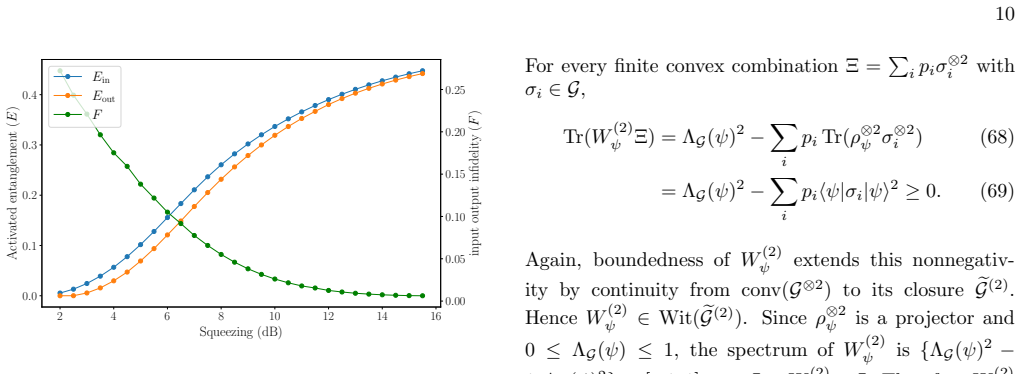
For the representative case n = m = 1, the optimal entanglement and EPR steering attainable within this witness-dependent activation family are exactly proportional to the underlying monotones. For closed convex free sets the monotones are faithful, strongly monotonic under free instruments, Lipschitz continuous and convex; for closed nonconvex sets faithfulness requires a two-copy lift. Witness-dependent CPTP channels are constructed whose outputs are two-qubit Werner states, and the framework is illustrated on odd-parity states, pure-loss single-photon states and GKP states.
What carries the argument
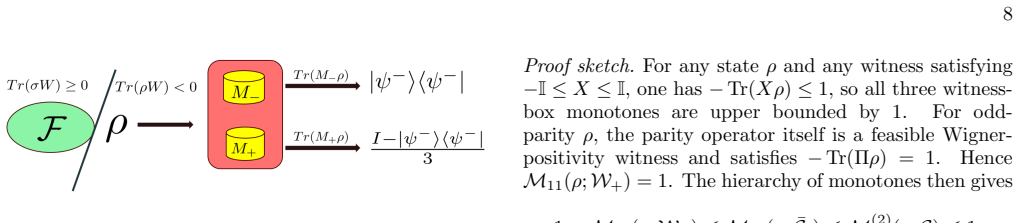
Witness-dependent completely positive trace-preserving measure-and-prepare channels that output two-qubit Werner states, indexed by box constraints on the witness operators.
If this is right
- The monotones supply direct lower bounds on the entanglement and steering that can be activated from given continuous-variable states.
- Explicit lower bounds for pure-state genuine non-Gaussianity and standard non-Gaussianity follow for odd-parity, single-photon and GKP states.
- For nonconvex free sets the two-copy lift restores faithfulness while preserving the activation construction.
- Closed continuous-variable free sets in general admit witness-based quantifiers that carry a direct operational interpretation via discrete-variable correlations.
Where Pith is reading between the lines
- The exact proportionality suggests that witness information can be used to optimize resource conversion rates between continuous-variable and discrete-variable systems.
- Laboratory implementations could test the strength of continuous-variable resources by preparing the output Werner states and measuring their entanglement or steering.
- The same witness-channel construction may extend to resource theories outside the three continuous-variable cases treated here.
Load-bearing premise
Closed convex free sets allow the defined monotones to be faithful and strongly monotonic under free instruments, and witness-dependent channels exist whose outputs achieve the exact proportionality for Werner states.
What would settle it
Prepare a specific odd-parity continuous-variable state, apply one of the constructed witness-dependent channels to obtain a two-qubit Werner state, and measure its concurrence or steering parameter to check whether the value exactly equals the monotone computed from the witness.
Figures

read the original abstract
We introduce a general witness-based framework for quantifying and operationally activating continuous-variable (CV) resources into discrete-variable (DV) bipartite entanglement or Einstein- Podolsky-Rosen (EPR) steering. For the three standard CV resource theories associated with Wigner negativity (WN), genuine non-Gaussianity (GNG), and standard non-Gaussianity (SNG), we define infinite families of bounded-witness monotones indexed by box constraints on the witness operators. For closed convex free sets, these monotones are faithful, strongly monotonic under free instruments, Lipschitz continuous, and convex. For closed nonconvex free sets, we show that faithfulness requires a two-copy lift and formulate the corresponding strong-monotonicity statement in the lifted theory. We further construct witness-dependent completely positive trace-preserving (CPTP) measure-and-prepare channels whose outputs are two-qubit Werner states. For the representative case n = m = 1, the optimal entanglement and EPR steering attainable within this witness-dependent activation family are exactly proportional to the underlying monotones. We illustrate the framework with odd-parity states, pure-loss single-photon states, and Gottesman- Kitaev-Preskill (GKP) states, and derive explicit lower bounds for pure-state GNG and SNG. More broadly, our results show that closed CV free sets admit witness-based quantifiers with a direct operational interpretation in terms of experimentally accessible DV correlations.
Editorial analysis
A structured set of objections, weighed in public.
Referee Report
Summary. The manuscript develops a witness-based framework to quantify continuous-variable resources including Wigner negativity (WN), genuine non-Gaussianity (GNG), and standard non-Gaussianity (SNG) via bounded-witness monotones. For closed convex free sets, these monotones are shown to be faithful, strongly monotonic under free instruments, Lipschitz continuous, and convex. A two-copy lift is introduced for closed nonconvex free sets to ensure faithfulness. The authors construct witness-dependent measure-and-prepare CPTP channels that output two-qubit Werner states, and demonstrate that for the case n = m = 1, the optimal entanglement and EPR steering within this family are exactly proportional to the underlying monotones. The framework is applied to odd-parity states, pure-loss single-photon states, and GKP states, yielding explicit lower bounds for pure-state GNG and SNG.
Significance. This framework establishes a direct operational connection between CV resource quantifiers and DV entanglement/steering measures through explicit channel constructions. The proportionality result for the representative case, achieved via the defined activation family, provides a concrete way to activate CV resources into measurable DV correlations. Credit is due to the explicit constructions of the witness-dependent channels and the detailed proofs of the monotone properties for convex sets, which strengthen the operational interpretation. If the derivations hold, the work advances the understanding of resource activation across CV and DV regimes.
minor comments (2)
- [Abstract] Abstract: the proportionality claim for n=m=1 is stated clearly but would benefit from a one-sentence pointer to the explicit form of the Werner-state output (e.g., the relation between the witness expectation value and the Werner parameter p) to make the construction immediately verifiable.
- The notation for box constraints on the witness operators is introduced without an immediate concrete example for one of the three resource theories (WN, GNG, SNG); adding a short illustrative calculation in the main text would improve readability.
Simulated Author's Rebuttal
We thank the referee for their positive assessment of our manuscript, accurate summary of the witness-based framework, and recommendation for minor revision. The significance statement correctly highlights the operational connection between CV monotones and DV correlations via the explicit channel constructions and proportionality result.
Circularity Check
Central proportionality result holds by explicit construction of witness-dependent channels
specific steps
-
self definitional
[Abstract (and corresponding construction section)]
"We further construct witness-dependent completely positive trace-preserving (CPTP) measure-and-prepare channels whose outputs are two-qubit Werner states. For the representative case n = m = 1, the optimal entanglement and EPR steering attainable within this witness-dependent activation family are exactly proportional to the underlying monotones."
The channels are defined to output Werner states whose entanglement/steering measures are linear in the witness expectation. The monotones are defined directly from the same witness operators. Therefore the proportionality is true by the construction of the activation family and the linearity of the DV quantifiers, not by an additional theorem or external verification.
full rationale
The paper defines witness-based monotones from bounded witness operators on CV states. It then explicitly constructs witness-dependent measure-and-prepare CPTP channels that map to two-qubit Werner states. For n=m=1 the entanglement and steering quantifiers on those Werner states are linear in the witness expectation value by the known formulas for Werner states. The stated 'optimal attainable' values are therefore identical to the monotone values by the choice of channels, reducing the claimed operational activation result to a direct consequence of the definitions rather than an independent derivation. No other load-bearing steps exhibit circularity; the faithfulness and monotonicity proofs for closed convex sets are separate and non-circular.
Axiom & Free-Parameter Ledger
axioms (2)
- domain assumption Closed convex free sets admit faithful, strongly monotonic, Lipschitz continuous, and convex witness-based monotones indexed by box constraints.
- domain assumption Witness-dependent CPTP measure-and-prepare channels exist whose outputs are two-qubit Werner states with entanglement/steering proportional to the monotones.
Reference graph
Works this paper leans on
-
[1]
LetFbe any free set and consider the n=m= 1 witness-box monotone
Forρ η in (52), M11(ρη;W +) = [2η−1] +.(55) The proof uses the following elementary boundary- mixing lemma. LetFbe any free set and consider the n=m= 1 witness-box monotone. Assume there exist a free stateσ∈ F, a stateτ /∈ F, and a feasible witnessX such that Tr(Xσ) = 0 and Tr(Xτ) =−1.(56) Then for everyt∈[0,1], the mixtureρ t := (1−t)σ+tτ satisfies M11(ρ...
-
[2]
Deformation and flow of amor- phous solids: Insights from elastoplastic models,
E. Chitambar and G. Gour, Quantum resource theo- ries, Reviews of Modern Physics91, 10.1103/revmod- phys.91.025001 (2019)
-
[3]
Gour,Quantum Resource Theories(Cambridge Uni- versity Press, 2025)
G. Gour,Quantum Resource Theories(Cambridge Uni- versity Press, 2025)
2025
-
[4]
L. K. Grover, A fast quantum mechanical algorithm for database search (1996), arXiv:quant-ph/9605043 [quant- ph]
work page Pith review arXiv 1996
-
[5]
P. W. Shor, Polynomial-time algorithms for prime factor- ization and discrete logarithms on a quantum computer, SIAM Journal on Computing26, 1484–1509 (1997)
1997
-
[6]
H.-Y. Huang, S. Choi, J. R. McClean, and J. Preskill, The vast world of quantum advantage (2025), arXiv:2508.05720 [quant-ph]
-
[7]
Serafini,Quantum Continuous Variables: A Primer of Theoretical Methods(CRC Press, 2017)
A. Serafini,Quantum Continuous Variables: A Primer of Theoretical Methods(CRC Press, 2017)
2017
-
[8]
S. L. Braunstein and P. van Loock, Quantum information with continuous variables, Reviews of Modern Physics 77, 513–577 (2005)
2005
- [9]
-
[10]
M. G. Genoni, M. G. A. Paris, and K. Banaszek, Measure of the non-gaussian character of a quantum state, Phys- ical Review A76, 10.1103/physreva.76.042327 (2007)
-
[11]
M. G. Genoni, M. G. A. Paris, and K. Banaszek, Quan- tifying the non-gaussian character of a quantum state by quantum relative entropy, Physical Review A78, 10.1103/physreva.78.060303 (2008)
-
[12]
Marian and T
P. Marian and T. A. Marian, Relative entropy is an ex- act measure of non-gaussianity, Phys. Rev. A88, 012322 (2013)
2013
-
[14]
Turner, M
L. Turner, M. Gut ¸˘ a, and G. Adesso, All non-gaussian states are advantageous for channel discrimination: ro- bustness of non-convex continuous variable quantum re- sources, New Journal of Physics27, 094507 (2025)
2025
-
[15]
R. Takagi and Q. Zhuang, Convex resource theory of non-gaussianity, Physical Review A97, 10.1103/phys- reva.97.062337 (2018)
-
[16]
N. Li, S. Luo, and Y. Sun, Information-theoretic aspects of werner states, Annals of Physics424, 168371 (2021)
2021
-
[17]
B.-H. Wang, Entangled states in the role of witnesses, Physical Review A97, 10.1103/physreva.97.050302 (2018)
- [18]
-
[19]
Watrous,The Theory of Quantum Information(Cam- bridge University Press, 2018)
J. Watrous,The Theory of Quantum Information(Cam- bridge University Press, 2018)
2018
-
[20]
Chabaud, P.-E
U. Chabaud, P.-E. Emeriau, and F. Grosshans, Witness- ing wigner negativity, Quantum5, 471 (2021)
2021
-
[21]
Gottesman, A
D. Gottesman, A. Kitaev, and J. Preskill, Encoding a qubit in an oscillator, Phys. Rev. A64, 012310 (2001)
2001
-
[22]
V. V. Albert, K. Noh, K. Duivenvoorden, D. J. Young, R. Brierley, P. Reinhold, C. Vuillot, L. Li, C. Shen, S. Girvin,et al., Performance and structure of single- mode bosonic codes, Physical Review A97, 032346 (2018)
2018
-
[23]
B. M. Terhal, J. Conrad, and C. Vuillot, Towards scalable bosonic quantum error correction, Quantum Science and Technology5, 043001 (2020)
2020
-
[24]
K. Noh, V. V. Albert, and L. Jiang, Quantum capacity bounds of gaussian thermal loss channels and achievable rates with gottesman-kitaev-preskill codes, IEEE Trans- actions on Information Theory65, 2563–2582 (2019)
2019
-
[25]
Hastrup and U
J. Hastrup and U. L. Andersen, Analysis of loss correc- tion with the gottesman-kitaev-preskill code, Phys. Rev. A108, 052413 (2023)
2023
-
[26]
B. W. Walshe, B. Q. Baragiola, R. N. Alexander, and N. C. Menicucci, Continuous-variable gate teleportation and bosonic-code error correction, Phys. Rev. A102, 062411 (2020)
2020
discussion (0)
Sign in with ORCID, Apple, or X to comment. Anyone can read and Pith papers without signing in.