Recognition: unknown
Mean-field phase diagrams of spinor bosons in an optical cavity
Pith reviewed 2026-05-10 09:04 UTC · model grok-4.3
The pith
Spinor bosons in an optical cavity form antiferromagnetic Mott insulators, ferromagnetic density waves, and three supersolid phases.
A machine-rendered reading of the paper's core claim, the machinery that carries it, and where it could break.
Core claim
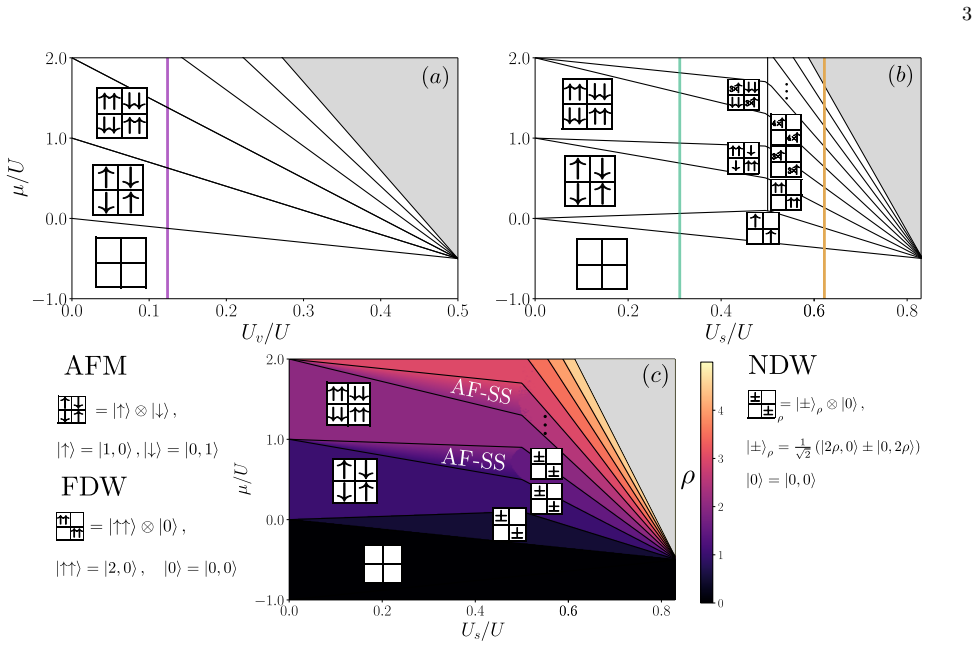
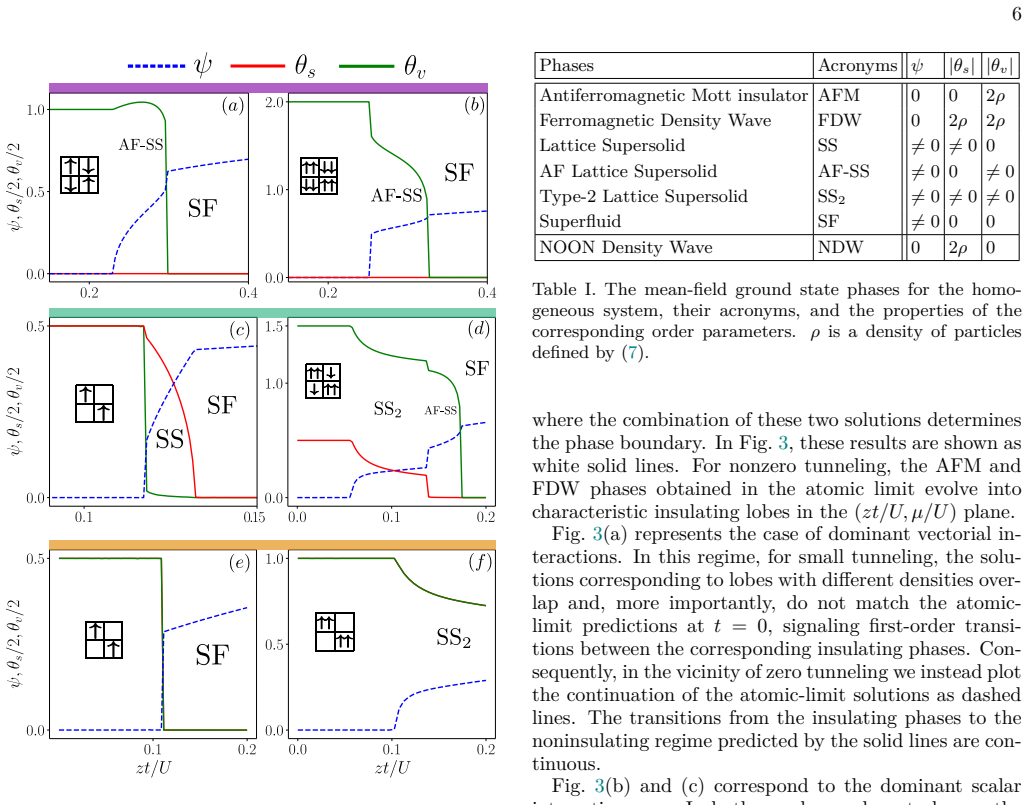
By combining analytical arguments with numerical calculations based on the Gutzwiller ansatz in the grand-canonical mean-field approach, the system exhibits two types of magnetic phases: an antiferromagnetic Mott insulator and a ferromagnetic density wave. In addition, three distinct supersolid phases emerge, characterized by different patterns of spin and density imbalances. For zero total magnetization, only two of the three supersolid regimes survive, and the ferromagnetic density waves are replaced by NOON density waves. These new ground states present density-modulated quantum superpositions of the underlying spin components of the bosons. The phase diagram of the trapped system is also
What carries the argument
The grand-canonical mean-field treatment with the Gutzwiller ansatz, which approximates the many-body state as a product of local states and minimizes the energy to locate phases under cavity-mediated long-range interactions.
If this is right
- Two magnetic phases and three supersolids appear when total magnetization is unconstrained.
- Imposing zero total magnetization replaces ferromagnetic density waves with NOON density waves and eliminates one supersolid regime.
- The trapped-system phase diagram provides concrete guidance for experiments with harmonic confinement.
- Each supersolid is distinguished by a unique combination of spin and density modulation patterns.
Where Pith is reading between the lines
- Measurements of local density and spin correlations in current ultracold-atom setups could detect the predicted phases.
- Beyond-mean-field fluctuations may shift the stability regions of the supersolid phases.
- Varying the relative positioning of lattice nodes and cavity antinodes is likely to produce additional phases not covered here.
Load-bearing premise
The assumption that external lattice nodes coincide exactly with cavity antinodes, together with the validity of the grand-canonical mean-field treatment for capturing the true ground states.
What would settle it
Exact diagonalization or quantum Monte Carlo results on small lattices that produce ground-state energies or order parameters incompatible with the mean-field phase boundaries.
Figures



read the original abstract
The plethora of possible ground states of spinor bosons placed in an external lattice and a cavity is revisited. We discuss the simplest case when the external lattice nodes coincide with the antinodes of the cavity field. We analyze the problem within the grand-canonical mean-field approach, considering both the homogeneous system and the nonhomogeneous case with a harmonic trapping potential. Due to the spin degree of freedom, in the homogeneous case we treat the system in a twofold manner: we impose the physically relevant total-magnetization constraint, while also discussing the minimization landscape for the full unconstrained problem. In the latter, by combining analytical arguments with numerical calculations based on the Gutzwiller ansatz, we show that the system exhibits two types of magnetic phases: an antiferromagnetic Mott insulator (AFM) and a ferromagnetic density wave (FDW). In addition, three distinct supersolid phases emerge, characterized by different patterns of spin and density imbalances. In case of the zero total magnetization, only two of the three supersolid regimes survive, and the FDW phases are replaced by NOON density waves (NDW). These new ground states present density-modulated quantum superpositions of the underlying spin components of the bosons. Finally, we present the phase diagram of the trapped system, which is directly relevant for future experiments.
Editorial analysis
A structured set of objections, weighed in public.
Referee Report
Summary. The manuscript revisits ground states of spinor bosons in an optical lattice whose nodes coincide with cavity antinodes. Within the grand-canonical mean-field treatment and Gutzwiller ansatz, it analyzes the homogeneous system both with and without a total-magnetization constraint, identifying an antiferromagnetic Mott insulator (AFM), a ferromagnetic density wave (FDW), and three supersolid phases in the unconstrained case; under zero magnetization the FDW is replaced by NOON density waves (NDW) while two supersolids remain. A phase diagram for the harmonically trapped system is also presented.
Significance. If the reported phases are robust, the work supplies a concrete mean-field map of magnetic and supersolid states arising from the interplay of spinor interactions, short-range repulsion, and cavity-mediated long-range coupling. The explicit treatment of both constrained and unconstrained magnetization, together with the trapped geometry directly relevant to experiments, strengthens the manuscript's utility for guiding cavity-QED ultracold-atom studies.
major comments (2)
- [homogeneous-system analysis and numerical Gutzwiller results] The central phase diagram (homogeneous unconstrained and constrained cases) rests on grand-canonical Gutzwiller minimization without reported checks against fluctuation corrections, finite-size scaling, or comparisons to exact methods for small clusters. Because cavity-mediated interactions are long-range and compete with on-site repulsion, mean-field is known to overestimate the stability of supersolid and density-wave phases near first-order transitions; this directly affects the claimed existence of the three supersolids and the FDW/NDW replacement.
- [model definition and homogeneous case] The assumption that external-lattice nodes coincide exactly with cavity antinodes fixes the form of the cavity-mediated term and is stated as the 'simplest case,' yet no sensitivity analysis is provided for small deviations from this alignment. Such deviations would alter the momentum structure of the interaction and could destabilize the reported AFM and supersolid patterns.
minor comments (2)
- [supersolid regimes] The three supersolid phases are characterized by 'different patterns of spin and density imbalances,' but the manuscript would benefit from explicit definitions or order-parameter expressions for each (e.g., staggered magnetization versus density modulation amplitudes) to facilitate comparison with future work.
- [trapped-system phase diagram] In the trapped-system section, details on how the harmonic potential is discretized within the Gutzwiller ansatz and on the convergence criteria with respect to trap frequency or system size are not fully specified.
Simulated Author's Rebuttal
We thank the referee for their careful reading of the manuscript and for the constructive comments. We address each major point below and outline the revisions we intend to make.
read point-by-point responses
-
Referee: The central phase diagram (homogeneous unconstrained and constrained cases) rests on grand-canonical Gutzwiller minimization without reported checks against fluctuation corrections, finite-size scaling, or comparisons to exact methods for small clusters. Because cavity-mediated interactions are long-range and compete with on-site repulsion, mean-field is known to overestimate the stability of supersolid and density-wave phases near first-order transitions; this directly affects the claimed existence of the three supersolids and the FDW/NDW replacement.
Authors: We agree that the Gutzwiller mean-field treatment can overestimate the stability of supersolid and density-wave phases, especially near first-order transitions when long-range cavity interactions compete with local repulsion. Our work is explicitly framed as a mean-field study to identify candidate phases. We performed internal consistency checks by varying the number of sites in the ansatz, but did not carry out finite-size scaling or exact comparisons. In the revised manuscript we will add a paragraph discussing the limitations of the mean-field approximation in this setting, citing relevant literature on fluctuation effects in cavity systems, and clarifying that the reported phases should be viewed as mean-field predictions whose stability requires further investigation with beyond-mean-field methods. revision: partial
-
Referee: The assumption that external-lattice nodes coincide exactly with cavity antinodes fixes the form of the cavity-mediated term and is stated as the 'simplest case,' yet no sensitivity analysis is provided for small deviations from this alignment. Such deviations would alter the momentum structure of the interaction and could destabilize the reported AFM and supersolid patterns.
Authors: The perfect node-antinode alignment is presented as the simplest experimentally accessible case that yields a well-defined cavity-mediated interaction with momentum transfer set by the cavity wave vector. We concur that small misalignments would modify the interaction momentum structure and could influence phase stability. A full numerical sensitivity scan over misalignment parameters would require substantial additional computations. We will revise the text to include a brief discussion, based on perturbative reasoning, of how small deviations are expected to affect the reported phases, and we will note that the qualitative features of the AFM, FDW/NDW, and supersolid states are anticipated to remain robust for minor misalignments. revision: partial
Circularity Check
No circularity: standard mean-field + Gutzwiller derivation is self-contained
full rationale
The paper's central claims follow from applying the grand-canonical mean-field approximation and Gutzwiller variational ansatz to a Hamiltonian whose cavity-mediated interaction is fixed by the stated lattice-antinode coincidence assumption. Analytical arguments identify candidate phases (AFM, FDW, NDW, supersolids) whose stability is then checked by numerical energy minimization on both constrained and unconstrained magnetization landscapes; neither the ansatz nor the minimization procedure is defined in terms of the resulting phase labels. No load-bearing step reduces a prediction to a fitted input or to a self-citation chain, and the method is externally benchmarked against conventional Bose-Hubbard mean-field treatments.
Axiom & Free-Parameter Ledger
Reference graph
Works this paper leans on
-
[1]
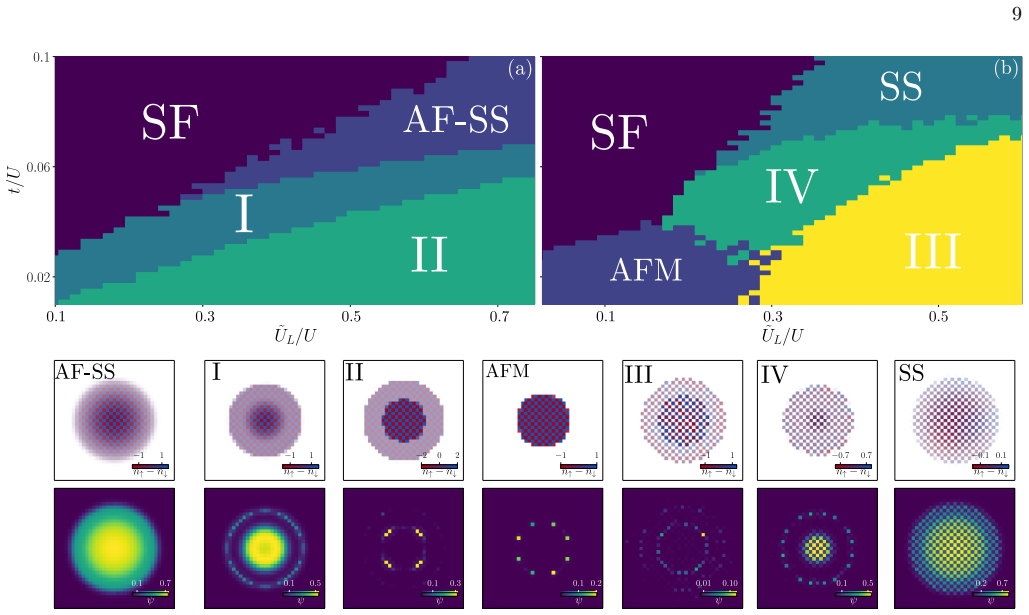
and [35], the extensive nature of the cavity-mediated interactions prevents the infinite-system solution from serving as a reliable approximation within a local den- sity approximation. Consequently, the system size is no Acronyms Combination of phases in the trap I AF-SS – AFMρ=1– AF-SS II AF-SS – AFMρ=1– AF-SS – AFMρ=2 III SS – NDWρ=1/2– SS – NDWρ=1 IV ...
-
[2]
The problem of identifying phases in the trap may be treated as a textbook pattern recognition [39]
that such an approach reproduces the experimental data with good accuracy. The problem of identifying phases in the trap may be treated as a textbook pattern recognition [39]. Each point in the (˜UL/U,t/U) parameter space corresponds to a trapped system characterized by three observables 9 Figure 6. Behavior of the nonhomogeneous gas of spinor bosons coup...
2025
-
[3]
Domokos and H
P. Domokos and H. Ritsch, Collective cooling and self- organization of atoms in a cavity, Phys. Rev. Lett.89, 253003 (2002)
2002
-
[4]
A. T. Black, H. W. Chan, and V. Vuletić, Observation of collective friction forces due to spatial self-organization of atoms: From rayleigh to bragg scattering, Phys. Rev. Lett.91, 203001 (2003)
2003
-
[5]
J. K. Asbóth, P. Domokos, H. Ritsch, and A. Vukics, Self-organization of atoms in a cavity field: Threshold, bistability, and scaling laws, Phys. Rev. A72, 053417 (2005)
2005
-
[6]
Maschler and H
C. Maschler and H. Ritsch, Cold atom dynamics in a quantum optical lattice potential, Phys. Rev. Lett.95, 260401 (2005)
2005
-
[7]
Maschler, I
C. Maschler, I. B. Mekhov, and H. Ritsch, Ultra- cold atoms in optical lattices generated by quantized light fields, The European Physical Journal D46, 545 (2008)
2008
-
[8]
Larson, B
J. Larson, B. Damski, G. Morigi, and M. Lewenstein, Mott-insulator states of ultracold atoms in optical res- onators, Phys. Rev. Lett.100, 050401 (2008)
2008
-
[9]
Fernández-Vidal, G
S. Fernández-Vidal, G. De Chiara, J. Larson, and G. Mo- rigi, Quantum ground state of self-organized atomic crys- tals in optical resonators, Phys. Rev. A81, 043407 (2010)
2010
-
[10]
Dogra, F
N. Dogra, F. Brennecke, S. D. Huber, and T. Donner, Phase transitions in a Bose-Hubbard model with cavity- mediated global-range interactions, Phys. Rev. A94, 023632 (2016)
2016
-
[11]
A. E. Niederle, G. Morigi, and H. Rieger, Ultracold bosons with cavity-mediated long-range interactions: A local mean-field analysis of the phase diagram, Phys. Rev. A94, 033607 (2016)
2016
-
[12]
Y. Chen, Z. Yu, and H. Zhai, Quantum phase transitions of the bose-hubbard model inside a cavity, Phys. Rev. A 93, 041601 (2016)
2016
-
[13]
Y. Li, L. He, and W. Hofstetter, Lattice-supersolid phase of strongly correlated bosons in an optical cavity, Phys. Rev. A87, 051604 (2013)
2013
-
[14]
Panas, A
J. Panas, A. Kauch, and K. Byczuk, Spectral properties and phase diagram of correlated lattice bosons in an op- tical cavity within bosonic dynamical mean-field theory, Phys. Rev. B95, 115105 (2017)
2017
-
[15]
Klinder, H
J. Klinder, H. Keßler, M. R. Bakhtiari, M. Thorwart, and A. Hemmerich, Observation of a superradiant mott insulator in the dicke-hubbard model, Phys. Rev. Lett. 115, 230403 (2015)
2015
-
[16]
Landig, L
R. Landig, L. Hruby, N. Dogra, M. Landini, R. Mottl, T. Donner, and T. Esslinger, Quantum phases from com- peting short- and long-range interactions in an optical lattice, Nature532, 476–479 (2016)
2016
-
[17]
Hruby, N
L. Hruby, N. Dogra, M. Landini, T. Donner, and T. Esslinger, Metastability and avalanche dy- namics in strongly correlated gases with long- range interactions, PNAS115, 3279 (2018), https://www.pnas.org/content/115/13/3279.full.pdf
2018
-
[18]
Flottat, L
T. Flottat, L. d. F. de Parny, F. Hébert, V. G. Rousseau, and G. G. Batrouni, Phase diagram of bosons in a two-dimensional optical lattice with infinite-range cavity- 11 mediated interactions, Phys. Rev. B95, 144501 (2017)
2017
-
[19]
Himbert, C
L. Himbert, C. Cormick, R. Kraus, S. Sharma, and G. Morigi, Mean-field phase diagram of the extended bose-hubbard model of many-body cavity quantum elec- trodynamics, Phys. Rev. A99, 043633 (2019)
2019
-
[20]
Habibian, A
H. Habibian, A. Winter, S. Paganelli, H. Rieger, and G. Morigi, Bose-glass phases of ultracold atoms due to cavity backaction, Phys. Rev. Lett.110, 075304 (2013)
2013
-
[21]
Habibian, A
H. Habibian, A. Winter, S. Paganelli, H. Rieger, and G. Morigi, Quantum phases of incommensurate opti- cal lattices due to cavity backaction, Phys. Rev. A88, 043618 (2013)
2013
-
[22]
S. F. Caballero-Benitez and I. B. Mekhov, Bond order via light-induced synthetic many-body interactions of ul- tracold atoms in optical lattices, New Journal of Physics 18, 113010 (2016)
2016
-
[23]
Chanda, R
T. Chanda, R. Kraus, G. Morigi, and J. Zakrzewski, Self- organized topological insulator due to cavity-mediated correlated tunneling, Quantum5, 501 (2021)
2021
-
[24]
Chanda, R
T. Chanda, R. Kraus, J. Zakrzewski, and G. Morigi, Bond order via cavity-mediated interactions, Phys. Rev. B106, 075137 (2022)
2022
-
[25]
Halati, A
C.-M. Halati, A. Sheikhan, and C. Kollath, Theoretical methods to treat a single dissipative bosonic mode cou- pled globally to an interacting many-body system, Phys. Rev. Res.2, 043255 (2020)
2020
-
[26]
Halati, A
C.-M. Halati, A. Sheikhan, H. Ritsch, and C. Kol- lath, Numerically exact treatment of many-body self- organization in a cavity, Phys. Rev. Lett.125, 093604 (2020)
2020
-
[27]
G. Orso, J. Zakrzewski, and P. Deuar, Self-organized cav- ity bosons beyond the adiabatic elimination approxima- tion, Phys. Rev. Lett.134, 183405 (2025)
2025
-
[28]
Landini, N
M. Landini, N. Dogra, K. Kroeger, L. Hruby, T. Don- ner, and T. Esslinger, Formation of a spin texture in a quantum gas coupled to a cavity, Phys. Rev. Lett.120, 223602 (2018)
2018
-
[29]
R. M. Kroeze, Y. Guo, V. D. Vaidya, J. Keeling, and B. L. Lev, Spinor self-ordering of a quantum gas in a cavity, Phys. Rev. Lett.121, 163601 (2018)
2018
-
[30]
L. Zhou, H. Pu, H. Y. Ling, and W. Zhang, Cavity- mediated strong matter wave bistability in a spin-1 con- densate, Phys. Rev. Lett.103, 160403 (2009)
2009
-
[31]
Safaei, O
S. Safaei, O. E. Mustecaplioglu, and B. Tanatar, Raman superradiance and spin lattice of ultracold atoms in op- tical cavities, New Journal of Physics15, 083037 (2013)
2013
-
[32]
Padhi and S
B. Padhi and S. Ghosh, Spin-orbit-coupled bose-einstein condensates in a cavity: Route to magnetic phases through cavity transmission, Phys. Rev. A90, 023627 (2014)
2014
-
[33]
Mivehvar, H
F. Mivehvar, H. Ritsch, and F. Piazza, Cavity-quantum- electrodynamical toolbox for quantum magnetism, Phys. Rev. Lett.122, 113603 (2019)
2019
-
[34]
Lozano-Méndez, A
K. Lozano-Méndez, A. H. Cásares, and S. F. Caballero- Benítez, Spin entanglement and magnetic competition via long-range interactions in spinor quantum optical lat- tices, Phys. Rev. Lett.128, 080601 (2022)
2022
-
[35]
L. Carl, R. Rosa-Medina, S. D. Huber, T. Esslinger, N. Dogra, and T. Dubcek, Phases, instabilities and ex- citations in a two-component lattice model with photon- mediated interactions, Phys. Rev. Res.5, L032003 (2023)
2023
-
[36]
Chanda, L
T. Chanda, L. Barbiero, M. Lewenstein, M. J. Mark, and J. Zakrzewski, Recent progress on quantum simula- tions of non-standard bose–hubbard models, Reports on Progress in Physics88, 044501 (2025)
2025
-
[37]
Sundar and E
B. Sundar and E. J. Mueller, Lattice bosons with infinite- rangecheckerboardinteractions,Phys.Rev.A94,033631 (2016)
2016
-
[38]
P. Kok, H. Lee, and J. P. Dowling, Creation of large- photon-number path entanglement conditioned on pho- todetection, Phys. Rev. A65, 052104 (2002)
2002
-
[39]
van Oosten, P
D. van Oosten, P. van der Straten, and H. T. C. Stoof, Quantum phases in an optical lattice, Phys. Rev. A63, 053601 (2001)
2001
-
[40]
Zakrzewski, Mean-field dynamics of the superfluid- insulator phase transition in a gas of ultracold atoms, Phys
J. Zakrzewski, Mean-field dynamics of the superfluid- insulator phase transition in a gas of ultracold atoms, Phys. Rev. A71, 043601 (2005)
2005
-
[41]
Dawid, J
A. Dawid, J. Arnold, B. Requena, A. Gresch, M. Płodzień, K. Donatella, K. A. Nicoli, P. Stornati, R. Koch, M. Büttner, R. Okuła, G. Muñoz-Gil, R. A. Vargas-Hernández, A. Cervera-Lierta, J. Carrasquilla, V. Dunjko, M. Gabrié, P. Huembeli, E. van Nieuwenburg, F. Vicentini, L. Wang, S. J. Wetzel, G. Carleo, E. Gre- plová, R. Krems, F. Marquardt, M. Tomza, M....
2025
-
[42]
We employed the pytorch python library, creating CNN with four learnable layers
-
[43]
Virtanen, R
P. Virtanen, R. Gommers, T. E. Oliphant, M. Haber- land, T. Reddy, D. Cournapeau, E. Burovski, P. Pe- terson, W. Weckesser, J. Bright, S. J. van der Walt, M. Brett, J. Wilson, K. J. Millman, N. Mayorov, A. R. J. Nelson, E. Jones, R. Kern, E. Larson, C. J. Carey, İ. Po- lat, Y. Feng, E. W. Moore, J. VanderPlas, D. Laxalde, J. Perktold, R. Cimrman, I. Henri...
2020
discussion (0)
Sign in with ORCID, Apple, or X to comment. Anyone can read and Pith papers without signing in.