Recognition: unknown
An Open-Source Hardware-Aware Sub-THz Radio-Stripe Simulator
Pith reviewed 2026-05-10 10:38 UTC · model grok-4.3
The pith
An open-source simulator traces the full waveform-level signal chain in sub-THz radio-stripe systems from central baseband generation through fiber links to impaired radio units.
A machine-rendered reading of the paper's core claim, the machinery that carries it, and where it could break.
Core claim
The simulator provides an end-to-end model of the signal path in sub-THz radio-stripe systems by generating CP-OFDM baseband signals in the central unit, passing them through parameterized polymer microwave fiber and coupler links, applying configurable impairments at the booster or active radio units, and combining with deterministic, stochastic, or ray-tracing wireless channel models before computing performance metrics such as normalised mean square error, signal-to-noise-and-distortion ratio, and bit error rate.
What carries the argument
The configuration-driven full waveform-level signal chain simulator, which chains baseband generation, fiber propagation, RF impairment models, and propagation channels.
If this is right
- Reproducible studies of how impairments accumulate across cascaded fiber front-haul and RF stages become feasible without physical hardware.
- Effects of calibration methods and algorithmic decisions such as radio-unit selection and beam management can be evaluated at the waveform level.
- Intermediate signals can be inspected to isolate degradation at each stage of the chain.
- Site-specific propagation data can be integrated to assess performance under realistic deployment conditions.
Where Pith is reading between the lines
- The tool could shorten design cycles by allowing virtual prototyping of sub-THz systems before fabrication.
- Researchers might use it to rank which impairments most limit overall throughput in given bandwidth and array-size regimes.
- The same modeling structure could extend to other carrier frequencies that rely on fiber-RF cascades for distributed arrays.
Load-bearing premise
The measurement-parameterized models for polymer microwave fiber, couplers, and RF impairments accurately represent real hardware behavior across the configurations users will test.
What would settle it
A direct comparison of simulator outputs against measured waveforms and metrics from a physical sub-THz radio-stripe prototype using matching fiber, coupler, and radio-unit parameters would settle whether the models reproduce observed impairment accumulation.
Figures


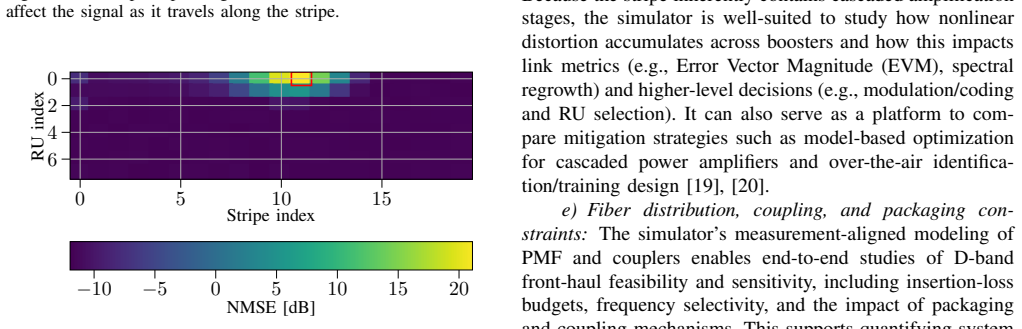
read the original abstract
Sub-Terahertz radio-stripe and distributed MIMO architectures promise extreme spatial reuse and multi-GHz bandwidths, but the cascaded fiber front-haul and RF hardware impairments strongly shape end-to-end performance. This paper presents an open-source, configuration-driven simulator that models the full waveform-level signal chain from CP-OFDM baseband generation in the central unit, through measurement-parameterized polymer microwave fiber and coupler links, to booster/active Radio Units (RUs) with configurable nonlinearity, noise, in-phase and quadrature imbalance, and oscillator phase noise and carrier frequency offset. Wireless propagation is supported via lightweight deterministic and stochastic per-subcarrier channel models as well as site-specific ray-tracing datasets generated with a companion Sionna ray-tracer module. The simulator exports intermediate waveforms and system metrics (e.g., normalised mean square error, signal-to-noise-and-distortion ratio, bit error rate) to enable reproducible studies of impairment accumulation, calibration, and algorithmic choices such as RU selection and beam management.
Editorial analysis
A structured set of objections, weighed in public.
Referee Report
Summary. The paper presents an open-source, configuration-driven simulator for sub-THz radio-stripe and distributed MIMO architectures. It implements the full waveform-level signal chain from CP-OFDM baseband generation in the central unit, through measurement-parameterized polymer microwave fiber and coupler links, to booster/active Radio Units with configurable nonlinearity, noise, I/Q imbalance, oscillator phase noise, and carrier frequency offset. Wireless channels are modeled via lightweight deterministic/stochastic per-subcarrier models and site-specific ray-tracing datasets, with exports of intermediate waveforms and metrics (NMSE, SNDR, BER) to support reproducible studies of impairment accumulation, calibration, and algorithms such as RU selection and beam management.
Significance. If the implementation faithfully matches the described models, this tool would provide substantial value to the sub-THz communications community by enabling hardware-aware, reproducible simulations of cascaded front-haul and RF impairments without physical testbeds. The open-source release, configuration interface, and waveform/metric export features directly address the need for accessible platforms to study impairment accumulation and system-level algorithmic choices in high-bandwidth distributed MIMO setups.
minor comments (1)
- [Abstract] The abstract and introduction would benefit from an explicit statement of the simulator's supported bandwidth range and computational scaling to help readers assess applicability to their target scenarios.
Simulated Author's Rebuttal
We thank the referee for the positive review and the recommendation to accept the manuscript. The recognition of the simulator's potential value to the sub-THz communications community is appreciated.
Circularity Check
No circularity: tool-description paper with no derived predictions
full rationale
The manuscript describes an open-source, configuration-driven simulator implementing a waveform-level chain (CP-OFDM baseband through measurement-parameterized PMF/coupler links to RUs with configurable impairments, plus channel models). No new equations are derived, no parameters are fitted to data and then called predictions, and no uniqueness theorems or ansatzes are smuggled via self-citation. The central claim is the existence and architecture of the tool itself; model equations are presented as configurable blocks whose fidelity is a user-facing caveat, not a load-bearing derivation. The open-source release allows direct verification that the implementation matches the text, rendering the contribution self-contained against external benchmarks.
Axiom & Free-Parameter Ledger
Reference graph
Works this paper leans on
-
[1]
High-Level Models for Tandem Opera- tion,
6GTandem Consortium, “High-Level Models for Tandem Opera- tion,” 6GTandem (SNS JU, Grant Agreement No. 101096302), Tech. Rep. D3.1, Mar. 2024
2024
-
[2]
Detailed Models Including Hardware Specifics and Cross-Layer 6GTandem Operation,
6GTandem Consortium, “Detailed Models Including Hardware Specifics and Cross-Layer 6GTandem Operation,” 6GTandem (SNS JU, Grant Agreement No. 101096302), Tech. Rep. D3.2, Oct. 2024
2024
-
[3]
Final Algorithms for Efficient Transmis- sion and Support for New Services,
6GTandem Consortium, “Final Algorithms for Efficient Transmis- sion and Support for New Services,” 6GTandem (SNS JU, Grant Agreement No. 101096302), Tech. Rep. D3.4, Oct. 2024
2024
-
[4]
End-to-End Simulation of 5G mmWave Networks,
M. Mezzavilla et al., “End-to-End Simulation of 5G mmWave Networks,”IEEE Communications Surveys & Tutorials, vol. 20, no. 3, pp. 2237–2263, 2018.DOI: 10.1109/COMST.2018.2828880
-
[5]
A Tutorial on NYUSIM: Sub-Terahertz and Millimeter-Wave Channel Simulator for 5G, 6G, and Beyond,
H. Poddar, S. Ju, D. Shakya, and T. S. Rappaport, “A Tutorial on NYUSIM: Sub-Terahertz and Millimeter-Wave Channel Simulator for 5G, 6G, and Beyond,”IEEE Communications Surveys & Tutori- als, vol. 26, no. 2, pp. 824–857, 2024.DOI: 10.1109/COMST.2023. 3344671
-
[6]
H. Poddar, A. Chowdary, T. S. Rappaport, and M. Chafii, “Full-Stack End-To-End Sub-THz Simulations at 140 GHz using NYUSIM Channel Model in ns-3,” in2024 IEEE Wireless Commu- nications and Networking Conference (WCNC), 2024, pp. 1–6.DOI: 10.1109/WCNC57260.2024.10570665
-
[7]
HermesPy: An Open- Source Link-Level Evaluator for 6G,
J. Adler, T. Kronauer, and A. N. Barreto, “HermesPy: An Open- Source Link-Level Evaluator for 6G,”IEEE Access, vol. 10, pp. 120 256–120 273, 2022.DOI: 10.1109/ACCESS.2022.3222063
-
[8]
Waveform Learning Under Phase Noise Impairment for Sub-THz Communications,
D. Marasinghe, L. H. Nguyen, J. Mohammadi, Y . Chen, T. Wild, and N. Rajatheva, “Waveform Learning Under Phase Noise Impairment for Sub-THz Communications,”IEEE Transactions on Communica- tions, vol. 73, no. 1, pp. 117–131, 2025.DOI: 10.1109/TCOMM. 2024.3430982
-
[9]
TiEMPO: open-source time-dependent end-to- end model for simulating ground-based submillimeter astronomical observations,
E. Huijten et al., “TiEMPO: open-source time-dependent end-to- end model for simulating ground-based submillimeter astronomical observations,” inMillimeter, Submillimeter, and Far-Infrared Detec- tors and Instrumentation for Astronomy X, SPIE, vol. 11453, 2020, pp. 562–581
2020
-
[10]
Circularly Polarized Sub- THz Antenna Design for Distributed Deployment,
Y . Cao, M. Wojnowski, and B. K. Lau, “Circularly Polarized Sub- THz Antenna Design for Distributed Deployment,” in2024 18th European Conference on Antennas and Propagation (EuCAP), 2024, pp. 1–4.DOI: 10.23919/EuCAP60739.2024.10501515
-
[11]
F. Ait Aoudia, J. Hoydis, M. Nimier-David, B. Nicolet, S. Cammerer, and A. Keller, “Sionna RT: Technical Report,” arXiv:2504.21719, Nov. 2025. [Online]. Available: https : / / arxiv. org/abs/2504.21719
-
[12]
Hoydis et al.,Sionna, version 1.2.1, 2022
J. Hoydis et al.,Sionna, version 1.2.1, 2022
2022
-
[13]
Nimr (et
A. Nimr (et. al.),Hexa-X Deliverable D2.3: Radio models and enabling techniques towards ultra-high data rate links and capacity in 6G, Technical Report, Hexa-X Project, avail- able online: https://hexa-x.eu/wp-content/uploads/2023/04/Hexa-X- D2 3 v1.0.pdf, Apr. 2023
2023
-
[14]
Report on Packaged Samples for Antenna Unit and Central Unit and Plastic Fibre for demonstrator including designs, simulation and characterization,
6GTandem Consortium, “Report on Packaged Samples for Antenna Unit and Central Unit and Plastic Fibre for demonstrator including designs, simulation and characterization,” 6GTandem (SNS JU, Grant Agreement No. 101096302), Tech. Rep. D4.3, Mar. 2024
2024
- [15]
- [16]
-
[17]
Propagation Distance Estimation for Radio over Fiber with Cascaded Structure,
D. Kong, D. P. Moya Osorio, and E. G. Larsson, “Propagation Distance Estimation for Radio over Fiber with Cascaded Structure,” in2024 IEEE 25th International Workshop on Signal Processing Advances in Wireless Communications (SPAWC), 2024, pp. 691– 695.DOI: 10.1109/SPAWC60668.2024.10694520
-
[18]
Radio Over Fiber With Cascaded Structure: Algorithm for Uplink Positioning,
D. Kong, D. P. M. Osorio, and E. G. Larsson, “Radio Over Fiber With Cascaded Structure: Algorithm for Uplink Positioning,”IEEE Transactions on Wireless Communications, vol. 25, pp. 9000–9014, 2026.DOI: 10.1109/TWC.2025.3641043
-
[19]
Moryakova, T
O. Moryakova, T. Eriksson, and H. Johansson,Modeling, Analysis, and Optimization of Cascaded Power Amplifiers, 2025. arXiv: 2503. 14083[eess.SP]. [Online]. Available: https://arxiv.org/abs/2503. 14083
2025
-
[20]
F. Rottenberg, T. Feys, and N. Tervo,Optimal Training Design for Over-the-Air Polynomial Power Amplifier Model Estimation, 2024. arXiv: 2404.12830[eess.SP]. [Online]. Available: https://arxiv. org/abs/2404.12830
-
[21]
In2024 IEEE 74th Electronic Components and Technology Conference (ECTC)
V . Liakonis, Y . Papananos, M. Wojnowski, and W. Hartner, “High- Performance Polymer Microwave Fiber Coupler in eWLB Package for Sub-THz Communication,” in2024 IEEE 74th Electronic Com- ponents and Technology Conference (ECTC), 2024, pp. 748–753. DOI: 10.1109/ECTC51529.2024.00122
-
[22]
Efficient Implementation of Polymer Microwave Fiber Links Employing Non-Galvanic Coupling Mechanism,
V . Liakonis, Y . Papananos, F. Dielacher, M. Wojnowski, and W. Hartner, “Efficient Implementation of Polymer Microwave Fiber Links Employing Non-Galvanic Coupling Mechanism,”Applied Sciences, vol. 15, no. 4, p. 1824, 2025.DOI: 10.3390/app15041824 [Online]. Available: https://doi.org/10.3390/app15041824
-
[23]
In: 2025 IEEE International Symposium on Circuits and Systems (ISCAS)
Y . Yan, V . Vassilev, F. Str¨ombeck, D. Wu, and H. Zirath, “A 48 Gbps Communication Link Over D-Band Polymer Microwave Fiber,” in2025 IEEE International Symposium on Circuits and Systems (ISCAS), 2025, pp. 1–4.DOI: 10.1109/ISCAS56072.2025.11043384
-
[24]
M. Mollaalipour, M. Bao, Y . Yan, and H. Zirath, “D-Band Cascode Up conversion Mixer Utilizing Double Mixing Technique for En- hanced Linearity and Output Power in 130-nm SiGe Process,”IEEE Transactions on Microwave Theory and Techniques, vol. 73, no. 9, pp. 6425–6434, 2025.DOI: 10.1109/TMTT.2025.3560920
discussion (0)
Sign in with ORCID, Apple, or X to comment. Anyone can read and Pith papers without signing in.