Recognition: unknown
Learning to Concatenate Quantum Codes
Pith reviewed 2026-05-10 10:54 UTC · model grok-4.3
The pith
Learning adapts the sequence of quantum error-correcting codes to the noise that appears after each concatenation level.
A machine-rendered reading of the paper's core claim, the machinery that carries it, and where it could break.
Core claim
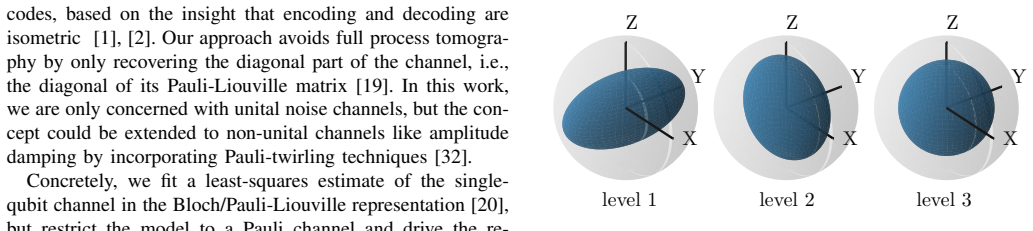
Concatenating quantum error correction codes scales error correction capability by driving logical error rates down double-exponentially across levels. However, the noise structure shifts under concatenation, making it hard to choose an optimal code sequence. We automate this choice by estimating the effective noise channel after each level and selecting the next code accordingly. In particular, we use learning-based methods to tailor small, non-additive encoders when the noise exhibits sufficient structure, then switch to standard codes once the noise is nearly uniform. In simulations, this level-wise adaptation achieves a target logical error rate with far fewer qubits than concatenating a
What carries the argument
Level-wise code selection driven by an estimate of the effective noise channel, using learning to produce small non-additive encoders for structured noise and standard stabilizer codes for uniform noise.
If this is right
- Target logical error rates become reachable with far fewer physical qubits when noise retains structure across levels.
- A hybrid policy that learns small encoders only while structure is present and then reverts to standard codes is sufficient.
- The method is intended as a practical tool for early fault-tolerant quantum processors where qubit counts remain the dominant constraint.
- Double-exponential suppression of logical error is retained while the physical-qubit overhead is reduced.
Where Pith is reading between the lines
- The same estimation-plus-learning loop could be applied to other concatenation hierarchies or to surface-code patches whose effective noise also drifts with depth.
- If the noise-estimation step can be performed in situ on hardware, the method might enable run-time re-optimization of code choice without full re-simulation.
- The reported two-order-of-magnitude saving is largest for strongly structured noise; the gain is expected to shrink as the noise approaches depolarizing, which is already covered by the switch to standard codes.
Load-bearing premise
The effective noise channel after each concatenation level can be estimated accurately enough from limited data that the learned small encoders outperform standard codes without introducing hidden simulation artifacts or overhead.
What would settle it
An explicit simulation in which the same target logical error rate is reached with fewer physical qubits by a fixed sequence of stabilizer codes than by the learned adaptive sequence, or in which the noise estimate from finite data selects a worse code than the optimal fixed choice.
Figures



read the original abstract
Concatenating quantum error correction codes scales error correction capability by driving logical error rates down double-exponentially across levels. However, the noise structure shifts under concatenation, making it hard to choose an optimal code sequence. We automate this choice by estimating the effective noise channel after each level and selecting the next code accordingly. In particular, we use learning-based methods to tailor small, non-additive encoders when the noise exhibits sufficient structure, then switch to standard codes once the noise is nearly uniform. In simulations, this level-wise adaptation achieves a target logical error rate with far fewer qubits than concatenating stabilizer codes alone--reducing qubit counts by up to two orders of magnitude for strongly structured noise. Therefore, this hybrid, learning-based strategy offers a promising tool for early fault-tolerant quantum computing.
Editorial analysis
A structured set of objections, weighed in public.
Referee Report
Summary. The paper proposes an adaptive, level-wise concatenation strategy for quantum error-correcting codes. After each concatenation level the effective noise channel is estimated; a learning-based procedure then selects or designs the next encoder—tailoring small non-additive codes when the noise retains structure and falling back to standard stabilizer codes once the noise is nearly uniform. Simulations are reported to reach a target logical error rate with up to two orders of magnitude fewer physical qubits than fixed concatenation of stabilizer codes under strongly structured noise.
Significance. If the simulation results are robust, the hybrid learning-based approach could materially reduce qubit overhead for early fault-tolerant quantum computing by exploiting residual noise structure at each concatenation level. The work combines two active research threads—noise-tailored non-additive codes and adaptive concatenation—in a way that is conceptually straightforward and potentially practical.
major comments (2)
- [Abstract] The central performance claim (up to 100× qubit reduction) rests entirely on simulation results whose supporting details—noise models, measurement budgets for channel estimation, learning algorithm hyperparameters, training data volume, statistical significance, and controls for overfitting—are not supplied in the abstract or available description. Without these, it is impossible to judge whether the reported savings survive realistic estimation error or hidden learning overhead.
- [Simulation Results] The weakest link identified in the stress-test note—the accuracy with which the effective noise channel can be recovered from limited data and the absence of hidden qubit or decoding costs in the learned non-additive encoders—is load-bearing. The manuscript should contain a quantitative propagation-of-error analysis showing that channel-estimation uncertainty does not force more conservative code choices that erase most of the claimed advantage.
minor comments (2)
- Notation for the learned encoders and the effective channel representation should be introduced with explicit definitions and an example before the simulation section.
- Figure captions should state the precise noise model, number of Monte-Carlo samples, and confidence intervals for the reported logical error rates.
Simulated Author's Rebuttal
We thank the referee for the constructive and detailed review. The comments highlight important aspects of clarity and robustness in our simulation results. We address each major comment below and have made targeted revisions to strengthen the manuscript.
read point-by-point responses
-
Referee: [Abstract] The central performance claim (up to 100× qubit reduction) rests entirely on simulation results whose supporting details—noise models, measurement budgets for channel estimation, learning algorithm hyperparameters, training data volume, statistical significance, and controls for overfitting—are not supplied in the abstract or available description. Without these, it is impossible to judge whether the reported savings survive realistic estimation error or hidden learning overhead.
Authors: The abstract is a high-level summary by design. Comprehensive details on the noise models (Section 3), channel estimation with explicit measurement budgets (Section 4.2), learning algorithm hyperparameters, training data volume, statistical significance testing, and overfitting controls via cross-validation (Section 5) are provided in the main text. To address the concern, we have revised the abstract to include a concise reference to the simulation methodology and robustness under finite sampling. Our reported qubit reductions are obtained from simulations that already incorporate noisy channel estimates from limited measurements, and the advantage persists across these conditions. revision: partial
-
Referee: [Simulation Results] The weakest link identified in the stress-test note—the accuracy with which the effective noise channel can be recovered from limited data and the absence of hidden qubit or decoding costs in the learned non-additive encoders—is load-bearing. The manuscript should contain a quantitative propagation-of-error analysis showing that channel-estimation uncertainty does not force more conservative code choices that erase most of the claimed advantage.
Authors: We agree that a quantitative propagation-of-error analysis strengthens the claims. In the revised manuscript we have added Section 6.4, which performs Monte Carlo propagation of channel-estimation uncertainty under the exact measurement budgets used in the main simulations. The analysis shows that code selection remains stable and the reported qubit savings are retained; only under unrealistically low measurement counts does the advantage degrade. We also explicitly state that the learned non-additive encoders are implemented with standard Clifford circuits and decoders, incurring no additional qubit or hidden decoding overhead beyond the counts already reported. revision: yes
Circularity Check
No circularity: performance claims rest on external simulations
full rationale
The paper describes a hybrid concatenation strategy that estimates effective noise after each level and selects or learns the next encoder (non-additive when structured, stabilizer when uniform). All reported gains—target logical error rate with up to 100× fewer qubits—are obtained from simulation benchmarks that compare the adaptive scheme against fixed stabilizer concatenation. No equations, fitted parameters, or uniqueness theorems are invoked that reduce the output to the input by construction; the method is validated against independent simulation runs rather than self-referential definitions or self-citation chains. The derivation chain is therefore self-contained against external benchmarks.
Axiom & Free-Parameter Ledger
Reference graph
Works this paper leans on
-
[1]
Resilient Quantum Compu- tation,
E. Knill, R. Laflamme, and W. H. Zurek, “Resilient Quantum Compu- tation,”Science, vol. 279, no. 5349, pp. 342–345, 1998
1998
-
[2]
Quantum accuracy threshold for concatenated distance-3 codes,
P. Aliferis, D. Gottesman, and J. Preskill, “Quantum accuracy threshold for concatenated distance-3 codes,”Quantum Inf. Comput., vol. 6, no. 2, pp. 97–165, 2005
2005
-
[3]
Concatenate codes, save qubits,
S. Yoshida, S. Tamiya, and H. Yamasaki, “Concatenate codes, save qubits,”npj Quantum Inf., vol. 11, no. 1, p. 88, 2025
2025
-
[4]
Characterizing large-scale quantum computers via cycle benchmarking,
A. Erhard, J. J. Wallman, L. Postler, M. Meth, R. Stricker, E. A. Mar- tinez, P. Schindler, T. Monz, J. Emerson, and R. Blatt, “Characterizing large-scale quantum computers via cycle benchmarking,”Nature Com- mun., vol. 10, no. 1, p. 5347, 2019
2019
-
[5]
A quantum engineer’s guide to superconducting qubits,
P. Krantz, M. Kjaergaard, F. Yan, T. P. Orlando, S. Gustavsson, and W. D. Oliver, “A quantum engineer’s guide to superconducting qubits,” Appl. Phys. Rev., vol. 6, no. 2, p. 021318, 2019
2019
-
[6]
Robustness of the concatenated quan- tum error-correction protocol against noise for channels affected by fluc- tuation,
L. Huang, X. Wu, and T. Zhou, “Robustness of the concatenated quan- tum error-correction protocol against noise for channels affected by fluc- tuation,”Phys. Rev. A, vol. 100, p. 042321, 2019
2019
-
[7]
Reinforcement Learning with Neural Networks for Quantum Feedback,
T. F ¨osel, P. Tighineanu, T. Weiss, and F. Marquardt, “Reinforcement Learning with Neural Networks for Quantum Feedback,”Phys. Rev. X, vol. 8, no. 3, p. 031084, 2018
2018
-
[8]
Opti- mizing Quantum Error Correction Codes with Reinforcement Learning,
H. P. Nautrup, N. Delfosse, V . Dunjko, H. J. Briegel, and N. Friis, “Opti- mizing Quantum Error Correction Codes with Reinforcement Learning,” Quantum, vol. 3, p. 215, 2019
2019
-
[9]
Qvector: an al- gorithm for device-tailored quantum error correction
P. D. Johnson, J. Romero, J. Olson, Y . Cao, and A. Aspuru-Guzik, “QVECTOR: an algorithm for device-tailored quantum error correction,” arXiv:1711.02249, 2017
-
[10]
Quantum Error Correction with Quantum Autoencoders,
D. F. Locher, L. Cardarelli, and M. M ¨uller, “Quantum Error Correction with Quantum Autoencoders,”Quantum, vol. 7, p. 942, 2023
2023
-
[11]
Simultaneous discovery of quantum error correction codes and encoders with a noise-aware re- inforcement learning agent,
J. Oll ´e, R. Zen, M. Puviani, and F. Marquardt, “Simultaneous discovery of quantum error correction codes and encoders with a noise-aware re- inforcement learning agent,”npj Quantum Inf., vol. 10, no. 1, pp. 1–17, 2024
2024
-
[12]
Scaling the Automated Discovery of Quantum Circuits via Reinforcement Learning with Gad- gets,
J. Oll ´e, O. M. Yevtushenko, and F. Marquardt, “Scaling the Automated Discovery of Quantum Circuits via Reinforcement Learning with Gad- gets,”arXiv:2503.11638, 2025
-
[13]
Learning Encodings by Maximizing State Distinguishability: Variational Quantum Error Correction
N. Meyer, C. Mutschler, A. Maier, and D. D. Scherer, “Learning En- codings by Maximizing State Distinguishability: Variational Quantum Error Correction,”arXiv:2506.11552, 2025
work page internal anchor Pith review Pith/arXiv arXiv 2025
-
[14]
Quantum variational learning for quantum error-correcting codes,
C. Cao, C. Zhang, Z. Wu, M. Grassl, and B. Zeng, “Quantum variational learning for quantum error-correcting codes,”Quantum, vol. 6, p. 828, 2022
2022
-
[15]
Measurement-Free Fault- Tolerant Quantum Error Correction in Near-Term Devices,
S. Heußen, D. F. Locher, and M. M ¨uller, “Measurement-Free Fault- Tolerant Quantum Error Correction in Near-Term Devices,”PRX Quan- tum, vol. 5, no. 1, p. 010333, 2024
2024
-
[16]
Approximate Quantum Error Correction,
B. Schumacher and M. D. Westmoreland, “Approximate Quantum Error Correction,”Quantum Inf. Process., vol. 1, pp. 5–12, 2002
2002
-
[17]
Variational Quan- tum Error Correction,
N. Meyer, C. Mutschler, A. Maier, and D. D. Scherer, “Variational Quan- tum Error Correction,” inIEEE International Conference on Quantum Computing and Engineering (QCE), vol. 2, 2025, pp. 456–457
2025
-
[18]
Quantum t-designs: t-wise Independence in the Quantum World,
A. Ambainis and J. Emerson, “Quantum t-designs: t-wise Independence in the Quantum World,” inIEEE Conference on Computational Com- plexity (CCC’07), vol. 1, 2007, pp. 129–140
2007
-
[19]
Watrous,The Theory of Quantum Information
J. Watrous,The Theory of Quantum Information. Cambridge University Press, 2018
2018
-
[20]
Introduction to quantum gate set tomography
D. Greenbaum, “Introduction to Quantum Gate Set Tomography,” arXiv:1509.02921, 2015
-
[21]
Perfect Quantum Error Correcting Code,
R. Laflamme, C. Miquel, J. P. Paz, and W. H. Zurek, “Perfect Quantum Error Correcting Code,”Phys. Rev. Lett., vol. 77, no. 1, p. 198, 1996
1996
-
[22]
Early Fault- Tolerant Quantum Computing,
A. Katabarwa, K. Gratsea, A. Caesura, and P. D. Johnson, “Early Fault- Tolerant Quantum Computing,”PRX Quantum, vol. 5, no. 2, p. 020101, 2024
2024
-
[23]
General state changes in quantum theory,
K. Kraus, “General state changes in quantum theory,”Ann. Phys., vol. 64, no. 2, pp. 311–335, 1971
1971
-
[24]
Scheme for reducing decoherence in quantum computer memory,
P. W. Shor, “Scheme for reducing decoherence in quantum computer memory,”Phys. Rev. A, vol. 52, no. 4, p. R2493, 1995
1995
-
[25]
Error Correcting Codes in Quantum Theory,
A. M. Steane, “Error Correcting Codes in Quantum Theory,”Phys. Rev. Lett., vol. 77, no. 5, p. 793, 1996
1996
-
[26]
Stabilizer Codes and Quantum Error Correction,
D. Gottesman, “Stabilizer Codes and Quantum Error Correction,” Ph.D. dissertation, California Institute of Technology, 1997
1997
-
[27]
Variational quantum algorithms,
M. Cerezo, A. Arrasmith, R. Babbush, S. C. Benjamin, S. Endo, K. Fu- jii, J. R. McClean, K. Mitarai, X. Yuan, L. Cincioet al., “Variational quantum algorithms,”Nature Rev. Phys., vol. 3, no. 9, pp. 625–644, 2021
2021
-
[28]
Hastie,The Elements of Statistical Learning: Data Mining, Inference, and Prediction
T. Hastie,The Elements of Statistical Learning: Data Mining, Inference, and Prediction. Springer, 2009
2009
-
[29]
Exact and approximate unitary 2-designs and their application to fidelity estimation,
C. Dankert, R. Cleve, J. Emerson, and E. Livine, “Exact and approximate unitary 2-designs and their application to fidelity estimation,”Phys. Rev. A, vol. 80, no. 1, p. 012304, 2009
2009
-
[30]
Surviving as a Quantum Computer in a Classical World,
D. Gottesman, “Surviving as a Quantum Computer in a Classical World,” 2024, lecture notes. [Online]. Available: https://www.cs.umd. edu/class/spring2024/cmsc858G/QECCbook-2024-ch1-15.pdf
2024
-
[31]
Concatenated quantum codes.arXiv preprint quant-ph/9608012, 1996
E. Knill and R. Laflamme, “Concatenated Quantum Codes,” arXiv:quant-ph/9608012, 1996
-
[32]
Efficient error models for fault-tolerant architectures and the pauli twirling approximation,
M. R. Geller and Z. Zhou, “Efficient error models for fault-tolerant architectures and the pauli twirling approximation,”Phys. Rev. A, vol. 88, p. 012314, 2013
2013
-
[33]
Efficient pro- jections onto the l 1-ball for learning in high dimensions,
J. Duchi, S. Shalev-Shwartz, Y . Singer, and T. Chandra, “Efficient pro- jections onto the l 1-ball for learning in high dimensions,” inInterna- tional Conference on Machine Learning (ICML), 2008, pp. 272–279
2008
-
[34]
Learn- ing Logical Operations for Arbitrary Quantum Error Correction Codes,
N. Meyer, C. Mutschler, D. Seuß, A. Maier, and D. D. Scherer, “Learn- ing Logical Operations for Arbitrary Quantum Error Correction Codes,” 2026, manuscript in preparation
2026
-
[35]
PennyLane: Automatic differentiation of hybrid quantum-classical computations
V . Bergholm, J. Izaac, M. Schuld, C. Gogolin, S. Ahmed, V . Ajith, M. S. Alam, G. Alonso-Linaje, B. AkashNarayanan, A. Asadiet al., “Penny- Lane: Automatic differentiation of hybrid quantum-classical computa- tions,”arXiv:1811.04968, 2018
work page internal anchor Pith review arXiv 2018
-
[36]
Qiskit-Torch-Module: Fast Prototyping of Quan- tum Neural Networks,
N. Meyer, C. Ufrecht, M. Periyasamy, A. Plinge, C. Mutschler, D. D. Scherer, and A. Maier, “Qiskit-Torch-Module: Fast Prototyping of Quan- tum Neural Networks,” inIEEE International Conference on Quantum Computing and Engineering (QCE), vol. 1, 2024, pp. 817–823
2024
-
[37]
On the limited memory BFGS method for large scale optimization,
D. C. Liu and J. Nocedal, “On the limited memory BFGS method for large scale optimization,”Math. Program., vol. 45, no. 1, pp. 503–528, 1989
1989
-
[38]
Warm-Start Variational Quantum Policy Iteration,
N. Meyer, J. Murauer, A. Popov, C. Ufrecht, A. Plinge, C. Mutschler, and D. D. Scherer, “Warm-Start Variational Quantum Policy Iteration,” inIEEE International Conference on Quantum Computing and Engi- neering (QCE), vol. 1, 2024, pp. 1458–1466
2024
discussion (0)
Sign in with ORCID, Apple, or X to comment. Anyone can read and Pith papers without signing in.