Recognition: unknown
Sharp-interface VOF method for phase-change simulations on unstructured meshes
Pith reviewed 2026-05-10 08:35 UTC · model grok-4.3
The pith
A sharp-interface VOF method for phase-change simulations on unstructured meshes computes evaporation rates from local temperature gradients at geometrically reconstructed interfaces and validates against analytical solutions on Stefan, Sucking, and Scriven problems.
A machine-rendered reading of the paper's core claim, the machinery that carries it, and where it could break.
Core claim
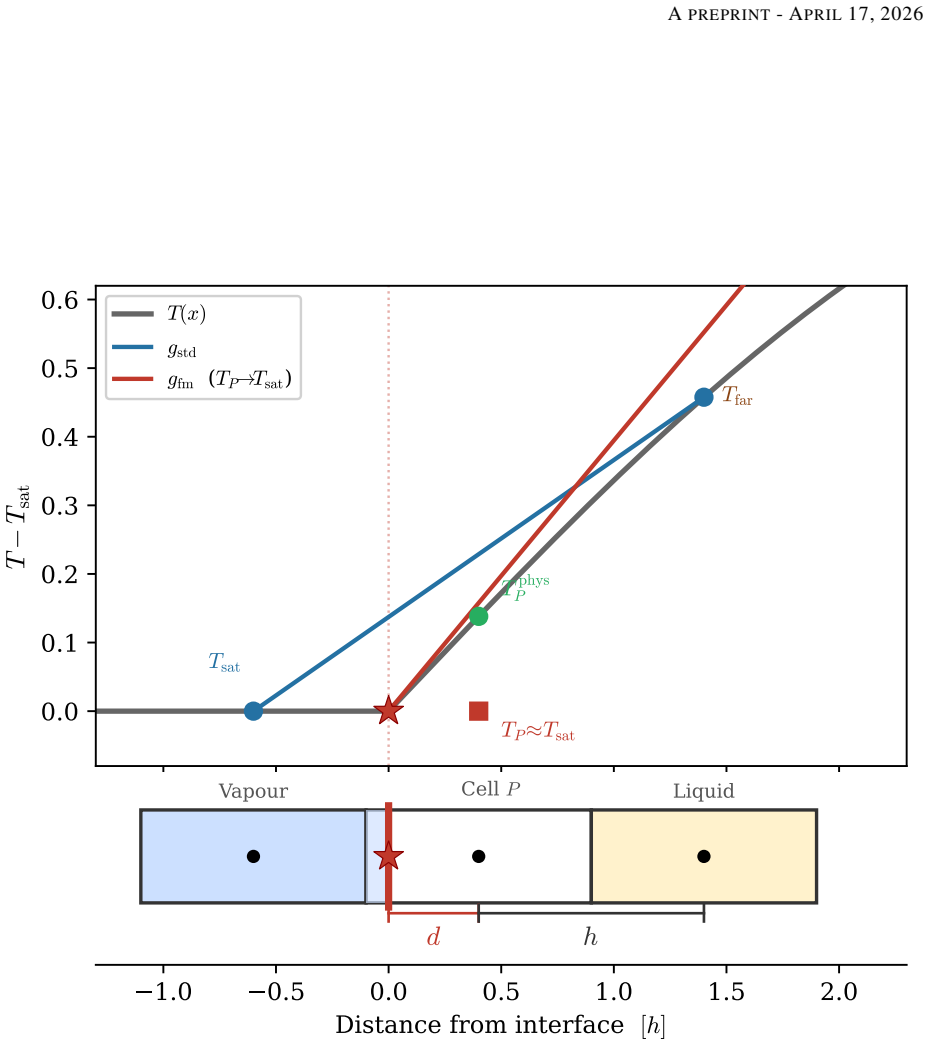
We present a phase-change simulation method for unstructured meshes that combines the algebraic Volume-of-Fluid (VOF) technique with geometric interface reconstruction... Phase-change rates are computed from local temperature gradients evaluated at the reconstructed interface, without empirical closure models, using a reconstruction procedure that operates on arbitrary polyhedral cells.
Load-bearing premise
The reconstruction procedure that operates on arbitrary polyhedral cells accurately captures the interface geometry sufficiently for reliable local temperature gradient evaluation without introducing significant numerical artifacts or requiring empirical closures.
Figures








read the original abstract
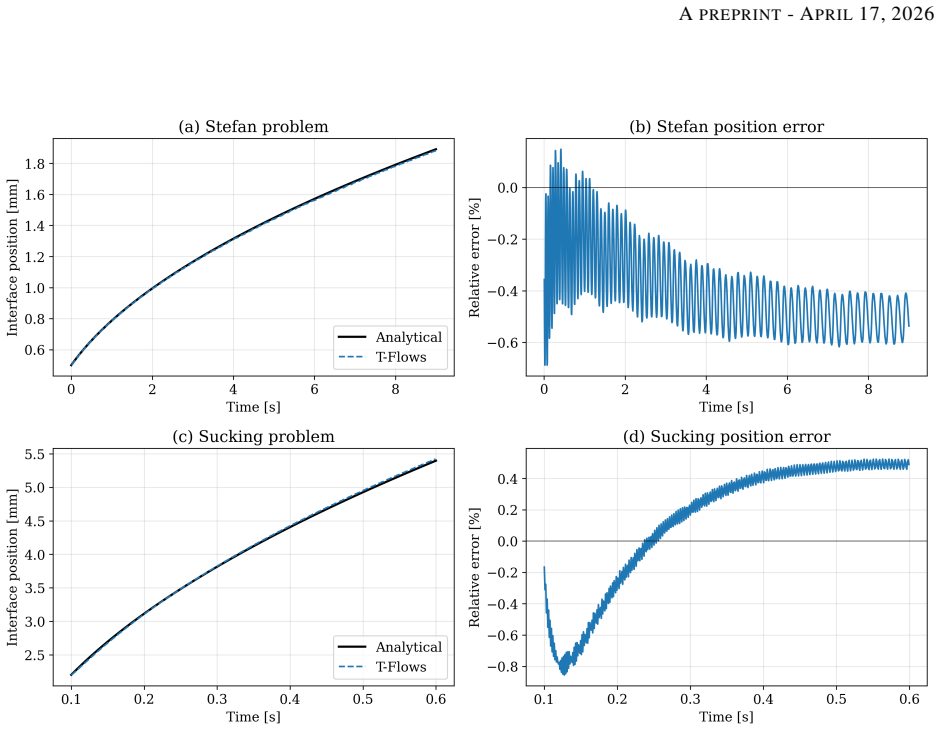
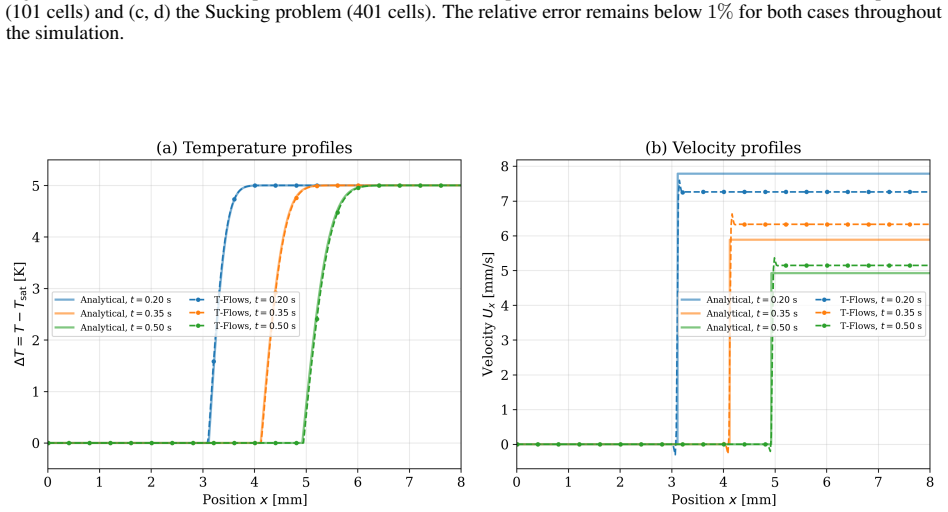
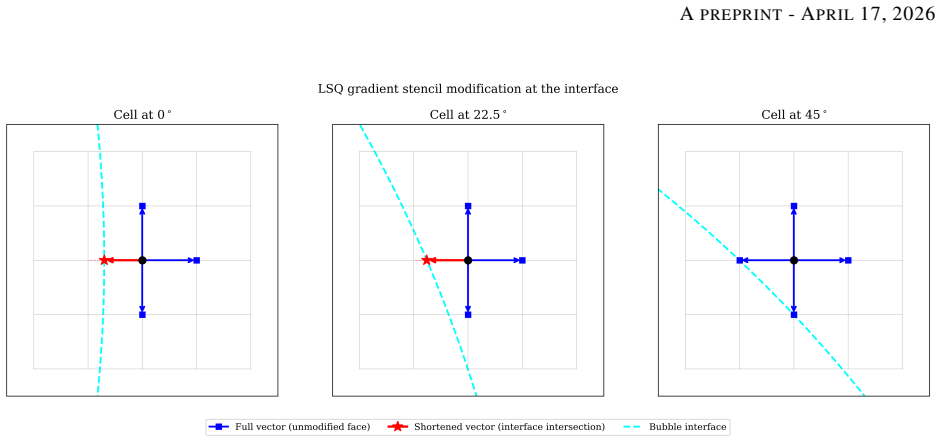
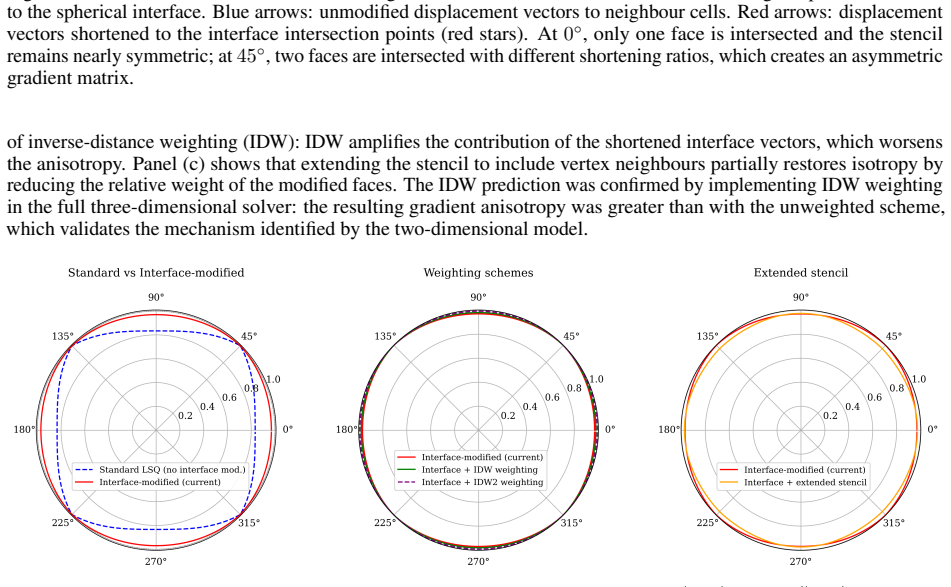
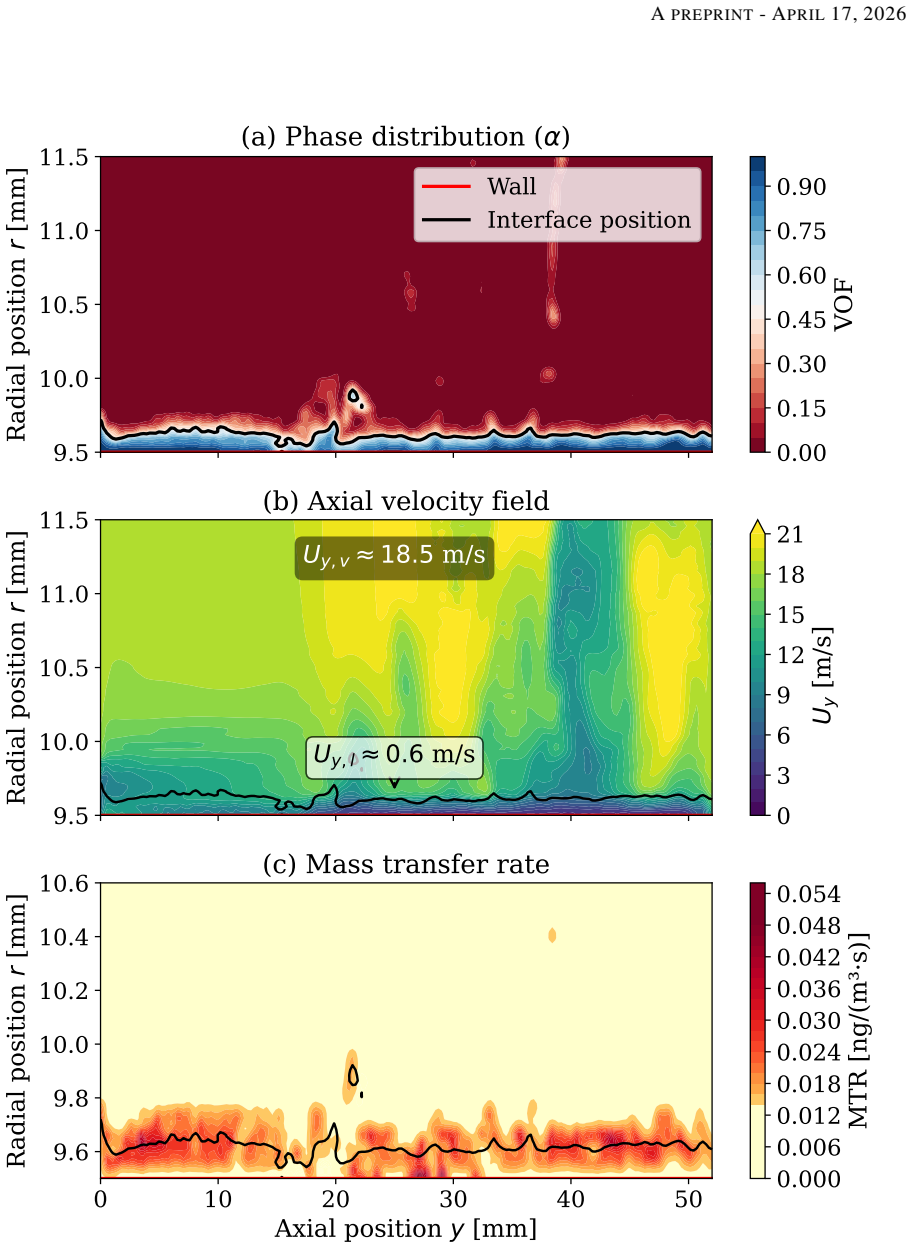
Unstructured meshes are among the most versatile approaches for capturing non-canonical geometries in fluid dynamics simulations. Despite this, most high-fidelity first-principles phase-change models are developed and applied on structured meshes. We present a phase-change simulation method for unstructured meshes that combines the algebraic Volume-of-Fluid (VOF) technique with geometric interface reconstruction, implemented in an in-house open-source CFD code. Phase-change rates are computed from local temperature gradients evaluated at the reconstructed interface, without empirical closure models, using a reconstruction procedure that operates on arbitrary polyhedral cells. Because the method relies on the standard finite-volume framework, it can be integrated into other cell-centred codes supporting unstructured meshes. The approach is validated against the one-dimensional Stefan and Sucking problems and the three-dimensional Scriven bubble growth on both hexahedral and polyhedral meshes, showing good agreement with analytical solutions in all three cases. A detailed analysis of the Scriven problem reveals that the interface-modified least-squares gradient stencil on Cartesian meshes overestimates the interfacial temperature gradient, producing a persistent overshoot of the analytical bubble radius and a coherent four-fold anisotropy that elongates the bubble along grid diagonals. On polyhedral meshes, the irregular face orientations eliminate both effects, yielding isotropic growth and monotonic convergence. Finally, we demonstrate the framework on turbulent upward co-current annular boiling flow, where early transient results are qualitatively consistent with a previous LES study and experimental observations of wave-modulated evaporation.
Editorial analysis
A structured set of objections, weighed in public.
Referee Report
Summary. The manuscript presents a sharp-interface VOF method for phase-change simulations on unstructured meshes. It combines algebraic VOF with geometric interface reconstruction on arbitrary polyhedral cells to compute phase-change rates directly from local temperature gradients at the reconstructed interface, without empirical closures. The approach is implemented in an open-source finite-volume CFD code and validated against analytical solutions for the 1D Stefan problem, Sucking problem, and 3D Scriven bubble growth on both hexahedral and polyhedral meshes. A detailed analysis shows Cartesian-mesh artifacts (persistent radius overshoot and four-fold anisotropy) that are eliminated on irregular polyhedral meshes, with an additional demonstration on turbulent annular boiling flow.
Significance. If the central claims hold, the work is significant because it extends first-principles phase-change modeling to unstructured meshes, which are required for complex engineering geometries. The explicit documentation of Cartesian-mesh artifacts and their removal via polyhedral face orientations supplies a concrete, falsifiable insight into gradient evaluation near interfaces. The open-source implementation within the standard finite-volume framework and the parameter-free formulation (no fitted closures) are strengths that support reproducibility and broader adoption in boiling/condensation simulations.
major comments (2)
- [Validation section (Scriven problem)] Validation (Scriven bubble analysis): the claim that polyhedral meshes yield 'isotropic growth and monotonic convergence' is load-bearing for the central assertion that the reconstruction furnishes reliable gradients on arbitrary cells. However, the manuscript reports only qualitative agreement and visual elimination of anisotropy; quantitative error norms (e.g., L2 or L∞ deviation of bubble radius from the analytical Scriven solution, or sphericity measures) versus mesh resolution are not provided for the polyhedral cases, leaving the monotonicity claim partially unverified.
- [Numerical method] Numerical method (interface reconstruction and gradient evaluation): the reconstruction procedure that 'operates on arbitrary polyhedral cells' and the 'interface-modified least-squares gradient stencil' are the core technical contributions. The text describes the stencil's effect on Cartesian meshes but does not supply the explicit algorithmic steps, weighting, or stencil modification equations for general polyhedra, which are needed to confirm that the four-fold anisotropy is eliminated by geometry rather than by mesh-specific tuning.
minor comments (2)
- [Abstract] The abstract states that early transient results for annular boiling are 'qualitatively consistent' with prior LES and experiments; adding the specific non-dimensional time or physical time at which the comparison is made would clarify the scope of the demonstration.
- [Figures] Figure captions for the Scriven bubble results should explicitly state the mesh types (hexahedral vs. polyhedral) and resolutions used in each panel to allow direct cross-reference with the convergence discussion.
Simulated Author's Rebuttal
We thank the referee for the positive assessment and constructive comments. We address each major comment below and will revise the manuscript accordingly.
read point-by-point responses
-
Referee: [Validation section (Scriven problem)] Validation (Scriven bubble analysis): the claim that polyhedral meshes yield 'isotropic growth and monotonic convergence' is load-bearing for the central assertion that the reconstruction furnishes reliable gradients on arbitrary cells. However, the manuscript reports only qualitative agreement and visual elimination of anisotropy; quantitative error norms (e.g., L2 or L∞ deviation of bubble radius from the analytical Scriven solution, or sphericity measures) versus mesh resolution are not provided for the polyhedral cases, leaving the monotonicity claim partially unverified.
Authors: We agree that quantitative error norms would strengthen the validation. In the revised manuscript we will add L2 and L∞ norms of the bubble-radius deviation from the analytical Scriven solution together with sphericity measures, plotted versus mesh resolution for both hexahedral and polyhedral meshes. These data will quantitatively confirm isotropic growth and monotonic convergence on the polyhedral cases. revision: yes
-
Referee: [Numerical method] Numerical method (interface reconstruction and gradient evaluation): the reconstruction procedure that 'operates on arbitrary polyhedral cells' and the 'interface-modified least-squares gradient stencil' are the core technical contributions. The text describes the stencil's effect on Cartesian meshes but does not supply the explicit algorithmic steps, weighting, or stencil modification equations for general polyhedra, which are needed to confirm that the four-fold anisotropy is eliminated by geometry rather than by mesh-specific tuning.
Authors: The algorithmic description appears in Section 3. To make the procedure fully reproducible for arbitrary polyhedra we will expand the revised text with the explicit reconstruction steps on general polyhedral cells, the weighting scheme used in the least-squares gradient, and the precise stencil modification based on the reconstructed interface plane. This will demonstrate that the elimination of four-fold anisotropy follows directly from the irregular face orientations rather than any mesh-specific tuning. revision: yes
Circularity Check
No significant circularity in the derivation chain
full rationale
The paper describes a numerical method that combines algebraic VOF with geometric interface reconstruction on arbitrary polyhedral cells within the standard finite-volume framework, then computes phase-change rates directly from reconstructed-interface temperature gradients. All load-bearing steps are explicit geometric and discretization procedures whose outputs are validated against independent analytical solutions (1D Stefan, Sucking, 3D Scriven) on both hexahedral and polyhedral meshes; the reported convergence, isotropy, and artifact removal are direct numerical outcomes rather than re-statements of fitted inputs or self-citations. No equation reduces to its own definition, no parameter fitted to a subset is relabeled a prediction, and no uniqueness theorem or ansatz is imported via self-citation. The derivation is therefore self-contained against external benchmarks.
Axiom & Free-Parameter Ledger
axioms (2)
- standard math Standard finite-volume discretization and gradient reconstruction assumptions hold for unstructured polyhedral meshes.
- domain assumption Geometric interface reconstruction on arbitrary polyhedral cells yields sufficiently accurate interface normals and areas for temperature gradient evaluation.
Reference graph
Works this paper leans on
-
[1]
K. Nishida, S. Morooka, M. Mori, Y . Koizumi (Eds.), Boiling Water Reactors, V ol. 4 of JSME Series in Thermal and Nuclear Power Generation, Elsevier, 2023.doi:10.1016/B978-0-12-821361-2.09988-8
-
[2]
J. H. Lim, M. Park, S. M. Shin, S. S. Chung, Exploring the onset of nucleate boiling with hypervapotron channel for tokamak cooling system application, Applied Thermal Engineering 209 (2022) 118334. doi: 10.1016/j.applthermaleng.2022.118334
-
[3]
S. M. Sohel Murshed, C. A. Nieto de Castro, A critical review of traditional and emerging techniques and fluids for electronics cooling, Renewable and Sustainable Energy Reviews 78 (2017) 821–833. doi:10.1016/j.rser. 2017.04.112
-
[4]
C. R. Kharangate, I. Mudawar, Review of computational studies on boiling and condensation, International Journal of Heat and Mass Transfer 108 (2017) 1164–1196.doi:10.1016/j.ijheatmasstransfer.2016.12.065
-
[5]
Y . Hu, H. Gao, Y . Yan, A comprehensive review of boiling heat transfer on multi-scale hybrid surfaces and applications, Journal of Industrial and Engineering Chemistry 143 (2025) 123–143. doi:10.1016/j.jiec. 2024.09.002
-
[7]
Y . Chen, B. Yu, W. Lu, B. Wang, D. Sun, K. Jiao, W. Zhang, W. Tao, Review on numerical simulation of boiling heat transfer from atomistic to mesoscopic and macroscopic scales, International Journal of Heat and Mass Transfer 225 (2024) 125396.doi:10.1016/j.ijheatmasstransfer.2024.125396
-
[8]
D. Juric, G. Tryggvason, Computations of boiling flows, International Journal of Multiphase Flow 24 (3) (1998) 387–410.doi:10.1016/S0301-9322(97)00050-5
-
[9]
A. Esmaeeli, G. Tryggvason, A front tracking method for computations of boiling in complex geometries, International Journal of Multiphase Flow 30 (7) (2004) 1037–1050. doi:10.1016/j.ijmultiphaseflow. 2004.04.008
-
[10]
D. M. Anderson, G. B. McFadden, A. A. Wheeler, Diffuse-interface methods in fluid mechanics, Annual Review of Fluid Mechanics 30 (1998) 139–165.doi:10.1146/annurev.fluid.30.1.139
-
[11]
Roccon, Boiling heat transfer by phase-field method, Acta Mechanica 236 (2025) 5623–5638
A. Roccon, Boiling heat transfer by phase-field method, Acta Mechanica 236 (2025) 5623–5638. doi:10.1007/ s00707-024-04122-7
2025
-
[12]
M. Sussman, P. Smereka, S. Osher, A level set approach for computing solutions to incompressible two-phase flow, Journal of Computational Physics 114 (1) (1994) 146–159.doi:10.1006/jcph.1994.1155
-
[13]
S. Tanguy, T. Ménard, A. Berlemont, A level set method for vaporizing two-phase flows, Journal of Computational Physics 221 (2) (2007) 837–853.doi:10.1016/j.jcp.2006.07.003
-
[14]
G. Sahut, G. Ghigliotti, G. Balarac, M. Bernard, V . Moureau, P. Marty, Numerical simulation of boiling on unstructured grids, Journal of Computational Physics 432 (2021) 110161. doi:10.1016/j.jcp.2021.110161
-
[16]
A. Iskhakova, Y . Kondo, K. Tanimoto, N. T. Dinh, I. A. Bolotnov, Interface capturing flow boiling simulations in a compact heat exchanger, ASME Journal of Heat and Mass Transfer 145 (2023) 041605. doi:10.1115/1. 4056688
work page doi:10.1115/1 2023
-
[17]
C. W. Hirt, B. D. Nichols, V olume of fluid (VOF) method for the dynamics of free boundaries, Journal of Computational Physics 39 (1) (1981) 201–225.doi:10.1016/0021-9991(81)90145-5. 34 APREPRINT- APRIL17, 2026
-
[18]
Pattern Recog- nition153, 110500 (2024).https://doi.org/https://doi.org/10.1016/j
D. Zhang, C. Jiang, D. Liang, Z. Chen, Y . Yang, Y . Shi, A refined volume-of-fluid algorithm for capturing sharp fluid interfaces on arbitrary meshes, Journal of Computational Physics 274 (2014) 709–736. doi:10.1016/j. jcp.2014.06.043
work page doi:10.1016/j 2014
-
[19]
S. Saincher, V . Sriram, An efficient operator-split CICSAM scheme for three-dimensional multiphase-flow problems on Cartesian grids, Computers & Fluids 240 (2022) 105440. doi:10.1016/j.compfluid.2022. 105440
-
[20]
L. Bureš, Y . Sato, A. Pautz, Piecewise linear interface-capturing volume-of-fluid method in axisymmetric cylindrical coordinates, Journal of Computational Physics 436 (2021) 110291. doi:10.1016/j.jcp.2021. 110291
-
[21]
T. Long, J. Pan, S. Zaleski, An edge-based interface tracking (EBIT) method for multiphase flows with phase change, Journal of Computational Physics 513 (2024) 113159.doi:10.1016/j.jcp.2024.113159
-
[22]
Y . Sato, B. Niˇceno, A sharp-interface phase change model for a mass-conservative interface tracking method, Journal of Computational Physics 249 (2013) 127–161.doi:10.1016/j.jcp.2013.04.035
-
[23]
L. Bureš, Y . Sato, Direct numerical simulation of evaporation and condensation with the geometric VOF method and a sharp-interface phase-change model, International Journal of Heat and Mass Transfer 173 (2021) 121233. doi:10.1016/j.ijheatmasstransfer.2021.121233
-
[24]
J. Poblador-Ibanez, N. Valle, B. J. Boersma, A momentum balance correction to the non-conservative one- fluid formulation in boiling flows using volume-of-fluid, Journal of Computational Physics 524 (2025) 113704. doi:10.1016/j.jcp.2024.113704
-
[25]
R. P. Fedkiw, T. Aslam, B. Merriman, S. Osher, A non-oscillatory Eulerian approach to interfaces in multimaterial flows (the ghost fluid method), Journal of Computational Physics 152 (2) (1999) 457–492. doi:10.1006/jcph. 1999.6236
-
[26]
F. Gibou, L. Chen, D. Nguyen, S. Banerjee, A level set based sharp interface method for the multiphase incompressible Navier–Stokes equations with phase change, Journal of Computational Physics 222 (2) (2007) 536–555.doi:10.1016/j.jcp.2006.07.035
-
[27]
L. Rueda Villegas, R. Alis, M. Lepilliez, S. Tanguy, A ghost fluid/level set method for boiling flows and liquid evaporation: Application to the Leidenfrost effect, Journal of Computational Physics 316 (2016) 789–813. doi:10.1016/j.jcp.2016.04.031
-
[28]
T. Mari´c, D. B. Kothe, D. Bothe, Unstructured un-split geometrical V olume-of-Fluid methods – A review, Journal of Computational Physics 420 (2020) 109695.doi:10.1016/j.jcp.2020.109695
-
[29]
M. Herrmann, A balanced force refined level set grid method for two-phase flows on unstructured flow solver grids, Journal of Computational Physics 227 (2008) 2674–2706.doi:10.1016/j.jcp.2007.11.002
-
[30]
H. Nishikawa, From hyperbolic diffusion scheme to gradient method: implicit Green–Gauss gradients for unstructured grids, Journal of Computational Physics 372 (2018) 126–160. doi:10.1016/j.jcp.2018.06.019
-
[31]
A. Syrakos, S. Varchanis, Y . Dimakopoulos, A. Goulas, J. Tsamopoulos, A critical analysis of some popular methods for the discretisation of the gradient operator in finite volume methods, Physics of Fluids 29 (2017) 127103.doi:10.1063/1.4997985
-
[32]
G. Giustini, R. I. Issa, A method for simulating interfacial mass transfer on arbitrary meshes, Physics of Fluids 33 (8) (2021) 087102.doi:10.1063/5.0058987
-
[33]
W. H. Lee, A pressure iteration scheme for two-phase flow modeling, in: T. N. Veziroglu (Ed.), Multiphase Transport: Fundamentals, Reactor Safety, Applications, V ol. 1, Hemisphere Publishing, Washington, DC, 1980, pp. 407–431
1980
-
[34]
H. Scheufler, J. Roenby, TwoPhaseFlow: A framework for developing two phase flow solvers in OpenFOAM, OpenFOAM Journal 3 (2023) 200–224.doi:10.51560/ofj.v3.80
-
[35]
J. López, J. Hernández, isoap: A software for isosurface extraction on arbitrary polyhedra (Jul. 2021). doi: 10.17632/4rcf98s74c.1
-
[36]
Niceno, J
B. Niceno, J. Kren, Y . Sato, T-Flows (2025). URLhttps://github.com/DelNov/T-Flows
2025
-
[37]
S. Balay, S. Abhyankar, M. F. Adams, S. Benson, J. Brown, P. Brune, K. Buschelman, E. Constantinescu, L. Dalcin, A. Dener, V . Eijkhout, J. Faibussowitsch, W. D. Gropp, V . Hapla, T. Isaac, P. Jolivet, D. Karpeev, D. Kaushik, M. G. Knepley, F. Kong, S. Kruger, D. A. May, L. C. McInnes, R. T. Mills, L. Mitchell, T. Munson, J. E. Roman, K. Rupp, P. Sanan, J...
-
[38]
G. Tryggvason, R. Scardovelli, S. Zaleski, Direct numerical simulations of gas-liquid multiphase flows, Cambridge University Press, Cambridge ; New York, 2011.doi:10.1017/CBO9780511975264
-
[39]
O. Ubbink, R. I. Issa, A method for capturing sharp fluid interfaces on arbitrary meshes, Journal of Computational Physics 153 (1) (1999) 26–50.doi:10.1006/jcph.1999.6276
-
[40]
H. Jasak, H. G. Weller, A. D. Gosman, High resolution NVD differencing scheme for arbitrarily unstructured meshes, International Journal for Numerical Methods in Fluids 31 (2) (1999) 431–449. doi:10.1002/(SICI) 1097-0363(19990930)31:2<431::AID-FLD884>3.0.CO;2-T
-
[41]
Denner, Balanced-force two-phase flow modelling on unstructured and adaptive meshes, Ph.D
F. Denner, Balanced-force two-phase flow modelling on unstructured and adaptive meshes, Ph.D. thesis, Imperial College London (2013). URLhttps://spiral.imperial.ac.uk/handle/10044/1/28101
2013
-
[42]
S. R. Mathur, J. Y . Murthy, A pressure-based method for unstructured meshes, Numerical Heat Transfer, Part B: Fundamentals 31 (2) (1997) 195–215.doi:10.1080/10407799708915105
-
[43]
J. U. Brackbill, D. B. Kothe, C. Zemach, A continuum method for modeling surface tension, Journal of Computa- tional Physics 100 (2) (1992) 335–354.doi:10.1016/0021-9991(92)90240-Y
-
[44]
C. M. Rhie, W. L. Chow, Numerical study of the turbulent flow past an airfoil with trailing edge separation, AIAA Journal 21 (11) (1983) 1526–1532.doi:10.2514/3.8284
-
[45]
S.-K. Choi, Note on the use of momentum interpolation method for unsteady flows, Numerical Heat Transfer, Part A: Applications 36 (1999) 545–550.doi:10.1080/104077899274679
-
[46]
S.-K. Choi, S.-O. Kim, C.-H. Lee, H.-K. Choi, Use of the momentum interpolation method for flows with a large body force, Numerical Heat Transfer, Part B: Fundamentals 43 (3) (2003) 267–287. doi:10.1080/713836204
-
[47]
J. Mencinger, I. Žun, On the finite volume discretization of discontinuous body force field on collocated grid: Application to VOF method, Journal of Computational Physics 221 (2) (2007) 524–538. doi:10.1016/j.jcp. 2006.06.021
-
[48]
B. Yu, W. Q. Tao, J. J. Wei, Y . Kawaguchi, T. Tagawa, H. Ozoe, Discussion on momentum interpolation method for collocated grids of incompressible flow, Numerical Heat Transfer, Part B: Fundamentals 42 (2) (2002) 141–166. doi:10.1080/10407790190053824
-
[49]
S. Majumdar, Role of underrelaxation in momentum interpolation for calculation of flow with nonstaggered grids, Numerical Heat Transfer, Part B: Fundamentals 13 (1) (1988) 125–132.doi:10.1080/10407788808913607
-
[50]
J. Papageorgakopoulos, G. Arampatzis, D. Assimacopoulos, N. C. Markatos, Enhancement of the momentum interpolation method on non-staggered grids, International Journal for Numerical Methods in Fluids 33 (1) (2000) 1–22.doi:10.1002/(SICI)1097-0363(20000515)33:1<1::AID-FLD978>3.0.CO;2-0
-
[51]
J. H. Ferziger, M. Peri´c, R. L. Street, Computational Methods for Fluid Dynamics, 4th Edition, Springer, 2020. doi:10.1007/978-3-319-99693-6
-
[52]
S. Tanguy, M. Sagan, B. Lalanne, F. Couderc, C. Colin, Benchmarks and numerical methods for the simulation of boiling flows, Journal of Computational Physics 264 (2014) 1–22.doi:10.1016/j.jcp.2014.01.014
-
[53]
L. E. Scriven, On the dynamics of phase growth, Chemical Engineering Science 10 (1-2) (1959) 1–13. doi: 10.1016/0009-2509(59)80019-1
-
[54]
C. Geuzaine, J.-F. Remacle, Gmsh: A 3-D finite element mesh generator with built-in pre- and post-processing facilities, International Journal for Numerical Methods in Engineering 79 (2009) 1309–1331. doi:10.1002/nme. 2579
work page doi:10.1002/nme 2009
-
[55]
B. Diskin, J. L. Thomas, Comparison of node-centered and cell-centered unstructured finite-volume discretizations: inviscid fluxes, AIAA Journal 49 (2012) 836–854.doi:10.2514/1.J050897
-
[56]
F. Nicoud, F. Ducros, Subgrid-scale stress modelling based on the square of the velocity gradient tensor, Flow, Turbulence and Combustion 62 (3) (1999) 183–200.doi:10.1023/A:1009995426001
-
[57]
Y . Sato, B. Niceno, Large eddy simulation of upward co-current annular boiling flow using an interface tracking method, Nuclear Engineering and Design 321 (2017) 69–81.doi:10.1016/j.nucengdes.2017.03.003
-
[58]
J. R. Barbosa Jr, G. F. Hewitt, S. M. Richardson, High-speed visualisation of nucleate boiling in vertical annular flow, International Journal of Heat and Mass Transfer 46 (2003) 5153–5160. doi:10.1016/S0017-9310(03) 00231-X
-
[59]
A. Bottaro, Note on open boundary conditions for elliptic flows, Numerical Heat Transfer, Part B: Fundamentals 18 (2) (1990) 243–256.doi:10.1080/10407799008944952. 36 APREPRINT- APRIL17, 2026
-
[60]
B. P. Leonard, The ULTIMATE conservative difference scheme applied to unsteady one-dimensional advection, Computer Methods in Applied Mechanics and Engineering 88 (1) (1991) 17–74. doi:10.1016/0045-7825(91) 90232-U
-
[61]
A. Syrakos, O. Oxtoby, E. de Villiers, S. Varchanis, Y . Dimakopoulos, J. Tsamopoulos, A unification of least- squares and Green–Gauss gradients under a common projection-based gradient reconstruction framework, Mathe- matics and Computers in Simulation 205 (2023) 108–141.doi:10.1016/j.matcom.2022.09.008
-
[62]
H. Nishikawa, Efficient gradient stencils for robust implicit finite-volume solver convergence on distorted grids, Journal of Computational Physics 386 (2019) 486–501.doi:10.1016/j.jcp.2019.02.026. Appendix A CICSAM The Compressive Interface Capturing Scheme for Arbitrary Meshes (CICSAM), developed by [39], is summarised here. Within the finite-volume fra...
discussion (0)
Sign in with ORCID, Apple, or X to comment. Anyone can read and Pith papers without signing in.