Recognition: unknown
Perturbative calculations of light nuclei up to N³LO in chiral effective field theory
Pith reviewed 2026-05-10 09:27 UTC · model grok-4.3
The pith
Chiral effective field theory with RG-guided power counting predicts binding energies of tritium, helium-4, and lithium-6 up to N3LO by treating subleading two-nucleon interactions perturbatively.
A machine-rendered reading of the paper's core claim, the machinery that carries it, and where it could break.
Core claim
The central claim is that renormalization-group guided power counting in chiral EFT permits a consistent perturbative treatment of two-nucleon interactions up to N3LO. When the low-energy constants are calibrated to the tritium binding energy, the resulting interactions yield reliable ground-state energies for helium-4 and lithium-6 without encountering large higher-order corrections or convergence breakdowns in these few-nucleon systems.
What carries the argument
Renormalization-group guided power counting that organizes chiral EFT interactions and justifies perturbative inclusion of subleading two-nucleon forces.
If this is right
- Light-nuclei binding energies can be calculated with controlled truncation errors from the chiral expansion.
- Calibrating the interaction to the tritium binding energy is required to obtain robust results for helium-4 and lithium-6.
- Perturbative treatment of subleading two-nucleon forces avoids the need for full non-perturbative resummation in these systems.
- Nuclear structure predictions gain a more direct and systematic link to the underlying quantum chromodynamics.
Where Pith is reading between the lines
- The same power counting may be tested on other observables such as charge radii or electromagnetic transition strengths in light nuclei.
- If perturbative convergence persists, the approach could lower computational demands for ab initio calculations in medium-mass nuclei.
- Discrepancies with data might point to the necessity of including higher-order three-nucleon forces at N3LO.
- The framework could be extended to scattering observables or to nuclei with A greater than 6 to check the range of validity.
Load-bearing premise
The renormalization-group guided power counting stays valid and subleading two-nucleon interactions can be added perturbatively without generating large higher-order effects or convergence failures in four- and six-nucleon systems.
What would settle it
If the N3LO predictions for the helium-4 or lithium-6 binding energies deviate from experiment by amounts larger than the expected truncation error, or if adding the next order worsens rather than improves agreement, the perturbative power-counting scheme would be falsified.
Figures



read the original abstract
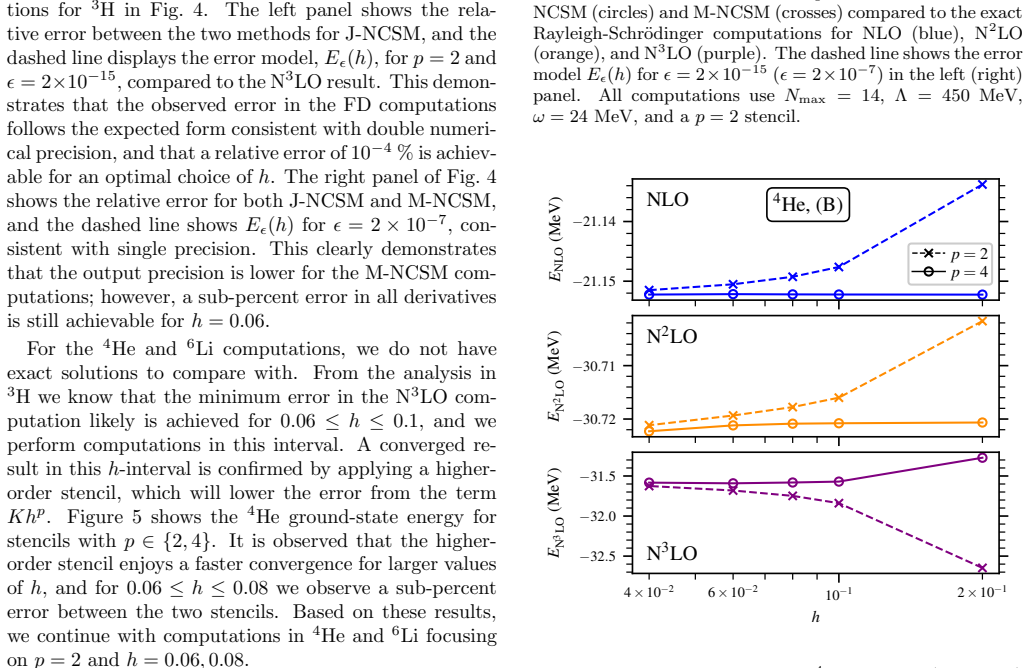
We predict ground-state energies of $^3$H, $^4$He, and $^6$Li in chiral effective field theory up to next-to-next-to-next-to-leading-order (N$^3$LO) using a power counting guided by renormalization-group invariance. Subleading two-nucleon interactions are treated perturbatively, and for $^4$He and $^6$Li, we calculate the perturbative corrections from numerical derivatives of ground-state energies obtained with Lanczos diagonalization. We find that including the $^3$H binding energy in the calibration is essential for robust predictions of $^4$He and $^6$Li. This work demonstrates that the employed power counting can be applied to construct nuclear interactions with predictive power for light nuclei, bringing nuclear structure predictions closer to a foundation in quantum chromodynamics.
Editorial analysis
A structured set of objections, weighed in public.
Referee Report
Summary. The manuscript presents perturbative calculations of the ground-state energies of ^3H, ^4He, and ^6Li in chiral effective field theory up to N^3LO. It employs a renormalization-group guided power counting in which subleading two-nucleon interactions are treated perturbatively. Corrections for ^4He and ^6Li are obtained from numerical derivatives of Lanczos ground-state energies. The authors report that including the ^3H binding energy in the low-energy constant calibration is essential for obtaining robust predictions of the A=4 and A=6 systems and conclude that the approach demonstrates predictive power for light nuclei with a foundation closer to QCD.
Significance. If the perturbative treatment and RG power counting are validated, the work would represent a useful step toward systematic, computationally efficient nuclear interactions at higher orders. It could reduce the cost of including N^3LO terms while preserving the ability to make falsifiable predictions for light nuclei once calibrated to a minimal set of data.
major comments (2)
- [Perturbative corrections and numerical derivatives] The section describing the perturbative corrections for ^4He and ^6Li (via numerical derivatives of Lanczos energies) provides no explicit convergence diagnostics. There is no reported magnitude of the N^3LO shift relative to N^2LO, no test of derivative stability with respect to step size, and no a-posteriori error estimate from omitted orders. Because the central claim of robust, predictive power rests on the perturbative series remaining well-behaved in these systems, this omission is load-bearing.
- [Calibration and results for A=4,6] The calibration discussion asserts that inclusion of the ^3H binding energy is essential for robust ^4He and ^6Li predictions, yet the manuscript does not quantify the change in those predictions when ^3H is omitted from the fit. A direct before/after comparison would be required to substantiate the claim that the RG-guided power counting yields predictive power only after this calibration step.
minor comments (2)
- [Abstract] The abstract states concrete numerical results are obtained but does not quote the final energies or uncertainties; adding these values would improve readability.
- [Methods] Notation for the perturbative expansion parameter and the numerical derivative step size should be defined explicitly in the methods section to allow reproduction.
Simulated Author's Rebuttal
We thank the referee for the careful reading of our manuscript and the constructive comments, which have helped identify areas where additional detail will strengthen the presentation. We address each major comment below and will incorporate the requested information in a revised version.
read point-by-point responses
-
Referee: The section describing the perturbative corrections for ^4He and ^6Li (via numerical derivatives of Lanczos energies) provides no explicit convergence diagnostics. There is no reported magnitude of the N^3LO shift relative to N^2LO, no test of derivative stability with respect to step size, and no a-posteriori error estimate from omitted orders. Because the central claim of robust, predictive power rests on the perturbative series remaining well-behaved in these systems, this omission is load-bearing.
Authors: We agree that explicit convergence diagnostics are important to substantiate the perturbative treatment. In the revised manuscript we will report the magnitudes of the N^3LO shifts relative to N^2LO for both ^4He and ^6Li, include tests of numerical derivative stability under variations in step size, and add an a-posteriori truncation-error estimate based on the observed order-by-order convergence pattern. These additions will directly address the concern that the well-behaved nature of the series is load-bearing for our conclusions. revision: yes
-
Referee: The calibration discussion asserts that inclusion of the ^3H binding energy is essential for robust ^4He and ^6Li predictions, yet the manuscript does not quantify the change in those predictions when ^3H is omitted from the fit. A direct before/after comparison would be required to substantiate the claim that the RG-guided power counting yields predictive power only after this calibration step.
Authors: We acknowledge that a quantitative before/after comparison is needed to make the claim fully explicit. In the revised manuscript we will add a direct comparison (in a table or supplementary figure) of the ^4He and ^6Li ground-state energies obtained with and without the ^3H binding energy in the low-energy-constant calibration. This will quantify the improvement in predictive accuracy and robustness when the ^3H datum is included, thereby supporting the assertion that this calibration step is essential. revision: yes
Circularity Check
No significant circularity detected
full rationale
The provided abstract and description show a standard calibration of low-energy constants to a subset of data (including ³H binding energy) followed by perturbative predictions for ⁴He and ⁶Li using numerical derivatives of Lanczos energies. No quoted equations or steps reduce any claimed prediction exactly to the fitted inputs by construction, nor do they rely on self-citation chains, imported uniqueness theorems, or smuggled ansatze. The power counting and perturbative treatment are presented as independent methodological choices whose validity is asserted separately from the numerical results. This is the most common honest outcome for such EFT applications.
Axiom & Free-Parameter Ledger
free parameters (1)
- Low-energy constants (LECs) in chiral EFT
axioms (2)
- domain assumption Chiral effective field theory power counting guided by renormalization-group invariance
- domain assumption Perturbative expansion converges for the ground-state energies of A=3-6 nuclei
Reference graph
Works this paper leans on
-
[1]
Weinberg, Phenomenological Lagrangians, Physica A 96, 327 (1979)
S. Weinberg, Phenomenological Lagrangians, Physica A 96, 327 (1979)
1979
-
[2]
Weinberg, Nuclear forces from chiral Lagrangians, Phys
S. Weinberg, Nuclear forces from chiral Lagrangians, Phys. Lett. B251, 288 (1990)
1990
-
[3]
Weinberg, Effective chiral Lagrangians for nucleon - pion interactions and nuclear forces, Nucl
S. Weinberg, Effective chiral Lagrangians for nucleon - pion interactions and nuclear forces, Nucl. Phys. B363, 3 (1991)
1991
-
[4]
R. Machleidt and D. R. Entem, Chiral effective field theory and nuclear forces, Phys. Rept.503, 1 (2011), arXiv:1105.2919 [nucl-th]
-
[5]
Modern Theory of Nuclear Forces
E. Epelbaum, H.-W. Hammer, and U.-G. Meissner, Mod- ern Theory of Nuclear Forces, Rev. Mod. Phys.81, 1773 (2009), arXiv:0811.1338 [nucl-th]
work page Pith review arXiv 2009
- [6]
-
[7]
Hergert, A Guided Tour ofab initioNuclear Many-Body Theory, Front
H. Hergert, A Guided Tour ofab initioNuclear Many-Body Theory, Front. in Phys.8, 379 (2020), arXiv:2008.05061 [nucl-th]
-
[8]
A. Ekstr¨ om, C. Forss´ en, G. Hagen, G. R. Jansen, W. Jiang, and T. Papenbrock, What is ab initio in nuclear theory?, Front. Phys.11, 1129094 (2023), arXiv:2212.11064 [nucl-th]
-
[9]
S. Elhatisari, D. Lee, G. Rupak, E. Epelbaum, H. Krebs, T. A. L¨ ahde, T. Luu, and U.-G. Meißner, Ab ini- tio alpha-alpha scattering, Nature528, 111 (2015), arXiv:1506.03513 [nucl-th]
- [10]
-
[11]
B. Huet al., Ab initio predictions link the neutron skin of 208Pb to nuclear forces, Nature Phys.18, 1196 (2022), arXiv:2112.01125 [nucl-th]
- [12]
- [13]
-
[14]
Frank, D
W. Frank, D. J. Land, and R. M. Spector, Singular po- tentials, Rev. Mod. Phys.43, 36 (1971)
1971
-
[15]
van Kolck, The Problem of Renormalization of Chiral Nuclear Forces, Front
U. van Kolck, The Problem of Renormalization of Chiral Nuclear Forces, Front. in Phys.8, 79 (2020), arXiv:2003.06721 [nucl-th]
-
[16]
B. Long and U. van Kolck, Renormalization of Singular Potentials and Power Counting, Annals Phys.323, 1304 (2008), arXiv:0707.4325 [quant-ph]
-
[17]
B. Long and C. J. Yang, Short-range nuclear forces in singlet channels, Phys. Rev. C86, 024001 (2012), arXiv:1202.4053 [nucl-th]
-
[18]
Long and C.-J
B. Long and C.-J. Yang, Renormalizing chiral nuclear forces: Triplet channels, Phys. Rev. C85, 034002 (2012)
2012
-
[19]
B. Long and C. J. Yang, Renormalizing chiral nuclear forces: a case study of 3P0, Phys. Rev. C84, 057001 (2011), arXiv:1108.0985 [nucl-th]
-
[20]
Pavon Valderrama, Reexamining the perturbative renormalizability of coupled triplets, Phys
M. Pavon Valderrama, Reexamining the perturbative renormalizability of coupled triplets, Phys. Rev. C113, 014001 (2026), arXiv:2510.15789 [nucl-th]
- [21]
- [22]
-
[23]
O. Thim, Low-Energy Theorems for Neutron–Proton Scattering inχEFT Using a Perturbative Power Count- ing, Few Body Syst.65, 69 (2024), arXiv:2403.10292 [nucl-th]
- [24]
- [25]
- [26]
-
[27]
Renormalization- group-invariant effective field theory
A. M. Gasparyan and E. Epelbaum, “Renormalization- group-invariant effective field theory” for few-nucleon systems is cutoff dependent, Phys. Rev. C107, 034001 (2023), arXiv:2210.16225 [nucl-th]
- [28]
- [29]
-
[30]
Thim, py-ncsm: Python code for the no- core shell model,https://github.com/othim/py-ncsm (2025), github repository
O. Thim, py-ncsm: Python code for the no- core shell model,https://github.com/othim/py-ncsm (2025), github repository
2025
-
[31]
C. Forss´ en, B. D. Carlsson, H. T. Johansson, D. S¨ a¨ af, A. Bansal, G. Hagen, and T. Papenbrock, Large-scale ex- act diagonalizations reveal low-momentum scales of nu- clei, Phys. Rev. C97, 034328 (2018), arXiv:1712.09951 [nucl-th]
-
[32]
Caurier and F
E. Caurier and F. Nowacki, Present Status of Shell Model Techniques, Acta Physica Polonica B30, 705 (1999)
1999
-
[33]
E. Caurier, G. Martinez-Pinedo, F. Nowacki, A. Poves, J. Retamosa, and A. P. Zuker, Full 0 h-bar omega shell model calculation of the binding energies of the 1f(7/2) nuclei, Phys. Rev. C59, 2033 (1999), arXiv:nucl- th/9809068
-
[34]
Navrtil and E
P. Navrtil and E. Caurier, Nuclear structure with accu- rate chiral perturbation theory nucleon nucleon potential: Application to Li-6 and B-10, Phys. Rev. C69, 014311 (2004)
2004
- [35]
- [36]
- [37]
- [38]
- [39]
-
[40]
M. C. Birse, Power counting with one-pion exchange, Phys. Rev. C74, 014003 (2006), arXiv:nucl-th/0507077
work page Pith review arXiv 2006
-
[41]
Wu and B
S. Wu and B. Long, Perturbativennscattering in chiral effective field theory, Phys. Rev. C99, 024003 (2019)
2019
- [42]
- [43]
-
[44]
Fornberg, Generation of finite difference formulas on arbitrarily spaced grids, Mathematics of Computation 51, 699 (1988)
B. Fornberg, Generation of finite difference formulas on arbitrarily spaced grids, Mathematics of Computation 51, 699 (1988)
1988
-
[45]
W. J. Huang, M. Wang, F. G. Kondev, G. Audi, and S. Naimi, The AME 2020 atomic mass evaluation (I). Evaluation of input data, and adjustment procedures, Chin. Phys. C45, 030002 (2021)
2020
-
[46]
See Supplemental Material at [URL will be inserted by publisher] for phase shifts and additional deuteron re- sults
- [47]
-
[48]
S. Binderet al.(LENPIC), Few-nucleon and many- nucleon systems with semilocal coordinate-space regu- 7 larized chiral nucleon-nucleon forces, Phys. Rev. C98, 014002 (2018), arXiv:1802.08584 [nucl-th]
-
[49]
K ¨onig, Energies and radii of light nuclei around unitarity, Eur
S. K¨ onig, Energies and radii of light nuclei around uni- tarity, Eur. Phys. J. A56, 113 (2020), arXiv:1910.12627 [nucl-th]
- [50]
-
[51]
Eigenvector continuation with subspace learning
D. Frame, R. He, I. Ipsen, D. Lee, D. Lee, and E. Rrapaj, Eigenvector continuation with subspace learning, Phys. Rev. Lett.121, 032501 (2018), arXiv:1711.07090 [nucl- th]
work page Pith review arXiv 2018
-
[52]
S. K¨ onig, A. Ekstr¨ om, K. Hebeler, D. Lee, and A. Schwenk, Eigenvector Continuation as an Efficient and Accurate Emulator for Uncertainty Quantification, Phys. Lett. B810, 135814 (2020), arXiv:1909.08446 [nucl-th]
-
[53]
Furnstahl and Sebastian König and Dean Lee , title =
T. Duguet, A. Ekstr¨ om, R. J. Furnstahl, S. K¨ onig, and D. Lee, Eigenvector Continuation and Projection-Based Emulators, (2023), arXiv:2310.19419 [nucl-th]
-
[54]
V. G. J. Stoks, R. A. M. Klomp, M. C. M. Rentmeester, and J. J. de Swart, Partial wave analysis of all nucleon- nucleon scattering data below 350-MeV, Phys. Rev. C 48, 792 (1993)
1993
-
[55]
R. Navarro P´ erez, J. E. Amaro, and E. Ruiz Arriola, The low-energy structure of the nucleon–nucleon interaction: statistical versus systematic uncertainties, J. Phys. G43, 114001 (2016), arXiv:1410.8097 [nucl-th]
- [56]
-
[57]
R. Machleidt, The High precision, charge dependent Bonn nucleon-nucleon potential (CD-Bonn), Phys. Rev. C63, 024001 (2001), arXiv:nucl-th/0006014. 8 END MA TTER Numerical accuracy of perturbative computations.− We now analyze the convergence of the FD method for computing perturbative corrections in more detail. The relative error in ann:th-order finite-d...
-
[58]
The (+∆) indicates that the Nijmegen phase shift atT lab = 25 MeV is shifted +7 ◦ to reduce the strength of the NLO correction, as seen in the NLO phase shift predictions in Fig
used, as indicated. The (+∆) indicates that the Nijmegen phase shift atT lab = 25 MeV is shifted +7 ◦ to reduce the strength of the NLO correction, as seen in the NLO phase shift predictions in Fig. S1. Pot. Partial wave LO NLO N2LO N3LO 1S0 5 5, 25 5, 25, 50 5, 25, 50, 75 A 3S1 30 - 30, 50 30, 50 ϵ1 50 50 1S0 5 5, 25 (+∆) 5, 25, 50 5, 25, 50, 75 B’ 3S1 3...
discussion (0)
Sign in with ORCID, Apple, or X to comment. Anyone can read and Pith papers without signing in.