Multispecific DNA-Coatings for Self-Assembly
Pith reviewed 2026-05-10 10:02 UTC · model grok-4.3
The pith
Precise multispecific DNA coatings on colloidal particles still limit equilibrium co-assembly to sequential pathways because of narrow overlapping temperature windows for reversible interactions.
A machine-rendered reading of the paper's core claim, the machinery that carries it, and where it could break.
Core claim
The authors show that multispecific DNA coatings can be produced with tunable and predictable composition using isothermal DNA polymerization, but that equilibrium co-assembly of different particle types is constrained by the limited number of DNA sequence pairs whose hybridization remains reversible within a shared temperature window. This necessitates incorporating sequential assembly pathways into structure design, where the coating composition determines the sequence of binding events.
What carries the argument
Multispecific DNA coatings on colloidal particles, where the key mechanism is the requirement for overlapping temperature windows of reversible hybridization for simultaneous interactions in equilibrium assembly.
If this is right
- Coating composition directly controls the order in which different particle types bind during assembly.
- Finite-sized and dynamic structures become feasible only when sequential pathways are explicitly designed.
- Systematic tuning of interaction strengths must accompany composition control to enable complex assemblies.
- Reproducibility of assemblies improves with the polymerization method over click chemistry due to reduced variation.
Where Pith is reading between the lines
- This limitation suggests that engineering DNA sequences with broader or more tunable melting temperatures could expand the number of particle types that can co-assemble at equilibrium.
- Similar constraints may affect other sequence-specific interaction systems, pointing to a general need for sequential design in programmable assembly.
- Experiments with varying numbers of sequences per particle could test whether the temperature window limit scales predictably or has a hard upper bound.
Load-bearing premise
The temperature windows for hybridization of different DNA sequence pairs can be sufficiently overlapped or sequential pathways can be engineered without introducing unaccounted kinetic or stability problems.
What would settle it
Demonstrating stable equilibrium co-assembly of three or more distinct DNA-coated particle types with all interactions reversible at the same temperature without relying on sequential steps would disprove the central limitation.
Figures
read the original abstract
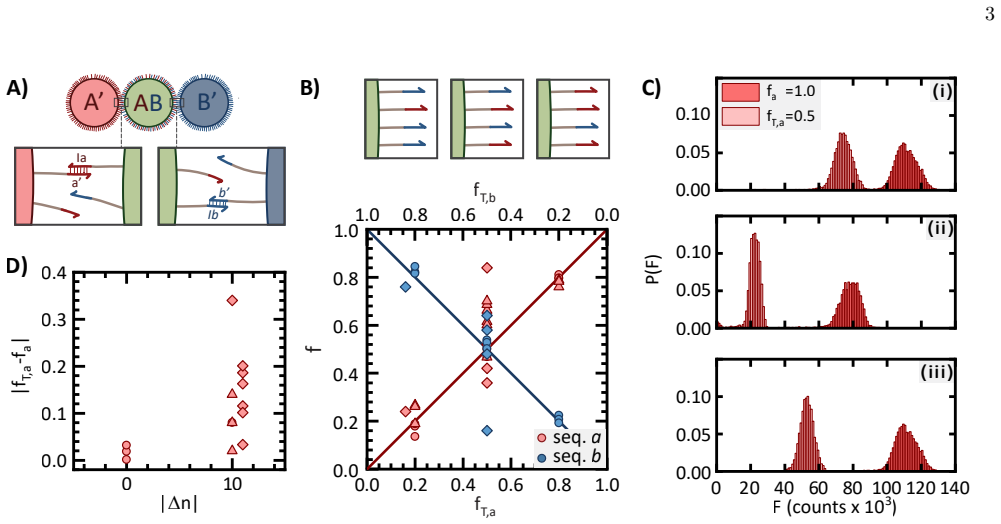
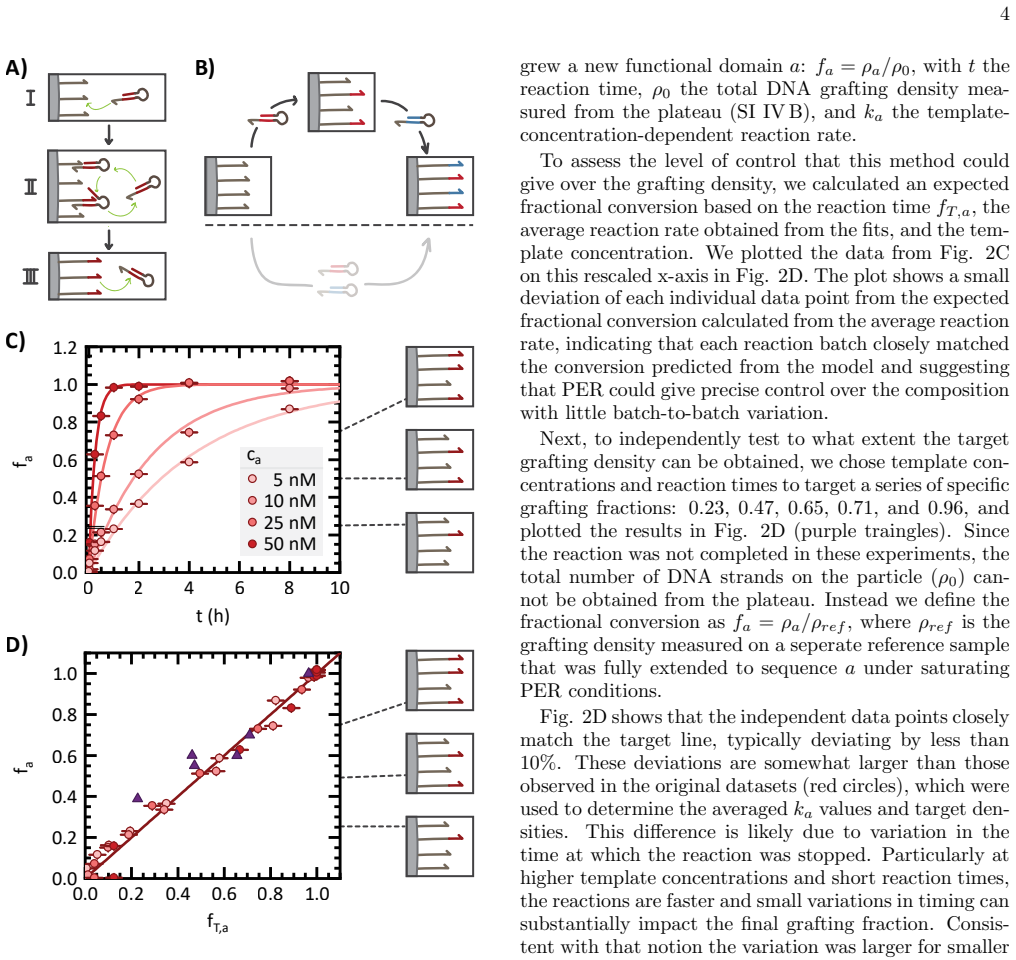
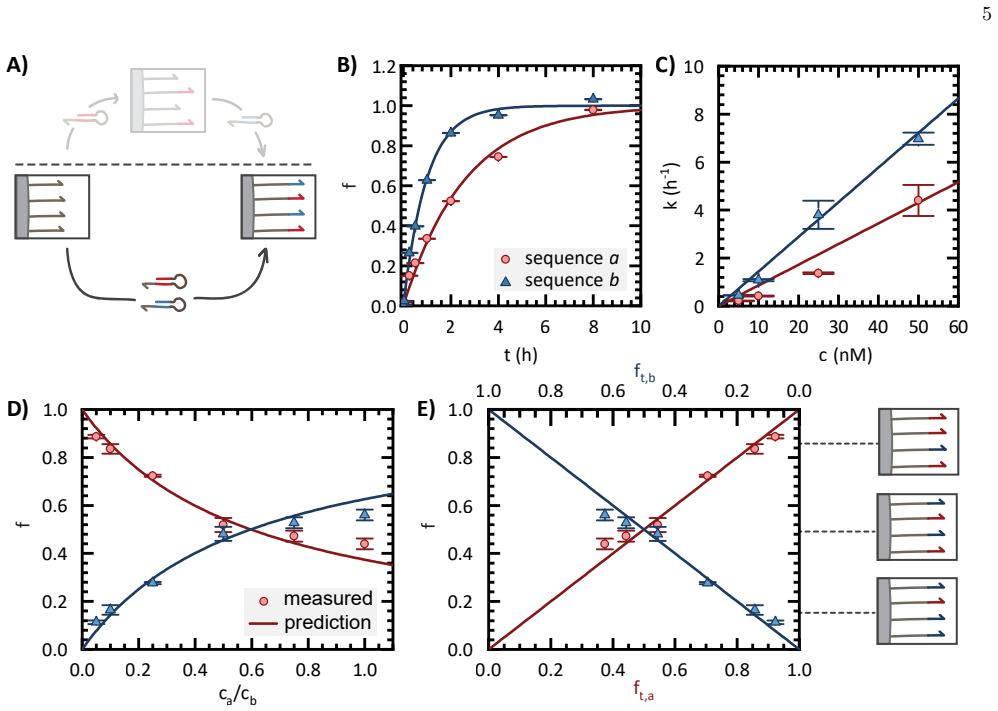
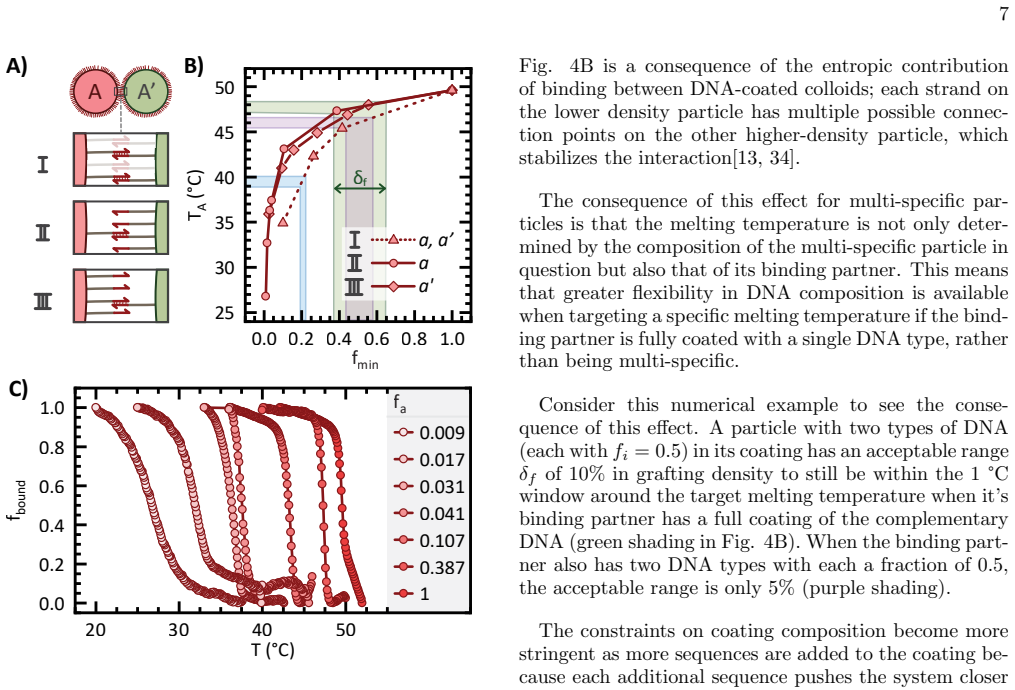
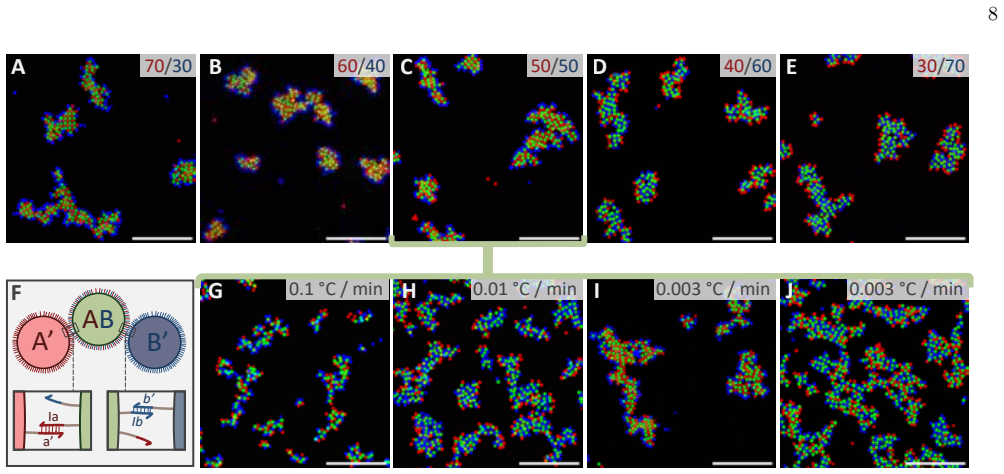
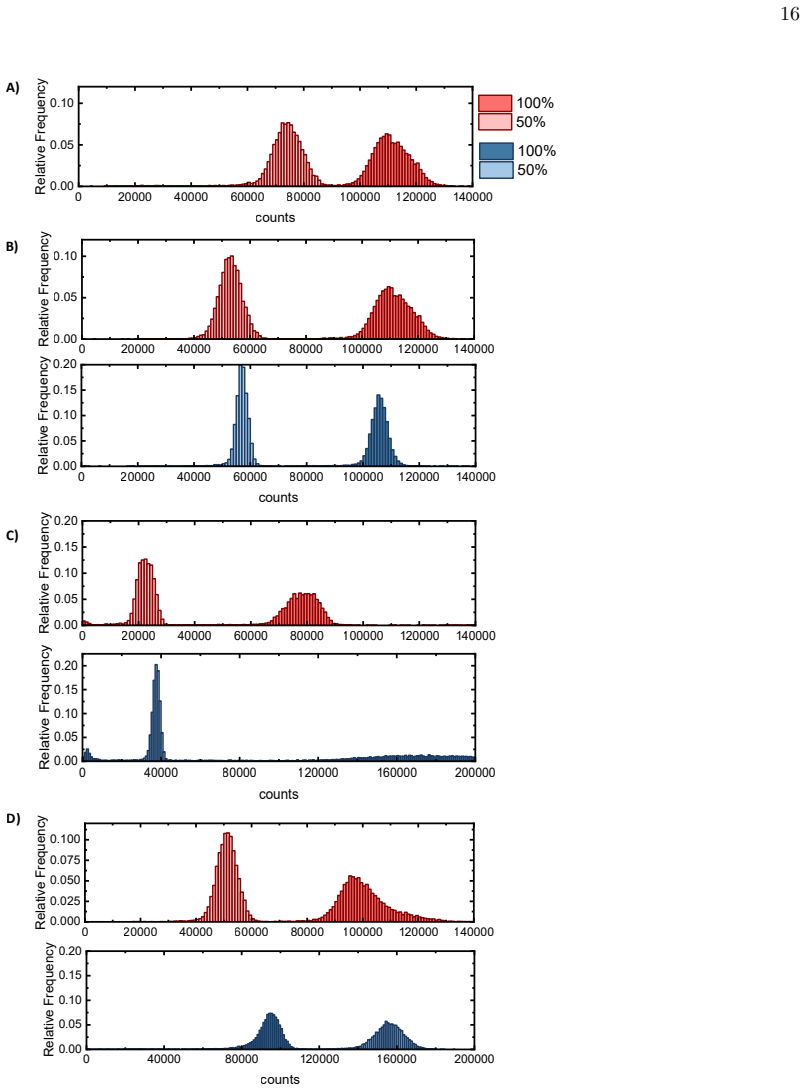
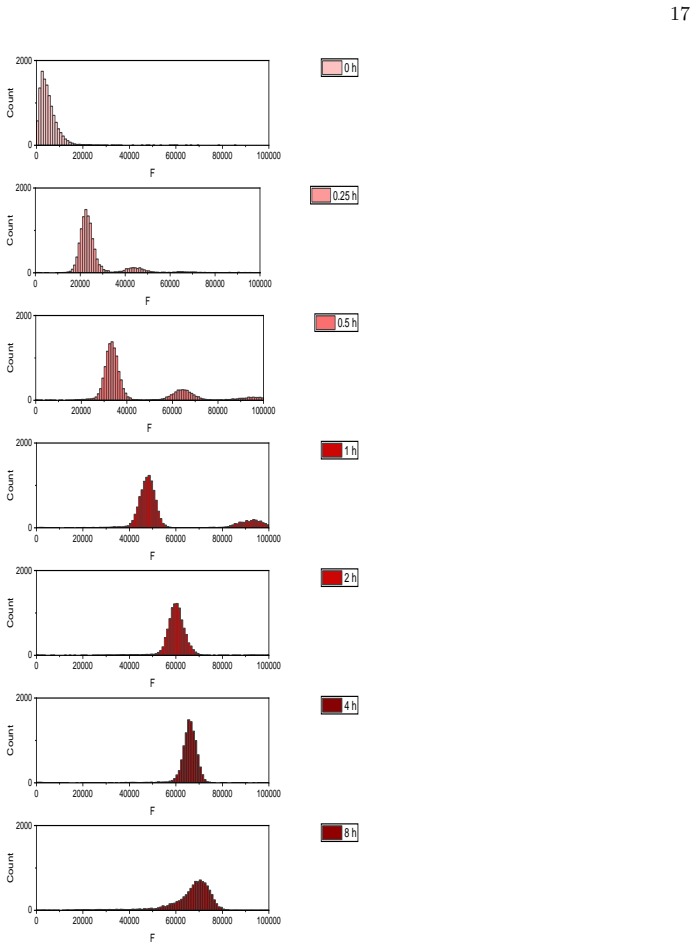
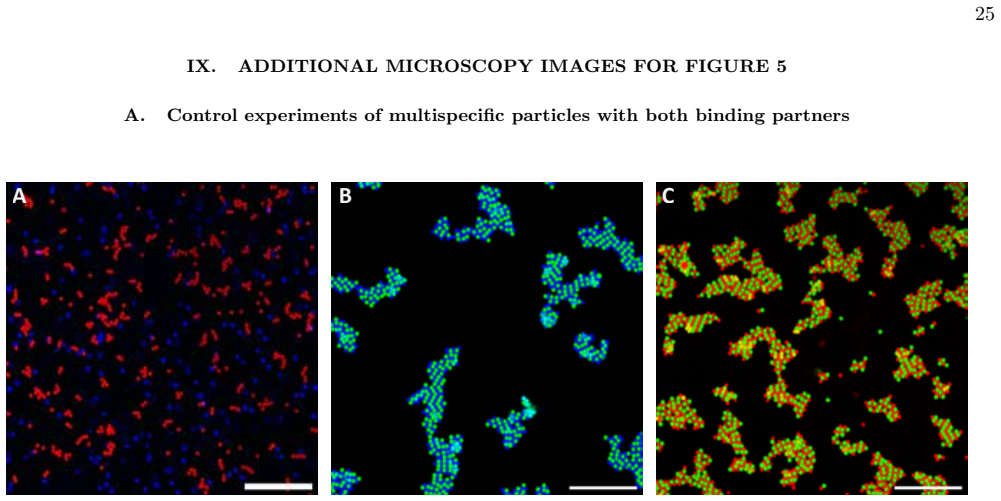
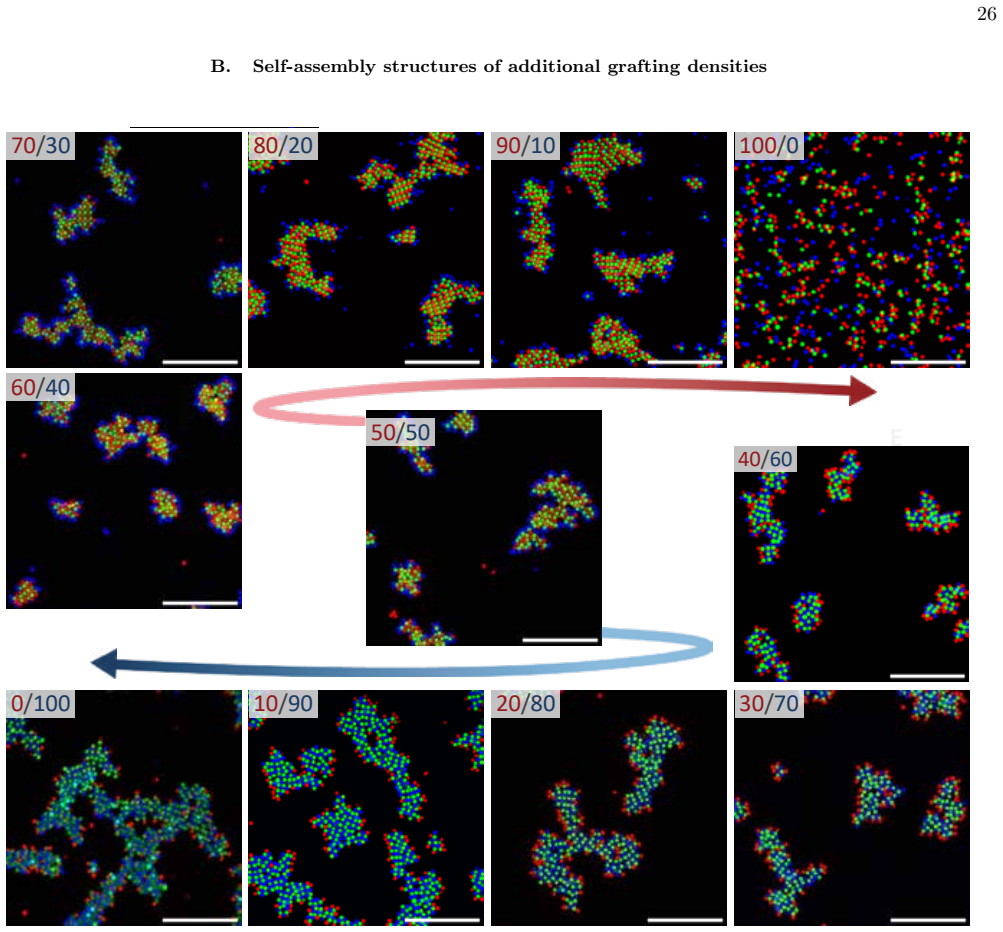
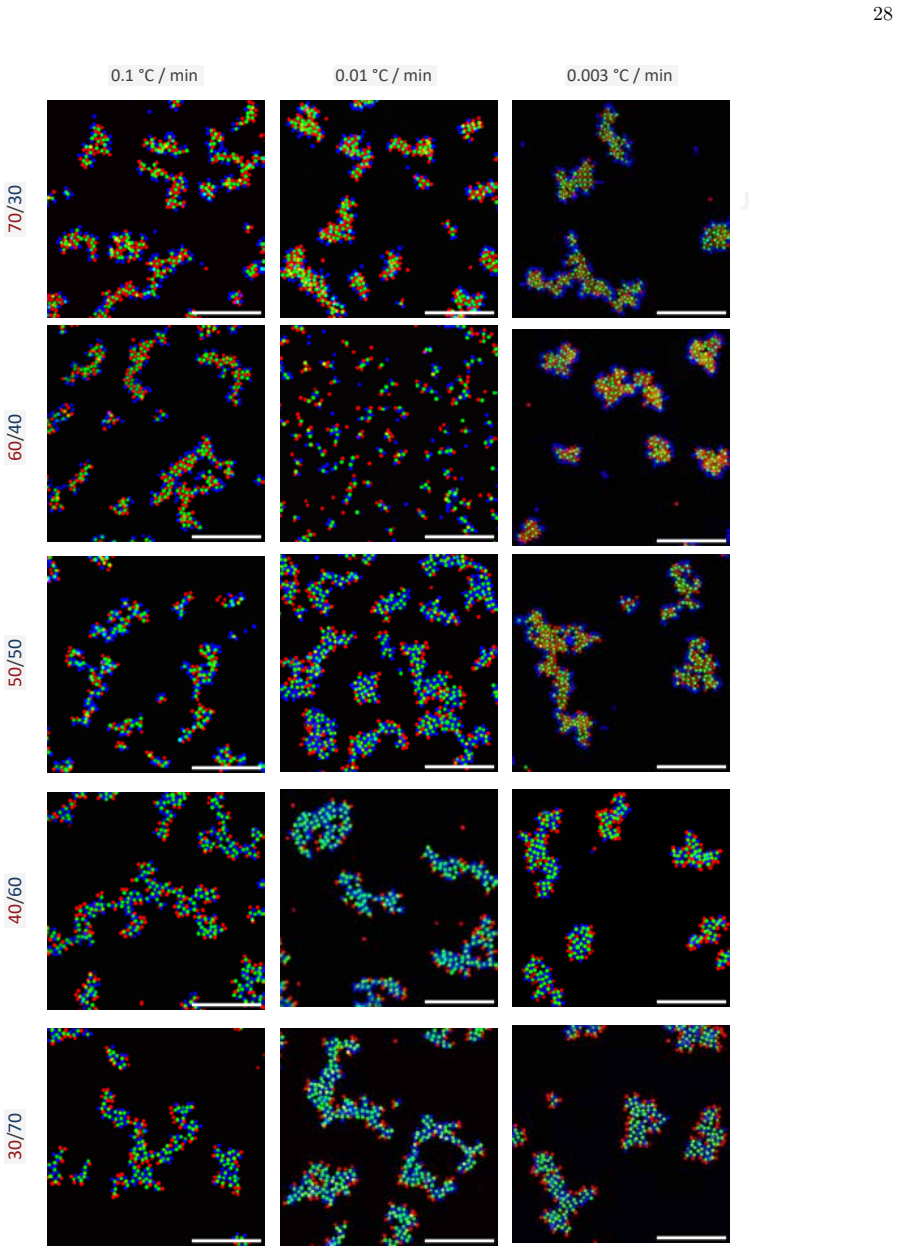
DNA-coated particles are promising as building blocks for functional and finite-sized assemblies because they can be programmed with orthogonal interactions owing to the sequence-specific hybridization of DNA strands. To fully exploit this programmability, it is important to develop particles with coatings that incorporate multiple distinct DNA sequences in tunable ratios and to understand how the coating composition influences self-assembly. Here, we compared two strategies to graft multiple DNA sequences in tunable and well-defined ratios on micron-sized colloidal particles. We found that a method based on click chemistry yielded mixed coatings with large batch-to-batch variation in the composition, while a method based on isothermal DNA polymerization produced coatings of predictable composition with a precision of a few percent, but requires reaction rate measurements for each new sequence in the coating. Our self-assembly experiments showed that, even with precise control over coating composition, equilibrium co-assembly of multiple types of DNA-coated particles is limited by the number of interactions that are reversible within the same narrow temperature window. This finding highlights the need to explicitly incorporate sequential assembly pathways into structure design, with coating composition dictating the order of binding events, Together, our results show how systematic tuning of interaction strength and sequential assembly through multispecific DNA coatings is a prerequisite for the experimental realization of finite-sized and dynamic structures that have so far remained largely theoretical.
Editorial analysis
A structured set of objections, weighed in public.
Referee Report
Summary. The manuscript compares two strategies for grafting multiple distinct DNA sequences onto micron-sized colloidal particles in tunable ratios: a click-chemistry approach that produces large batch-to-batch compositional variation, and an isothermal DNA-polymerization method that yields predictable compositions with a few-percent precision (but requires per-sequence reaction-rate calibration). Self-assembly experiments with these multispecific coatings demonstrate that, even under precise compositional control, equilibrium co-assembly of multiple particle types remains limited by the number of DNA-hybridization interactions that stay reversible inside a single narrow temperature window, thereby motivating the explicit design of sequential assembly pathways.
Significance. If the reported temperature-window constraint proves general rather than sequence-specific, the work supplies both practical coating protocols and a design principle that could enable experimental realization of finite-sized, dynamic colloidal structures previously studied only theoretically. The polymerization method's few-percent precision and the direct comparison of grafting strategies are concrete methodological advances.
major comments (1)
- [Self-assembly experiments] Self-assembly results section: The central claim that 'equilibrium co-assembly ... is limited by the number of interactions that are reversible within the same narrow temperature window' (and therefore requires sequential pathways) rests on the implicit assumption that the chosen DNA sequences could not be redesigned for greater Tm overlap. No melting-temperature data, sequence-selection criteria, or optimization attempts are described, so it is unclear whether the observed limitation is intrinsic or specific to the particular sequences tested.
minor comments (2)
- [Abstract] The abstract states 'precision of a few percent' and 'narrow temperature window' without accompanying error bars, sample sizes, or statistical tests; these quantitative claims should be supported by explicit data in the main text or supplementary figures.
- [Methods] The manuscript should clarify whether the polymerization method's rate measurements were performed under the exact buffer and temperature conditions used for subsequent self-assembly, to allow readers to assess transferability.
Simulated Author's Rebuttal
We are grateful to the referee for their careful reading and valuable feedback on our manuscript. Below we provide a point-by-point response to the major comment and outline the revisions we plan to make.
read point-by-point responses
-
Referee: [Self-assembly experiments] Self-assembly results section: The central claim that 'equilibrium co-assembly ... is limited by the number of interactions that are reversible within the same narrow temperature window' (and therefore requires sequential pathways) rests on the implicit assumption that the chosen DNA sequences could not be redesigned for greater Tm overlap. No melting-temperature data, sequence-selection criteria, or optimization attempts are described, so it is unclear whether the observed limitation is intrinsic or specific to the particular sequences tested.
Authors: We thank the referee for pointing out this potential ambiguity in our presentation. It is correct that the manuscript does not provide melting-temperature data, explicit sequence-selection criteria, or details on optimization attempts for the DNA sequences. This could leave open the question of whether the narrow temperature window for reversible interactions is an intrinsic limitation or particular to the sequences we selected. In response, we will revise the self-assembly results section to include the predicted and measured melting temperatures for each DNA sequence used, as well as a brief description of our sequence design approach (selecting sequences with similar Tm values in the 50-60 °C range using standard thermodynamic models). We will also add a short discussion noting that, while further optimization of sequence lengths and GC content might slightly broaden the overlap, the cooperative unzipping of DNA duplexes inherently produces relatively sharp melting transitions (typically spanning only a few degrees Celsius). Consequently, achieving simultaneous reversibility for more than a small number of distinct interactions within one temperature window remains difficult, consistent with prior observations in the DNA-colloid literature. These additions will clarify that the limitation is largely general rather than sequence-specific, while acknowledging that targeted redesign can provide marginal improvements. revision: partial
Circularity Check
No circularity: experimental methods comparison with direct measurements
full rationale
The paper reports experimental protocols for multispecific DNA coatings on colloidal particles, batch variation measurements, and self-assembly observations. No mathematical derivations, equations, fitted parameters renamed as predictions, or self-referential definitions appear in the provided text. Conclusions about temperature-window limitations rest on direct experimental outcomes rather than any internal reduction to inputs by construction. No load-bearing self-citations or ansatz smuggling are evident; the work is self-contained against external benchmarks of particle coating and hybridization experiments.
Axiom & Free-Parameter Ledger
Reference graph
Works this paper leans on
-
[1]
W. M. Jacobs and W. B. Rogers, Annual Review of Con- densed Matter Physics16, 443 (2025)
work page 2025
- [2]
-
[3]
J. S. Kahn and O. Gang, Angewandte Chemie Interna- tional Edition61, e202105678 (2022)
work page 2022
-
[4]
C. R. Laramy, M. N. O’Brien, and C. A. Mirkin, Nature Reviews Materials4, 201 (2019)
work page 2019
-
[5]
L. Feng, R. Dreyfus, R. Sha, N. C. Seeman, and P. M. Chaikin, Advanced Materials25, 2779 (2013)
work page 2013
-
[6]
J. S. Oh, G.-R. Yi, and D. J. Pine, ACS Nano14, 15786 (2020)
work page 2020
-
[7]
M. R. Jones, R. J. Macfarlane, B. Lee, J. Zhang, K. L. Young, A. J. Senesi, and C. A. Mirkin, Nature Materials 9, 913 (2010)
work page 2010
-
[8]
M. Rinaldin, R. W. Verweij, I. Chakraborty, and D. J. Kraft, Soft Matter15, 1345 (2019)
work page 2019
-
[9]
M. He, J. P. Gales, ´E. Ducrot, Z. Gong, G.-R. Yi, S. Sacanna, and D. J. Pine, Nature585, 524 (2020), pub- lisher: Springer Science and Business Media LLC
work page 2020
-
[10]
Y. Wang, Y. Wang, X. Zheng, ´E. Ducrot, J. S. Yodh, M. Weck, and D. J. Pine, Nature Communications6, 7253 (2015)
work page 2015
-
[11]
W. Zhou, Y. Lim, H. Lin, S. Lee, Y. Li, Z. Huang, J. S. Du, B. Lee, S. Wang, A. S´ anchez-Iglesias, M. Grzelczak, L. M. Liz-Marz´ an, S. C. Glotzer, and C. A. Mirkin, Na- ture Materials23, 424 (2024)
work page 2024
- [12]
-
[13]
M. E. Leunissen, R. Dreyfus, F. C. Cheong, D. G. Grier, R. Sha, N. C. Seeman, and P. M. Chaikin, Nature Mate- rials8, 590 (2009)
work page 2009
-
[14]
M.-P. Valignat, O. Theodoly, J. C. Crocker, W. B. Rus- sel, and P. M. Chaikin, Proceedings of the National Academy of Sciences102, 4225 (2005), publisher: Pro- ceedings of the National Academy of Sciences
work page 2005
-
[15]
W. Liu, J. Halverson, Y. Tian, A. V. Tkachenko, and O. Gang, Nature Chemistry8, 867 (2016), publisher: Springer Science and Business Media LLC
work page 2016
-
[16]
Y. Tian, T. Wang, W. Liu, H. L. Xin, H. Li, Y. Ke, W. M. Shih, and O. Gang, Nature Nanotechnology10, 637 (2015)
work page 2015
-
[17]
J. S. Oh, M. He, G.-R. Yi, and D. J. Pine, Langmuir36, 3583 (2020)
work page 2020
-
[18]
A. J. Kim, P. L. Biancaniello, and J. C. Crocker, Lang- muir22, 1991 (2006)
work page 1991
-
[19]
J. A. Zheng, M. Holmes-Cerfon, D. J. Pine, and S. Mar- bach, Proceedings of the National Academy of Sciences 121, e2318865121 (2024)
work page 2024
-
[20]
K.-T. Wu, L. Feng, R. Sha, R. Dreyfus, A. Y. Grosberg, N. C. Seeman, and P. M. Chaikin, Proceedings of the National Academy of Sciences109, 18731 (2012)
work page 2012
-
[21]
W. B. Rogers, W. M. Shih, and V. N. Manoharan, Nature Reviews Materials1, 16008 (2016)
work page 2016
-
[22]
M. R. Jones, N. C. Seeman, and C. A. Mirkin, Science 347, 1260901 (2015)
work page 2015
-
[23]
Z. Zeravcic, V. N. Manoharan, and M. P. Brenner, Pro- ceedings of the National Academy of Sciences111, 15918 (2014)
work page 2014
-
[24]
N. A. Mahynski, R. Mao, E. Pretti, V. K. Shen, and J. Mittal, Soft Matter16, 3187 (2020)
work page 2020
-
[25]
Z. Zeravcic and M. P. Brenner, Proceedings of the Na- tional Academy of Sciences111, 1748 (2014)
work page 2014
-
[26]
L. Di Michele, F. Varrato, J. Kotar, S. H. Nathan, G. Foffi, and E. Eiser, Nature Communications4, n/a (2013), publisher: Springer Science and Business Media LLC
work page 2013
-
[27]
H. Seyforth, S. Chatterjee, T. E. Videbæk, M. Mondal, W. M. Jacobs, and W. B. Rogers, The underappreci- ated role of nonspecific interactions in the crystallization of DNA-coated colloids (2025), arXiv:2501.02220 [cond- mat]
-
[28]
A. Murugan, Z. Zeravcic, M. P. Brenner, and S. Leibler, Proceedings of the National Academy of Sciences112, 54 (2015)
work page 2015
- [29]
-
[30]
S. Angioletti-Uberti, B. M. Mognetti, and D. Frenkel, Nature Materials11, 518 (2012)
work page 2012
-
[31]
F. Cui, S. Marbach, J. A. Zheng, M. Holmes-Cerfon, and D. J. Pine, Nature Communications13, 2304 (2022)
work page 2022
-
[32]
I.-S. Jo, J. S. Oh, M. Soula, M. Lee, D. J. Pine, E. Ducrot, and G.-R. Yi, Chemistry of Materials36, 3820 (2024)
work page 2024
-
[33]
M. M. Maye, D. Nykypanchuk, D. van der Lelie, and O. Gang, Small3, 1678 (2007)
work page 2007
-
[34]
R. Dreyfus, M. E. Leunissen, R. Sha, A. Tkachenko, N. C. Seeman, D. J. Pine, and P. M. Chaikin, Physical Review E81, 041404 (2010)
work page 2010
-
[35]
P. G. Moerman, H. Fang, T. E. Videbæk, W. B. Rogers, and R. Schulman, Soft Matter19, 8779 (2023)
work page 2023
-
[36]
J. S. Oh, G.-R. Yi, and D. J. Pine, ACS Nano14, 4595 (2020)
work page 2020
- [37]
-
[38]
J. Y. Kishi, T. E. Schaus, N. Gopalkrishnan, F. Xuan, and P. Yin, Nature Chemistry10, 155 (2018)
work page 2018
-
[39]
K. A. Johnson, Annual Review of Biochemistry62, 685 (1993)
work page 1993
- [40]
-
[41]
J. S. Oh, Y. Wang, D. J. Pine, and G.-R. Yi, Chemistry of Materials27, 8337 (2015)
work page 2015
-
[42]
X. Xia, H. Hu, M. P. Ciamarra, and R. Ni, Science Ad- vances6, eaaz6921 (2020)
work page 2020
- [43]
-
[44]
Transient self-organisation of DNA coated colloids directed by enzymatic reactions
H. Dehne, A. Reitenbach, and A. R. Bausch, Scien- tific Reports9, 10.1038/s41598-019-43720-7 (2019), pub- lisher: Springer Science and Business Media LLC
-
[45]
J. Lowensohn, B. Oyarz´ un, G. Narv´ aez Paliza, B. M. Mognetti, and W. B. Rogers, Physical Review X9, 041054 (2019)
work page 2019
-
[46]
M. T. Casey, R. T. Scarlett, W. Benjamin Rogers, I. Jenkins, T. Sinno, and J. C. Crocker, Nature Com- munications3, 1209 (2012)
work page 2012
-
[47]
Angioletti-Uberti, inFrontiers of Nanoscience, Vol
S. Angioletti-Uberti, inFrontiers of Nanoscience, Vol. 13 (Elsevier, 2019) pp. 87–123
work page 2019
-
[48]
Y. Sun, N. C. Harris, and C.-H. Kiang, Physica A: Sta- tistical Mechanics and its Applications354, 1 (2005)
work page 2005
-
[49]
L. J. Stenke and B. Sacc` a, Nano Letters22, 8818 (2022)
work page 2022
-
[50]
P. Zhan, A. Peil, Q. Jiang, D. Wang, S. Mousavi, Q. Xiong, Q. Shen, Y. Shang, B. Ding, C. Lin, Y. Ke, and N. Liu, Chemical Reviews123, 3976 (2023)
work page 2023
-
[51]
E. M. Furst, Soft Matter9, 9039 (2013)
work page 2013
-
[52]
A. McMullen, M. Mu˜ noz Basagoiti, Z. Zeravcic, and J. Bruji´ c, Nature610, 502 (2022)
work page 2022
-
[53]
F. M. Hecht and A. R. Bausch, Proceedings of the Na- tional Academy of Sciences113, 8577 (2016)
work page 2016
-
[54]
P. G. Moerman, C.-H. Chou, T. E. Videbaek, W. B. Rogers, and R. Schulman, Proceedings of the National Academy of Sciences123, e2527410123 (2026)
work page 2026
-
[55]
A. D. Buskermolen, Y.-T. Lin, L. Van Smeden, R. B. Van Haaften, J. Yan, K. Sergelen, A. M. De Jong, and M. W. J. Prins, Nature Communications13, 6052 (2022)
work page 2022
-
[56]
P. Xu, T. Cao, Q. Fan, X. Wang, F. Ye, and E. Eiser, Proceedings of the National Academy of Sciences120, e2305995120 (2023)
work page 2023
- [57]
- [58]
- [59]
-
[60]
J. N. Zadeh, C. D. Steenberg, J. S. Bois, B. R. Wolfe, M. B. Pierce, A. R. Khan, R. M. Dirks, and N. A. Pierce, Journal of Computational Chemistry32, 170 (2011). 13 SUPPLEMENTARY INFORMATION I. DNA SEQUENCES Name Sequence (5’-3’) Figures a /5DBCON/ 40T ACCATCCTACC 1 polyT /5DBCON/ 40T 1 b (short) /5DBCON/ 40T ACTCATCTCAA 1 b (long) /5DBCON/ 40T C TCCTAATT...
work page 2011
discussion (0)
Sign in with ORCID, Apple, or X to comment. Anyone can read and Pith papers without signing in.