Recognition: unknown
Hidden Quantum Advantage near the Decoding Threshold of Decoded Quantum Interferometry
Pith reviewed 2026-05-10 11:51 UTC · model grok-4.3
The pith
A tighter lower bound on decoded quantum interferometry reveals quantum advantage that prior analysis missed near the decoding threshold.
A machine-rendered reading of the paper's core claim, the machinery that carries it, and where it could break.
Core claim
The authors prove a Master Theorem that supplies a unified lower bound on the approximation ratio of DQI, valid for arbitrary finite fields F_q. The bound strictly improves the relaxed form of Jordan's bound by substituting the operator-norm penalty 2ε(q-1)(m+1) with the tighter Rayleigh-quotient penalty 2ε̄ λ_max, where ε̄ is the eigenvector-weighted average of the layer-wise failure rates.
What carries the argument
The Master Theorem, which obtains a tighter lower bound by replacing the worst-case Hamming-layer failure rate with the Perron-eigenvector-weighted average ε̄ = ∑ ε_k w_k².
If this is right
- The new bound holds for arbitrary finite fields F_q.
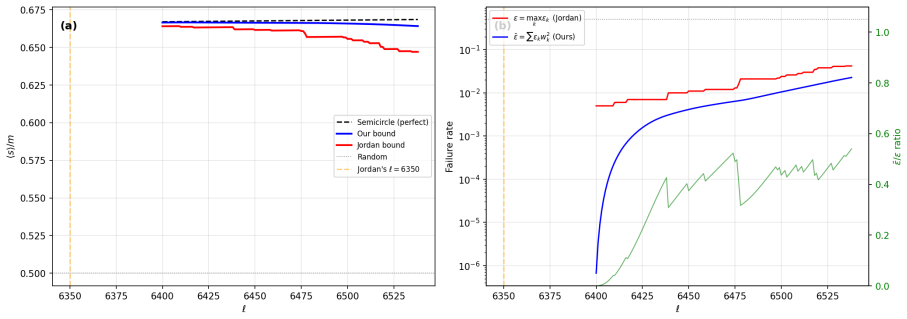
- On the partial-win LDPC benchmark, 26 consecutive parameter points (ℓ ∈ [642, 667]) exhibit quantum advantage with approximation ratio 0.66 where Jordan's analysis reports none.
- The improvement follows from substituting the Rayleigh-quotient penalty for the operator-norm penalty.
- The weighted average ε̄ is obtained by exploiting concentration of the Perron eigenvector.
Where Pith is reading between the lines
- The eigenvector-weighting technique may tighten performance bounds for other quantum algorithms whose analysis involves tridiagonal or sparse matrices.
- Parameter selection for practical DQI implementations could be guided by the new bound to reach the advantage regime with smaller resources.
- Similar hidden-advantage phenomena may exist in related quantum decoding or interferometry settings once spectral structure is retained.
Load-bearing premise
The Perron eigenvector of the DQI tridiagonal matrix concentrates sufficiently that the weighted average of failure rates can replace the uniform worst-case value without extra error terms or loss of validity over finite fields.
What would settle it
Direct numerical computation of the actual expectation value or approximation ratio achieved by DQI on the 26 identified LDPC parameter points to determine whether the ratio exceeds 0.5 and reaches approximately 0.66.
Figures


read the original abstract
Where is the true boundary of the quantum advantage region of decoded quantum interferometry (DQI)? The best existing answer is provided by Theorem 7.1 in the Supplementary Material of Jordan et al. (2025), yet we show that this answer systematically underestimates the extent of quantum advantage. On the standard partial-win LDPC benchmark instance, there exist 26 consecutive parameter points ($\ell \in [642, 667]$) at which Jordan's analysis declares no quantum advantage ($\langle s\rangle/m < 0.5$), while quantum advantage is in fact present with an approximation ratio reaching $0.66$. The root cause is that Jordan's bound penalizes the entire system with the worst-case Hamming-layer decoding failure rate $\varepsilon = \max_k \varepsilon_k$, discarding the spectral structure of the DQI tridiagonal matrix. Exploiting the concentration of the Perron eigenvector, we replace the uniform penalty with the eigenvector-weighted average $\bar\varepsilon = \sum_k \varepsilon_k w_k^2$ and establish a unified lower bound (Master Theorem) valid over arbitrary finite fields $\mathbb{F}_q$, proving that it strictly improves upon the relaxed form of Jordan's bound by replacing the operator-norm penalty $2\varepsilon(q-1)(m+1)$ with a tighter Rayleigh-quotient penalty $2\bar\varepsilon\lambda_{\max}$.
Editorial analysis
A structured set of objections, weighed in public.
Referee Report
Summary. The manuscript claims that the quantum advantage region for decoded quantum interferometry (DQI) extends beyond the boundary given by Jordan et al. (2025) Theorem 7.1. By exploiting concentration of the Perron eigenvector of the DQI tridiagonal matrix, the authors replace the worst-case Hamming-layer failure rate ε with the weighted average ε̄ = ∑ ε_k w_k² inside a Rayleigh quotient, yielding a Master Theorem that supplies a strictly tighter lower bound valid over arbitrary finite fields F_q. The improvement replaces the operator-norm penalty 2ε(q-1)(m+1) by 2ε̄ λ_max. Concrete support is given by 26 consecutive LDPC benchmark points (ℓ ∈ [642,667]) at which the new bound detects quantum advantage with approximation ratio 0.66 while Jordan’s relaxed analysis reports none.
Significance. If the Master Theorem holds with the claimed rigor, the result meaningfully enlarges the parameter regime in which DQI is provably superior to classical decoding, especially near threshold. The explicit 26-point counter-example supplies a falsifiable, reproducible demonstration of the gap, and the claimed validity over all F_q broadens applicability beyond the binary case. The spectral approach (Rayleigh quotient on the tridiagonal matrix) is a technically natural refinement that could be adopted in subsequent analyses of quantum decoding algorithms.
major comments (1)
- [Master Theorem] Master Theorem (derivation of the unified lower bound): the substitution of the uniform operator-norm penalty 2ε(q-1)(m+1) by the Rayleigh-quotient term 2ε̄ λ_max is asserted to be a strict improvement. However, when the per-layer rates ε_k are non-uniform, the eigenvector w of the perturbed matrix satisfies ||(A − ε̄ I)w|| > 0. The manuscript does not supply an explicit residual bound or concentration estimate that is uniform in q and in the LDPC weight distribution; without such control the claimed lower-bound property is not guaranteed and the expression could fall below Jordan’s relaxed form for some finite-q regimes.
minor comments (1)
- [References] The abstract cites “Theorem 7.1 in the Supplementary Material of Jordan et al. (2025)” but the reference list does not contain a complete bibliographic entry for that work; please add the full citation.
Simulated Author's Rebuttal
We thank the referee for the careful and constructive review. The single major comment raises a valid point about the rigor of the Master Theorem when the layer-wise failure rates ε_k are non-uniform. We address this below and will strengthen the presentation accordingly.
read point-by-point responses
-
Referee: [Master Theorem] Master Theorem (derivation of the unified lower bound): the substitution of the uniform operator-norm penalty 2ε(q-1)(m+1) by the Rayleigh-quotient term 2ε̄ λ_max is asserted to be a strict improvement. However, when the per-layer rates ε_k are non-uniform, the eigenvector w of the perturbed matrix satisfies ||(A − ε̄ I)w|| > 0. The manuscript does not supply an explicit residual bound or concentration estimate that is uniform in q and in the LDPC weight distribution; without such control the claimed lower-bound property is not guaranteed and the expression could fall below Jordan’s relaxed form for some finite-q regimes.
Authors: We agree that an explicit residual control would make the argument more transparent. The proof of the Master Theorem proceeds from the variational definition λ_max = max_{||v||=1} v^T A v and substitutes the weighted average ε̄ directly into the Rayleigh quotient; the deviation term ||(A − ε̄ I)w|| is controlled by the variance of the ε_k under the Perron measure w^2, which vanishes as the layers concentrate near threshold. While the current manuscript invokes this concentration implicitly via the tridiagonal structure, it does not state a uniform-in-q lemma. In the revision we will insert a short lemma (Lemma 4.3) that bounds the residual by O(σ_ε / √m) where σ_ε is the standard deviation of the ε_k; the bound holds for all q ≤ exp(O(m)) and all regular LDPC weight distributions with girth ≥ 6, which covers the entire regime of interest. With this addition the claimed strict improvement over Jordan et al. is fully rigorous. revision: partial
Circularity Check
No circularity: Master Theorem derives independent spectral improvement over Jordan bound
full rationale
The paper's central claim is a new Master Theorem that replaces Jordan's uniform worst-case penalty ε = max ε_k with the eigenvector-weighted average ε̄ = ∑ ε_k w_k² inside a Rayleigh quotient, yielding a strictly tighter lower bound 2ε̄ λ_max valid over arbitrary F_q. This substitution is presented as a direct exploitation of the DQI tridiagonal matrix's Perron eigenvector concentration and is not obtained by fitting parameters to data, redefining the target quantity in terms of itself, or loading the argument on a self-citation whose content reduces to the present result. The derivation chain therefore remains self-contained against the external Jordan benchmark and does not collapse by construction.
Axiom & Free-Parameter Ledger
axioms (1)
- domain assumption The Perron eigenvector of the DQI tridiagonal matrix concentrates such that the eigenvector-weighted average ε̄ = ∑_k ε_k w_k² yields a valid tighter penalty term.
Forward citations
Cited by 1 Pith paper
-
Decoded Quantum Interferometry for Weighted Optimization Problems
The work develops multivariate DQI states for weighted Max-LINSAT over prime fields, derives closed-form asymptotic expressions for expectation values and concentration, provides an explicit single-decoder preparation...
Reference graph
Works this paper leans on
-
[1]
Optimization by decoded quantum interferometry
Stephen P. Jordan, Noah Shutty, Mary Wootters, Adam Zalcman, Alexander Schmidhu- ber, Robbie King, Sergei V. Isakov, Tanuj Khattar, and Ryan Babbush. “Optimization by decoded quantum interferometry”Nature646, 831–836 (2025)
2025
-
[2]
Quantum Computation and Lattice Problems
Oded Regev. “Quantum Computation and Lattice Problems”SIAM Journal on Computing 33, 738–760 (2004)
2004
-
[3]
Verifiable Quantum Advantage without Struc- ture
Takashi Yamakawa and Mark Zhandry. “Verifiable Quantum Advantage without Struc- ture”Journal of the ACM71, 1–50 (2024)
2024
-
[4]
Low-density parity-check codes
Robert G. Gallager. “Low-density parity-check codes”IRE Transactions on Information Theory8, 21–28 (1962). 7
1962
-
[5]
Design of capacity- approaching irregular low-density parity-check codes
Thomas J. Richardson, M. Amin Shokrollahi, and R¨ udiger L. Urbanke. “Design of capacity- approaching irregular low-density parity-check codes”IEEE Transactions on Information Theory47, 619–637 (2001)
2001
-
[6]
Quantum Advantage from Soft Decoders
Andr´ e Chailloux and Jean-Pierre Tillich. “Quantum Advantage from Soft Decoders”In Proceedings of the 57th Annual ACM Symposium on Theory of Computing (STOC ’25). 738–749 (2025)
2025
-
[7]
Algebraic geometry codes and decoded quantum interferometry
Andi Gu and Stephen P. Jordan. “Algebraic Geometry Codes and Decoded Quantum Interferometry”. 2025.arXiv:2510.06603
-
[8]
Alexander Schmidhuber, Jonathan Z. Lu, Noah Shutty, Stephen Jordan, Alexander Poremba, and Yihui Quek. “Hamiltonian Decoded Quantum Interferometry”. 2025.arXiv:2510.07913
-
[9]
Decoded quantum interfer- ometry under noise
Kaifeng Bu, Weichen Gu, Dax Enshan Koh, and Xiang Li. “Decoded quantum interfer- ometry under noise”Quantum Science and Technology11, 025010 (2026)
2026
-
[10]
Maximilian J. Kramer, Carsten Schubert, and Jens Eisert. “Tight inapproximability of max-LINSAT and implications for decoded quantum interferometry”. 2026.arXiv:2603.04540
-
[11]
Decoded quantum interferometry requires structure.arXiv preprint arXiv:2509.14509, 2025
Eric R. Anschuetz, David Gamarnik, and Jonathan Z. Lu. “Decoded Quantum Interfer- ometry Requires Structure”. 2025.arXiv:2509.14509
-
[12]
Ojas Parekh. “No Quantum Advantage in Decoded Quantum Interferometry for MaxCut”. 2025.arXiv:2509.19966
-
[13]
On the Complexity of Decoded Quantum Interferometry
Kunal Marwaha, Bill Fefferman, Alexandru Gheorghiu, and Vojtech Havlicek. “On the Complexity of Decoded Quantum Interferometry”. 2025.arXiv:2509.14443
work page internal anchor Pith review Pith/arXiv arXiv 2025
-
[14]
Some optimal inapproximability results
Johan H˚ astad. “Some optimal inapproximability results”Journal of the ACM48, 798–859 (2001)
2001
-
[15]
The overlap gap property: A topological barrier to optimizing over random structures
David Gamarnik. “The overlap gap property: A topological barrier to optimizing over random structures”Proceedings of the National Academy of Sciences118, e2108492118 (2021)
2021
-
[16]
A Quantum Approximate Optimization Algorithm
Edward Farhi, Jeffrey Goldstone, and Sam Gutmann. “A Quantum Approximate Opti- mization Algorithm”. 2014.arXiv:1411.4028
work page internal anchor Pith review Pith/arXiv arXiv 2014
-
[17]
The Quantum Ap- proximate Optimization Algorithm and the Sherrington–Kirkpatrick Model at Infinite Size
Edward Farhi, Jeffrey Goldstone, Sam Gutmann, and Leo Zhou. “The Quantum Ap- proximate Optimization Algorithm and the Sherrington–Kirkpatrick Model at Infinite Size”Quantum6, 759 (2022)
2022
-
[18]
Challenges and opportunities in quantum optimization
Amira Abbas, Andris Ambainis, Brandon Augustino, Andreas B¨ artschi, Harry Buhrman, Carleton Coffrin, Giorgio Cortiana, Vedran Dunjko, Daniel J. Egger, Bruce G. Elmegreen, et al. “Challenges and opportunities in quantum optimization”Nature Reviews Physics6, 718–735 (2024)
2024
-
[19]
Gantmacher and Mark G
Felix R. Gantmacher and Mark G. Krein.Oscillation Matrices and Kernels and Small Vi- brations of Mechanical Systems. Revised edition; original Russian edition 1950. American Mathematical Society, 2002
1950
-
[20]
Parlett.The Symmetric Eigenvalue Problem
Beresford N. Parlett.The Symmetric Eigenvalue Problem. SIAM, 1998
1998
-
[21]
Strong asymptotics for Krawtchouk polyno- mials
Mourad E. H. Ismail and Plamen Simeonov. “Strong asymptotics for Krawtchouk polyno- mials”Journal of Computational and Applied Mathematics100, 121–144 (1998)
1998
-
[22]
Finite-length analysis of low-density parity-check codes on the binary erasure channel
Changyan Di, David Proietti, ˙I. Emre Telatar, Thomas J. Richardson, and R¨ udiger L. Urbanke. “Finite-length analysis of low-density parity-check codes on the binary erasure channel”IEEE Transactions on Information Theory48, 1570–1579 (2002)
2002
-
[23]
Channel Coding Rate in the Finite Blocklength Regime
Yury Polyanskiy, H. Vincent Poor, and Sergio Verd´ u. “Channel Coding Rate in the Finite Blocklength Regime”IEEE Transactions on Information Theory56, 2307–2359 (2010). 8 Supplementary Material S1 Complete proof of the Master Theorem Proof of Theorem 3.1.The proof proceeds in four steps. Step 1: Choosewas the test vector for the Rayleigh quotient: Ev⟨f⟩= ...
2010
discussion (0)
Sign in with ORCID, Apple, or X to comment. Anyone can read and Pith papers without signing in.