Recognition: unknown
Symmetry Preserving Contact Interaction Approaches: An Overview of Meson and Diquark Form Factors
Pith reviewed 2026-05-10 10:35 UTC · model grok-4.3
The pith
The contact interaction framework provides a consistent and simple description of meson and diquark form factors that aligns with lattice QCD.
A machine-rendered reading of the paper's core claim, the machinery that carries it, and where it could break.
Core claim
The authors present an updated overview showing that the Contact Interaction has evolved to treat ground and excited states, yielding a simple yet consistent approach to nonperturbative QCD. They examine the mass spectrum and elastic form factors of forty mesons and their diquark partners, update comparisons with recent literature including lattice results, and conclude that the framework remains a practical tool for hadron structure studies with applications to baryons and multiquark states.
What carries the argument
The symmetry-preserving Contact Interaction approximation, which replaces the full quark-quark interaction with a momentum-independent form while preserving key QCD symmetries to enable bound-state calculations.
If this is right
- The model supplies predictions that can guide studies of baryons and multiquark states.
- Updated comparisons clarify the model's performance, strengths, and limitations across quark sectors.
- Forthcoming data from FAIR will supply indirect constraints through spectroscopy and in-medium properties.
- High-precision form-factor measurements at Jefferson Lab and the Electron Ion Collider will directly test the predictions.
Where Pith is reading between the lines
- If the framework continues to match data, it could serve as a computationally light baseline for exploring more complex systems before committing to full lattice simulations.
- Systematic discrepancies in particular channels might indicate where momentum-dependent gluon effects must be restored.
- The same machinery could be adapted to compute transition form factors between ground and excited states for direct comparison with planned experiments.
- Consistent success across forty states suggests the approach may generalize to in-medium modifications relevant for heavy-ion environments.
Load-bearing premise
The contact interaction approximation remains sufficiently accurate for the internal structure and form factors of mesons and diquarks across light and heavy sectors when benchmarked against full QCD or lattice results.
What would settle it
High-precision lattice QCD or experimental measurements of electromagnetic form factors for excited heavy mesons that deviate markedly from Contact Interaction predictions while agreeing among themselves would show the approximation has broken down.
Figures



read the original abstract
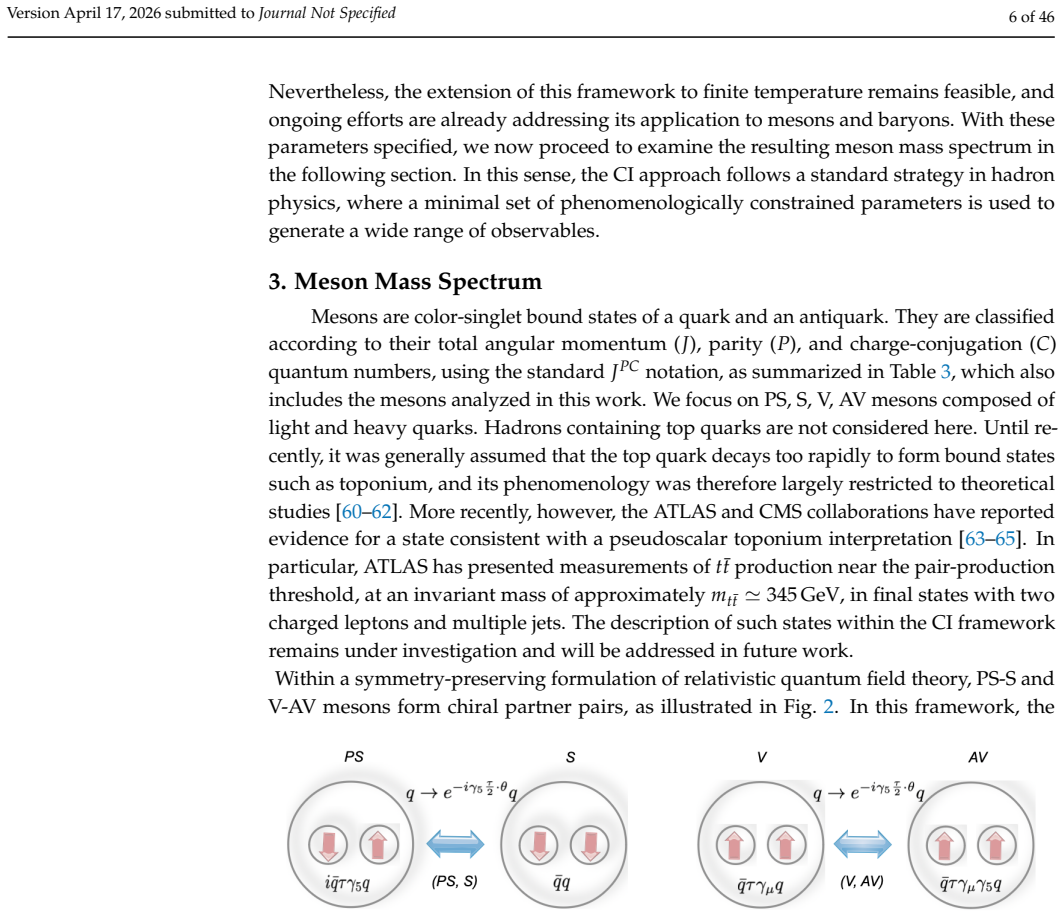
We present an updated overview of the symmetry preserving Contact Interaction model in hadronic physics, developed a little over a decade ago to describe the mass spectrum and internal structure of mesons and diquarks composed of light and heavy quarks. Over the years, the Contact Interaction has evolved into a framework capable of treating both ground and excited states, providing a simple yet consistent approach to nonperturbative QCD. In this review, we examine the mass spectrum and elastic form factors of forty mesons with different spins and parities, together with their corresponding diquark partners. Importantly, we update the comparison of Contact Interaction predictions using recent results from the literature, offering a fresh perspective on the model's performance, strengths, and limitations. The analysis presented here refines previous conclusions and supports the Contact Interaction as a practical tool for hadron structure studies, with potential applications to baryons and multiquark states. We also present comparisons with other theoretical models and approaches, including lattice quantum chromodynamics, and comment on future prospects in view of ongoing and planned hadron structure experimental programs. In particular, forthcoming measurements at FAIR, together with future studies at Jefferson Lab and the Electron Ion Collider, are expected to provide key insights into hadron structure, with FAIR offering indirect constraints via hadron spectroscopy, hadronic interactions, and in-medium properties, while high-precision data on meson structure and form factors from Jefferson Lab and the Electron Ion Collider will provide valuable benchmarks to confront Contact Interaction based predictions.
Editorial analysis
A structured set of objections, weighed in public.
Referee Report
Summary. The manuscript is an updated overview of the symmetry-preserving contact interaction (CI) model in hadronic physics. It examines the mass spectra and elastic form factors of forty mesons (ground and excited states with various spins and parities, light and heavy quarks) and their diquark partners. The review updates comparisons to lattice QCD and other models, refines prior conclusions on the framework's consistency, discusses strengths and limitations, and outlines potential extensions to baryons/multiquark states along with prospects for experiments at FAIR, Jefferson Lab, and the EIC.
Significance. If the updated comparisons demonstrate acceptable accuracy, the review would establish the CI model as a computationally simple yet symmetry-preserving tool for nonperturbative QCD studies of hadron structure. It could usefully complement lattice QCD for excited states and heavy sectors, serving as a practical benchmark for interpreting data from upcoming hadron physics programs.
major comments (2)
- [mass spectrum and form factor results for the forty mesons] The sections presenting the mass spectrum and form factor results for the forty mesons (including excited states): the claim that the CI provides a 'consistent approach' across light and heavy sectors requires explicit quantification of agreement with lattice QCD (e.g., average relative deviations or tabulated differences for radial excitations), as the momentum-independent approximation may introduce larger systematic effects in these cases that are not fully addressed by the overview.
- [updated comparisons for heavy-quark mesons and diquarks] The updated comparisons for heavy-quark mesons and diquarks: without a dedicated analysis of how deviations from lattice results scale with quark mass or for excited states, it is difficult to confirm that the framework remains sufficiently accurate to support its use as a practical tool, given the known limitations of contact interactions in capturing momentum-dependent nonperturbative effects.
minor comments (2)
- The abstract states that forty mesons are examined but does not enumerate the specific states or quantum numbers covered; adding a summary table or explicit list would improve clarity for readers assessing the scope.
- Figure captions and tables comparing CI predictions to lattice data should explicitly reference the sources of the lattice results and note any post-hoc adjustments or error treatments used in the comparisons.
Simulated Author's Rebuttal
We thank the referee for the constructive comments and the positive overall assessment of our overview. We address each major point below and outline the revisions we will make to strengthen the manuscript.
read point-by-point responses
-
Referee: [mass spectrum and form factor results for the forty mesons] The sections presenting the mass spectrum and form factor results for the forty mesons (including excited states): the claim that the CI provides a 'consistent approach' across light and heavy sectors requires explicit quantification of agreement with lattice QCD (e.g., average relative deviations or tabulated differences for radial excitations), as the momentum-independent approximation may introduce larger systematic effects in these cases that are not fully addressed by the overview.
Authors: We agree that explicit quantification will improve the clarity and rigor of our claims regarding consistency. In the revised manuscript we will add tables that report relative deviations (and, where appropriate, average deviations) between the contact-interaction results and available lattice-QCD data for both masses and form factors. These tables will be organized by light versus heavy sectors and by ground versus radially excited states. We will also expand the accompanying text to discuss the possible systematic impact of the momentum-independent approximation on excited-state observables. revision: yes
-
Referee: [updated comparisons for heavy-quark mesons and diquarks] The updated comparisons for heavy-quark mesons and diquarks: without a dedicated analysis of how deviations from lattice results scale with quark mass or for excited states, it is difficult to confirm that the framework remains sufficiently accurate to support its use as a practical tool, given the known limitations of contact interactions in capturing momentum-dependent nonperturbative effects.
Authors: We acknowledge that a quantitative scaling study would be desirable. Because the present work is an overview that compiles and updates existing literature results rather than performing new calculations, a full dedicated scaling analysis lies outside the scope of this review. Nevertheless, we will add a concise discussion subsection that extracts and comments on the observed trends in deviations as a function of quark mass and excitation level from the updated comparisons already presented. This addition will make the limitations of the contact-interaction framework more explicit while still supporting its utility as a practical, symmetry-preserving tool. revision: partial
Circularity Check
Minor self-citation to prior model development present but not load-bearing; external lattice QCD benchmarks provide independent validation
specific steps
-
self citation load bearing
[Abstract]
"We present an updated overview of the symmetry preserving Contact Interaction model in hadronic physics, developed a little over a decade ago to describe the mass spectrum and internal structure of mesons and diquarks composed of light and heavy quarks. Over the years, the Contact Interaction has evolved into a framework capable of treating both ground and excited states, providing a simple yet consistent approach to nonperturbative QCD."
The overview's premise of the model having 'evolved' into a consistent framework is justified by reference to its prior development, with overlapping author involvement implied by the review context; however, this is mitigated by the paper's explicit update of comparisons to independent external results like lattice QCD, preventing full load-bearing circularity.
full rationale
The paper is an overview that references the Contact Interaction model's development 'a little over a decade ago' and its evolution into a framework for ground and excited states. It updates comparisons of predictions against recent literature results, explicitly including lattice QCD. No derivation chain within the review reduces by construction to self-defined inputs, fitted parameters renamed as predictions, or unverified self-citations as the sole support. The central claim that the model is a practical tool rests on these external benchmarks rather than circular reduction to prior author works.
Axiom & Free-Parameter Ledger
axioms (1)
- domain assumption The contact interaction preserves chiral symmetry and other QCD symmetries in the Bethe-Salpeter framework for bound states.
Forward citations
Cited by 1 Pith paper
-
A Poincar\'e-covariant study of strange quark stars
A Poincaré-covariant vector-vector contact interaction yields an equation of state for strange quark matter whose mass-radius and tidal properties match pulsar and gravitational-wave constraints for two tuned parameter sets.
Reference graph
Works this paper leans on
-
[1]
Gell-Mann, Symmetries of baryons and mesons, Phys
Gell-Mann, M. Symmetries of baryons and mesons.Phys. Rev.1962,125, 1067–1084. doi:10.1103/PhysRev.125.1067
-
[2]
Gell-Mann, A Schematic Model of Baryons and Mesons, Phys
Gell-Mann, M. A Schematic Model of Baryons and Mesons.Phys. Lett.1964,8, 214–215. doi:10.1016/S0031-9163(64)92001-3
-
[3]
Hadron Physics Opportunities at FAIR,
Messchendorp, J.G.; et al. Hadron Physics Opportunities at FAIR.arXiv preprint2025, [arXiv:hep- ex/2512.15986]
-
[4]
Accardi, A.; et al. Strong interaction physics at the luminosity frontier with 22 GeV electrons at Jefferson Lab.Eur. Phys. J. A2024,60, 173, [arXiv:nucl-ex/2306.09360]. doi:10.1140/epja/s10050- 024-01282-x
-
[5]
Pion and Kaon Structure at the Electron-Ion Collider.Eur
Aguilar, A.C.; et al. Pion and Kaon Structure at the Electron-Ion Collider.Eur. Phys. J. A2019, 55, 190, [arXiv:nucl-ex/1907.08218]. doi:10.1140/epja/i2019-12885-0
-
[6]
Revealing the structure of light pseudoscalar mesons at the electron–ion collider.J
Arrington, J.; et al. Revealing the structure of light pseudoscalar mesons at the electron–ion collider.J. Phys. G2021,48, 075106, [arXiv:nucl-ex/2102.11788]. doi:10.1088/1361-6471/abf5c3
-
[7]
The pion: an enigma within the Standard Model.J
Horn, T.; Roberts, C.D. The pion: an enigma within the Standard Model.J. Phys. G2016, 43, 073001, [arXiv:nucl-th/1602.04016]. doi:10.1088/0954-3899/43/7/073001
-
[8]
Abdul Khalek, R.; et al. Science Requirements and Detector Concepts for the Electron-Ion Col- lider: EIC Yellow Report.Nucl. Phys. A2022,1026, 122447, [arXiv:physics.ins-det/2103.05419]. doi:10.1016/j.nuclphysa.2022.122447
-
[9]
Electron-ion collider in China.Front
Anderle, D.P .; et al. Electron-ion collider in China.Front. Phys. (Beijing)2021,16, 64701, [arXiv:nucl-ex/2102.09222]. doi:10.1007/s11467-021-1062-0. Version April 17, 2026 submitted toJournal Not Specified 41 of 46
-
[10]
Strong decays of baryons and missing resonances.Phys
Bijker, R.; Ferretti, J.; Galatà, G.; García-Tecocoatzi, H.; Santopinto, E. Strong decays of baryons and missing resonances.Phys. Rev. D2016,94, 074040, [arXiv:hep-ph/1506.07469]. doi:10.1103/PhysRevD.94.074040
-
[11]
Aznauryan, I.G.; Burkert, V .D. Electroexcitation of the ∆(1232) 3 2 + and ∆(1600) 3 2 + in a light- front relativistic quark model.Phys. Rev. C2015,92, 035211, [arXiv:hep-ph/1506.03183]. doi:10.1103/PhysRevC.92.035211
-
[12]
Charge radii of light and heavy mesons.Eur
Hwang, C.W. Charge radii of light and heavy mesons.Eur. Phys. J.2002,C23, 585–590, [arXiv:hep-ph/hep-ph/0112237]. doi:10.1007/s100520200904
-
[13]
Structure of heavy mesons in the light-front quark model
Arifi, A.J.; Happ, L.; Ohno, S.; Oka, M. Structure of heavy mesons in the light-front quark model. Phys. Rev. D2024,110, 014020, [arXiv:hep-ph/2401.07933]. doi:10.1103/PhysRevD.110.014020
-
[14]
Electromagnetic structure of B c and heavy quarkonia in the light -front quark model,
Harjapradipta, R.R.; Ridwan, M.; Arifi, A.J.; Mart, T. Electromagnetic structure of Bc and heavy quarkonia in the light-front quark model2026. [arXiv:hep-ph/2603.13819]. doi:10.1142/S0217732326420034
-
[15]
In-medium electromagnetic form factors of pseu- doscalar mesons from the quark model.Phys
Arifi, A.J.; Hutauruk, P .T.P .; Tsushima, K. In-medium electromagnetic form factors of pseu- doscalar mesons from the quark model.Phys. Rev. D2025,111, 074004, [arXiv:hep- ph/2412.09883]. doi:10.1103/PhysRevD.111.074004
-
[16]
Form-factors of meson decays in constituent quark model
Melikhov, D. Form-factors of meson decays in constituent quark model. 3rd German-Russian Workshop on Progress in Heavy Quark Physics, 1996, [hep-ph/9607216]
work page internal anchor Pith review arXiv 1996
-
[17]
Lattice Calculation of Pion Form Fac- tor with Overlap Fermions.Phys
Wang, G.; Liang, J.; Draper, T.; Liu, K.F.; Yang, Y.B. Lattice Calculation of Pion Form Fac- tor with Overlap Fermions.Phys. Rev. D2021,104, 074502, [arXiv:hep-ph/2006.05431]. doi:10.1103/PhysRevD.104.074502
-
[18]
Vector and axial-vector couplings of D and D* mesons in 2+1 flavor Lattice QCD.Phys
Can, K.U.; Erkol, G.; Oka, M.; Ozpineci, A.; Takahashi, T.T. Vector and axial-vector couplings of D and D* mesons in 2+1 flavor Lattice QCD.Phys. Lett. B2013,719, 103–109, [arXiv:hep- lat/1210.0869]. doi:10.1016/j.physletb.2012.12.050
-
[19]
Radiative transitions in charmonium from lattice QCD.Phys
Dudek, J.J.; Edwards, R.G.; Richards, D.G. Radiative transitions in charmonium from lattice QCD.Phys. Rev. D2006,73, 074507, [hep-ph/0601137]. doi:10.1103/PhysRevD.73.074507
-
[20]
Precision Calcula- tion of the Electromagnetic Radii of the Proton and Neutron from Lattice QCD.Phys
Djukanovic, D.; von Hippel, G.; Meyer, H.B.; Ottnad, K.; Salg, M.; Wittig, H. Precision Calcula- tion of the Electromagnetic Radii of the Proton and Neutron from Lattice QCD.Phys. Rev. Lett. 2024,132, 211901, [arXiv:hep-lat/2309.07491]. doi:10.1103/PhysRevLett.132.211901
-
[21]
Pion and Kaon box contribution to aµHLbL.Phys
Miramontes, A.; Bashir, A.; Raya, K.; Roig, P . Pion and Kaon box contribution to aµHLbL.Phys. Rev. D2022,105, 074013, [arXiv:hep-ph/2112.13916]. doi:10.1103/PhysRevD.105.074013
-
[22]
Nucleon and Roper electromagnetic elas- tic and transition form factors.Phys
Wilson, D.J.; Cloet, I.C.; Chang, L.; Roberts, C.D. Nucleon and Roper electromagnetic elas- tic and transition form factors.Phys. Rev.2012,C85, 025205, [arXiv:nucl-th/1112.2212]. doi:10.1103/PhysRevC.85.025205
-
[23]
Electromagnetic transition form-factors of light mesons.Phys
Maris, P .; Tandy, P .C. Electromagnetic transition form-factors of light mesons.Phys. Rev. C2002, 65, 045211, [nucl-th/0201017]. doi:10.1103/PhysRevC.65.045211
-
[24]
Bethe-Salpeter study of vector meson masses and decay constants.Phys
Maris, P .; Tandy, P .C. Bethe-Salpeter study of vector meson masses and decay constants.Phys. Rev. C1999,60, 055214, [nucl-th/9905056]. doi:10.1103/PhysRevC.60.055214
-
[25]
Hadron Physics and the Dyson-Schwinger Equations of QCD.AIP Conf
Maris, P . Hadron Physics and the Dyson-Schwinger Equations of QCD.AIP Conf. Proc.2007, 892, 65–71, [nucl-th/0611057]. doi:10.1063/1.2714348
-
[26]
Pseudovector components of the pion, pi0 — > gamma gamma, and F(pi) (q**2).Phys
Maris, P .; Roberts, C.D. Pseudovector components of the pion, pi0 — > gamma gamma, and F(pi) (q**2).Phys. Rev. C1998,58, 3659–3665, [nucl-th/9804062]. doi:10.1103/PhysRevC.58.3659
-
[27]
pi- and rho- mesons, and their diquark partners, from a contact interaction.Phys
Roberts, H.L.L.; Bashir, A.; Gutierrez-Guerrero, L.X.; Roberts, C.D.; Wilson, D.J. pi- and rho- mesons, and their diquark partners, from a contact interaction.Phys. Rev.2011,C83, 065206, [arXiv:nucl-th/1102.4376]. doi:10.1103/PhysRevC.83.065206
-
[28]
Direct measurement of the 39Ar half- life from 3.4 years of data with the DEAP-3600 detector,
Miramontes, A.S.; Papavassiliou, J.; Pawlowski, J.M. Electromagnetic properties of heavy-light mesons.Eur. Phys. J. C2025,85, 1390, [arXiv:hep-ph/2508.20631]. doi:10.1140/epjc/s10052-025- 15121-w
-
[29]
Higuera-Angulo, I.M.; Hernández-Pinto, R.J.; Raya, K.; Bashir, A. Electromagnetic and two- photon transition form factors of the pseudoscalar mesons: An algebraic model computation. Phys. Rev. D2024,110, 034013, [arXiv:hep-ph/2407.06461]. doi:10.1103/PhysRevD.110.034013
-
[30]
Almeida-Zamora, B.; Cobos-Martínez, J.J.; Bashir, A.; Raya, K.; Rodríguez-Quintero, J.; Segovia, J. Algebraic model to study the internal structure of pseudoscalar mesons with heavy-light quark content.Phys. Rev. D2024,109, 014016, [arXiv:hep-ph/2309.17282]. doi:10.1103/PhysRevD.109.014016. Version April 17, 2026 submitted toJournal Not Specified 42 of 46
-
[31]
Raya, K.; Bedolla, M.A.; Cobos-Martínez, J.J.; Bashir, A. Heavy quarkonia in a contact interaction and an algebraic model: mass spectrum, decay constants, charge radii and elastic and transition form factors.Few Body Syst.2018,59, 133, [arXiv:nucl-th/1711.00383]. doi:10.1007/s00601-018- 1455-y
-
[32]
Pion form factor from a contact interaction.Phys
Gutierrez-Guerrero, L.X.; Bashir, A.; Cloet, I.C.; Roberts, C.D. Pion form factor from a contact interaction.Phys. Rev.2010,C81, 065202, [arXiv:nucl-th/1002.1968]. doi:10.1103/PhysRevC.81.065202
-
[33]
Masses of Light and Heavy Mesons and Baryons: A Unified Picture.Phys
Gutiérrez-Guerrero, L.X.; Bashir, A.; Bedolla, M.A.; Santopinto, E. Masses of Light and Heavy Mesons and Baryons: A Unified Picture.Phys. Rev. D2019,100, 114032, [arXiv:nucl- th/1911.09213]. doi:10.1103/PhysRevD.100.114032
-
[34]
Mesons and baryons: Parity partners
Gutiérrez-Guerrero, L.X.; Paredes-Torres, G.; Bashir, A. Mesons and baryons: Parity partners. Phys. Rev. D2021,104, 094013, [arXiv:hep-ph/2109.09058]. doi:10.1103/PhysRevD.104.094013
-
[35]
Hernández-Pinto, R.J.; Gutiérrez-Guerrero, L.X.; Bashir, A.; Bedolla, M.A.; Higuera-Angulo, I.M. Electromagnetic form factors and charge radii of pseudoscalar and scalar mesons: A comprehensive contact interaction analysis.Phys. Rev. D2023,107, 054002, [arXiv:hep- ph/2301.11881]. doi:10.1103/PhysRevD.107.054002
-
[36]
Hernández-Pinto, R.J.; Gutiérrez-Guerrero, L.X.; Bedolla, M.A.; Bashir, A. Electric, magnetic, and quadrupole form factors and charge radii of vector mesons: From light to heavy sec- tors in a contact interaction.Phys. Rev. D2024,110, 114015, [arXiv:hep-ph/2410.23813]. doi:10.1103/PhysRevD.110.114015
-
[37]
First radial excitations of mesons and diquarks in a contact interaction.Phys
Paredes-Torres, G.; Gutiérrez-Guerrero, L.X.; Bashir, A.; Miramontes, Á.S. First radial excitations of mesons and diquarks in a contact interaction.Phys. Rev. D2024,109, 114006, [arXiv:hep- ph/2405.06101]. doi:10.1103/PhysRevD.109.114006
-
[38]
First radial excitations of baryons in a contact interaction: Mass spectrum.Phys
Gutiérrez-Guerrero, L.X.; Raya, A.; Albino, L.; Hernández-Pinto, R.J. First radial excitations of baryons in a contact interaction: Mass spectrum.Phys. Rev. D2024,110, 074015, [arXiv:hep- ph/2409.06057]. doi:10.1103/PhysRevD.110.074015
-
[39]
Baryon and me- son screening masses.Phys
Wang, K.l.; Liu, Y.x.; Chang, L.; Roberts, C.D.; Schmidt, S.M. Baryon and me- son screening masses.Phys. Rev. D2013,87, 074038, [arXiv:nucl-th/1301.6762]. doi:10.1103/PhysRevD.87.074038
-
[40]
Chen, C.; Gao, F.; Qin, S.x. Screening masses of positive- and negative-parity hadron ground states, including those with strangeness.Phys. Rev. D2025,112, 014022, [arXiv:hep- ph/2412.15045]. doi:10.1103/527r-mtxb
-
[41]
Gravitational form factors of pseudoscalar mesons in a contact interaction.Phys
Sultan, M.A.; Xing, Z.; Raya, K.; Bashir, A.; Chang, L. Gravitational form factors of pseudoscalar mesons in a contact interaction.Phys. Rev. D2024,110, 054034, [arXiv:hep-ph/2407.10437]. doi:10.1103/PhysRevD.110.054034
-
[42]
Contact interaction analysis of pion GTMDs.Eur
Zhang, J.L.; Cui, Z.F.; Ping, J.; Roberts, C.D. Contact interaction analysis of pion GTMDs.Eur. Phys. J. C2021,81, 6, [arXiv:hep-ph/2009.11384]. doi:10.1140/epjc/s10052-020-08791-1
-
[43]
On consistency of the interacting (anti)holomorphic higher-spin sector
Yu, Y.; Cheng, P .; Xing, H.Y.; Gao, F.; Roberts, C.D. Contact interaction study of proton parton distributions.Eur. Phys. J. C2024,84, 739, [arXiv:hep-ph/2402.06095]. doi:10.1140/epjc/s10052- 024-13068-y
-
[44]
Abelian anomaly and neutral pion production.Phys
Roberts, H.L.L.; Roberts, C.D.; Bashir, A.; Gutierrez-Guerrero, L.X.; Tandy, P .C. Abelian anomaly and neutral pion production.Phys. Rev.2010,C82, 065202, [arXiv:nucl-th/1009.0067]. doi:10.1103/PhysRevC.82.065202
-
[45]
Masses of ground and excited-state hadrons
Roberts, H.L.L.; Chang, L.; Cloet, I.C.; Roberts, C.D. Masses of ground and excited-state hadrons. Few Body Syst.2011,51, 1–25, [arXiv:nucl-th/1101.4244]. doi:10.1007/s00601-011-0225-x
-
[46]
Process- independent strong running coupling.Phys
Binosi, D.; Mezrag, C.; Papavassiliou, J.; Roberts, C.D.; Rodriguez-Quintero, J. Process- independent strong running coupling.Phys. Rev.2017,D96, 054026, [arXiv:nucl-th/1612.04835]. doi:10.1103/PhysRevD.96.054026
-
[47]
Deur, A.; Brodsky, S.J.; de Teramond, G.F. The QCD Running Coupling.Prog. Part. Nucl. Phys. 2016,90, 1–74, [arXiv:hep-ph/1604.08082]. doi:10.1016/j.ppnp.2016.04.003
-
[48]
Process- independent effective coupling
Rodríguez-Quintero, J.; Binosi, D.; Mezrag, C.; Papavassiliou, J.; Roberts, C.D. Process- independent effective coupling. From QCD Green’s functions to phenomenology.Few Body Syst.2018,59, 121, [arXiv:nucl-th/1801.10164]. doi:10.1007/s00601-018-1437-0. Version April 17, 2026 submitted toJournal Not Specified 43 of 46
-
[49]
Boucaud, P .; Leroy, J.P .; Yaouanc, A.L.; Micheli, J.; Pene, O.; Rodriguez-Quintero, J. The Infrared Behaviour of the Pure Yang-Mills Green Functions.Few Body Syst.2012,53, 387–436, [arXiv:hep-ph/1109.1936]. doi:10.1007/s00601-011-0301-2
-
[50]
Evidence of ghost suppression in gluon mass scale dynamics.Eur
Aguilar, A.C.; Binosi, D.; Figueiredo, C.T.; Papavassiliou, J. Evidence of ghost suppression in gluon mass scale dynamics.Eur. Phys. J.2018,C78, 181, [arXiv:hep-ph/1712.06926]. doi:10.1140/epjc/s10052-018-5679-2
-
[51]
Coupled dynamics in gluon mass generation and the im- pact of the three-gluon vertex.Phys
Binosi, D.; Papavassiliou, J. Coupled dynamics in gluon mass generation and the im- pact of the three-gluon vertex.Phys. Rev.2018,D97, 054029, [arXiv:hep-ph/1709.09964]. doi:10.1103/PhysRevD.97.054029
-
[52]
Locating the Gribov horizon.Phys
Gao, F.; Qin, S.X.; Roberts, C.D.; Rodriguez-Quintero, J. Locating the Gribov horizon.Phys. Rev. 2018,D97, 034010, [arXiv:hep-ph/1706.04681]. doi:10.1103/PhysRevD.97.034010
-
[53]
Hadron Properties and Dyson-Schwinger Equations.Prog
Roberts, C.D. Hadron Properties and Dyson-Schwinger Equations.Prog. Part. Nucl. Phys.2008, 61, 50–65, [arXiv:nucl-th/0712.0633]. doi:10.1016/j.ppnp.2007.12.034
-
[54]
Cutoff-independent regularization of four-fermion interactions for color superconductivity.Phys
Farias, R.L.S.; Dallabona, G.; Krein, G.; Battistel, O.A. Cutoff-independent regularization of four-fermion interactions for color superconductivity.Phys. Rev.2006,C73, 018201, [arXiv:hep- ph/hep-ph/0510145]. doi:10.1103/PhysRevC.73.018201
-
[55]
Farias, R.L.S.; Dallabona, G.; Krein, G.; Battistel, O.A. Extension of the Nambu-Jona-Lasinio model at high densities and temperatures using an implicit regularization scheme.Phys. Rev. 2008,C77, 065201, [arXiv:hep-ph/hep-ph/0604203]. doi:10.1103/PhysRevC.77.065201
-
[56]
Spectrum of hadrons with strangeness
Chen, C.; Chang, L.; Roberts, C.D.; Wan, S.; Wilson, D.J. Spectrum of hadrons with strangeness. Few Body Syst.2012,53, 293–326, [arXiv:nucl-th/1204.2553]. doi:10.1007/s00601-012-0466-3
-
[57]
Charmonia in a contact interaction.Phys
Bedolla, M.A.; Cobos-Martinez, J.J.; Bashir, A. Charmonia in a contact interaction.Phys. Rev. 2015,D92, 054031, [arXiv:hep-ph/1601.05639]. doi:10.1103/PhysRevD.92.054031
-
[58]
Ramírez-Garrido, M.A.; Hernández-Pinto, R.J.; Higuera-Angulo, I.M.; Gutiérrez-Guerrero, L.X. Screening masses for scalar and pseudoscalar mesons and their diquark partners: Insights from the contact interaction model.Phys. Rev. D2025,112, 034024, [arXiv:hep-ph/2508.01099]. doi:10.1103/jfzy-2nt4
-
[59]
Gutiérrez-Guerrero, L.X.; Ramírez-Garrido, M.A.; Pérez de León, M.A.; Hernández-Pinto, R.J. Unified analysis of screening masses for vector and axial-vector mesons and their diquark partners in the contact interaction model.Phys. Rev. D2026,113, 014035. doi:10.1103/7y5n- mtwh
-
[60]
Toponium: The smallest bound state and simplest hadron in quantum mechanics.Phys
Fu, J.H.; Li, Y.J.; Yang, H.M.; Li, Y.B.; Zhang, Y.J.; Shen, C.P . Toponium: The smallest bound state and simplest hadron in quantum mechanics.Phys. Rev. D2025,111, 114020, [arXiv:hep- ph/2412.11254]. doi:10.1103/fqc9-k315
-
[61]
Mass Spectrum, Radii, and Radiative Decay Widths of Toponium,
Akbar, N.; Asghar, I.; Ahmad, Z. Properties of Toponium Mesons with Non-relativistic QCD Potential Model2024. [arXiv:hep-ph/2411.08548]
-
[62]
Topped baryo ns from QCD sum rules,
Zhang, S.W.; Tan, W.H.; Luo, X.; Chen, H.X. Topped baryons from QCD sum rules2025. [arXiv:hep-ph/2507.05895]
-
[63]
Observation of a pseudoscalar excess at the top quar k pair production threshold,
Hayrapetyan, A.; et al. Observation of a pseudoscalar excess at the top quark pair production threshold2025. [arXiv:hep-ex/2503.22382]
-
[64]
Observation of quantum entanglement with top quarks at the ATLAS detector
Aad, G.; et al. Observation of quantum entanglement with top quarks at the ATLAS detector. Nature2024,633, 542–547, [arXiv:hep-ex/2311.07288]. doi:10.1038/s41586-024-07824-z
-
[65]
Observation of a cross-section enhancement near the t¯t production threshold in √s =13 TeV pp collisions with the ATLAS detector2025
-
[66]
Santowsky, N.; Eichmann, G.; Fischer, C.S.; Wallbott, P .C.; Williams, R.σ-meson: Four-quark versus two-quark components and decay width in a Bethe-Salpeter approach.Phys. Rev. D 2020,102, 056014, [arXiv:hep-ph/2007.06495]. doi:10.1103/PhysRevD.102.056014
-
[67]
Reply to comment on ”The σ-meson: four-quark vs
Santowsky, N.; Eichmann, G.; Fischer, C.S.; Wallbott, P .C.; Williams, R. Reply to comment on ”The σ-meson: four-quark vs. two-quark components and decay width in a Bethe-Salpeter approach”2021. [arXiv:hep-ph/2103.14673]
-
[68]
Santowsky, N.; Fischer, C.S. Light scalars: Four-quark versus two-quark states in the complex energy plane from Bethe-Salpeter equations.Phys. Rev. D2022,105, 034025, [arXiv:hep- ph/2109.00755]. doi:10.1103/PhysRevD.105.034025
-
[69]
A Relativistic equation for bound state problems.Phys
Salpeter, E.E.; Bethe, H.A. A Relativistic equation for bound state problems.Phys. Rev.1951, 84, 1232–1242. doi:10.1103/PhysRev.84.1232. Version April 17, 2026 submitted toJournal Not Specified 44 of 46
-
[70]
A relativistic formulation for the quark model for mesons.Annals Phys
Llewellyn-Smith, C.H. A relativistic formulation for the quark model for mesons.Annals Phys. 1969,53, 521–558. doi:10.1016/0003-4916(69)90035-9
-
[71]
Version 2
Zweig, G., An SU(3) model for strong interaction symmetry and its breaking. Version 2. In DEVELOPMENTS IN THE QUARK THEORY OF HADRONS. VOL. 1. 1964 - 1978; Lichtenberg, D.B.; Rosen, S.P ., Eds.; 1964; pp. 22–101
1964
-
[72]
Zweig, (1964), 10.17181/CERN-TH-401
Zweig, G. An SU(3) model for strong interaction symmetry and its breaking. Version 11964. doi:10.17181/CERN-TH-401
-
[73]
Hadron Masses in a Gauge Theory.Phys
De Rujula, A.; Georgi, H.; Glashow, S.L. Hadron Masses in a Gauge Theory.Phys. Rev.1975, D12, 147–162. doi:10.1103/PhysRevD.12.147
-
[74]
The strong coupling constant: state of the art and the decade ahead,
Chen, H.X.; Chen, W.; Liu, X.; Liu, Y.R.; Zhu, S.L. A review of the open charm and open bottom systems.Rept. Prog. Phys.2017,80, 076201, [arXiv:hep-ph/1609.08928]. doi:10.1088/1361- 6633/aa6420
-
[75]
Parity partners in the baryon resonance spectrum.Phys
Lu, Y.; Chen, C.; Roberts, C.D.; Segovia, J.; Xu, S.S.; Zong, H.S. Parity partners in the baryon resonance spectrum.Phys. Rev.2017,C96, 015208, [arXiv:nucl-th/1705.03988]. doi:10.1103/PhysRevC.96.015208
-
[76]
Masses of ground-state mesons and baryons, including those with heavy quarks.Phys
Yin, P .L.; Chen, C.; Krein, G.; Roberts, C.D.; Segovia, J.; Xu, S.S. Masses of ground-state mesons and baryons, including those with heavy quarks.Phys. Rev.2019,D100, 034008, [arXiv:nucl-th/1903.00160]. doi:10.1103/PhysRevD.100.034008
-
[77]
Masses of positive- and negative-parity hadron ground-states, including those with heavy quarks.Eur
Yin, P .L.; Cui, Z.F.; Roberts, C.D.; Segovia, J. Masses of positive- and negative-parity hadron ground-states, including those with heavy quarks.Eur. Phys. J. C2021,81, 327, [arXiv:hep- ph/2102.12568]. doi:10.1140/epjc/s10052-021-09097-6
-
[78]
Investigation of rainbow-ladder trun- cation for excited and exotic mesons.Phys
Qin, S.x.; Chang, L.; Liu, Y.x.; Roberts, C.D.; Wilson, D.J. Investigation of rainbow-ladder trun- cation for excited and exotic mesons.Phys. Rev. C2012,85, 035202, [arXiv:nucl-th/1109.3459]. doi:10.1103/PhysRevC.85.035202
-
[79]
Interaction model for the gap equation
Qin, S.x.; Chang, L.; Liu, Y.x.; Roberts, C.D.; Wilson, D.J. Interaction model for the gap equation. Phys. Rev. C2011,84, 042202, [arXiv:nucl-th/1108.0603]. doi:10.1103/PhysRevC.84.042202
-
[80]
Dynamics, symmetries and hadron properties.eConf 2007,C070910, 125, [arXiv:nucl-th/0710.5746]
Cloet, I.C.; Krassnigg, A.; Roberts, C.D. Dynamics, symmetries and hadron properties.eConf 2007,C070910, 125, [arXiv:nucl-th/0710.5746]
discussion (0)
Sign in with ORCID, Apple, or X to comment. Anyone can read and Pith papers without signing in.