Recognition: unknown
Extraordinary Surface Criticalities for Interacting Fermions
Pith reviewed 2026-05-10 10:22 UTC · model grok-4.3
The pith
Certain defect renormalization group flows in the three-dimensional Gross-Neveu-Yukawa model admit exact infrared solutions that encode fermionic anomalies in surface dynamics.
A machine-rendered reading of the paper's core claim, the machinery that carries it, and where it could break.
Core claim
In the three-dimensional Gross-Neveu-Yukawa model, a class of defect renormalization group flows possesses exact infrared solutions. These solutions encode fermionic anomalies within the resulting surface dynamics. The space of defect couplings exhibits emergent topological and geometric structures, which the authors relate to a defect analogue of the CFT distance conjecture.
What carries the argument
defect renormalization group flows in the Gross-Neveu-Yukawa model, which reach exact infrared fixed points where anomalies appear in surface dynamics and geometric structures emerge in coupling space
Load-bearing premise
The renormalization group flows in the defect setup of the 3D Gross-Neveu-Yukawa model permit exact infrared solutions that encode the anomalies without requiring numerical or approximate methods.
What would settle it
A lattice Monte Carlo simulation of the three-dimensional Gross-Neveu-Yukawa model with chosen surface defects that produces infrared fixed-point values or anomaly coefficients inconsistent with the exact solutions would falsify the claim.
Figures

read the original abstract
Interacting fermions exhibit a rich landscape of surface defects and associated critical phenomena. We investigate novel surface critical behavior in the three-dimensional Gross-Neveu-Yukawa model. For a class of defect renormalization group flows, we obtain exact infrared solutions and show how fermionic anomalies are encoded in the resulting surface dynamics. We further uncover emergent topological and geometric structures in the defect coupling space, and comment on their relation to a defect analogue of the CFT distance conjecture.
Editorial analysis
A structured set of objections, weighed in public.
Referee Report
Summary. The manuscript examines novel surface critical behavior in the three-dimensional Gross-Neveu-Yukawa model. For a class of defect renormalization group flows, it obtains exact infrared solutions and shows how fermionic anomalies are encoded in the resulting surface dynamics. It further identifies emergent topological and geometric structures in the defect coupling space and comments on their relation to a defect analogue of the CFT distance conjecture.
Significance. If the exact IR solutions and anomaly encoding hold without fine-tuning, the work would offer valuable benchmarks for defect CFTs in interacting fermionic systems, where exact results are rare. The emergent structures and distance-conjecture link could stimulate further exploration of geometric aspects of defects, complementing bulk CFT studies.
major comments (1)
- [Section on defect RG flows and exact IR solutions] The exact IR solutions are derived within a reduced subspace of defect couplings. The manuscript must demonstrate that these fixed points are attractive (or that the subspace is reached without fine-tuning) under generic perturbations in the full defect coupling space; otherwise the claimed surface criticalities and anomaly encoding would not be realized in generic flows. This stability analysis is load-bearing for the central claims.
minor comments (1)
- [Introduction] The abstract and introduction could include a brief comparison to prior work on surface defects in the GNY model to better contextualize the novelty of the exact solutions.
Simulated Author's Rebuttal
We thank the referee for their careful reading and constructive comments on our manuscript. We address the major comment below.
read point-by-point responses
-
Referee: The exact IR solutions are derived within a reduced subspace of defect couplings. The manuscript must demonstrate that these fixed points are attractive (or that the subspace is reached without fine-tuning) under generic perturbations in the full defect coupling space; otherwise the claimed surface criticalities and anomaly encoding would not be realized in generic flows. This stability analysis is load-bearing for the central claims.
Authors: We appreciate the referee highlighting this point. Our work explicitly considers a class of defect renormalization group flows that admit exact infrared solutions, as stated in the abstract and throughout the manuscript. The claims regarding surface criticalities, anomaly encoding, and emergent structures are made within this class and do not assert that the fixed points are reached or stable under generic perturbations in the full defect coupling space. We will revise the manuscript to more explicitly delineate the scope of our results and to motivate the physical relevance of the reduced subspace (e.g., via symmetry constraints or specific lattice realizations that naturally restrict the defect couplings). A complete stability analysis in the unrestricted space would require the full set of beta functions outside the subspace, which are not known exactly and lie beyond the present exact-solution approach. revision: partial
Circularity Check
No significant circularity; exact IR solutions derived from RG equations without reduction to inputs
full rationale
The paper obtains exact infrared solutions by solving the defect renormalization group flows in the 3D Gross-Neveu-Yukawa model, then extracts anomaly encoding and emergent structures in coupling space. No quoted steps reduce a prediction to a fitted parameter by construction, invoke self-citations as load-bearing uniqueness theorems, or smuggle ansatze. The derivation chain remains self-contained against the model's beta functions and anomaly matching, with the CFT distance conjecture comment appearing as an interpretive remark rather than a foundational assumption. This is the expected outcome for an analytic RG study.
Axiom & Free-Parameter Ledger
axioms (1)
- domain assumption The three-dimensional Gross-Neveu-Yukawa model is a valid effective description for the interacting fermions and surface defects under study.
Forward citations
Cited by 1 Pith paper
-
A Twist on Scattering from Defect Anomalies
Defect 't Hooft anomalies trap charges at symmetry-line junctions and thereby drive categorical scattering into twist operators.
Reference graph
Works this paper leans on
-
[1]
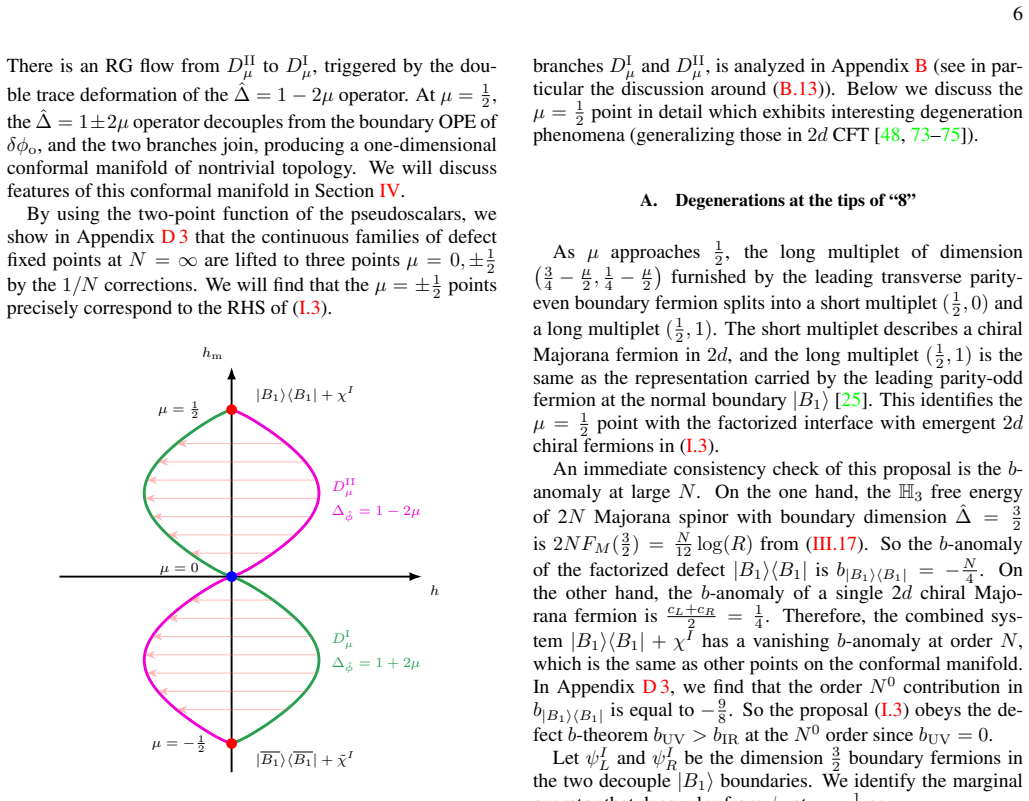
−γ1/¯x12 2µ±tanh( r 2) cosh( r 2) , (III.11) 5 wherer≡arccosh(v)andG ± satisfy the boundary condition γ1G±(x1, x2) z1→0 =∓G ±(x1, x2)|z1→0 .(III.12) The fermion propagatorsG 11 andG 12 can be expressed as linear combinations ofG ±, with coefficients fixed by the bulk conformal block expansion. According to [26], for a bulk op- erator of dimension∆, there ...
-
[2]
So theb-anomaly of the factorized defect|B 1⟩⟨B1|isb |B1⟩⟨B1| =− N 4
= N 12 log(R)from (III.17). So theb-anomaly of the factorized defect|B 1⟩⟨B1|isb |B1⟩⟨B1| =− N 4 . On the other hand, theb-anomaly of a single 2dchiral Majo- rana fermion is cL+cR 2 = 1
-
[3]
In Appendix D 3, we find that the orderN 0 contribution in b|B1⟩⟨B1| is equal to− 9
Therefore, the combined sys- tem|B 1⟩⟨B1|+χ I has a vanishingb-anomaly at orderN, which is the same as other points on the conformal manifold. In Appendix D 3, we find that the orderN 0 contribution in b|B1⟩⟨B1| is equal to− 9
-
[4]
Letψ I L andψ I R be the dimension 3 2 boundary fermions in the two decouple|B 1⟩boundaries
So the proposal (I.3) obeys the de- fectb-theoremb UV > bIR at theN 0 order sinceb UV = 0. Letψ I L andψ I R be the dimension 3 2 boundary fermions in the two decouple|B 1⟩boundaries. We identify the marginal operator that decouples fromϕ e atµ= 1 2 as Oe = 1√ 2N (ψI L +ψ I R)χI .(IV .1) Similarly, the marginal operator that decouples fromϕ o at µ= 1 2 is...
-
[5]
A. J. Bray and M. A. Moore, J. Phys. A10, 1927 (1977)
1927
-
[6]
D. M. McAvity and H. Osborn, Nucl. Phys. B455, 522 (1995), arXiv:cond-mat/9505127
work page Pith review arXiv 1995
-
[7]
Cardy,Scaling and Renormalization in Statistical Physics, Cambridge Lecture Notes in Physics (Cambridge University Press, 1996)
J. Cardy,Scaling and Renormalization in Statistical Physics, Cambridge Lecture Notes in Physics (Cambridge University Press, 1996)
1996
- [8]
- [9]
-
[10]
CFT in AdS and boundary RG flows,
S. Giombi and H. Khanchandani, JHEP11, 118 (2020), arXiv:2007.04955 [hep-th]
-
[11]
J. Padayasi, A. Krishnan, M. A. Metlitski, I. A. Gruzberg, and M. Meineri, SciPost Phys.12, 190 (2022), arXiv:2111.03071 [cond-mat.stat-mech]
- [12]
-
[13]
A. Krishnan and M. A. Metlitski, SciPost Phys.15, 090 (2023), arXiv:2301.05728 [cond-mat.str-el]
-
[14]
Surface defects in the O(N ) model,
M. Tr ´epanier, JHEP09, 074 (2023), arXiv:2305.10486 [hep- th]
-
[15]
Notes on a surface defect in the O(N ) model,
S. Giombi and B. Liu, JHEP12, 004 (2023), arXiv:2305.11402 [hep-th]
-
[16]
Phases of surface defects in scalar field theories,
A. Raviv-Moshe and S. Zhong, JHEP08, 143 (2023), arXiv:2305.11370 [hep-th]
- [17]
- [18]
-
[19]
Fer mionic Symmetry Protected Topological Phases and Cobordisms,
A. Kapustin, R. Thorngren, A. Turzillo, and Z. Wang, JHEP 12, 052 (2015), arXiv:1406.7329 [cond-mat.str-el]
-
[20]
Fermion Path Integrals And Topological Phases
E. Witten, Rev. Mod. Phys.88, 035001 (2016), arXiv:1508.04715 [cond-mat.mes-hall]
work page Pith review arXiv 2016
-
[21]
Gapped Boundary Phases of Topological Insulators via Weak Coupling,
N. Seiberg and E. Witten, PTEP2016, 12C101 (2016), arXiv:1602.04251 [cond-mat.str-el]
- [22]
-
[23]
E. Witten, Phys. Rev. B94, 195150 (2016), arXiv:1605.02391 [hep-th]
-
[24]
Jackiw and C
R. Jackiw and C. Rebbi, Phys. Rev. D13, 3398 (1976)
1976
-
[25]
C. G. Callan, Jr. and J. A. Harvey, Nucl. Phys. B250, 427 (1985)
1985
-
[26]
N. Seiberg, T. Senthil, C. Wang, and E. Witten, Annals Phys. 374, 395 (2016), arXiv:1606.01989 [hep-th]
- [27]
-
[28]
Defect Anomalies, a Spin-Flux Duality, and Boson-Kondo Problems,
Z. Komargodski, F. K. Popov, and B. C. Rayhaun, (2025), arXiv:2508.14963 [hep-th]
- [29]
- [30]
- [31]
- [32]
- [33]
-
[34]
L. Iliesiu, F. Kos, D. Poland, S. S. Pufu, D. Simmons-Duffin, and R. Yacoby, JHEP03, 120 (2016), arXiv:1508.00012 [hep- th]
- [35]
- [36]
- [37]
- [38]
- [39]
-
[40]
J. A. Gracey, Int. J. Mod. Phys. A6, 395 (1991), [Erratum: Int.J.Mod.Phys.A 6, 2755 (1991)]
1991
-
[41]
J. A. Gracey, Phys. Lett. B297, 293 (1992)
1992
- [42]
- [43]
-
[44]
Diatlyk, Z
O. Diatlyk, Z. Sun, and Y . Wang, (2026), to appear
2026
-
[45]
The ordinary surface defect of the GNY model,
O. Diatlyk, Z. Sun, and Y . Wang, “The ordinary surface defect of the GNY model,” (2026), to appear
2026
-
[46]
For example, a non-genuine ’t Hooft loop in4dSU(N)gauge theory can be viewed as a mon- odromy defect for theZ N electric one-form symmetry
Usual monodromy defects are defined for0-form symmetries, but their extension top-form symmetries is straightforward: they correspond to localized flux insertions for the associated background gauge fields. For example, a non-genuine ’t Hooft loop in4dSU(N)gauge theory can be viewed as a mon- odromy defect for theZ N electric one-form symmetry. The novelt...
-
[47]
K. Jensen and A. O’Bannon, Phys. Rev. Lett.116, 091601 (2016), arXiv:1509.02160 [hep-th]
- [48]
-
[49]
Wang, JHEP11, 122 (2021), arXiv:2012.06574 [hep-th]
Y . Wang, JHEP11, 122 (2021), arXiv:2012.06574 [hep-th]
-
[50]
T. Shachar, R. Sinha, and M. Smolkin, SciPost Phys.15, 240 (2023), arXiv:2212.08081 [hep-th]
-
[51]
On the Geometry of the String Landscape and the Swampland
H. Ooguri and C. Vafa, Nucl. Phys. B766, 21 (2007), arXiv:hep-th/0605264
work page Pith review arXiv 2007
-
[52]
H. Ooguri and Y . Wang, JHEP12, 154 (2024), arXiv:2405.00674 [hep-th]
-
[53]
T. Grover, D. N. Sheng, and A. Vishwanath, Science344, 280 (2014), arXiv:1301.7449 [cond-mat.str-el]
- [54]
-
[55]
A. Atanasov, A. Hillman, and D. Poland, JHEP11, 140 (2018), arXiv:1807.05702 [hep-th]
-
[56]
A. Atanasov, A. Hillman, D. Poland, J. Rong, and N. Su, JHEP08, 136 (2022), arXiv:2201.02206 [hep-th]
- [57]
-
[58]
G. Cuomo and S. Zhang, JHEP03, 022 (2024), arXiv:2306.00085 [hep-th]
-
[59]
The extraordinary-log scenario in theO(N)Wilson-Fisher theory [9, 54] does not appear to happen here as in confirmed 9 by our direct largeNanalysis in Section III
-
[60]
In fact, the phase diagram ofO(N)-invariant boundaries in the GNY model as presented in [25] is incomplete ind= 3. In particular, there is in addition, another extraordinary bound- ary universality class with decoupled fermions, much like the extraordinary surface defect considered here; furthermore, the special and ordinary boundaries disappear at a crit...
-
[61]
Boundary criticality in the GNY model at higher orders,
O. Diatlyk, S. Giombi, and Z. Sun, “Boundary criticality in the GNY model at higher orders,” (2026), to appear
2026
-
[62]
R. Thorngren and Y . Wang, JHEP09, 017 (2021), arXiv:2012.15861 [hep-th]
-
[63]
A. N. Redlich, Phys. Rev. D29, 2366 (1984)
1984
-
[64]
A. J. Niemi and G. W. Semenoff, Phys. Rev. Lett.51, 2077 (1983)
2077
-
[65]
Alvarez-Gaume, S
L. Alvarez-Gaume, S. Della Pietra, and G. W. Moore, Annals Phys.163, 288 (1985)
1985
-
[66]
C. C ´ordova, D. S. Freed, H. T. Lam, and N. Seiberg, SciPost Phys.8, 001 (2020), arXiv:1905.09315 [hep-th]
- [67]
-
[68]
Any3dspin QFT is defined up to a quantized Chern-Simons counter-termkCS g withk∈Zwhich modifies the contact terms in the stress-tensor two-point functions and shifts the boundary gravitational anomaly [45, 87–89] but this effect is canceled between one boundary|B⟩and its transverse reflec- tion⟨B|
-
[69]
This fixes the Chern-Simons counterterm in the previous footnote
Here the constant shift inρis fixed by requiringρ(0) = 1/2 so that the anomaly theory (II.7) isT-invariant [90]. This fixes the Chern-Simons counterterm in the previous footnote
-
[70]
Zinn-Justin, Nucl
J. Zinn-Justin, Nucl. Phys. B367, 105 (1991)
1991
-
[71]
See Appendix B for relevant three-point functions
In contrast, the deformationhϕ 2δ(z)is marginal but not ex- actly marginal in the largeNlimit [41]. See Appendix B for relevant three-point functions
-
[72]
The 1 N anomalous dimensions is positive for the fermions and negative for the pseudoscalar
The fermion and pseudoscalar fields all have dimension∆ = 1in the largeNlimit. The 1 N anomalous dimensions is positive for the fermions and negative for the pseudoscalar. [36, 39]
- [73]
-
[74]
A. Basu and L. I. Uruchurtu, Class. Quant. Grav.23, 6059 (2006), arXiv:hep-th/0603089
-
[75]
A new logarithmic solution emerges at this point and is given by∂ µ(G+ −G −)|µ=1/2
The two solutionsG ± in (III.11) are degenerate atµ= 1/2 where the fermionic Breitenlohner-Freedman (BF) bound in AdS3 is saturated. A new logarithmic solution emerges at this point and is given by∂ µ(G+ −G −)|µ=1/2. While its lead- ing fall-off at largercorresponds to a ˆ∆ = 1/2boundary fermion, this solution is not normalizable [91]. This is another ind...
-
[76]
In our normalization, this free fermion propagator is − /x12 4π|x12|3
-
[77]
M. Kontsevich and Y . Soibelman, inKIAS Annual Interna- tional Conference on Symplectic Geometry and Mirror Sym- metry(2000) pp. 203–263, arXiv:math/0011041
-
[78]
D. Roggenkamp and K. Wendland, Commun. Math. Phys. 251, 589 (2004), arXiv:hep-th/0308143
-
[79]
Soibelman, (2025), arXiv:2506.00896 [hep-th]
Y . Soibelman, (2025), arXiv:2506.00896 [hep-th]
-
[80]
Alternatively, one can derive the relation betweenµandsby computing the anomalous dimension ofψ I L/R under this per- turbation and matching it with the boundary dimension ofΨ I e. This requires the boundary fermion four-point function at or- der1/Nfor the normal boundary condition, analogous to the boundary four-point functions studied in the largeNexpan...
discussion (0)
Sign in with ORCID, Apple, or X to comment. Anyone can read and Pith papers without signing in.