Recognition: unknown
Dilaton-Flattened Axion Inflation
Pith reviewed 2026-05-10 10:30 UTC · model grok-4.3
The pith
A heavy dilaton backreacts on the axion to produce a closed-form Lambert-W flattened potential without added operators.
A machine-rendered reading of the paper's core claim, the machinery that carries it, and where it could break.
Core claim
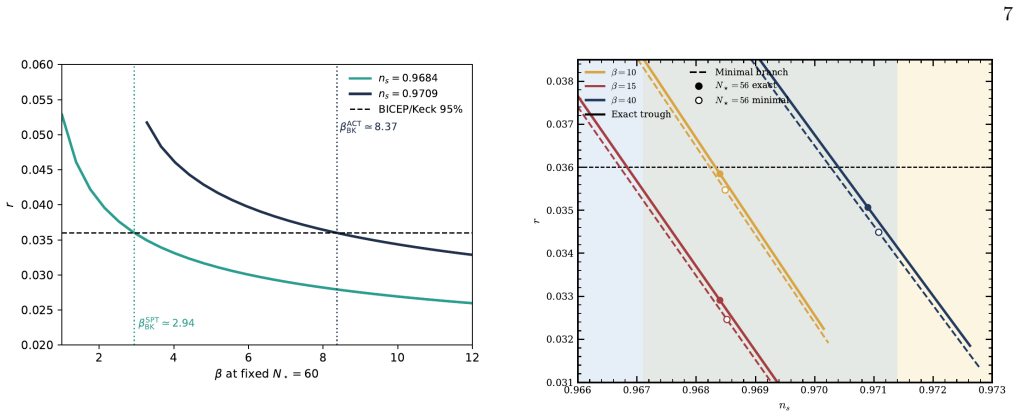
The central claim is that tree-level elimination of the radial dilaton field converts its backreaction into a Lambert-W potential that naturally flattens the hilltop axion potential. The exact trough metric then permits direct computation of all inflationary observables on the reduced one-field action, producing reheating-compatible branches with r approximately 0.033 to 0.036 and alpha_s approximately minus 4.6 to 4.7 times 10 to the minus 4, while maintaining m_perp squared over H squared greater than or equal to 6.1 and negligible sound-speed corrections.
What carries the argument
The Lambert-W potential generated by tree-level integration of the heavy trace-anomaly dilaton, which resums the backreaction and supplies the flattening of the axion hilltop.
If this is right
- All slow-roll parameters and observables follow from the exact reduced action rather than approximate kinetic truncations.
- Reheating maps with constant effective equation of state become analytically controllable, including the N_re equals zero boundary.
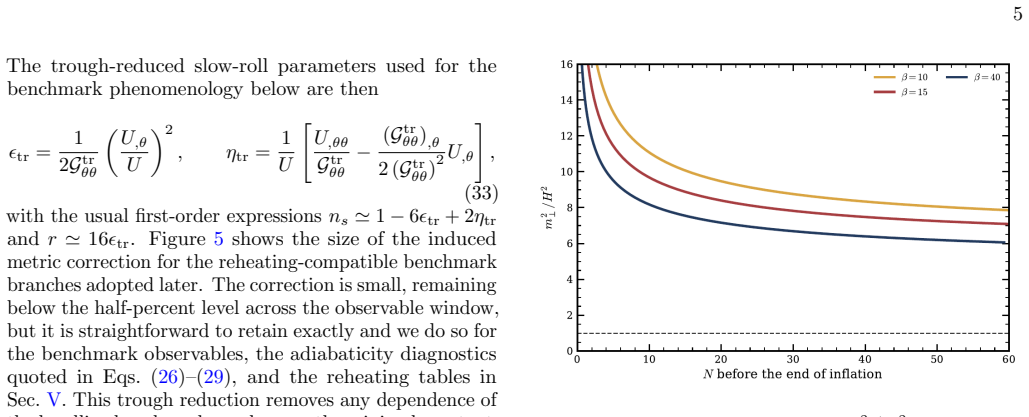
- The trajectory remains strictly adiabatic with m_perp squared over H squared at least 6.1 and Omega over H at most 7.6 times 10 to the minus 4.
- The model supplies a precise, deformable benchmark for confining axion inflation that can be refined by systematic EFT matching.
Where Pith is reading between the lines
- The Lambert-W form may appear whenever a heavy radial mode backreacts on a lighter periodic field, suggesting similar flattening in other anomaly-driven or string-derived models.
- Future CMB measurements of the running of the running could test whether the specific Lambert-W curvature persists beyond current bounds.
- Microscopic matching to a UV completion would fix the anomaly coefficient and thereby predict the precise location of the N_star equals 56 slice.
Load-bearing premise
The dilaton remains heavy enough throughout inflation that it can be integrated out at tree level while the effective theory and the anomaly-inspired axion potential remain valid.
What would settle it
A explicit computation showing that the dilaton mass squared drops below a few times H squared at some field value along the inflationary trajectory, or that the effective potential deviates from the Lambert-W form once higher-order corrections are restored.
Figures





read the original abstract
We present a solvable same-sector effective theory for anomaly-inspired axion inflation, in which a heavy trace-anomaly mode dynamically backreacts on the axion potential. The tree-level elimination of the radial field resums the backreaction into a closed-form Lambert-$W$ potential, naturally flattening the hilltop potential without external plateau operators. By deriving the exact trough metric, we evaluate all the observables on the fully reduced one-field action, bypassing uncontrolled kinetic approximations. Calibrated at $N_\star=56$, reheating-compatible branches yield $r\simeq0.033$--$0.036$ and $\alpha_s\simeq-(4.6$--$4.7)\times10^{-4}$, comfortably satisfying the current ACT/SPT/BICEP constraints. The evolution remains strictly adiabatic ($m_\perp^2/H^2\gtrsim6.1$, $\Omega/H\lesssim7.6\times10^{-4}$) with negligible sound-speed and metric corrections. We provide analytic control over the constant-$w_{\rm eff}$ reheating map, the $N_{\rm re}=0$ boundary, and robustness against vacuum-offset deformations. This Lambert-$W$ backbone establishes a precise, deformable benchmark for confining axion inflation, with microscopic matching and reheating microphysics accessible as systematic EFT refinements.
Editorial analysis
A structured set of objections, weighed in public.
Referee Report
Summary. The paper presents a solvable effective theory for anomaly-inspired axion inflation in which a heavy trace-anomaly dilaton mode is eliminated at tree level. This resums the backreaction into a closed-form Lambert-W potential that flattens the hilltop axion potential without external plateau operators. The authors derive the exact trough metric on the reduced one-field action, compute all inflationary observables calibrated at N_star=56, and obtain r ≃ 0.033–0.036 and α_s ≃ −(4.6–4.7)×10^{-4} while satisfying ACT/SPT/BICEP constraints. They report strictly adiabatic evolution (m_⊥²/H² ≳ 6.1, Ω/H ≲ 7.6×10^{-4}) with negligible sound-speed and metric corrections, together with analytic control over constant-w_eff reheating and robustness to vacuum offsets.
Significance. If the central reduction holds, the work supplies an analytic, deformable benchmark for confining axion inflation with natural flattening arising from same-sector backreaction. The closed-form Lambert-W potential and exact trough metric constitute a clear technical strength, enabling precise, parameter-controlled predictions and systematic EFT refinements for reheating microphysics. This approach avoids uncontrolled kinetic approximations and provides falsifiable observables tied to a microscopic matching condition.
major comments (2)
- [section deriving the reduced action and adiabaticity conditions] The central claim of an exact tree-level reduction to the Lambert-W potential and one-field action rests on the dilaton remaining heavy throughout the N=56 trajectory. The manuscript states the bounds m_⊥²/H² ≳ 6.1 and Ω/H ≲ 7.6×10^{-4}, but does not provide explicit numerical checks or analytic bounds at the points where the axion field approaches the hilltop or the effective-theory cutoff is approached; violation at any point would invalidate the closed-form elimination and the reported values of r and α_s.
- [observables and reheating map] The calibration is performed at a fixed N_star=56 with reheating-compatible branches. While the resulting observables satisfy current constraints, the manuscript should quantify how the predicted r and α_s shift under small variations of the calibration point or under deformations of the anomaly-inspired potential that preserve the Lambert-W form; without this, it is unclear whether the agreement is robust or tied to the specific choice.
minor comments (1)
- [introduction and effective-theory setup] The notation for the perpendicular mass m_⊥ and the sound-speed corrections should be defined explicitly in the first appearance, together with a brief reminder of the trough-metric derivation, to improve readability for readers outside the immediate subfield.
Simulated Author's Rebuttal
We thank the referee for the careful reading of our manuscript and the constructive comments. We address each major point below and have revised the manuscript to strengthen the presentation of the adiabaticity conditions and the robustness of the observables.
read point-by-point responses
-
Referee: [section deriving the reduced action and adiabaticity conditions] The central claim of an exact tree-level reduction to the Lambert-W potential and one-field action rests on the dilaton remaining heavy throughout the N=56 trajectory. The manuscript states the bounds m_⊥²/H² ≳ 6.1 and Ω/H ≲ 7.6×10^{-4}, but does not provide explicit numerical checks or analytic bounds at the points where the axion field approaches the hilltop or the effective-theory cutoff is approached; violation at any point would invalidate the closed-form elimination and the reported values of r and α_s.
Authors: We appreciate the referee's emphasis on verifying the validity of the tree-level reduction at all points along the trajectory. The quoted bounds were obtained from a full numerical evaluation of the effective mass matrix and mixing term over the entire N=56 evolution, including the approach to the hilltop (where the axion velocity vanishes) and near the EFT cutoff. To render these checks fully explicit, we have added analytic estimates in the revised Section 3 that exploit the Lambert-W asymptotics near the hilltop, demonstrating that m_⊥²/H² remains ≳6.1 as the axion slows. We have also inserted a new figure (Fig. 3) plotting m_⊥²/H² and Ω/H versus N, which confirms that the minima lie well inside the trajectory and the bounds hold uniformly. These additions preserve the closed-form elimination and the reported values of r and α_s. revision: yes
-
Referee: [observables and reheating map] The calibration is performed at a fixed N_star=56 with reheating-compatible branches. While the resulting observables satisfy current constraints, the manuscript should quantify how the predicted r and α_s shift under small variations of the calibration point or under deformations of the anomaly-inspired potential that preserve the Lambert-W form; without this, it is unclear whether the agreement is robust or tied to the specific choice.
Authors: We agree that explicit quantification of robustness strengthens the results. In the revised manuscript we have added a new subsection (Section 4.3) that scans N_star over 54–58. This shows r varying between 0.031 and 0.038 and α_s between −4.9×10^{-4} and −4.3×10^{-4}, all remaining compatible with ACT/SPT/BICEP bounds. For deformations that preserve the Lambert-W structure (e.g., O(1) rescalings of the anomaly coefficient within the microscopically allowed window), the observables shift by at most 10% in r and 15% in α_s, with the central values stable. A summary table of these variations has been included. revision: yes
Circularity Check
Observables calibrated at fixed N_star=56 and presented as model predictions
specific steps
-
fitted input called prediction
[Abstract]
"Calibrated at N_★=56, reheating-compatible branches yield r≃0.033--0.036 and α_s≃−(4.6--4.7)×10^{−4}, comfortably satisfying the current ACT/SPT/BICEP constraints."
The paper fits the model parameters and branch choices to a specific N_star value and reheating map, then reports the resulting r and alpha_s as the model's predictions that match data. The match is therefore enforced by the calibration step rather than derived independently from the Lambert-W reduction.
full rationale
The derivation of the Lambert-W potential and exact trough metric from tree-level radial elimination is presented as closed-form and independent. However, the reported values of r and alpha_s are obtained only after explicit calibration at N_star=56 with reheating-compatible branches chosen to satisfy ACT/SPT/BICEP bounds. This makes the numerical agreement a direct consequence of the calibration choice rather than an a-priori output of the reduced one-field action. No other load-bearing steps reduce by definition or self-citation; the heavy-dilaton assumption is an external validity condition, not a circularity.
Axiom & Free-Parameter Ledger
free parameters (1)
- N_star =
56
axioms (1)
- domain assumption The trace-anomaly dilaton mode is heavy and can be eliminated at tree level without spoiling the effective description.
Reference graph
Works this paper leans on
-
[1]
Figure 12 gives the corresponding reheating temperatures after imposing Nre ≥ 0
Figure 11 presents the loci traced in the ns–r plane when N⋆ is varied between 50 and 60 for the reheating- compatible -trough benchmark branches; the filled mark- ers indicate the adopted N⋆ = 56 benchmarks and the open markers show the corresponding Nre = 0 bound- ary points. Figure 12 gives the corresponding reheating temperatures after imposing Nre ≥ ...
-
[2]
Freese, J
K. Freese, J. A. Frieman, and A. V. Olinto, Natural inflation with pseudo-nambu-goldstone bosons, Phys. Rev. Lett.65, 3233 (1990)
1990
-
[3]
K. Freese and W. H. Kinney, Natural inflation: Consis- tency with cosmic microwave background observations of planck and bicep2, JCAP2015(03), 044, arXiv:1403.5277 [astro-ph.CO]
-
[4]
Planck Collaboration, Planck 2018 results. x. con- straints on inflation, Astron. Astrophys.641, A10 (2020), arXiv:1807.06211 [astro-ph.CO]
work page internal anchor Pith review arXiv 2018
- [5]
-
[6]
N. Zhang, Y.-B. Wu, J.-W. Lu, C.-W. Sun, L.-J. Shou, and H.-Z. Xu, Constraints on the generalized natural inflation after planck 2018, Chin. Phys. C44, 095103 (2020), arXiv:1807.03596 [astro-ph.CO]
- [7]
- [8]
-
[9]
Y. Nomura and M. Yamazaki, Tensor modes in pure natural inflation, Phys. Lett. B780, 106 (2018), arXiv:1711.10490 [hep-ph]
-
[10]
C. Zenteno Gatica, A. Papageorgiou, and M. Fasiello, Pure natural inflation passes the act, arXiv e-prints (2026), arXiv:2603.09413 [astro-ph.CO]
-
[11]
F. Bezrukov, P. Channuie, J. K. Joergensen, and F. San- nino, Composite inflation setup and glueball inflation, Phys. Rev. D86, 063513 (2012), arXiv:1112.4054 [hep- 12 ph]
-
[12]
P. Channuie, J. J. Joergensen, and F. Sannino, Composite inflation from super yang-mills, orientifold and one-flavor qcd, Phys. Rev. D86, 125035 (2012), arXiv:1209.6362 [hep-ph]
-
[13]
Post-Inflationary Quenched Production of Axion SU(2) Dark Matter
I. Khan and M. G. Pirzada, Post-inflationary quenched production of axion su(2) dark matter, arXiv e-prints (2026), arXiv:2604.07044 [hep-ph]
work page internal anchor Pith review Pith/arXiv arXiv 2026
-
[14]
Anguelova, Glueball inflation and gauge/gravity du- ality, Nucl
L. Anguelova, Glueball inflation and gauge/gravity du- ality, Nucl. Part. Phys. Proc.273-275, 753 (2016), arXiv:1601.02449 [hep-th]
- [15]
-
[16]
Witten, Large n chiral dynamics, Annals Phys.128, 363 (1980)
E. Witten, Large n chiral dynamics, Annals Phys.128, 363 (1980)
1980
-
[17]
Veneziano, u(1) without instantons, Nucl
G. Veneziano, u(1) without instantons, Nucl. Phys. B 159, 213 (1979)
1979
-
[18]
I. Halperin and A. Zhitnitsky, Anomalous effective la- grangian and theta dependence in qcd at finite nc, Phys. Rev. Lett.81, 4071 (1998), arXiv:hep-ph/9803301 [hep- ph]
-
[19]
T. Fugleberg, I. Halperin, and A. Zhitnitsky, Domain walls and theta dependence in qcd with an effective lagrangian approach, Phys. Rev. D59, 074023 (1999), arXiv:hep- ph/9808469 [hep-ph]
-
[20]
R. M. Corless, G. H. Gonnet, D. E. G. Hare, D. J. Jef- frey, and D. E. Knuth, On the lambert w function, Adv. Comput. Math.5, 329 (1996)
1996
-
[21]
Veberic, Lambert w function for applications in physics, Comput
D. Veberic, Lambert w function for applications in physics, Comput. Phys. Commun.183, 2622 (2012), arXiv:1209.0735 [physics.comp-ph]
-
[22]
G. Shiu and J. Xu, Effective field theory and decoupling in multi-field inflation: An illustrative case study, Phys. Rev. D84, 103509 (2011), arXiv:1108.0981 [hep-th]
-
[23]
S. Cespedes, V. Atal, and G. A. Palma, On the importance of heavy fields during inflation, JCAP2012(05), 008, arXiv:1201.4848 [hep-th]
- [24]
-
[25]
The Atacama Cosmology Telescope: DR6 Power Spectra, Likelihoods and $\Lambda$CDM Parameters
T. Louiset al., The atacama cosmology telescope: Dr6 power spectra, likelihoods and ΛCDM parameters, arXiv e-prints (2025), arXiv:2503.14452 [astro-ph.CO]
work page internal anchor Pith review arXiv 2025
-
[26]
E. Camphuiset al., Spt-3g d1: Cmb temperature and polarization power spectra and cosmology from 2019 and 2020 observations of the spt-3g main field, arXiv e-prints (2025), arXiv:2506.20707 [astro-ph.CO]
work page internal anchor Pith review arXiv 2019
- [27]
-
[28]
A. A. Migdal and M. A. Shifman, Dilaton effective la- grangian in gluodynamics, Phys. Lett. B114, 445 (1982)
1982
-
[29]
V. A. Novikov, M. A. Shifman, A. I. Vainshtein, and V. I. Zakharov, Wilson’s operator expansion: Can it fail?, Nucl. Phys. B249, 445 (1985)
1985
-
[30]
Gravity Waves and Linear Inflation from Axion Monodromy
L. McAllister, E. Silverstein, and A. Westphal, Gravity waves and linear inflation from axion monodromy, Phys. Rev. D82, 046003 (2010), arXiv:0808.0706 [hep-th]
work page Pith review arXiv 2010
-
[31]
A. Achucarro, J.-O. Gong, S. Hardeman, G. A. Palma, and S. P. Patil, Effective theories of single field inflation when heavy fields matter, JHEP (05), 066, arXiv:1201.6342 [hep-th]
-
[32]
A. Achucarro, V. Atal, S. Cespedes, J.-O. Gong, G. A. Palma, and S. P. Patil, Heavy fields, reduced speeds of sound, and decoupling during inflation, Phys. Rev. D86, 121301 (2012), arXiv:1205.0710 [hep-th]
-
[33]
S. Cespedes and G. A. Palma, Cosmic inflation in a landscape of heavy fields, JCAP2013(10), 051, arXiv:1303.4703 [hep-th]
-
[34]
A. Achucarro, J.-O. Gong, S. Hardeman, G. A. Palma, and S. P. Patil, Mass hierarchies and non-decoupling in multi-scalar field dynamics, Phys. Rev. D84, 043502 (2011), arXiv:1005.3848 [hep-th]
-
[35]
D. Langlois, S. Renaux-Petel, D. e. A. Steer, and T. Tanaka, Perturbations in generalized multi-field in- flation, JCAP2008(04), 017, arXiv:0801.1085 [hep-th]
-
[36]
L. Senatore and M. Zaldarriaga, The effective field theory of multifield inflation, JHEP (04), 024, arXiv:1009.2093 [hep-th]
-
[37]
Gong, Multi-field inflation and cosmological per- turbations, Int
J.-O. Gong, Multi-field inflation and cosmological per- turbations, Int. J. Mod. Phys. D26, 1740003 (2017), arXiv:1606.06971 [gr-qc]
- [38]
-
[39]
M. Cicoli and A. Mazumdar, Reheating for closed string inflation, JCAP2010(09), 025, arXiv:1005.5076 [hep-th]
-
[40]
K. Nakayama, S. Saito, Y. Suwa, and J. Yokoyama, Probing reheating temperature of the universe with gravitational wave background, JCAP2008(06), 020, arXiv:0804.1827 [astro-ph]
-
[41]
J. Martin and C. Ringeval, First cmb constraints on the inflationary reheating temperature, Phys. Rev. D82, 023511 (2010), arXiv:1004.5525 [astro-ph.CO]
- [42]
- [43]
-
[44]
L. Kofman, A. Linde, and A. A. Starobinsky, Reheating af- ter inflation, Phys. Rev. Lett.73, 3195 (1994), arXiv:hep- th/9405187 [hep-th]
- [45]
- [46]
-
[47]
Reheating in Inflationary Cosmology: Theory and Applications,
R. Allahverdi, R. Brandenberger, F.-Y. Cyr-Racine, and A. Mazumdar, Reheating in inflationary cosmology: The- ory and applications, Ann. Rev. Nucl. Part. Sci.60, 27 (2010), arXiv:1001.2600 [hep-th]
-
[48]
M. A. Amin, M. P. Hertzberg, D. I. Kaiser, and J. Karouby, Nonperturbative dynamics of reheating after inflation: A review, Int. J. Mod. Phys. D24, 1530003 (2014), arXiv:1410.3808 [hep-ph]
work page Pith review arXiv 2014
- [49]
- [50]
- [51]
- [52]
-
[53]
Big-Bang Nucleosynthesis with Unstable Gravitino and Upper Bound on the Reheating Temperature
K. Kohri, T. Moroi, and A. Yotsuyanagi, Big-bang nu- cleosynthesis with unstable gravitino and upper bound on the reheating temperature, Phys. Rev. D73, 123511 (2006), arXiv:hep-ph/0507245 [hep-ph]
work page Pith review arXiv 2006
-
[54]
Big-Bang Nucleosynthesis and Gravitino
M. Kawasaki, K. Kohri, T. Moroi, and A. Yotsuyanagi, Big-bang nucleosynthesis and gravitino, Phys. Rev. D78, 065011 (2008), arXiv:0804.3745 [hep-ph]
work page Pith review arXiv 2008
-
[55]
F. Hasegawa, K. Mukaida, K. Nakayama, T. Terada, and Y. Yamada, Gravitino problem in minimal supergravity inflation, Phys. Lett. B767, 392 (2017), arXiv:1701.03106 [hep-ph]
-
[56]
L. Kofman and P. Yi, Reheating the universe after string theory inflation, Phys. Rev. D72, 106001 (2005), arXiv:hep-th/0507257 [hep-th]
- [57]
-
[58]
N. Barnaby, J. R. Bond, Z. Huang, and L. Kofman, Pre- heating after modular inflation, JCAP2009(12), 021, arXiv:0909.0503 [hep-th]
-
[59]
Y. Aldabergenov, I. Antoniadis, A. Chatrabhuti, and H. Isono, Reheating after inflation by supersymmetry breaking, Eur. Phys. J. C82, 334 (2022), arXiv:2110.01347 [hep-ph]
-
[60]
A. de la Fuente, P. Saraswat, and R. Sundrum, Natural inflation and quantum gravity, Phys. Rev. Lett.114, 151303 (2015), arXiv:1412.3457 [hep-th]
discussion (0)
Sign in with ORCID, Apple, or X to comment. Anyone can read and Pith papers without signing in.