Recognition: unknown
General framework for anticoncentration and linear cross-entropy benchmarking in photonic quantum advantage experiments
Pith reviewed 2026-05-10 11:37 UTC · model grok-4.3
The pith
A representation-theoretic framework computes average linear cross-entropy benchmarking scores and proves anticoncentration for Fock-state Boson Sampling in the saturated regime.
A machine-rendered reading of the paper's core claim, the machinery that carries it, and where it could break.
Core claim
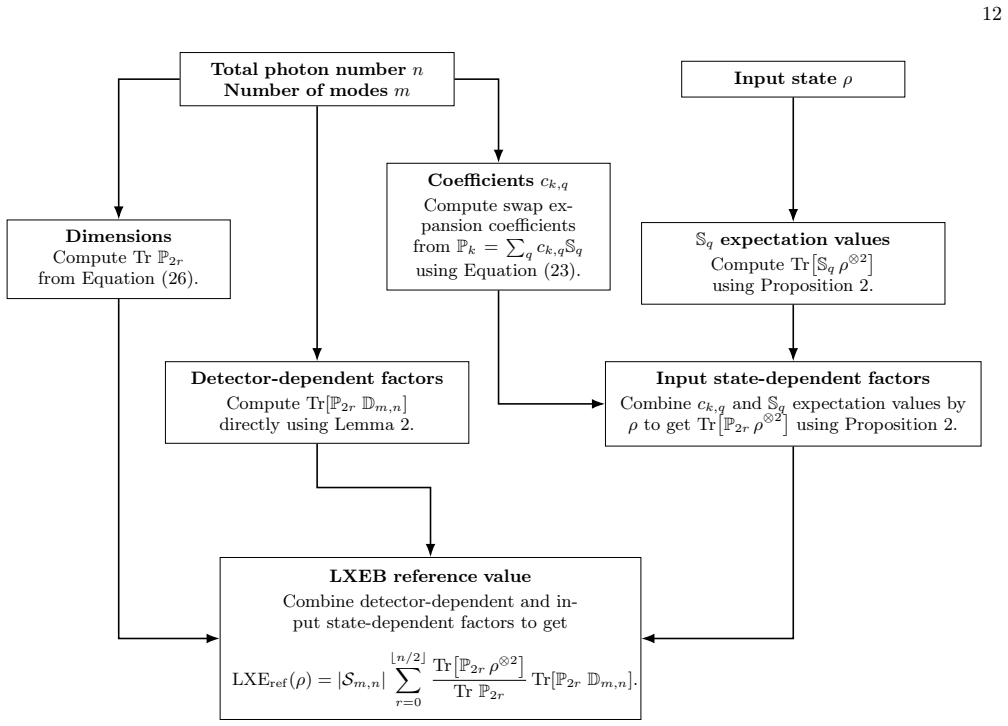
By decomposing two copies of the symmetric n-particle bosonic space into irreducible representations of the unitary group U(m), two-copy averages over Haar-random interferometers reduce to the computation of purities of the initial state after tracing out some particles. This allows exact classical evaluation of average LXEB scores across photonic quantum advantage protocols in any regime, including the saturated one where photon and mode numbers are comparable. The same reduction establishes anticoncentration of the output distribution for Fock-state Boson Sampling when the system is saturated.
What carries the argument
Decomposition of two copies of the n-particle bosonic space Sym^n(C^m) into irreducible representations of U(m), reducing two-copy Haar averages to purities of initial states after partial traces over particles.
If this is right
- Average LXEB scores can be computed exactly for n-photon m-mode scattering experiments in any regime.
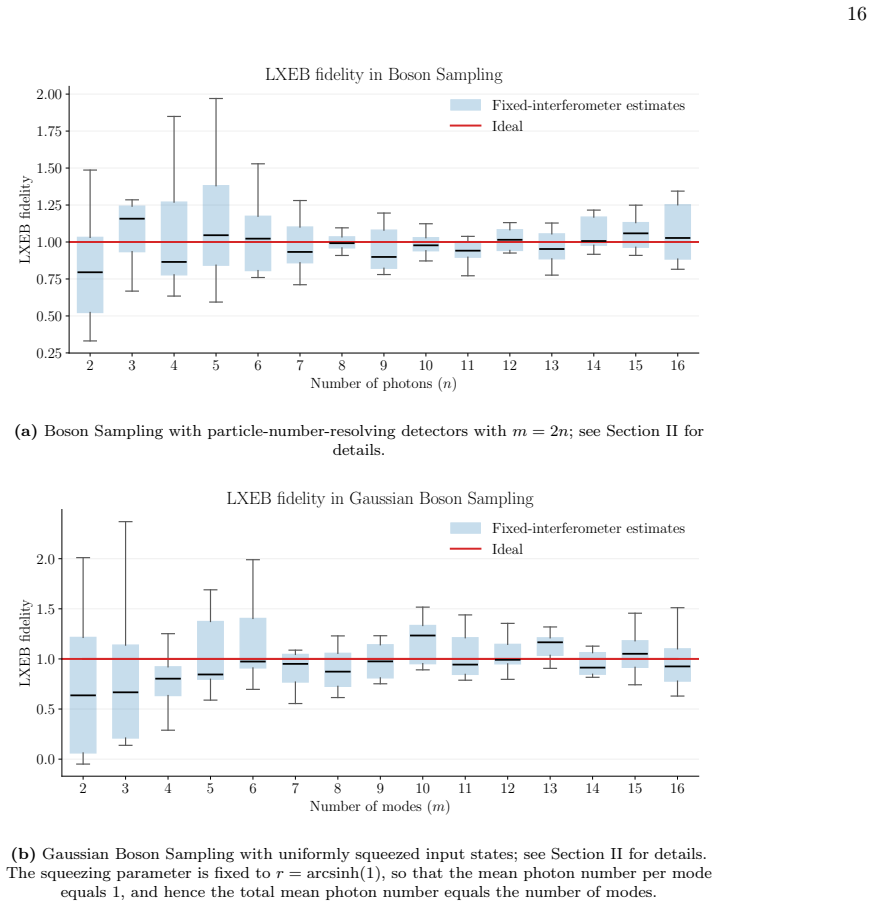
- Anticoncentration of the output distribution holds for traditional Fock-state Boson Sampling when photon number approaches mode number.
- Second moments are insufficient to establish meaningful anticoncentration for Gaussian Boson Sampling.
- Particle entanglement after partial traces directly determines the benchmarking scores and concentration properties.
Where Pith is reading between the lines
- The symmetry reduction could be adapted to compute higher moments or design optimized initial states for stronger verification in photonic experiments.
- Similar decomposition techniques might apply to other random unitary sampling models where multiple copies of symmetric spaces appear.
- Tuning the entanglement structure of the input state could improve LXEB scores or anticoncentration bounds in practice.
Load-bearing premise
The two-copy bosonic space decomposes into U(m) irreps such that Haar averages reduce exactly to purities after partial traces without additional corrections in the saturated regime.
What would settle it
A direct numerical computation of the second moment of output probabilities for small n and m in the saturated regime that deviates from the purity value predicted by the irrep decomposition would disprove the reduction.
Figures



read the original abstract
Photonic architectures are one of the leading platforms for demonstrating quantum computational advantage, with Boson Sampling and Gaussian Boson Sampling as the primary schemes. Yet, we lack for these photonic primitives a systematic theoretical understanding of linear cross-entropy benchmarking (LXEB), which is a central tool for testing quantum advantage proposals. In this work, we develop a representation-theoretic framework for the classical computation of average LXEB scores and second moments of output probability distributions, covering a range of quantum advantage experiments based on scattering $n$-photon states through $m$-mode Haar-random interferometers. Our methods apply in any regime, including the saturated regime, where the (expected) number of photons is comparable to the number of optical modes. The same second-moment techniques also allow us to prove anticoncentration for traditional Fock-state Boson Sampling in the saturated regime. Interestingly, for Gaussian Boson Sampling second moments are not sufficient to establish a meaningful anticoncentration statement. The technical core of our approach rests on decomposing two copies of the $n$-particle bosonic space $\mathrm{Sym}^n(\mathbb{C}^m)$ into irreducible representations of $\mathrm{U}(m)$. This reduces two-copy Haar averages to computing purities of initial states after partial traces over particles, highlighting the role that particle entanglement plays for LXEB and anticoncentration.
Editorial analysis
A structured set of objections, weighed in public.
Referee Report
Summary. The manuscript develops a representation-theoretic framework for computing average linear cross-entropy benchmarking (LXEB) scores and second moments of output probability distributions for photonic quantum advantage experiments based on scattering n-photon states through m-mode Haar-random interferometers. The core technique decomposes the two-copy bosonic space Sym^n(C^m) ⊗ Sym^n(C^m) under the diagonal U(m) action, reducing Haar averages to purities of initial states after partial traces over particles. This applies in any regime, including the saturated regime n ≈ m. The same methods prove anticoncentration for traditional Fock-state Boson Sampling in the saturated regime, while showing that second moments are insufficient to establish meaningful anticoncentration for Gaussian Boson Sampling.
Significance. If the central reduction holds exactly, the work supplies a systematic, closed-form tool for classically evaluating LXEB and output statistics in photonic advantage proposals across all parameter regimes, which is directly relevant to experimental verification. The anticoncentration result for Fock-state Boson Sampling in the saturated regime addresses a technically demanding case using standard U(m) representation theory on bosonic spaces. The framework explicitly connects particle entanglement (via the partial traces) to these benchmarking quantities, providing insight beyond case-by-case calculations.
major comments (1)
- [Technical core / decomposition of two-copy bosonic space] The technical core (abstract and the decomposition of Sym^n(C^m) ⊗ Sym^n(C^m)) asserts that two-copy Haar averages reduce exactly to purities after partial traces over particles, with no additional corrections even in the saturated regime n ≈ m. However, when occupation numbers become O(1), the partial-trace operators may fail to commute with the bosonic symmetrizer, potentially introducing overlaps with higher-weight representations and correction factors. This would undermine the claimed closed-form LXEB expressions and the anticoncentration proof for Fock-state sampling. An explicit check, commutation verification, or error bound for n ≈ m is required.
Simulated Author's Rebuttal
We thank the referee for their careful reading of the manuscript and for identifying the need to confirm the exactness of the central decomposition in the saturated regime. We address this point directly below.
read point-by-point responses
-
Referee: The technical core (abstract and the decomposition of Sym^n(C^m) ⊗ Sym^n(C^m)) asserts that two-copy Haar averages reduce exactly to purities after partial traces over particles, with no additional corrections even in the saturated regime n ≈ m. However, when occupation numbers become O(1), the partial-trace operators may fail to commute with the bosonic symmetrizer, potentially introducing overlaps with higher-weight representations and correction factors. This would undermine the claimed closed-form LXEB expressions and the anticoncentration proof for Fock-state sampling. An explicit check, commutation verification, or error bound for n ≈ m is required.
Authors: We thank the referee for this observation. The decomposition of the two-copy space Sym^n(C^m) ⊗ Sym^n(C^m) under the diagonal U(m) action is an exact statement of representation theory that holds for arbitrary n and m (including n ≈ m) without qualification or correction terms. The partial-trace operators employed in the framework are fully symmetric with respect to particle exchange and therefore commute with the bosonic symmetrizer by construction; they map the symmetric subspace to itself and do not mix in higher-weight representations. Consequently, the reduction of two-copy Haar averages to purities of the partially traced states remains exact in every regime, including the saturated case. This exact reduction directly supports both the closed-form LXEB expressions and the anticoncentration argument for Fock-state Boson Sampling. To make the commutation explicit, we will add a short verification (for example, the n = m = 3 case) in the revised manuscript. revision: partial
Circularity Check
No circularity: standard representation-theoretic reduction applied to bosonic space
full rationale
The paper's derivation chain rests on decomposing Sym^n(C^m) ⊗ Sym^n(C^m) under the diagonal U(m) action to reduce two-copy Haar averages exactly to purities after partial traces. This is a direct, non-self-referential application of known facts from representation theory of unitary groups to the bosonic Hilbert space, as described in the abstract. No equations or claims reduce a 'prediction' or central result to a fitted parameter, self-definition, or load-bearing self-citation chain. The framework is self-contained against external mathematical benchmarks (Schur-Weyl duality, irrep decompositions) and does not rename known empirical patterns or smuggle ansatzes via prior work. Minor self-citations, if present, are not load-bearing for the LXEB or anticoncentration results.
Axiom & Free-Parameter Ledger
axioms (2)
- domain assumption Interferometers are drawn from the Haar measure on U(m)
- standard math The two-copy space Sym^n(C^m) ⊗ Sym^n(C^m) decomposes into U(m) irreps allowing reduction of Haar averages to partial-trace purities
Reference graph
Works this paper leans on
-
[1]
J. L. O’Brien, A. Furusawa, and J. Vučković, Pho- tonicquantumtechnologies,NaturePhotonics3,687–695 (2009)
2009
-
[2]
F. Flamini, N. Spagnolo, N. Viggianiello, A. Crespi, R. Osellame, and F. Sciarrino, Benchmarking integrated linear-optical architectures for quantum information pro- cessing,ScientificReports7,10.1038/s41598-017-15174-2 (2017)
-
[3]
J. Bao, Z. Fu, T. Pramanik, J. Mao, Y. Chi, Y. Cao, C. Zhai, Y. Mao, T. Dai, X. Chen, X. Jia, L. Zhao, Y. Zheng, B. Tang, Z. Li, J. Luo, W. Wang, Y. Yang, Y. Peng, D. Liu, D. Dai, Q. He, A. L. Muthali, L. K. Oxenløwe, C. Vigliar, S. Paesani, H. Hou, R. Santagati, J. W. Silverstone, A. Laing, M. G. Thompson, J. L. O’Brien, Y. Ding, Q. Gong, and J. Wang, Ve...
2023
-
[4]
Aaronson and A
S. Aaronson and A. Arkhipov, The computational com- plexity of linear optics, inProceedings of the Forty- Third Annual ACM Symposium on Theory of Comput- ing, STOC ’11 (Association for Computing Machinery, New York, NY, USA, 2011) p. 333–342
2011
-
[5]
C. S. Hamilton, R. Kruse, L. Sansoni, S. Barkhofen, C. Silberhorn, and I. Jex, Gaussian Boson Sampling, Phys. Rev. Lett.119, 170501 (2017)
2017
-
[6]
Kruse, C
R. Kruse, C. S. Hamilton, L. Sansoni, S. Barkhofen, C. Silberhorn, and I. Jex, Detailed study of Gaussian boson sampling, Phys. Rev. A100, 032326 (2019)
2019
-
[7]
H. Wang, Y. He, Y.-H. Li, Z.-E. Su, b. li, H.-L. Huang, X. Ding, M.-c. Chen, C. Liu, J. Qin, J.-P. Li, Y.-M. He, C. Schneider, M. Kamp, C.-Z. Peng, S. Höfling, C.-Y. Lu, and J.-W. Pan, High-efficiency multiphoton boson sampling, Nat. Photon.11(2017)
2017
-
[8]
D. J. Brod, E. F. Galvão, A. Crespi, R. Osellame, N. Spagnolo, and F. Sciarrino, Photonic implementation of boson sampling: a review, Adv. Photonics1, 1 (2019)
2019
-
[9]
H. Wang, J. Qin, X. Ding, M.-C. Chen, S. Chen, X. You, Y.-M. He, X. Jiang, L. You, Z. Wang, C. Schneider, J. J. Renema, S. Höfling, C.-Y. Lu, and J.-W. Pan, Boson Sampling with 20 Input Photons and a 60-Mode Interfer- ometer in a1014-Dimensional Hilbert Space, Phys. Rev. Lett.123, 250503 (2019)
2019
-
[10]
A. W. Young, S. Geller, W. J. Eckner, N. Schine, S. Glancy, E. Knill, and A. M. Kaufman, An atomic bo- son sampler, Nature629, 311–316 (2024)
2024
-
[11]
Zhong, H
H.-S. Zhong, H. Wang, Y.-H. Deng, M.-C. Chen, L.-C. Peng, Y.-H. Luo, J. Qin, D. Wu, X. Ding, Y. Hu, P. Hu, X.-Y. Yang, W.-J. Zhang, H. Li, Y. Li, X. Jiang, L. Gan, 22 G. Yang, L. You, Z. Wang, L. Li, N.-L. Liu, C.-Y. Lu, and J.-W. Pan, Quantum computational advantage using photons, Science370, 1460–1463 (2020)
2020
-
[12]
Vincent, J
L.S.Madsen, F.Laudenbach, M.F.Askarani, F.Rortais, T. Vincent, J. F. F. Bulmer, F. M. Miatto, L. Neuhaus, L. G. Helt, M. J. Collins, A. Lita, T. Gerrits, S. Nam, V. Vaidya, and M. M. et al., Quantum computational ad- vantagewithaprogrammablephotonicprocessor,Nature 606, 75 (2022)
2022
-
[13]
H.-L. Liu, H. Su, S.-Q. Gong, Y.-C. Gu, H.-Y. Tang, M.-H. Jia, Q. Wei, Y. Song, D. Wang, M. Zheng, F. Chen, L. Li, S. Ren, X. Zhu, M. Wang, Y. Chen, Y. Liu, L. Song, P. Yang, J. Chen, H. An, L. Zhang, L. Gan, G. Yang, J.-M. Xu, Y.-M. He, H. Wang, H.-S. Zhong, M.-C. Chen, X. Jiang, L. Li, N.-L. Liu, Y.-H. Deng, X.-L. Su, Q. Zhang, C.-Y. Lu, and J.-W. Pan, ...
-
[14]
Rahimi-Keshari, T
S. Rahimi-Keshari, T. C. Ralph, and C. M. Caves, Suf- ficient Conditions for Efficient Classical Simulation of Quantum Optics, Phys. Rev. X6, 021039 (2016)
2016
-
[15]
Oszmaniec and D
M. Oszmaniec and D. J. Brod, Classical simulation of photonic linear optics with lost particles, New J. Phys. 20, 092002 (2018)
2018
-
[16]
García-Patrón, J
R. García-Patrón, J. J. Renema, and V. Shchesnovich, Simulating boson sampling in lossy architectures, Quan- tum3, 169 (2019)
2019
-
[17]
H. Qi, D. J. Brod, N. Quesada, and R. García-Patrón, Regimes of classical simulability for noisy gaussian boson sampling, Phys. Rev. Lett.124, 100502 (2020)
2020
-
[18]
V. S. Shchesnovich, Tight bound on the trace distance between a realistic device with partially indistinguishable bosons and the ideal BosonSampling, Phys. Rev. A91, 063842 (2015)
2015
-
[19]
J. Renema, A. Menssen, W. Clements, G. Triginer, W. Kolthammer, and I. Walmsley, Efficient Classi- cal Algorithm for Boson Sampling with Partially Dis- tinguishable Photons, Physical Review Letters120, 10.1103/physrevlett.120.220502 (2018)
-
[20]
G. V. Resta, L. Stasi, M. Perrenoud, S. El-Khoury, T. Brydges, R. Thew, H. Zbinden, and F. Bussières, Gigahertz detection rates and dynamic photon-number resolution with superconducting nanowire arrays, Nano Lett.23, 6018 (2023)
2023
-
[21]
Arkhipov, BosonSampling is robust against small er- rors in the network matrix, Phys
A. Arkhipov, BosonSampling is robust against small er- rors in the network matrix, Phys. Rev. A92, 062326 (2015)
2015
- [22]
- [23]
-
[24]
Spagnolo, C
N. Spagnolo, C. Vitelli, M. Bentivegna, D. J. Brod, A. Crespi, F. Flamini, S. Giacomini, G. Milani, R. Ram- poni, P. Mataloni, R. Osellame, E. F. Galvão, and F. Sciarrino, Experimental validation of photonic boson sampling, Nat. Photon.8, 615–620 (2014)
2014
-
[25]
Eisert, D
J. Eisert, D. Hangleiter, N. Walk, I. Roth, D. Markham, R. Parekh, U. Chabaud, and E. Kashefi, Quantum certi- fication and benchmarking, Nat. Rev. Phys.2, 382–390 (2020)
2020
-
[26]
D. Hangleiter and J. Eisert, Computational advantage of quantum random sampling, Rev. Mod. Phys.95, 10.1103/revmodphys.95.035001 (2023)
-
[27]
D. Hangleiter, M. Kliesch, J. Eisert, and C. Gogolin, Sample Complexity of Device-Independently Certi- fied “Quantum Supremacy”, Phys. Rev. Lett.122, 10.1103/physrevlett.122.210502 (2019)
-
[28]
Movassagh, Quantum supremacy and random circuits (2020), arXiv:1909.06210 [quant-ph]
R. Movassagh, Quantum supremacy and random circuits (2020), arXiv:1909.06210 [quant-ph]
-
[29]
Bouland, B
A. Bouland, B. Fefferman, C. Nirkhe, and U. Vazirani, On the complexity and verification of quantum random circuit sampling, Nature Physics15, 159 (2019)
2019
-
[30]
A. Bouland, D. Brod, I. Datta, B. Fefferman, D. Grier, F. Hernandez, and M. Oszmaniec, Complexity-theoretic foundations of bosonsampling with a linear number of modes (2025), arXiv:2312.00286 [quant-ph]
-
[31]
M. Oszmaniec, N. Dangniam, M. E. Morales, and Z. Zimborás, Fermion Sampling: A Robust Quantum Computational Advantage Scheme Using Fermionic Lin- ear Optics and Magic Input States, PRX Quantum3, 10.1103/prxquantum.3.020328 (2022)
-
[32]
Boixo, S
S. Boixo, S. V. Isakov, V. N. Smelyanskiy, R. Babbush, N. Ding, Z. Jiang, M. J. Bremner, J. M. Martinis, and H. Neven, Characterizing quantum supremacy in near- term devices, Nature Physics14, 595 (2018)
2018
-
[33]
Aruteet al., Quantum supremacy using a pro- grammable superconducting processor, Nature574, 505–510 (2019)
F. Aruteet al., Quantum supremacy using a pro- grammable superconducting processor, Nature574, 505–510 (2019)
2019
-
[34]
Aaronson and S
S. Aaronson and S. Gunn, On the classical hardness of spoofing linear cross-entropy benchmarking, Theory of Computing16, 1 (2020)
2020
-
[35]
Wu, W.-S
Y. Wu, W.-S. Bao, S. Cao, F. Chen, M.-C. Chen, X.Chen, T.-H.Chung, H.Deng, Y.Du, D.Fan, M.Gong, C. Guo, C. Guo, S. Guo, L. Han, L. Hong, H.-L. Huang, Y.-H. Huo, L. Li, N. Li, S. Li, F. Liang, C. Lin, J. Lin, H. Qian, D. Qiao, H. Rong, H. Su, L. Sun, L. Wang, S. Wang, D. Wu, Y. Xu, K. Yan, W. Yang, Y. Yang, Y. Ye, J. Yin, C. Ying, J. Yu, C. Zha, C. Zhang, ...
2021
-
[36]
Morvanet al., Phase transitions in random circuit sampling, Nature634, 328 (2024)
A. Morvanet al., Phase transitions in random circuit sampling, Nature634, 328 (2024)
2024
-
[37]
Spoofing linear cross- entropy benchmarking in shallow quantum circuits,
B. Barak, C.-N. Chou, and X. Gao, Spoofing Linear Cross-Entropy Benchmarking in Shallow Quantum Cir- cuits, in12th Innovations in Theoretical Computer Sci- ence Conference (ITCS 2021), LIPIcs, Vol. 185 (Schloss Dagstuhl – Leibniz-Zentrum für Informatik, 2021) pp. 30:1–30:20, arXiv:2005.02421 [quant-ph]
-
[38]
D. Aharonov, X. Gao, Z. Landau, Y. Liu, and U. Vazi- rani, A polynomial-time classical algorithm for noisy ran- dom circuit sampling, inProceedings of the 55th Annual ACM Symposium on Theory of Computing(2023) pp. 945–957, arXiv:2211.03999 [quant-ph]
-
[39]
X. Gao, M. Kalinowski, C.-N. Chou, M. D. Lukin, B. Barak, and S. Choi, Limitations of Linear Cross- Entropy as a Measure for Quantum Advantage, PRX Quantum5, 10.1103/prxquantum.5.010334 (2024)
-
[40]
J. Martínez-Cifuentes, H. de Guise, and N. Quesada, Lin- ear Cross-Entropy Certification of Quantum Computa- tional Advantage in Gaussian Boson Sampling (2024), arXiv:2403.15339 [quant-ph]. 23
-
[41]
A. Ehrenberg, J. T. Iosue, A. Deshpande, D. Hangleiter, and A. V. Gorshkov, Transition of Anticoncentration in Gaussian Boson Sampling, Physical Review Letters134, 10.1103/physrevlett.134.140601 (2025)
-
[42]
M. Bentivegna, N. Spagnolo, C. Vitelli, F. Flamini, N. Viggianiello, L. Latmiral, P. Mataloni, D. J. Brod, E. F. Galvão, A. Crespi, R. Ramponi, R. Osellame, and F. Sciarrino, Experimental scattershot boson sampling, Sci. Adv.1, 10.1126/sciadv.1400255 (2015)
-
[43]
Z. Li, N. R. Solomons, J. F. F. Bulmer, R. B. Patel, and I. A. Walmsley, A complexity transition in displaced Gaussian Boson sampling, npj Quantum Inf.11, 119 (2025)
2025
-
[44]
J. J. Renema, Simulability of partially distinguishable superposition and Gaussian boson sampling, Phys. Rev. A101, 10.1103/physreva.101.063840 (2020)
-
[45]
A. Ehrenberg, J. T. Iosue, A. Deshpande, D. Hangleiter, and A. V. Gorshkov, Second moment of Hafnians in Gaussian boson sampling, Physical Review A111, 10.1103/physreva.111.042412 (2025)
-
[46]
L. Stockmeyer, The complexity of approximate count- ing, inProceedings of the Fifteenth Annual ACM Sympo- sium on Theory of Computing, STOC ’83 (Association for Computing Machinery, New York, NY, USA, 1983) p. 118–126
1983
-
[47]
S. Nezami, Permanent of random matrices from rep- resentation theory: moments, numerics, concentration, and comments on hardness of boson-sampling (2021), arXiv:2104.06423 [quant-ph]
-
[48]
M. J. Bremner, A. Montanaro, and D. J. Shep- herd, Achieving quantum supremacy with sparse and noisy commuting quantum computations, Quantum1, 8 (2017)
2017
-
[49]
Hangleiter, J
D. Hangleiter, J. Bermejo-Vega, M. Schwarz, and J. Eis- ert, Anticoncentration theorems for schemes showing a quantum speedup, Quantum2, 65 (2018)
2018
-
[50]
A. M. Dalzell, N. Hunter-Jones, and F. G. S. L. Brandão, Random Quantum Circuits Anticoncentrate in Log Depth, PRX Quantum3, 010333 (2022)
2022
-
[51]
M. Oszmaniec, R. Augusiak, C. Gogolin, J. Kołodyński, A. Acín, and M. Lewenstein, Random Bosonic States for Robust Quantum Metrology, Physical Review X6, 10.1103/physrevx.6.041044 (2016)
-
[52]
V. Popkov, M. Salerno, and G. Schütz, Entangling power of permutation-invariant quantum states, Physical Re- view A72, 10.1103/physreva.72.032327 (2005)
-
[53]
J. A. Carrasco, F. Finkel, A. González-López, M. A. Rodríguez, and P. Tempesta, Generalized isotropic lip- kin–meshkov–glick models: ground state entanglement and quantum entropies, Journal of Statistical Mechan- ics: Theory and Experiment2016, 033114 (2016)
2016
-
[54]
S. Aaronson and A. Arkhipov, BosonSampling is far from uniform (2013), arXiv:1309.7460 [quant-ph]
-
[55]
Spagnolo, C
N. Spagnolo, C. Vitelli, M. Bentivegna, D. J. Brod, A. Crespi, F. Flamini, S. Giacomini, G. Milani, R. Ram- poni, P. Mataloni, R. Osellame, E. F. Galvão, and F. Sciarrino, Experimental validation of photonic boson sampling, Nature Photonics8, 615 (2014)
2014
-
[56]
M. Arienzo, D. Grinko, M. Kliesch, and M. Hein- rich, Bosonic Randomized Benchmarking with Passive Transformations, PRX Quantum6, 10.1103/prxquan- tum.6.020305 (2025)
-
[57]
C. H. Valahu, T. Navickas, M. J. Biercuk, and T. R. Tan, Benchmarking Bosonic Modes for Quantum Infor- mation with Randomized Displacements, PRX Quantum 5, 10.1103/prxquantum.5.040337 (2024)
-
[58]
M. Bentivegna, N. Spagnolo, C. Vitelli, D. J. Brod, A. Crespi, F. Flamini, R. Ramponi, P. Mataloni, R. Osellame, E. F. Galvão, and F. Sciarrino, Bayesian approach to Boson sampling validation, International Journal of Quantum Information12, 1560028 (2014), https://doi.org/10.1142/S021974991560028X
-
[59]
Martínez-Cifuentes, K
J. Martínez-Cifuentes, K. M. Fonseca-Romero, and N. Quesada, Classical models may be a better explana- tion of the Jiuzhang 1.0 Gaussian Boson Sampler than its targeted squeezed light model, Quantum7, 1076 (2023)
2023
-
[60]
A. Laing and J. L. O’Brien, Super-stable tomography of any linear optical device (2012), arXiv:1208.2868 [quant- ph]
-
[61]
Walschaers, J
M. Walschaers, J. Kuipers, J.-D. Urbina, K. Mayer, M. C. Tichy, K. Richter, and A. Buchleitner, A statistical benchmark for BosonSampling, New Journal of Physics 18, 032001 (2016)
2016
-
[62]
D. S. Phillips, M. Walschaers, J. J. Renema, I. A. Walms- ley, N. Treps, and J. Sperling, Benchmarking of Gaussian boson sampling using two-point correlators, Physical Re- view A99, 023836 (2019)
2019
-
[63]
Rahimi-Keshari, T
S. Rahimi-Keshari, T. C. Ralph, and C. M. Caves, Suffi- cient conditions for efficient classical simulation of quan- tum optics, Physical Review X6, 021039 (2016)
2016
-
[64]
Agresti, N
I. Agresti, N. Viggianiello, F. Flamini, N. Spagnolo, A. Crespi, R. Osellame, N. Wiebe, and F. Sciarrino, Pat- tern recognition techniques for Boson Sampling valida- tion, Physical Review X9, 011013 (2019)
2019
-
[65]
Seron, L
B. Seron, L. Novo, A. Arkhipov, and N. J. Cerf, Effi- cient validation of Boson Sampling from binned photon- number distributions, Quantum8, 1479 (2024)
2024
-
[66]
Chabaud, F
U. Chabaud, F. Grosshans, E. Kashefi, and D. Markham, Efficient verification of Boson Sampling, Quantum5, 578 (2021)
2021
-
[67]
A. M. Dalzell, N. Hunter-Jones, and F. G. S. L. Brandão, Random quantum circuits transform local noise into global white noise, Communications in Mathematical Physics405, 78 (2024)
2024
-
[68]
Fefferman, S
B. Fefferman, S. Ghosh, M. Gullans, K. Kuroiwa, and K. Sharma, Effect of nonunital noise on random-circuit sampling, PRX Quantum5, 030317 (2024)
2024
-
[69]
Helsen, I
J. Helsen, I. Roth, E. Onorati, A. H. Werner, and J. Eis- ert, A general framework for randomized benchmarking, PRX Quantum3, 020357 (2022)
2022
-
[70]
F. G. S. L. Brandão, A. W. Harrow, and M. Horodecki, Local random quantum circuits are approximate polynomial-designs, Communications in Mathematical Physics346, 397 (2016)
2016
-
[71]
T. Schuster, J. Haferkamp, and H.-Y. Huang, Ran- dom unitaries in extremely low depth, arXiv preprint arXiv:2407.07754 10.48550/arXiv.2407.07754 (2024)
-
[72]
R. I. Nepomechie and D. Raveh, Qudit Dicke state prepa- ration, Quantum Information & Computation24, 37–56 (2024)
2024
-
[73]
Fulton and J
W. Fulton and J. Harris,Representation Theory: A First Course, Graduate Texts in Mathematics (Springer New York, Springer New York, NY, 1991)
1991
-
[74]
Grier, D
D. Grier, D. J. Brod, J. M. Arrazola, M. B. d. A. Alonso, and N. Quesada, The Complexity of Bipartite Gaussian Boson Sampling, Quantum6, 863 (2022)
2022
-
[75]
A. A. Mele, Introduction to Haar Measure Tools in Quan- tum Information: A Beginner’s Tutorial, Quantum8, 24 1340 (2024)
2024
-
[76]
Kolarovszki, T
Z. Kolarovszki, T. Rybotycki, P. Rakyta, A. Kaposi, B. Poór, S. Jóczik, D. T. R. Nagy, H. Varga, K. H. El- Safty, G. Morse, M. Oszmaniec, T. Kozsik, and Z. Zim- borás, Piquasso: A Photonic Quantum Computer Simu- lation Software Platform, Quantum9, 1708 (2025)
2025
-
[77]
V. V. Petrov, On lower bounds for tail probabilities, Journal of Statistical Planning and Inference137, 2703 (2007), 5th St. Petersburg Workshop on Simulation
2007
-
[78]
N. Quesada, J. M. Arrazola, and N. Killoran, Gaussian boson sampling using threshold detectors, Physical Re- view A98, 10.1103/physreva.98.062322 (2018)
-
[79]
F.H.B.SomhorstandJ.J.Renema,Mitigatingquantum operation infidelity through engineering the distribution of photon losses, Optica Quantum4, 130 (2026)
2026
-
[80]
N. Hunter-Jones and J. Haferkamp, Ideal random quan- tum circuits pass the LXEB test, arXiv e-prints , arXiv:2602.22692 (2026), arXiv:2602.22692 [quant-ph]
discussion (0)
Sign in with ORCID, Apple, or X to comment. Anyone can read and Pith papers without signing in.