Recognition: unknown
Knowing that you do not know everything
Pith reviewed 2026-05-10 09:02 UTC · model grok-4.3
The pith
A rational agent with true and refinable knowledge of events cannot know whether she knows everything.
A machine-rendered reading of the paper's core claim, the machinery that carries it, and where it could break.
Core claim
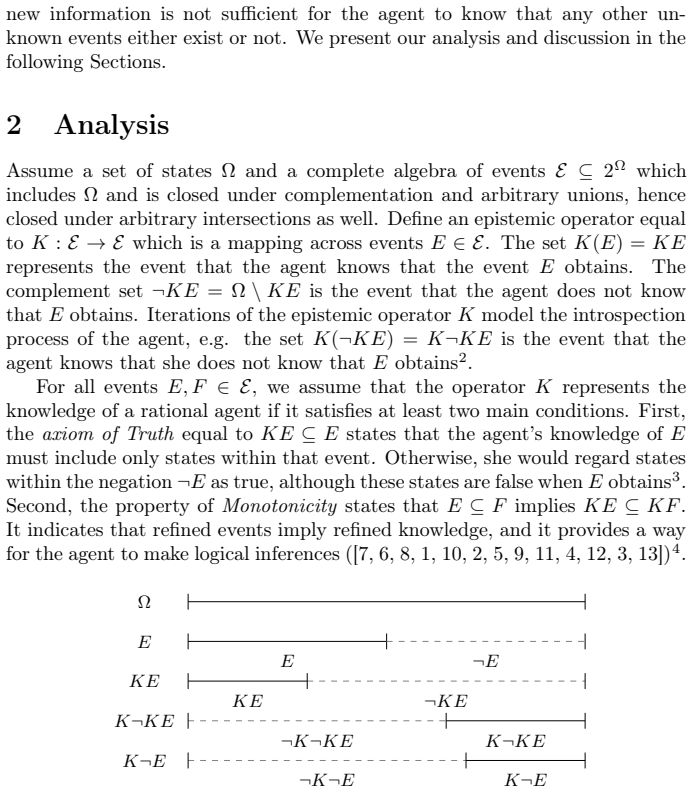
We show that a rational agent with true and refinable knowledge of events cannot know if she knows everything or not. This epistemic limitation is not resolved by introspection about tautologies or by learning about new events.
What carries the argument
The knowledge operator applied to the proposition 'I know everything,' within an epistemic framework where the operator satisfies truth and positive introspection.
If this is right
- Rational decision makers must act without certainty that their information is exhaustive.
- Acquiring new facts or reflecting on logical truths does not remove the uncertainty about knowledge completeness.
- Models of agent belief must incorporate an irreducible gap between knowing events and knowing that one knows all events.
- Standard assumptions of common knowledge in games cannot be taken to include an agent's certainty about her own total knowledge.
Where Pith is reading between the lines
- The limitation could affect how agents update beliefs in sequential decision problems where completeness of information is itself uncertain.
- It points to a possible source of persistent caution in economic choices even after repeated learning opportunities.
- Similar gaps may appear in any system that must assess whether its internal state captures all external contingencies.
Load-bearing premise
The agent starts with true knowledge of events that can be refined, and the knowledge operator obeys the usual rationality and truth axioms.
What would settle it
A formal model in which an agent satisfying the same truth and refinability conditions can deduce that she knows every event would falsify the central claim.
Figures

read the original abstract
We show that a rational agent with true and refinable knowledge of events cannot know if she knows everything or not. This epistemic limitation is not resolved by introspection about tautologies or by learning about new events.
Editorial analysis
A structured set of objections, weighed in public.
Referee Report
Summary. The paper claims to establish that a rational agent possessing true and refinable knowledge of events cannot know whether she knows everything or not. This epistemic limitation is argued to persist even under introspection about tautologies or upon learning about additional events.
Significance. If rigorously established, the result would identify a fundamental self-knowledge limitation for rational agents in epistemic models, with potential relevance to economic theories of information, decision-making under uncertainty, and bounded rationality. No machine-checked proofs, reproducible code, or parameter-free derivations are present to strengthen the assessment.
major comments (2)
- The central claim is presented in the abstract without any formal definitions of 'true and refinable knowledge,' the knowledge operator K, the event space, or the axioms governing rationality and truth. This absence makes it impossible to evaluate whether the limitation follows from the setup or is built into the definitions.
- No derivation, proof sketch, or model is supplied to support the assertion that the limitation is not resolved by introspection on tautologies or by learning new events. Without these steps, the result cannot be checked for internal consistency or load-bearing assumptions.
Simulated Author's Rebuttal
We are grateful to the referee for their report and for highlighting areas where the presentation of our results can be improved. Below we respond to each major comment. We will revise the manuscript accordingly to address the concerns raised.
read point-by-point responses
-
Referee: The central claim is presented in the abstract without any formal definitions of 'true and refinable knowledge,' the knowledge operator K, the event space, or the axioms governing rationality and truth. This absence makes it impossible to evaluate whether the limitation follows from the setup or is built into the definitions.
Authors: We agree with the referee that the abstract, being concise, omits the formal definitions. The body of the manuscript introduces 'true and refinable knowledge' as knowledge that is accurate and can be refined with new information, along with the standard knowledge operator K satisfying the usual axioms for rationality and truth (such as truth axiom and positive introspection). To make this accessible, we will include a short subsection in the introduction summarizing the formal setup, including the event space and axioms. revision: yes
-
Referee: No derivation, proof sketch, or model is supplied to support the assertion that the limitation is not resolved by introspection on tautologies or by learning new events. Without these steps, the result cannot be checked for internal consistency or load-bearing assumptions.
Authors: The manuscript presents the model of an agent with true and refinable knowledge and argues that she cannot know if her knowledge is complete. We concede that an explicit derivation or proof sketch for why introspection on tautologies or learning new events does not resolve the limitation is not sufficiently detailed. We will add a proof sketch demonstrating that even with these, the agent cannot know she knows everything, thereby allowing the reader to verify the consistency and assumptions. revision: yes
Circularity Check
No circularity; derivation is self-contained from standard epistemic axioms
full rationale
The paper establishes an epistemic limitation for a rational agent possessing true and refinable knowledge by applying the standard properties of knowledge operators (truth, positive introspection, etc.) within a formal framework. This yields the result that the agent cannot know whether she knows everything, and the limitation persists under introspection or learning. No step reduces by construction to a fitted input, self-definition, or load-bearing self-citation; the central claim is a theorem derived from the stated axioms rather than presupposed by them. The derivation remains independent of the target conclusion.
Axiom & Free-Parameter Ledger
axioms (1)
- domain assumption Rational agent possesses true and refinable knowledge of events
Reference graph
Works this paper leans on
-
[1]
Fagin, R., & Halpern, J. Y. (1987). Belief, awareness, and limited reason- ing.Artificial intelligence, 34(1), 39-76
1987
-
[2]
Y., Moses, Y., & Vardi, M
Fagin, R., Halpern, J. Y., Moses, Y., & Vardi, M. Y. (2003).Reasoning About Knowledge, MIT Press Books, The MIT Press, Ed. 1
2003
-
[3]
Fukuda, S. (2019). Epistemic foundations for set-algebraic representations of knowledge.Journal of Mathematical Economics, 84, 73-82
2019
-
[4]
Galanis, S. (2013). Unawareness of theorems.Economic Theory, 52, 41-73
2013
-
[5]
Heifetz, A., Meier, M., & Schipper, B. C. (2006). Interactive unawareness. Journal of Economic Theory, 130(1), 78-94
2006
-
[6]
(1962).Knowledge and belief: An introduction to the logic of the two notions
Hintikka, J. (1962).Knowledge and belief: An introduction to the logic of the two notions. Cornell University Press, Ithaca, New York
1962
-
[7]
Kripke, S. A. (1959). A completeness theorem in modal logic.The journal of symbolic logic, 24(1), 1-14
1959
-
[8]
Kripke, S. A. (1963). Semantical analysis of modal logic I. Normal propo- sitional calculi.Zeitschrift fur mathematische Logik und Grundlagen der Mathematik, 9(5-6), 67-96
1963
-
[9]
Li, J. (2009). Information structures with unawareness.Journal of Eco- nomic Theory, 144(3), 977-993
2009
-
[10]
Samet, D. (1990). Ignoring ignorance and agreeing to disagree.Journal of Economic Theory, 52(1), 190-207. 6
1990
-
[11]
Samet, D. (2010). S5 knowledge without partitions.Synthese, 172(1), 145- 155
2010
-
[12]
Schipper, B.C. (2014). Unawareness — a gentle introduction to both the literature and the special issue.Mathematical Social Sciences, 70, 1-9
2014
-
[13]
Tada, Y. (2024). AU Introspection and Symmetry under non-trivial un- awareness.Theory and Decision, 97, 409-421. 7
2024
discussion (0)
Sign in with ORCID, Apple, or X to comment. Anyone can read and Pith papers without signing in.