Recognition: unknown
Parity-unfolded distillation architecture for noise-biased platforms
Pith reviewed 2026-05-10 10:42 UTC · model grok-4.3
The pith
Parity-unfolded distillation prepares small-angle rotations directly on noise-biased platforms with 26% lower resources.
A machine-rendered reading of the paper's core claim, the machinery that carries it, and where it could break.
Core claim
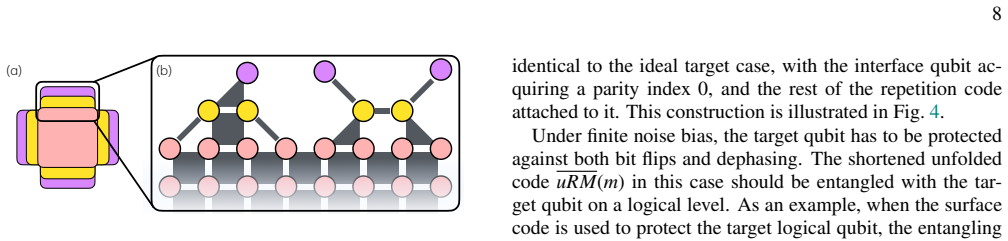
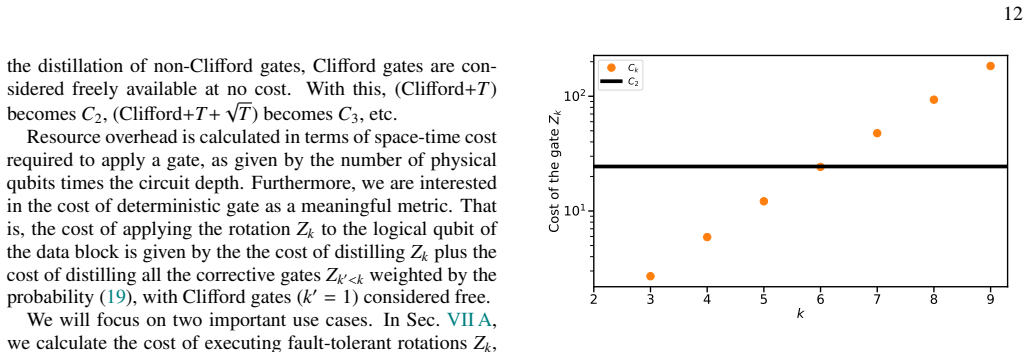
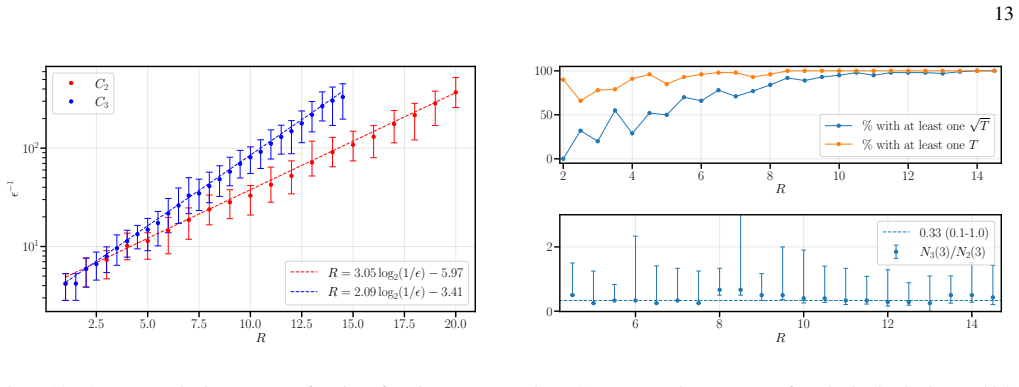
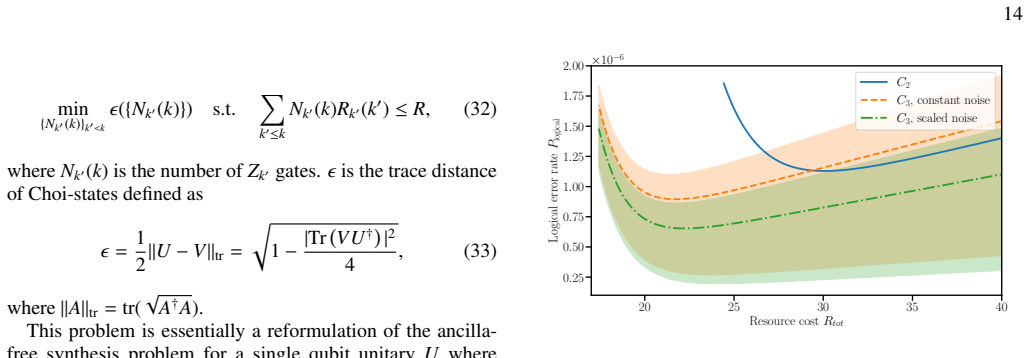
The central claim is that parity unfolding provides an efficient distillation method for gates at arbitrary levels of the Clifford hierarchy, enabling the fault-tolerant preparation of |Z_k> states with 2^{k+3} + O(2^{k/2}) qubits on planar nearest-neighbor biased-noise architectures. For algorithms needing native small rotations up to k=7, resource overheads decrease. Moreover, parity-unfolded distillation of T plus square-root T reduces the minimum achievable logical error rate by 43% and resource requirements by 26% compared to T-only unfolded distillation.
What carries the argument
parity unfolding: an efficient distillation procedure for magic states in the Clifford hierarchy that maintains noise bias on 2D nearest-neighbor layouts
If this is right
- Algorithms like quantum Fourier transform and phase estimation see reduced overhead for rotations up to 1/32 precision.
- Combined distillation of T and sqrt(T) states yields 43% better logical error rates than T-only methods.
- Resource usage for arbitrary rotation synthesis drops by 26%.
- The qubit scaling for preparing higher-order rotation states remains polynomial in 2^{k/2} on planar chips.
Where Pith is reading between the lines
- The method opens the possibility of implementing phase estimation with lower physical qubit counts on current biased-noise devices if the bias is preserved.
- Further optimizations might arise from integrating this with error-correcting codes tailored to bias.
- Testing the approach on small k values could validate the scaling before larger implementations.
Load-bearing premise
The platform's noise bias is maintained during distillation and no significant unbiased errors are introduced by the circuit implementations.
What would settle it
Simulating or implementing the (T + sqrt(T)) parity-unfolded distillation circuit on a biased noise model and checking if the logical error rate is indeed 43% lower than the T-only version at the same resource level.
Figures




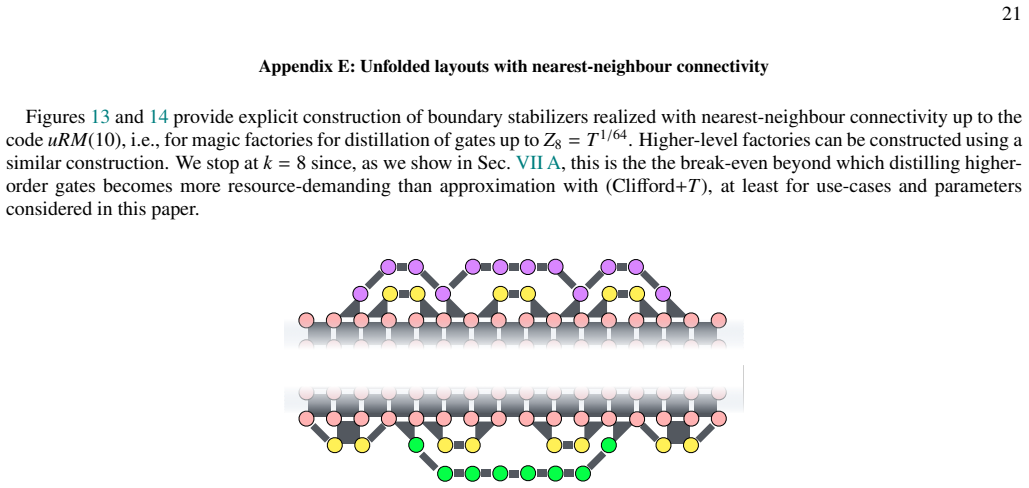
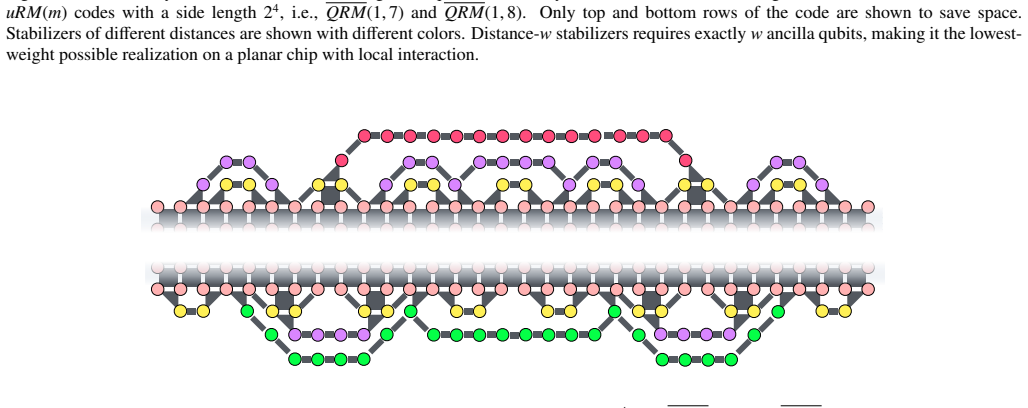
read the original abstract
We introduce the parity-unfolded architecture, a fault-tolerant quantum computing scheme that relies on direct preparation and teleportation of small-angle rotations $ Z^{1/2^{k}}$ rather than approximating them with the conventional (Clifford + $T$) gate set. The architecture is enabled by efficient distillation of gates from an arbitrary level of the Clifford hierarchy, which we refer to as parity unfolding. With it, a state $|Z_k\rangle = Z^{1/2^{k}}|{+}\rangle$ can be prepared fault-tolerantly using $2^{k+3} + O(2^{k/2})$ biased-noise qubits on a planar chip with nearest-neighbour connectivity. For algorithms requiring native $Z^{1/2^{k}}$ gates, such as the Quantum Fourier Transform and phase estimation, the proposed scheme allows to reduce resource overheads for up to $k=7$, i.e., up to $T^{1/32}$. Furthermore, when used for the synthesis of arbitrary small-angle rotations, parity-unfolded distillation of ($T$ + $\sqrt{T}$) reduces the minimum achievable logical error rate by 43% while cutting the resource requirements by 26%, when compared to unfolded distillation of only the $T$ gate.
Editorial analysis
A structured set of objections, weighed in public.
Referee Report
Summary. The paper introduces a parity-unfolded distillation architecture for fault-tolerant quantum computing on noise-biased platforms. It enables direct preparation and teleportation of small-angle rotations Z^{1/2^k} from arbitrary levels of the Clifford hierarchy, rather than approximating them via Clifford+T. The central claims are that a state |Z_k⟩ can be prepared fault-tolerantly using 2^{k+3} + O(2^{k/2}) biased-noise qubits on a planar chip with nearest-neighbor connectivity, that this reduces overheads for algorithms such as QFT and phase estimation up to k=7, and that parity-unfolded distillation of (T + √T) yields a 43% reduction in minimum achievable logical error rate and 26% fewer resources compared to T-only distillation for arbitrary small-angle rotations.
Significance. If the noise-bias preservation holds under the stated planar NN layout, the work would offer a concrete route to lower-overhead synthesis of small-angle rotations and native implementation of QFT/phase estimation on biased-noise hardware. The explicit resource formulas (2^{k+3} + O(2^{k/2})) and numerical percentage gains constitute falsifiable, parameter-free predictions that strengthen the contribution relative to prior distillation literature.
major comments (2)
- [§4.2, Figure 7] §4.2 and Figure 7: the error-propagation analysis for the parity-unfolded distillation circuit on the 2D NN grid does not provide an explicit gate schedule or SWAP/routing overhead calculation showing that introduced X/Y errors remain below the bias threshold; without this, the claimed 2^{k+3} + O(2^{k/2}) scaling and the 43%/26% gains cannot be verified as load-bearing.
- [§3, Eq. (12)] §3, Eq. (12): the derivation of the 43% logical-error reduction for (T + √T) versus T-only distillation assumes the noise model remains strictly Z-biased after teleportation; a concrete bound on the X/Y leakage rate introduced by the planar layout is required to support this numerical claim.
minor comments (2)
- [Abstract, §5.1] The abstract and §5.1 refer to 'up to k=7' without stating the precise resource crossover point versus standard Clifford+T synthesis; adding a table of overhead versus k would improve clarity.
- [§2] Notation for the parity-unfolding operator is introduced in §2 but used without re-definition in later circuit diagrams; a short reminder equation would aid readability.
Simulated Author's Rebuttal
We thank the referee for their detailed and insightful comments on our manuscript. We have reviewed the major comments concerning the error-propagation analysis and the assumptions in the logical-error reduction calculation. We provide point-by-point responses below and will make the necessary revisions to enhance the clarity and verifiability of our results.
read point-by-point responses
-
Referee: [§4.2, Figure 7] §4.2 and Figure 7: the error-propagation analysis for the parity-unfolded distillation circuit on the 2D NN grid does not provide an explicit gate schedule or SWAP/routing overhead calculation showing that introduced X/Y errors remain below the bias threshold; without this, the claimed 2^{k+3} + O(2^{k/2}) scaling and the 43%/26% gains cannot be verified as load-bearing.
Authors: We agree that an explicit gate schedule and SWAP/routing overhead calculation would strengthen independent verification of the error propagation under the planar nearest-neighbor connectivity. The O(2^{k/2}) term in the resource count is intended to incorporate the routing overhead on the 2D grid, and the architecture is constructed to keep introduced X/Y errors suppressed relative to the bias threshold. In the revised manuscript we will add a supplementary section containing the detailed gate schedule together with the corresponding bound on X/Y error rates, thereby confirming that these errors remain below threshold and supporting both the scaling formula and the reported percentage gains. revision: yes
-
Referee: [§3, Eq. (12)] §3, Eq. (12): the derivation of the 43% logical-error reduction for (T + √T) versus T-only distillation assumes the noise model remains strictly Z-biased after teleportation; a concrete bound on the X/Y leakage rate introduced by the planar layout is required to support this numerical claim.
Authors: The 43% reduction quoted from Eq. (12) is obtained under the assumption that Z-bias is preserved through the teleportation step, which is a central property of the parity-unfolded protocol on biased-noise hardware. We acknowledge that a quantitative bound on any X/Y leakage induced by the planar routing would make this assumption fully rigorous. In the revision we will insert an explicit upper bound on the leakage rate, derived directly from the error-propagation analysis, and demonstrate that it is small enough to preserve the validity of the 43% figure. revision: yes
Circularity Check
No circularity: resource counts and error reductions are direct outputs of the new architecture
full rationale
The paper introduces the parity-unfolded distillation architecture as a novel scheme relying on direct preparation and teleportation of small-angle rotations rather than Clifford+T approximation. The quoted resource scaling 2^{k+3} + O(2^{k/2}) and the 43%/26% improvements for (T + √T) vs T-only are presented as consequences of this architecture's efficiency on biased-noise planar layouts. No equations, fitted parameters, or self-citations are shown reducing these quantities to prior inputs by construction; the derivation chain remains self-contained against external benchmarks.
Axiom & Free-Parameter Ledger
axioms (2)
- domain assumption Noise is sufficiently biased that distillation circuits remain fault-tolerant at the stated overhead
- domain assumption Nearest-neighbor connectivity on a planar lattice is sufficient for the teleportation steps
Forward citations
Cited by 1 Pith paper
-
Local distillation from Reed Muller codes unfolding
Local 2D and 3D Reed-Muller distillation factories achieve output infidelities down to 8.256e-9 for CCZ states and 1.1811e-17 for T states from 10^{-3} input infidelity.
Reference graph
Works this paper leans on
-
[1]
Eastin and E
B. Eastin and E. Knill, Phys. Rev. Lett.102, 110502 (2009)
2009
-
[2]
Bravyi and R
S. Bravyi and R. König, Phys. Rev. Lett.110, 170503 (2013)
2013
-
[3]
Bravyi and A
S. Bravyi and A. Kitaev, Phys. Rev. A71, 022316 (2005)
2005
-
[4]
Litinski, Quantum3, 205 (2019)
D. Litinski, Quantum3, 205 (2019)
2019
-
[5]
Bravyi and J
S. Bravyi and J. Haah, Phys. Rev. A86, 052329 (2012)
2012
-
[6]
X. Zhou, D. W. Leung, and I. L. Chuang, Phys. Rev. A62, 052316 (2000)
2000
-
[7]
F. Butt, S. Heußen, M. Rispler, and M. Müller, PRX Quantum 5, 020345 (2024)
2024
-
[8]
M. E. Beverland, A. Kubica, and K. M. Svore, PRX Quantum 2, 020341 (2021)
2021
-
[9]
J. T. Anderson, G. Duclos-Cianci, and D. Poulin, Phys. Rev. Lett.113, 080501 (2014)
2014
-
[10]
Daguerre and I
L. Daguerre and I. H. Kim, Phys. Rev. Res.7, 023080 (2025)
2025
-
[11]
O’Gorman and E
J. O’Gorman and E. T. Campbell, Phys. Rev. A95, 032338 (2017)
2017
-
[12]
Bombín, New Journal of Physics17, 083002 (2015)
H. Bombín, New Journal of Physics17, 083002 (2015)
2015
-
[13]
Gauge color codes in two dimensions , volume =
C. Jones, P. Brooks, and J. Harrington, Physical Review A93 (2016), 10.1103/physreva.93.052332
-
[14]
M. A. Nielsen and I. L. Chuang,Quantum Computation and Quantum Information: 10th Anniversary Edition(Cambridge University Press, 2011)
2011
-
[15]
Chamberland and K
C. Chamberland and K. Noh, npj Quantum Information6, 91 (2020)
2020
-
[16]
Gidney and A
C. Gidney and A. G. Fowler, Quantum3, 135 (2019)
2019
-
[17]
Magic state cultivation: growing T states as cheap as CNOT gates
C. Gidney, N. Shutty, and C. Jones, “Magic state culti- vation: growing t states as cheap as cnot gates,” (2024), arXiv:2409.17595 [quant-ph]
work page internal anchor Pith review arXiv 2024
-
[18]
Distilling magic states in the bicycle architecture,
S. Xu, K. Liu, P. Rall, Z. He, and Y . Ding, “Distilling magic states in the bicycle architecture,” (2026), arXiv:2602.20546 [quant-ph]
-
[19]
D. Ruiz, J. Guillaud, C. Vuillot, and M. Mirrahimi, “Unfolded distillation: very low-cost magic state preparation for biased- noise qubits,” (2025), arXiv:2507.12511 [quant-ph]
-
[20]
Mirrahimi, Z
M. Mirrahimi, Z. Leghtas, V . V . Albert, S. Touzard, R. J. Schoelkopf, L. Jiang, and M. H. Devoret, New Journal of Physics16, 045014 (2014)
2014
-
[21]
Guillaud and M
J. Guillaud and M. Mirrahimi, Phys. Rev. X9, 041053 (2019)
2019
-
[22]
Réglade, A
U. Réglade, A. Bocquet, R. Gautier, J. Cohen, A. Marquet, E. Albertinale, N. Pankratova, M. Hallén, F. Rautschke, L. A. 16 Sellem, P. Rouchon, A. Sarlette, M. Mirrahimi, P. Campagne- Ibarcq, R. Lescanne, S. Jezouin, and Z. Leghtas, Nature629, 778 (2024)
2024
-
[23]
Climbing the diagonal clifford hierarchy,
J. Hu, Q. Liang, and R. Calderbank, “Climbing the diagonal clifford hierarchy,” (2021), arXiv:2110.11923 [quant-ph]
-
[24]
S. X. Cui, D. Gottesman, and A. Krishna, Phys. Rev. A95, 012329 (2017)
2017
-
[25]
Controlled jump in the clifford hierarchy,
Y . Xu and X. Wang, “Controlled jump in the clifford hierarchy,” (2026), arXiv:2602.22201 [quant-ph]
-
[26]
arXiv preprint arXiv:1302.3240 , year=
A. J. Landahl and C. Cesare, “Complex instruction set com- puting architecture for performing accurate quantumzrotations with less magic,” (2013), arXiv:1302.3240 [quant-ph]
-
[27]
Duclos-Cianci and D
G. Duclos-Cianci and D. Poulin, Phys. Rev. A91, 042315 (2015)
2015
-
[28]
E. T. Campbell and J. O’Gorman, Quantum Science and Tech- nology1, 015007 (2016)
2016
-
[29]
G. J. Mooney, C. D. Hill, and L. C. Hollenberg, Quantum5, 396 (2021)
2021
-
[30]
Computation with quantum reed-muller codes and their mapping onto 2d atom arrays,
A. Gong and J. M. Renes, “Computation with quantum reed- muller codes and their mapping onto 2d atom arrays,” (2024), arXiv:2410.23263 [quant-ph]
-
[31]
Quan, L.-L
D.-X. Quan, L.-L. Zhu, C.-X. Pei, and B. C. Sanders, Journal of Physics A: Mathematical and Theoretical51, 115305 (2018)
2018
-
[32]
Fellner, A
M. Fellner, A. Messinger, K. Ender, and W. Lechner, Phys. Rev. Lett.129, 180503 (2022)
2022
-
[33]
Optimal decoder for the error correcting parity code,
K. Tiurev, C. Goeller, L. Stenzel, P. Schnabl, A. Messinger, M. Fellner, and W. Lechner, “Optimal decoder for the error correcting parity code,” (2025), arXiv:2505.05210 [quant-ph]
-
[34]
D. Ruiz, J. Guillaud, A. Leverrier, M. Mirrahimi, and C. Vuil- lot, Nature Communications16, 1040 (2025)
2025
-
[35]
Tiurev, A
K. Tiurev, A. Pesah, P.-J. H. S. Derks, J. Roffe, J. Eisert, M. S. Kesselring, and J.-M. Reiner, Phys. Rev. Lett.133, 110601 (2024)
2024
-
[36]
J. P. B. Ataides, D. K. Tuckett, S. D. Bartlett, S. T. Flammia, and B. J. Brown, Nature Comm.12, 2172 (2021)
2021
-
[37]
J. Lee, J. Park, and J. Heo, Quantum Information Processing 20, 231 (2021)
2021
-
[38]
Romanesco codes: Bias-tailored qldpc codes from fractal codes,
C. Leroux and J. K. Iverson, “Romanesco codes: Bias-tailored qldpc codes from fractal codes,” (2025), arXiv:2506.00130 [quant-ph]
-
[39]
3 of Ref
A circuit for encoding a shortened QRM(1,4) code is given in Fig. 3 of Ref. [19]. A circuit for encoding a shortened QRM(1,5) code is given in Fig. 3 of Ref. [26]
-
[40]
Y . Chen and H. Vinck, “Notes on reed-muller codes,” (2009), arXiv:0901.2062 [cs.IT]
-
[41]
R. W. Heeres, P. Reinhold, N. Ofek, L. Frunzio, L. Jiang, M. H. Devoret, and R. J. Schoelkopf, Nature Communications8, 94 (2017)
2017
-
[42]
The open source code and the data used in this paper will be added in later revisions
-
[43]
M. A. Perlin, “qLDPC,”https://github.com/qLDPCOrg/ qLDPC(2023)
2023
-
[44]
T. Hao, A. Xu, and S. Tannu, inProceedings of the 31st ACM International Conference on Architectural Support for Pro- gramming Languages and Operating Systems, Volume 2(ACM,
-
[45]
Representation of quantum circuits with clifford andπ/8gates,
K. Matsumoto and K. Amano, arXiv preprint arXiv:0806.3834 (2008)
-
[46]
Kliuchnikov, K
V . Kliuchnikov, K. Lauter, R. Minko, A. Paetznick, and C. Pe- tit, Quantum7, 1208 (2023)
2023
-
[47]
A. J. Ferris and G. Vidal, Phys. Rev. B85, 165146 (2012)
2012
-
[48]
17 Appendix A: Proof of Lemma 1 Lemma 1Bulk stabilizers together with boundary stabilizers defined by Eq
The open source code and the data used in this paper will be added in later revisions. 17 Appendix A: Proof of Lemma 1 Lemma 1Bulk stabilizers together with boundary stabilizers defined by Eq. (10) form an independent set of 2 m −m−1 stabilizers on 2m physical qubits, i.e., generate a code with parameters [n,k] of Eq. (7), required for theRM(1,m) code. Pr...
-
[49]
to find gate sequences with low synthesis errors. Concretely, to sample efficiently, the tensor networkτ ℓ is contracted withUand brought to canonical form using repeated singular value decomposition so that eventually only one tensor is non- isometric. All other tensors contract to the identity with their conjugate transpose. This allows to interpret the...
discussion (0)
Sign in with ORCID, Apple, or X to comment. Anyone can read and Pith papers without signing in.