Recognition: unknown
Probing the large-scale structure with 21cm-galaxy cross-bispectrum: Estimates from simulations and forecasts for upcoming cosmological surveys
Pith reviewed 2026-05-10 09:25 UTC · model grok-4.3
The pith
The 21cm-galaxy cross-bispectrum provides enhanced detectability over the auto-bispectrum for probing large-scale structure with future surveys.
A machine-rendered reading of the paper's core claim, the machinery that carries it, and where it could break.
Core claim
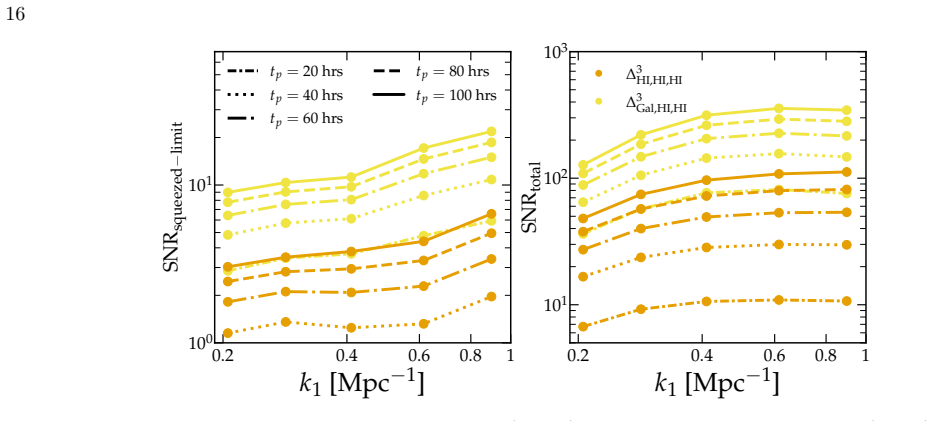
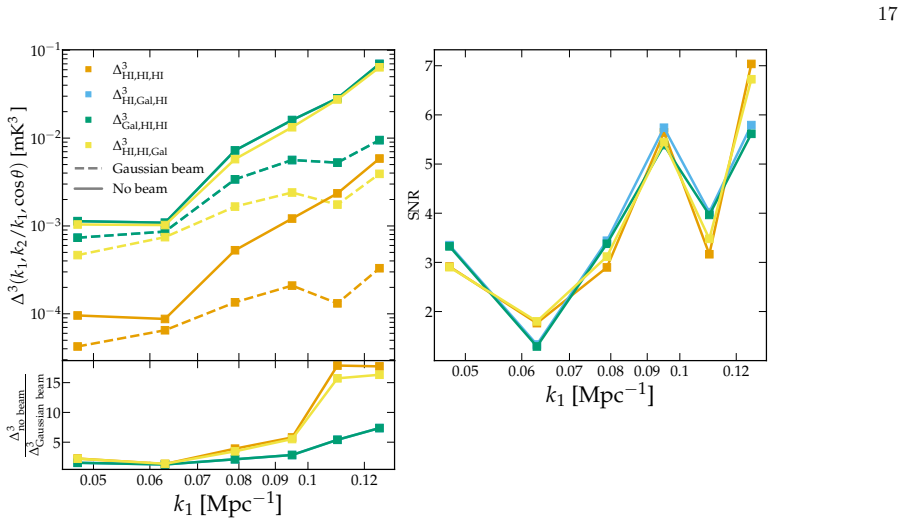
The 21cm-galaxy cross-bispectrum shows enhanced detectability compared to the 21cm auto-bispectrum for all unique triangles in the presence of instrumental noise for observations in interferometric mode. Forecasts indicate a 10σ detection for squeezed-limit triangles and a 100σ detection for all shapes combined on scales 0.2 Mpc^{-1} ≤ k1 ≤ 0.9 Mpc^{-1} with 100 hours of SKA-Mid observations per pointing. Detectability on large scales with single-dish mode is limited by cosmic variance. The work represents an initial step toward an end-to-end analysis pipeline for future observations.
What carries the argument
The 21cm-galaxy cross-bispectrum, which measures three-point correlations between the redshifted 21 cm signal and galaxy positions using predictions from galaxy evolution models.
If this is right
- The cross-bispectrum allows higher significance detections than the auto-bispectrum when instrumental noise is accounted for in interferometric observations.
- High detection significances of 10σ for squeezed triangles and 100σ for combined shapes are expected on intermediate scales with SKA-Mid.
- Single-dish observations are restricted by cosmic variance on very large scales.
- This sets the foundation for comprehensive analysis methods for cross-bispectrum data from upcoming surveys.
Where Pith is reading between the lines
- Such cross-correlations might help break degeneracies in cosmological parameters by providing complementary information to power spectra.
- Future work could test these forecasts against mock observations from current telescopes to improve model accuracy.
- The technique may generalize to cross-bispectra with other tracers like weak lensing for broader applications in cosmology.
Load-bearing premise
The theoretical galaxy evolution models must accurately represent the clustering and bias of the neutral hydrogen and galaxy fields on cosmological scales, otherwise the predicted detection strengths will not apply to real observations.
What would settle it
Observations from SKA-Mid in interferometric mode that yield signal-to-noise ratios much lower than 10σ for squeezed triangles or 100σ overall on scales from 0.2 to 0.9 per Mpc would indicate the forecasts are not accurate.
Figures


read the original abstract
The redshifted 21cm signal from the post-reionization epoch is highly non-Gaussian; thus, higher-order statistics, such as the bispectrum, are required to extract this non-Gaussian information. However, high-signal-to-noise ratio detection of the 21cm auto-bispectrum will be hindered by the presence of residual systematics. Cross-correlating the 21cm signal with galaxies offers a promising path to suppress this uncertainty from residual systematics and potentially increase the signal-to-noise ratio. We present a comprehensive analysis of the HI-galaxy cross-bispectrum using the predictions of theoretical galaxy evolution models defined on large cosmological volumes. Our analysis includes the cross-bispectrum for different triangle sizes and shapes, as well as for different combinations of the HI and galaxy fields. We forecast the detectability of the 21cm-galaxy cross-bispectrum at redshift $z\approx1$ with Euclid-like galaxy survey and SKA-Mid observations in both interferometric and single-dish modes of survey. We find that the 21cm-galaxy cross-bispectrum shows enhanced detectability compared to the 21cm auto-bispectrum for all unique triangles in the presence of instrumental noise for observations in interferometric mode. We forecast a 10$\sigma$ detection of cross-bispectrum for squeezed-limit triangles and a 100$\sigma$ detection for all shapes combined for scales $0.2~\text{Mpc}^{-1}\leq k_1 \leq 0.9~\text{Mpc}^{-1}$ with 100 hours of SKA-Mid observations per pointing. However, the detectability of the cross-bispectrum for large scales ($k_1 < 0.1~\text{Mpc}^{-1}$), which is accessible with the single-dish mode of survey, is limited by cosmic variance. Our analysis presents a first step towards an end-to-end analysis pipeline for the future observations of the 21cm-galaxy cross-bispectrum.
Editorial analysis
A structured set of objections, weighed in public.
Referee Report
Summary. The manuscript analyzes the HI-galaxy cross-bispectrum at z≈1 using theoretical galaxy evolution models on large cosmological volumes. It compares the cross-bispectrum to the 21cm auto-bispectrum for various triangle shapes and scales, and forecasts detectability with Euclid-like galaxy surveys combined with SKA-Mid observations in interferometric and single-dish modes. The central claims are enhanced detectability of the cross-bispectrum in the presence of instrumental noise and specific high signal-to-noise ratios (10σ for squeezed-limit triangles, 100σ for all shapes combined) for 0.2 Mpc^{-1} ≤ k1 ≤ 0.9 Mpc^{-1} with 100 hours per pointing, while noting cosmic-variance limits on larger scales.
Significance. If the underlying galaxy evolution models accurately capture the HI and galaxy clustering and higher-order correlations, the forecasts would usefully demonstrate the advantages of cross-bispectrum measurements for mitigating systematics and extracting non-Gaussian information from upcoming surveys. The use of large-volume simulations to include cosmic variance is a methodological strength that supports the scale-dependent claims.
major comments (2)
- [abstract and results] The quantitative forecasts for 10σ and 100σ detections (abstract and results section) are derived entirely from cross-bispectrum amplitudes generated by the external theoretical galaxy evolution models. No calibration against observational HI or galaxy clustering data at z≈1, nor comparison to independent simulations with known bias properties, is presented. Because the S/N ratios scale directly with these amplitudes, any systematic offset in modeled bias or three-point correlations would rescale the claimed significances; this is load-bearing for the central detectability claims.
- [methods] No sensitivity analysis or error budget is provided for variations in the galaxy evolution model parameters or assumptions (e.g., astrophysical prescriptions for HI content). Given that the paper's primary output consists of specific numerical forecasts rather than qualitative trends, the absence of such tests leaves the robustness of the 10σ/100σ numbers unassessed.
minor comments (2)
- [methods] The definition of 'unique triangles' and the precise binning in k-space for the combined-shape forecast could be clarified with an explicit equation or diagram in the methods section.
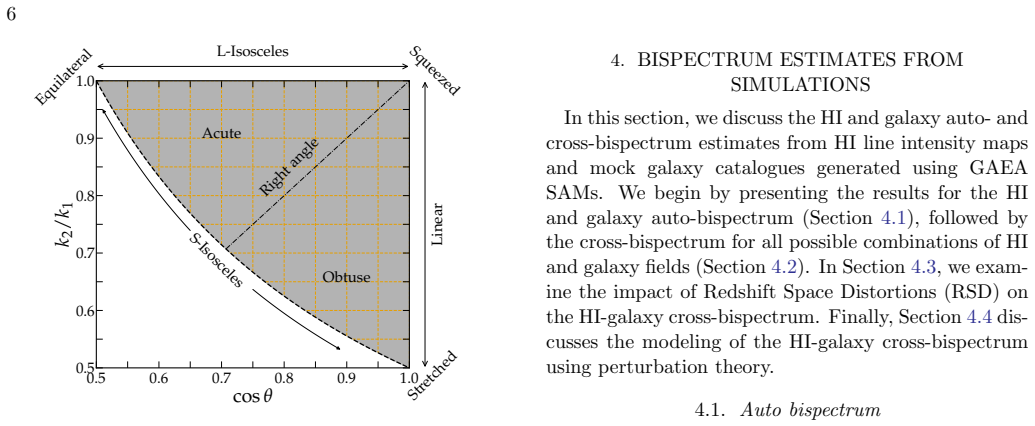
- [figures] Figure captions for the S/N plots should include the exact noise model parameters, survey area, and integration time assumptions used to generate the quoted values.
Simulated Author's Rebuttal
We thank the referee for their constructive and detailed comments, which help clarify the robustness of our forecasts. We respond to each major comment below and indicate the revisions we will make to the manuscript.
read point-by-point responses
-
Referee: [abstract and results] The quantitative forecasts for 10σ and 100σ detections (abstract and results section) are derived entirely from cross-bispectrum amplitudes generated by the external theoretical galaxy evolution models. No calibration against observational HI or galaxy clustering data at z≈1, nor comparison to independent simulations with known bias properties, is presented. Because the S/N ratios scale directly with these amplitudes, any systematic offset in modeled bias or three-point correlations would rescale the claimed significances; this is load-bearing for the central detectability claims.
Authors: We agree that the absolute S/N values depend on the amplitudes predicted by the galaxy evolution models. These models were previously calibrated to match HI and galaxy clustering observations at z≈1 (as referenced in the Methods section of our manuscript), but we acknowledge that an explicit summary of this calibration and comparisons to independent simulations were not included here. In the revised manuscript we will add a dedicated paragraph in the Methods section that summarizes the model calibration procedures from the original publications, cites relevant validation against observational data and other simulations, and discusses potential systematic uncertainties in the three-point correlations. We emphasize that the key comparative result—the enhanced detectability of the cross-bispectrum relative to the auto-bispectrum in the presence of noise—remains robust under overall amplitude rescalings, since both statistics are affected similarly by bias offsets. revision: yes
-
Referee: [methods] No sensitivity analysis or error budget is provided for variations in the galaxy evolution model parameters or assumptions (e.g., astrophysical prescriptions for HI content). Given that the paper's primary output consists of specific numerical forecasts rather than qualitative trends, the absence of such tests leaves the robustness of the 10σ/100σ numbers unassessed.
Authors: We concur that a sensitivity analysis is important for assessing the robustness of the specific numerical forecasts. In the revised manuscript we will add a new subsection (or appendix) that performs a limited sensitivity analysis. We will vary key model parameters, such as the HI-halo mass relation and star-formation efficiency, within their observational uncertainties, recompute the cross-bispectrum amplitudes and S/N ratios for representative triangle configurations, and present the resulting range in the quoted detection significances. This will provide a basic error budget and quantify how the 10σ and 100σ claims respond to plausible variations in the astrophysical prescriptions. revision: yes
Circularity Check
No significant circularity; forecasts use independent forward modeling from external galaxy evolution simulations.
full rationale
The paper computes cross-bispectrum amplitudes directly from the outputs of theoretical galaxy evolution models run on large cosmological volumes, then derives S/N forecasts by comparing those amplitudes to instrumental noise and cosmic variance for specified k-ranges and triangle shapes. This is standard forward modeling with no parameter fitting to the target observables, no self-definitional reduction of predictions to inputs, and no load-bearing self-citations or uniqueness theorems invoked to justify the central claims. The derivation chain remains independent of the forecasted detectability numbers themselves.
Axiom & Free-Parameter Ledger
Reference graph
Works this paper leans on
-
[1]
Abdalla, E., Ferreira, E. G. M., Landim, R. G., et al. 2022, A&A, 664, A14, doi: 10.1051/0004-6361/202140883
-
[2]
Alonso, D., Bull, P., Ferreira, P. G., & Santos, M. G. 2015, MNRAS, 447, 400, doi: 10.1093/mnras/stu2474
-
[3]
2023, ApJ, 947, 16, doi: 10.3847/1538-4357/acb13f
Amiri, M., Bandura, K., Chen, T., et al. 2023, ApJ, 947, 16, doi: 10.3847/1538-4357/acb13f
-
[4]
2024, ApJ, 963, 23, doi: 10.3847/1538-4357/ad0f1d
Amiri, M., Bandura, K., Chakraborty, A., et al. 2024, ApJ, 963, 23, doi: 10.3847/1538-4357/ad0f1d
-
[5]
Anderson, C. J., Luciw, N. J., Li, Y. C., et al. 2018, MNRAS, 476, 3382, doi: 10.1093/mnras/sty346
-
[6]
Autieri, G., Berti, M., Spinelli, M., Haridasu, B. S., & Viel, M. 2026, JCAP, 2026, 050, doi: 10.1088/1475-7516/2026/01/050
-
[7]
2018, Monthly Notices of the Royal Astronomical Society, 477, 1984, doi: 10.1093/mnras/sty714
Bag, S., Mondal, R., Sarkar, P., Bharadwaj, S., & Sahni, V. 2018, Monthly Notices of the Royal Astronomical Society, 477, 1984, doi: 10.1093/mnras/sty714
-
[8]
Barberi-Squarotti, M., et al. 2025, Mon. Not. Roy. Astron. Soc., 537, 3632, doi: 10.1093/mnras/staf195
-
[9]
Bartolo, N., Komatsu, E., Matarrese, S., & Riotto, A. 2004, PhR, 402, 103, doi: 10.1016/j.physrep.2004.08.022
-
[10]
2004, MNRAS, 351, 1379, doi: 10.1111/j.1365-2966.2004.07876.x
Battye, R. A., Davies, R. D., & Weller, J. 2004, MNRAS, 355, 1339, doi: 10.1111/j.1365-2966.2004.08416.x
-
[11]
Baugh, C. M., Gonzalez-Perez, V., Lagos, C. D. P., et al. 2019, MNRAS, 483, 4922, doi: 10.1093/mnras/sty3427
-
[12]
Bernal, J. L. 2024, Phys. Rev. D, 109, 043517, doi: 10.1103/PhysRevD.109.043517
-
[13]
Scoccimarro, R. 2002, PhR, 367, 1, doi: 10.1016/S0370-1573(02)00135-7
-
[14]
2024, MNRAS, 529, 4803, doi: 10.1093/mnras/stae755
Berti, M., Spinelli, M., & Viel, M. 2024, MNRAS, 529, 4803, doi: 10.1093/mnras/stae755
-
[15]
2020, MNRAS, 493, 594, doi: 10.1093/mnras/staa279
Bharadwaj, S., Mazumdar, A., & Sarkar, D. 2020, MNRAS, 493, 594, doi: 10.1093/mnras/staa279
-
[16]
Bharadwaj, S., Nath, B. B., & Sethi, S. K. 2001, Journal of Astrophysics and Astronomy, 22, 21, doi: 10.1007/BF02933588
-
[17]
Bharadwaj, S., & Sethi, S. K. 2001, Journal of Astrophysics and Astronomy, 22, 293, doi: 10.1007/BF02702273
-
[18]
Bharadwaj, S., & Srikant, P. S. 2004, Journal of Astrophysics and Astronomy, 25, 67, doi: 10.1007/BF02702289
-
[19]
Blanchard, A., et al. 2020, Astron. Astrophys., 642, A191, doi: 10.1051/0004-6361/202038071
-
[20]
Braun, R., Bonaldi, A., Bourke, T., Keane, E., & Wagg, J. 2019, arXiv e-prints, arXiv:1912.12699, doi: 10.48550/arXiv.1912.12699 19
-
[21]
Kamionkowski, M. 2017, Mon. Not. Roy. Astron. Soc., 467, 2996, doi: 10.1093/mnras/stx203
-
[22]
Bull, P., Ferreira, P. G., Patel, P., & Santos, M. G. 2015, ApJ, 803, 21, doi: 10.1088/0004-637X/803/1/21
-
[23]
Carucci, I. P., Irfan, M. O., & Bobin, J. 2020, MNRAS, 499, 304, doi: 10.1093/mnras/staa2854
-
[24]
Carucci, I. P., Bernal, J. L., Cunnington, S., et al. 2025, A&A, 703, A222, doi: 10.1051/0004-6361/202453461
-
[25]
2025, MNRAS, 538, 2204, doi: 10.1093/mnras/staf433
Villaescusa-Navarro, F. 2025, MNRAS, 538, 2204, doi: 10.1093/mnras/staf433
-
[26]
Chang, T.-C., Pen, U.-L., Bandura, K., & Peterson, J. B. 2010, arXiv e-prints, arXiv:1007.3709, doi: 10.48550/arXiv.1007.3709
-
[27]
Physical Review Letters , author =
Chang, T.-C., Pen, U.-L., Peterson, J. B., & McDonald, P. 2008, PhRvL, 100, 091303, doi: 10.1103/PhysRevLett.100.091303
-
[28]
Chapman, E., Abdalla, F. B., Harker, G., et al. 2012, MNRAS, 423, 2518, doi: 10.1111/j.1365-2966.2012.21065.x
-
[29]
Chapman, E., Abdalla, F. B., Bobin, J., et al. 2013, MNRAS, 429, 165, doi: 10.1093/mnras/sts333
-
[30]
Chhabra, M., & Bharadwaj, S. 2025, arXiv e-prints, arXiv:2508.19126, doi: 10.48550/arXiv.2508.19126 CHIME Collaboration, Amiri, M., Bandura, K., et al. 2025, arXiv e-prints, arXiv:2511.19620, doi: 10.48550/arXiv.2511.19620 CHIME Collaboration, Chakraborty, A., Dobbs, M., et al. 2026, arXiv e-prints, arXiv:2601.03240, doi: 10.48550/arXiv.2601.03240
-
[31]
Cunnington, S. 2022, Mon. Not. Roy. Astron. Soc., 512, 2408, doi: 10.1093/mnras/stac576
-
[32]
2021, MNRAS, 507, 1623, doi: 10.1093/mnras/stab2200
Cunnington, S., Watkinson, C., & Pourtsidou, A. 2021, MNRAS, 507, 1623, doi: 10.1093/mnras/stab2200
-
[33]
Cunnington, S., Wolz, L., Pourtsidou, A., & Bacon, D. 2019, Mon. Not. Roy. Astron. Soc., 488, 5452, doi: 10.1093/mnras/stz1916
-
[34]
Cunnington, S., Li, Y., Santos, M. G., et al. 2023, MNRAS, 518, 6262, doi: 10.1093/mnras/stac3060 de Jong, R. S., Agertz, O., Berbel, A. A., et al. 2019, The Messenger, 175, 3, doi: 10.18727/0722-6691/5117 De Lucia, G., Fontanot, F., Xie, L., & Hirschmann, M. 2024, A&A, 687, A68, doi: 10.1051/0004-6361/202349045 De Lucia, G., Tornatore, L., Frenk, C. S., ...
-
[35]
Desjacques, V., Jeong, D., & Schmidt, F. 2018, PhR, 733, 1, doi: 10.1016/j.physrep.2017.12.002
-
[36]
M., Majumdar, S., Shekhar Murmu, C., et al
Dosibhatla, M. M., Majumdar, S., Shekhar Murmu, C., et al. 2025, arXiv e-prints, arXiv:2508.09112, doi: 10.48550/arXiv.2508.09112
-
[37]
Montanari, F. 2020, JCAP, 2020, 003, doi: 10.1088/1475-7516/2020/12/003 Euclid Collaboration, Pezzotta, A., Moretti, C., et al. 2024, A&A, 687, A216, doi: 10.1051/0004-6361/202348939 Euclid Collaboration, Castander, F. J., Fosalba, P., et al. 2025, A&A, 697, A5, doi: 10.1051/0004-6361/202450853
-
[38]
Fontanot, F., De Lucia, G., Xie, L., et al. 2025, Astron. Astrophys., 699, A108, doi: 10.1051/0004-6361/202452029
-
[39]
2020, MNRAS, 496, 3943, doi: 10.1093/mnras/staa1716
Fontanot, F., De Lucia, G., Hirschmann, M., et al. 2020, MNRAS, 496, 3943, doi: 10.1093/mnras/staa1716
-
[40]
and Lang, Dustin and Goodman, Jonathan , title =
Foreman-Mackey, D., Hogg, D. W., Lang, D., & Goodman, J. 2013, PASP, 125, 306, doi: 10.1086/670067
-
[41]
Fry, J. N. 1984, ApJ, 279, 499, doi: 10.1086/161913
-
[42]
Furlanetto, S., Oh, S. P., & Briggs, F. 2006, Phys. Rept., 433, 181, doi: 10.1016/j.physrep.2006.08.002 Gil-Mar´ ın, H., Wagner, C., Fragkoudi, F., Jimenez, R., &
-
[43]
2012, JCAP, 2012, 047, doi: 10.1088/1475-7516/2012/02/047
Verde, L. 2012, JCAP, 2012, 047, doi: 10.1088/1475-7516/2012/02/047
-
[44]
Guandalin, C., Carucci, I. P., Alonso, D., & Moodley, K. 2022, MNRAS, 516, 3029, doi: 10.1093/mnras/stac2343 Guha Sarkar, T., & Hazra, D. K. 2013, JCAP, 2013, 002, doi: 10.1088/1475-7516/2013/04/002
-
[45]
Gupta, Y., Ajithkumar, B., Kale, H. S., et al. 2017, Current Science, 113, 707, doi: 10.18520/cs/v113/i04/707-714
-
[46]
Hirschmann, M., De Lucia, G., & Fontanot, F. 2016, MNRAS, 461, 1760, doi: 10.1093/mnras/stw1318
-
[47]
Jolicoeur, S., Maartens, R., De Weerd, E. M., et al. 2021, JCAP, 2021, 039, doi: 10.1088/1475-7516/2021/06/039
-
[48]
2025, JCAP, 08, 047, doi: 10.1088/1475-7516/2025/08/047
Joshi, B., & Kothari, R. 2025, JCAP, 08, 047, doi: 10.1088/1475-7516/2025/08/047
-
[49]
Kaiser, N. 1987, MNRAS, 227, 1, doi: 10.1093/mnras/227.1.1
-
[50]
2025, JCAP, 2025, 054, doi: 10.1088/1475-7516/2025/07/054
Kamran, M., Sahl´ en, M., Sarkar, D., & Majumdar, S. 2025, JCAP, 2025, 054, doi: 10.1088/1475-7516/2025/07/054
-
[51]
Karagiannis, D., Fonseca, J., Maartens, R., & Camera, S. 2021, Phys. Dark Univ., 32, 100821, doi: 10.1016/j.dark.2021.100821
-
[52]
2024, JCAP, 03, 034, doi: 10.1088/1475-7516/2024/03/034
Clarkson, C. 2024, JCAP, 03, 034, doi: 10.1088/1475-7516/2024/03/034
-
[53]
Karagiannis, D., Maartens, R., & Randrianjanahary, L. F. 2022, JCAP, 11, 003, doi: 10.1088/1475-7516/2022/11/003
-
[54]
2020, JCAP, 11, 052, doi: 10.1088/1475-7516/2020/11/052 20
Karagiannis, D., Slosar, A., & Liguori, M. 2020, JCAP, 11, 052, doi: 10.1088/1475-7516/2020/11/052 20
-
[55]
Kopana, M., Jolicoeur, S., & Maartens, R. 2025, Eur. Phys. J. C, 85, 538, doi: 10.1140/epjc/s10052-025-14241-7
-
[56]
Levi, M., Allen, L. E., Raichoor, A., et al. 2019, in Bulletin of the American Astronomical Society, Vol. 51, 57, doi: 10.48550/arXiv.1907.10688
-
[57]
2021, Research in Astronomy and Astrophysics, 21, 030, doi: 10.1088/1674-4527/21/2/30
Li, L.-C., Staveley-Smith, L., & Rhee, J. 2021, Research in Astronomy and Astrophysics, 21, 030, doi: 10.1088/1674-4527/21/2/30
-
[58]
Majumdar, S., Kamran, M., Pritchard, J. R., et al. 2020, MNRAS, 499, 5090, doi: 10.1093/mnras/staa3168
-
[59]
Mandelbaum, R., et al. 2018, doi: 10.2172/1471560
-
[60]
2023, The Astrophysical Journal, 951, 70, doi: 10.3847/1538-4357/acd44d
Massara, E., Villaescusa-Navarro, F., Hahn, C., et al. 2023, The Astrophysical Journal, 951, 70, doi: 10.3847/1538-4357/acd44d
-
[61]
Masui, K. W., Switzer, E. R., Banavar, N., et al. 2013, ApJL, 763, L20, doi: 10.1088/2041-8205/763/1/L20
-
[62]
Matarrese, S., Verde, L., & Heavens, A. F. 1997, MNRAS, 290, 651, doi: 10.1093/mnras/290.4.651
-
[63]
Matshawule, S. D., Spinelli, M., Santos, M. G., & Ngobese, S. 2021, Mon. Not. Roy. Astron. Soc., 506, 5075, doi: 10.1093/mnras/stab1688 MeerKLASS Collaboration, et al. 2025, Mon. Not. Roy. Astron. Soc., 537, 3632, doi: 10.1093/mnras/staf195
-
[64]
2026, MNRAS, 545, staf2071, doi: 10.1093/mnras/staf2071
Mishra, S., Trotta, R., & Viel, M. 2026, MNRAS, 545, staf2071, doi: 10.1093/mnras/staf2071
-
[65]
2015, MNRAS, 449, L41, doi: 10.1093/mnrasl/slv015
Acharyya, A. 2015, MNRAS, 449, L41, doi: 10.1093/mnrasl/slv015
-
[66]
2023, arXiv e-prints, arXiv:2311.05904, doi: 10.48550/arXiv.2311.05904
Moodley, K., Naidoo, W., Prince, H., & Penin, A. 2023, arXiv e-prints, arXiv:2311.05904, doi: 10.48550/arXiv.2311.05904
-
[67]
2011, International Journal of Modern Physics D, 20, 989, doi: 10.1142/S0218271811019335
Nan, R., Li, D., Jin, C., et al. 2011, International Journal of Modern Physics D, 20, 989, doi: 10.1142/S0218271811019335
-
[68]
Navarro, J. F., Frenk, C. S., & White, S. D. M. 1996, ApJ, 462, 563, doi: 10.1086/177173
-
[69]
Newburgh, L. B., Bandura, K., Bucher, M. A., et al. 2016, in Society of Photo-Optical Instrumentation Engineers (SPIE) Conference Series, Vol. 9906, Ground-based and Airborne Telescopes VI, ed. H. J. Hall, R. Gilmozzi, & H. K. Marshall, 99065X, doi: 10.1117/12.2234286
-
[70]
C., Remazeilles, M., & Dickinson, C
Olivari, L. C., Remazeilles, M., & Dickinson, C. 2016, MNRAS, 456, 2749, doi: 10.1093/mnras/stv2884
- [71]
-
[72]
2022, Journal of Cosmology and Astroparticle Physics, 2022, 027, doi: 10.1088/1475-7516/2022/11/027
Pathak, A., Bag, S., Dasgupta, S., et al. 2022, Journal of Cosmology and Astroparticle Physics, 2022, 027, doi: 10.1088/1475-7516/2022/11/027
-
[73]
Paul, S., Santos, M. G., Chen, Z., & Wolz, L. 2023, arXiv e-prints, arXiv:2301.11943, doi: 10.48550/arXiv.2301.11943
-
[74]
Peebles, P. J. E. 1980, The large-scale structure of the universe
1980
-
[75]
Pinheiro, R. F., Costa, A. A., & Sang, Y. 2026, https://arxiv.org/abs/2603.20160
-
[76]
Pozzetti, L., Hirata, C. M., Geach, J. E., et al. 2016, A&A, 590, A3, doi: 10.1051/0004-6361/201527081
-
[77]
F., Karagiannis, D., & Maartens, R
Randrianjanahary, L. F., Karagiannis, D., & Maartens, R. 2024, Physics of the Dark Universe, 45, 101530, doi: 10.1016/j.dark.2024.101530 Saiyad Ali, S., Bharadwaj, S., & Pandey, S. K. 2006, MNRAS, 366, 213, doi: 10.1111/j.1365-2966.2005.09847.x
-
[78]
2016, in MeerKAT Science: On the Pathway to the SKA, 32, doi: 10.22323/1.277.0032
Santos, M., Bull, P., Camera, S., et al. 2016, in MeerKAT Science: On the Pathway to the SKA, 32, doi: 10.22323/1.277.0032
-
[79]
Santos, M. G., et al. 2015, PoS, AASKA14, 019, doi: 10.22323/1.215.0019
-
[80]
2019, MNRAS, 490, 2880, doi: 10.1093/mnras/stz2799
Sarkar, D., Majumdar, S., & Bharadwaj, S. 2019, MNRAS, 490, 2880, doi: 10.1093/mnras/stz2799
discussion (0)
Sign in with ORCID, Apple, or X to comment. Anyone can read and Pith papers without signing in.