Recognition: unknown
Probing CP Violation with Hyperon EDMs at BESIII
Pith reviewed 2026-05-10 09:11 UTC · model grok-4.3
The pith
BESIII sets an upper limit on the Lambda hyperon electric dipole moment three orders of magnitude tighter than prior results through angular analysis of J/psi decays.
A machine-rendered reading of the paper's core claim, the machinery that carries it, and where it could break.
Core claim
Through a novel modular angular analysis of the full angular distributions arising from entangled Lambda-antilambda pairs produced in J/psi decays, the BESIII collaboration has established an upper limit on the Lambda electric dipole moment that improves by three orders of magnitude over all previous measurements, thereby providing a new experimental constraint on CP-violating contributions in the hyperon sector.
What carries the argument
The modular angular analysis of entangled baryon-antibaryon pairs from J/psi decays, which isolates the electric dipole form factor contribution from the complete set of angular observables.
If this is right
- The tighter Lambda EDM bound constrains possible new physics contributions to CP violation in the strange-quark sector.
- The same modular analysis framework can be applied to other hyperons such as the Sigma and Xi to obtain comparable limits.
- Electron-positron collider data on J/psi decays now serve as a precision tool for baryon EDM studies.
- These results help test models that invoke additional CP violation to account for the baryon asymmetry of the universe.
Where Pith is reading between the lines
- Extending the analysis to larger datasets or other decay channels could eventually yield a first measurement of a non-zero hyperon EDM if new physics is present.
- Cross-comparison of hyperon EDM limits with those from neutrons and electrons would map out the flavor structure of any beyond-Standard-Model CP violation.
- The technique opens a path to measuring additional CP-odd observables in hyperon decays at future high-luminosity colliders.
Load-bearing premise
The modular angular analysis accurately isolates the electric dipole form factor contribution from the angular distributions without unaccounted systematic effects or background contamination.
What would settle it
An independent experiment using a different technique, such as polarized hyperon beams or a different production channel, reporting a Lambda EDM value above the new BESIII upper limit would falsify the improvement claim.
Figures

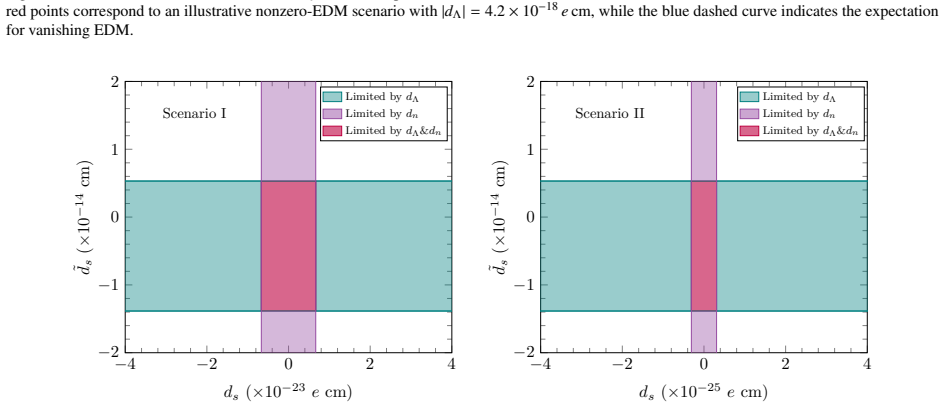
read the original abstract
The prevalence of matter over antimatter in the observable universe remains one of the most profound puzzles in modern physics, necessitating sources of charge-parity (CP) symmetry violation beyond those incorporated in the Standard Model. While electric dipole moments (EDMs) of elementary particles serve as sensitive probes for such new physics, the hyperon sector has historically remained a largely unexplored territory. This review synthesizes recent advancements in the search for hyperon EDMs, focusing on the novel modular angular analysis of entangled baryon-antibaryon pairs produced in $J/\psi$ decays at electron-positron colliders. We discuss the theoretical formalism connecting the electric dipole form factor to full angular distributions and highlight the recent milestone achieved by the BESIII experiment, which established an improved upper limit on the $\Lambda$ EDM. This result represents a three-order-of-magnitude improvement over historical measurements.
Editorial analysis
A structured set of objections, weighed in public.
Referee Report
Summary. The paper is a review synthesizing theoretical and experimental progress on hyperon electric dipole moments (EDMs) as probes of CP violation beyond the Standard Model. It focuses on the connection between the electric dipole form factor and angular distributions in entangled baryon-antibaryon pairs from J/ψ decays, and highlights the BESIII experiment's recent upper limit on the Λ EDM, which is stated to represent a three-order-of-magnitude improvement over prior measurements.
Significance. If the BESIII result holds, the review usefully draws attention to hyperon EDMs as an underexplored sector for new-physics searches at e⁺e⁻ colliders. The modular angular-analysis approach is a methodological strength that could extend to other baryon systems, and the reported improvement quantifies the experimental reach now achievable with existing data sets.
major comments (2)
- [Abstract] Abstract: the headline claim of a three-order-of-magnitude improvement on the Λ EDM upper limit is presented without accompanying quantitative comparison to historical bounds, data-selection criteria, or systematic-error budgets; because this improvement is the central result being synthesized, the review should at minimum tabulate or explicitly reference the numerical values and uncertainty sources from the cited BESIII analysis.
- [BESIII milestone section] Discussion of the modular angular analysis: the text asserts that the method isolates the electric-dipole form-factor contribution, yet provides no explicit validation (e.g., closure tests, background-subtraction studies, or cross-checks against simulated samples) that would allow a reader to assess residual contamination or acceptance biases; this is load-bearing for the reliability of the quoted limit.
minor comments (2)
- A concise table juxtaposing the new BESIII limit with previous experimental bounds would make the claimed improvement immediately visible and should be added.
- Notation for the electric-dipole form factor and its relation to the angular observables should be defined once at first use rather than assumed from the cited literature.
Simulated Author's Rebuttal
We are grateful to the referee for the constructive feedback. We have revised the manuscript to address the concerns raised regarding the abstract and the BESIII milestone section.
read point-by-point responses
-
Referee: [Abstract] Abstract: the headline claim of a three-order-of-magnitude improvement on the Λ EDM upper limit is presented without accompanying quantitative comparison to historical bounds, data-selection criteria, or systematic-error budgets; because this improvement is the central result being synthesized, the review should at minimum tabulate or explicitly reference the numerical values and uncertainty sources from the cited BESIII analysis.
Authors: We agree that a quantitative comparison strengthens the presentation. In the revised manuscript we will insert a compact table (or explicit numerical references) immediately following the headline claim, listing the prior upper limits, the new BESIII bound, and pointers to the data-selection and systematic-error details in the cited BESIII publication. revision: yes
-
Referee: [BESIII milestone section] Discussion of the modular angular analysis: the text asserts that the method isolates the electric-dipole form-factor contribution, yet provides no explicit validation (e.g., closure tests, background-subtraction studies, or cross-checks against simulated samples) that would allow a reader to assess residual contamination or acceptance biases; this is load-bearing for the reliability of the quoted limit.
Authors: The detailed validation studies (closure tests, background-subtraction procedures, and simulation cross-checks) are documented in the original BESIII analysis that we cite. To make the review more self-contained we will add a short paragraph summarizing the key validation results and acceptance-bias checks, with direct references to the relevant figures and supplementary material of the BESIII paper. revision: yes
Circularity Check
No significant circularity identified
full rationale
The paper is a review synthesizing prior BESIII experimental results on the Lambda EDM upper limit via angular analysis of J/psi decays. It references external data and standard theoretical formalism without any internal derivation, fit, or self-citation that reduces the central claim to a self-defined input or fitted parameter. The three-order-of-magnitude improvement is presented as an achieved experimental milestone from cited prior work, with no load-bearing step that collapses by construction to the paper's own equations or ansatz.
Axiom & Free-Parameter Ledger
axioms (1)
- domain assumption The electric dipole form factor is connected to full angular distributions via modular analysis of entangled baryon-antibaryon pairs from J/psi decays.
Reference graph
Works this paper leans on
-
[1]
J. H. Christenson, J. W. Cronin, V . L. Fitch, R. Turlay, Evidence for the 2πDecay of theK 0 2 Meson, Phys. Rev. Lett. 13 (1964) 138–140. doi:10.1103/PhysRevLett.13.138
-
[2]
Abe, et al., Observation of large CP violation in the neutralBmeson system, Phys
K. Abe, et al., Observation of large CP violation in the neutralBmeson system, Phys. Rev. Lett. 87 (2001) 091802. arXiv:hep-ex/0107061, doi:10.1103/PhysRevLett.87.091802
-
[3]
Aubert, et al., Observation of CP violation in theB 0 meson system, Phys
B. Aubert, et al., Observation of CP violation in theB 0 meson system, Phys. Rev. Lett. 87 (2001) 091801. arXiv:hep-ex/0107013, doi:10.1103/PhysRevLett.87.091801
-
[4]
Aaij, et al., Observation of CP Violation in Charm Decays, Phys
R. Aaij, et al., Observation of CP Violation in Charm Decays, Phys. Rev. Lett. 122 (21) (2019) 211803. arXiv:1903.08726, doi:10.1103/PhysRevLett.122.211803
-
[5]
R. Aaij, et al., Observation of charge–parity symmetry breaking in baryon decays, Nature 643 (8074) (2025) 1223–1228. arXiv:2503.16954, doi:10.1038/s41586-025-09119-3
-
[6]
A. D. Sakharov, Violation of CP Invariance, C Asymmetry, and Baryon Asymmetry of the Universe, Pisma Zh. Eksp. Teor. Fiz. 5 (1967) 32–35. doi:10.1070/PU1991v034n05ABEH002497
-
[7]
A. Riotto, Theories of baryogenesis, in: ICTP Summer School in High-Energy Physics and Cosmology, 1998, pp. 326–436. arXiv:hep-ph/9807454
work page internal anchor Pith review arXiv 1998
-
[8]
Beacham, et al., Physics Beyond Colliders at CERN: Beyond the Standard Model Working Group Report, J
J. Beacham, et al., Physics Beyond Colliders at CERN: Beyond the Standard Model Working Group Report, J. Phys. G 47 (1) (2020) 010501. doi:10.1088/1361-6471/ab4cd2
-
[9]
E., Fierlinger, P., Ramsey-Musolf, M
T. Chupp, P. Fierlinger, M. Ramsey-Musolf, J. Singh, Electric dipole moments of atoms, molecules, nuclei, and particles, Rev. Mod. Phys. 91 (1) (2019) 015001. doi:10.1103/RevModPhys.91.015001
-
[10]
Abel, et al., Measurement of the permanent electric dipole moment of the neutron, Phys
C. Abel, et al., Measurement of the permanent electric dipole moment of the neutron, Phys. Rev. Lett. 124 (8) (2020) 081803. doi:10.1103/PhysRevLett.124.081803
-
[11]
B. Graner, Y . Chen, E. G. Lindahl, B. R. Heckel, Reduced Limit on the Permanent Electric Dipole Mo- ment of Hg-199, Phys. Rev. Lett. 116 (16) (2016) 161601, [Erratum: Phys.Rev.Lett. 119, 119901 (2017)]. doi:10.1103/PhysRevLett.116.161601
-
[12]
M. Pospelov, A. Ritz, Electric dipole moments as probes of new physics, Annals Phys. 318 (2005) 119–169. doi:10.1016/j.aop.2005.04.002
-
[13]
K.-B. Chen, X.-G. He, J.-P. Ma, X.-B. Tong, Strange quark dipole constraints from the Lambda electric dipole moment at high momentum transfer, Phys. Rev. Lett. 136 (5) (2026) 051902. doi:10.1103/1x3y-qbcx
-
[14]
L. Pondrom, R. Handler, M. Sheaff, P. T. Cox, J. Dworkin, O. E. Overseth, T. Devlin, L. Schachinger, K. J. Heller, New limit on the electric dipole moment of the lambda hyperon, Phys. Rev. D 23 (1981) 814–816. doi:10.1103/PhysRevD.23.814. 5
-
[15]
BESIII Collaboration, Polarization and entanglement in baryon-antibaryon pair production in electron-positron annihilation, Nature Phys. 15 (2019) 631–634. doi:10.1038/s41567-019-0494-8
-
[16]
M. Ablikim, et al., Probing CP symmetry and weak phases with entangled double-strange baryons, Nature 606 (7912) (2022) 64–69. arXiv:2105.11155, doi:10.1038/s41586-022-04624-1
-
[17]
M. Ablikim, et al., Precise Measurements of Decay Parameters andCPAsymmetry with EntangledΛ− ¯ΛPairs, Phys. Rev. Lett. 129 (13) (2022) 131801. arXiv:2204.11058, doi:10.1103/PhysRevLett.129.131801
-
[18]
Ablikim, et al., Test ofC PSymmetry in Hyperon to Neutron Decays, Phys
M. Ablikim, et al., Test ofC PSymmetry in Hyperon to Neutron Decays, Phys. Rev. Lett. 131 (19) (2023) 191802. arXiv:2304.14655, doi:10.1103/PhysRevLett.131.191802
-
[19]
Ablikim, et al., Tests of CP symmetry in entangledΞ0-Ξ¯0 pairs, Phys
M. Ablikim, et al., Tests of CP symmetry in entangledΞ0-Ξ¯0 pairs, Phys. Rev. D 108 (3) (2023) L031106. arXiv:2305.09218, doi:10.1103/PhysRevD.108.L031106
-
[20]
Ablikim, et al., Strong and Weak CP Tests in Sequential Decays of PolarizedΣ0 Hyperons, Phys
M. Ablikim, et al., Strong and Weak CP Tests in Sequential Decays of PolarizedΣ0 Hyperons, Phys. Rev. Lett. 133 (10) (2024) 101902. arXiv:2406.06118, doi:10.1103/PhysRevLett.133.101902
-
[21]
Ablikim, et al., Precision CP Symmetry Test and Polarization Analysis inΣ+Decays, Phys
M. Ablikim, et al., Precision CP Symmetry Test and Polarization Analysis inΣ+Decays, Phys. Rev. Lett. 135 (14) (2025) 141804. arXiv:2503.17165, doi:10.1103/ysd5-s2gn
-
[22]
Li, Prospects for rare and forbidden hyperon decays at BESIII, Front
H.-B. Li, Prospects for rare and forbidden hyperon decays at BESIII, Front. Phys. (Beijing) 12 (5) (2017) 121301, [Erratum: Front.Phys.(Beijing) 14, 64001 (2019)]. arXiv:1612.01775, doi:10.1007/s11467-017-0691-9
-
[23]
X.-G. He, J. P. Ma, B. McKellar, CP violation in J/psi decay into Lambda anti-Lambda, Phys. Rev. D 47 (1993) R1744–R1746. doi:10.1103/PhysRevD.47.R1744
-
[24]
X.-G. He, J. P. Ma, B. McKellar, CP violation in fermion pair decays of neutral boson particles, Phys. Rev. D 49 (1994) 4548–4552. doi:10.1103/PhysRevD.49.4548
-
[25]
X. G. He, J. P. Ma, Testing P and CP symmetries with e+e- to J/psi to Lambda anti-Lambda, Phys. Lett. B 839 (2023) 137834. doi:10.1016/j.physletb.2023.137834
-
[26]
BESIII Collaboration, Search for Lambda electric dipole moment in J/psi decay (6 2025). arXiv:2506.19180
-
[27]
J. Fu, H.-B. Li, J.-P. Wang, F.-S. Yu, J. Zhang, Probing hyperon electric dipole moments with a full angular analysis, Phys. Rev. D 108 (9) (2023) L091301. doi:10.1103/PhysRevD.108.L091301
-
[28]
M. Achasov, et al., STCF conceptual design report: V olume I – Physics & detector, Front. Phys. (Beijing) 19 (1) (2024) 14701. doi:10.1007/s11467-023-1333-z. 6
discussion (0)
Sign in with ORCID, Apple, or X to comment. Anyone can read and Pith papers without signing in.