Recognition: unknown
The Proton Radius Puzzle
Pith reviewed 2026-05-10 08:20 UTC · model grok-4.3
The pith
Recent experiments have resolved the proton radius puzzle by aligning muonic and electronic measurements.
A machine-rendered reading of the paper's core claim, the machinery that carries it, and where it could break.
Core claim
The author states that the proton radius puzzle arose from discrepant measurements indicating a potential breakdown of the Standard Model via lepton universality violation, but very recent experiments have resolved the discrepancy so that the proton radius puzzle is no more.
What carries the argument
The proton radius extracted from the 2S-2P energy difference in muonic hydrogen, now shown to match values from electronic hydrogen and scattering data through updated measurements.
If this is right
- A single consistent value for the proton radius can now be used in atomic and nuclear calculations.
- Lepton universality holds for the electromagnetic interactions probed by these measurements.
- No modification to Coulomb's law is required at the scale of the proton.
- Precision tests of quantum electrodynamics in hydrogen can proceed with the established radius.
Where Pith is reading between the lines
- Independent replication of the recent agreeing measurements by separate groups would increase in the resolution.
- The now-consistent radius value allows cleaner extraction of proton structure details such as form factors.
- Apparent anomalies in radius measurements for other light nuclei may merit similar cross-checks.
Load-bearing premise
The very recent experiments accurately and completely resolve the original discrepancy without introducing new systematic errors or unaccounted effects.
What would settle it
A follow-up high-precision experiment that again finds a statistically significant difference between the muonic and electronic determinations of the proton radius would show the puzzle remains.
Figures
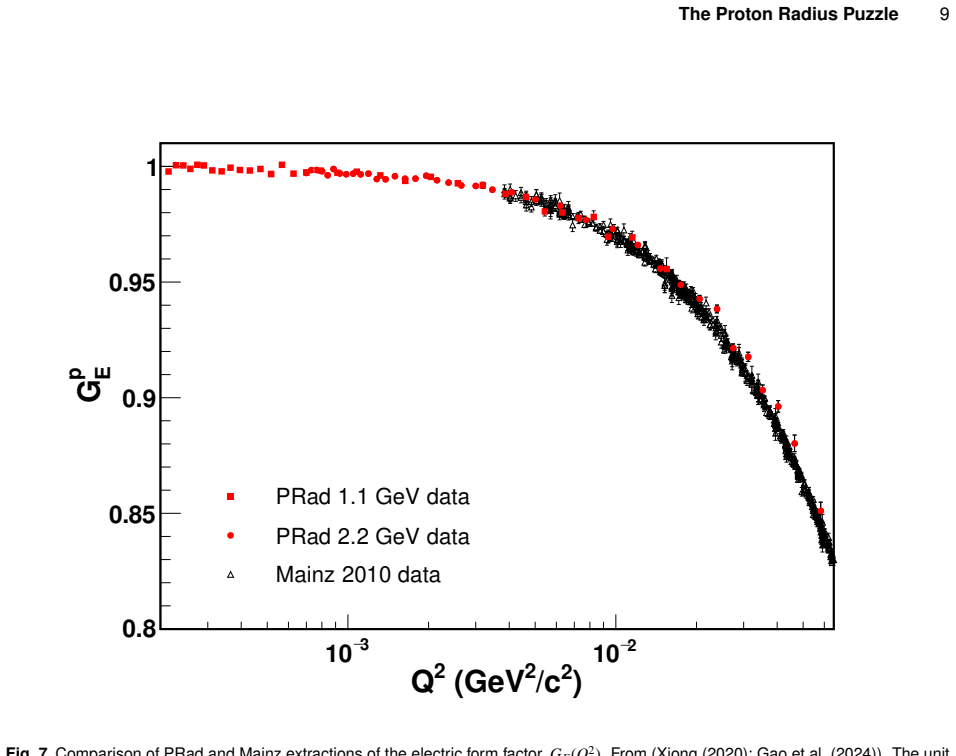
read the original abstract
Pohl et al. measured the energy difference between the 2P and 2S states of muonic hydrogen and used it to determine a precise value of the proton radius. The result disagreed significantly from values extracted from electronic hydrogen and elastic electron-proton scattering. This discrepancy was exciting because it indicated a breakdown of Coulomb's law. In more technical terms, the discrepancy indicated that a fundamental property of the Standard Model, known as lepton universality, could be violated. This chapter explains the origins, meaning and significance of the puzzle. A resolution, based on very recent experiments, is stated. The proton radius puzzle is no more.
Editorial analysis
A structured set of objections, weighed in public.
Referee Report
Summary. The manuscript is a chapter explaining the origins of the proton radius puzzle from the significant discrepancy between the proton charge radius extracted from muonic hydrogen 2S-2P spectroscopy (Pohl et al.) and values from electronic hydrogen spectroscopy and elastic electron-proton scattering. It discusses the implications for a possible violation of lepton universality and Coulomb's law in the Standard Model, and states that the puzzle has been resolved by very recent experiments, concluding that the proton radius puzzle is no more.
Significance. If the stated resolution holds, it would confirm lepton universality and the consistency of electromagnetic interactions for muons and electrons, removing an apparent breakdown in the Standard Model. However, the manuscript is expository and contains no new data, derivations, error analyses, or quantitative comparisons, so its significance is limited to providing historical and conceptual context rather than advancing or validating the resolution.
major comments (1)
- [Abstract] Abstract: The central claim that 'the proton radius puzzle is no more' and that it is resolved 'based on very recent experiments' is load-bearing for the manuscript but is unsupported by any specific experimental results, radius values with uncertainties, systematic error discussions, or citations within the text. The abstract provides only the historical discrepancy without internal validation or details on how the recent experiments reconcile the muonic (~0.84 fm) and electronic (~0.88 fm) values.
Simulated Author's Rebuttal
We thank the referee for the careful reading and constructive comments on our expository chapter. We address the single major comment below.
read point-by-point responses
-
Referee: [Abstract] Abstract: The central claim that 'the proton radius puzzle is no more' and that it is resolved 'based on very recent experiments' is load-bearing for the manuscript but is unsupported by any specific experimental results, radius values with uncertainties, systematic error discussions, or citations within the text. The abstract provides only the historical discrepancy without internal validation or details on how the recent experiments reconcile the muonic (~0.84 fm) and electronic (~0.88 fm) values.
Authors: We agree that the abstract would be strengthened by explicit support for the resolution claim. The manuscript is an expository overview of the puzzle's origins and implications rather than a data analysis paper, so it references rather than re-derives the recent results. In revision we will expand the abstract to cite the key recent experiments (e.g., the updated CREMA muonic-hydrogen results and the latest electronic-hydrogen and scattering determinations) and briefly note the now-consistent radius value near 0.84 fm. This adds the requested citations and reconciliation statement while preserving the chapter's high-level scope. revision: yes
Circularity Check
No circularity: paper is a non-derivational historical summary relying on external experiments
full rationale
The manuscript contains no equations, derivations, fitted parameters, or internal predictions. It functions purely as a review summarizing the history of the proton radius discrepancy and citing external recent experiments for resolution. No load-bearing claim reduces by construction to the paper's own inputs or self-citations. The central assertion (puzzle resolved) is presented as dependent on independent experimental results outside the paper, satisfying the self-contained benchmark criterion.
Axiom & Free-Parameter Ledger
Reference graph
Works this paper leans on
-
[1]
Precise determination of the proton magnetic radius from electron scattering data.Phys
Alarc´on JM, Higinbotham DW and Weiss C (2020). Precise determination of the proton magnetic radius from electron scattering data.Phys. Rev. C102 (3): 035203. doi:10.1103/PhysRevC.102.035203.2002.05167. Aliberti R and et al. (2025). The anomalous magnetic moment of the muon in the Standard Model: an update.Phys. Rept.1143: 1–158. doi:10.1016/j.physrep.202...
-
[2]
Behaviour of large-area avalanche photodiodes under intense magnetic fields for vuv- visible- and x-ray photon detection.Nucl. Inst. Meth. A498 (1-3): 362–368. Fleurbaey H, Galtier S, Thomas S, Bonnaud M, Julien L, Biraben F , Nez F , Abgrall M and Gu ´ena J (2018). New Measurement of the1S− 3STransition Frequency of Hydrogen: Contribution to the Proton C...
-
[3]
doi:10.22323/1.413.0005. Gasparian A and et al. (PRad) (2020),
-
[4]
PRad-II: A New Upgraded High Precision Measurement of the Proton Charge Radius2009.10510. Gilman R and et al. (MUSE) (2013),
-
[5]
Goswami R, Talukdar P , Das B, Raha U and Myhrer F (2025)
Studying the Proton ”Radius” Puzzle with\mu p Elastic Scattering1303.2160. Goswami R, Talukdar P , Das B, Raha U and Myhrer F (2025). Lepton-proton two-photon exchange with improved soft-photon approximation including proton’s structure effects in HBχPT.Phys. Rev. D111 (11): 113009. doi:10.1103/PhysRevD.111.113009. Grinin A, Matveev A, Y ost DC, Maisenbac...
-
[7]
The anomalous magnetic moment of the muon: status and perspectives.Ann. Rev. Nucl. Part. Sci doi:10.1146/annurev-nucl-102422-040841.2512.16980. Hofstadter R and McAllister RW (1955). Electron Scattering From the Proton.Phys. Rev.98: 217–218. doi:10.1103/PhysRev.98.217. Jegerlehner F and Nyffeler A (2009). The Muon g-2.Phys. Rept.477: 1–110. doi:10.1016/j....
work page doi:10.1146/annurev-nucl-102422-040841.2512.16980 1955
-
[8]
AMBER – A Strong-Interaction Facility at CERN doi:10.1080/10619127.2026.2614257.2601.06570. Kottmann F , Daniel H, Hartmann FJ, Hauser P , Maierl C, Markushin VE, M¨uhlbauer M, Petitjean C, Pohl R, Schott W and Taqqu D (1999). Kinetic energies of exotic H atoms at formation and cascade.Hyp. Interact.119:
-
[9]
Proc., 564, 13–20
Kottmann F , Biraben F , Conde CAN, Donche-Gay C, H¨ansch TW, Hartmann FJ, Hauser P , Hughes V, Huot O, Indelicato P , Knowles P , Liu YW, Markushin V, Mulhauser F , Nez F , Pohl R, Rabinowitz P , dos Santos J, Schaller L, Schneuwly H, Schott W, Taqqu D and Veloso J (2001), Towards a Lamb shift measurement in muonic hydrogen, Cantatore G, (Ed.), Quantum E...
2001
-
[10]
Lehmann P , Taylor R and Wilson R (1962)
Nucleon charge radius measurement with low-energy electron scattering2507.19862. Lehmann P , Taylor R and Wilson R (1962). Electron-proton scattering at low momentum transfers.Phys. Rev.126:
-
[11]
Testing lepton universality with ep andµp elastic scattering in the MUSE experiment
Lin WW (2024). Testing lepton universality with ep andµp elastic scattering in the MUSE experiment. Ph.D. thesis, Rutgers U., Piscataway (main). doi:10.7282/t3-s46b-6761. Liu YS, McKeen D and Miller GA (2016). Electrophobic Scalar Boson and Muonic Puzzles.Phys. Rev. Lett.117 (10): 101801. doi:10.1103/ PhysRevLett.117.101801.1605.04612. Liu YS, McKeen D an...
-
[12]
Nucleon Electromagnetic Form Factors,
Parthey CG, Matveev A, Alnis J, Bernhard B, Beyer A, Holzwarth R, Maistrou A, Pohl R, Predehl K, Udem T, Wilken T, Kolachevsky N, Abgrall M, Rovera D, Salomon C, Laurent P and H¨ansch TW (2011). Improved measurement of the hydrogen 1S–2S transition frequency.Phys. Rev. Lett. 107: 203001.[arXiv: 1107.3101 (atom-ph)]. Perdrisat CF , Punjabi V and Vanderhaeg...
work page doi:10.1016/j.ppnp.2007.05.001.hep-ph/0612014 2011
-
[13]
Absolute electron-proton cross sections at low momentum transfer measured with a high pressure gas target system.Nucl
Simon GG, Schmitt C, Borowski F and Walther VH (1990). Absolute electron-proton cross sections at low momentum transfer measured with a high pressure gas target system.Nucl. Phys. A333 (3): 381–391. Strauch S (MUSE) (2018). The MUon Scattering Experiment (MUSE) at the Paul Scherrer Institute.PoSNuFACT2018:
1990
-
[14]
Suda T (2025). Low-energy electron scattering for nucleons and exotic nuclei - ULQ2 and SCRIT -.Nucl. Phys. A1060: 123122. doi:10.1016/j. nuclphysa.2025.123122. Tucker-Smith D and Y avin I (2011). Muonic hydrogen and MeV forces.Phys. Rev. D83: 101702. doi:10.1103/PhysRevD.83.101702.1011.4922. Wang Y and et al. (A1, MAGIX) (2022). Low-Q2 elastic electron-p...
work page doi:10.1016/j 2025
-
[15]
doi:10.3390/universe9040182. 2302.13818. Xiong W and et al. (2019). A small proton charge radius from an electron–proton scattering experiment.Nature575 (7781): 147–150. doi: 10.1038/s41586-019-1721-2. Yzombard P , Thomas S, Julien L, Biraben F and Nez F (2023). 1S-3S cw spectroscopy of hydrogen/deuterium atom.Eur. Phys. J.77 (2):
-
[16]
Zhan X, Allada K, Armstrong DS, Arrington J, Bertozzi W, Boeglin W and et al
doi:10.1140/epjd/s10053-023-00605-9.2302.07537. Zhan X, Allada K, Armstrong DS, Arrington J, Bertozzi W, Boeglin W and et al. (2011). High-precision measurement of the proton elastic form factor ratioµ pGE /GM at lowQ 2.Phys. Lett. B705: 59
work page doi:10.1140/epjd/s10053-023-00605-9.2302.07537 2011
discussion (0)
Sign in with ORCID, Apple, or X to comment. Anyone can read and Pith papers without signing in.