Recognition: unknown
Exact Analysis of a One-Dimensional Yang-Gaudin Model with Two-Body Loss
Pith reviewed 2026-05-10 08:16 UTC · model grok-4.3
The pith
The one-dimensional Yang-Gaudin model with two-body loss remains exactly solvable for both bosons and fermions.
A machine-rendered reading of the paper's core claim, the machinery that carries it, and where it could break.
Core claim
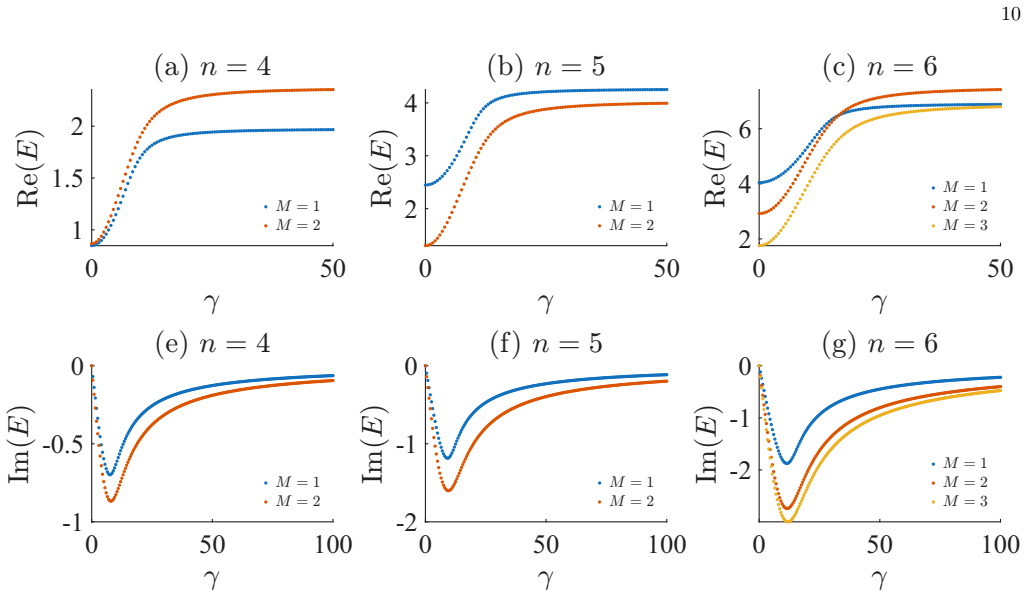
The one-dimensional Yang-Gaudin model with two-body loss remains exactly solvable irrespective of whether constituent particles are bosons or fermions. By relating the Liouvillian spectrum to the right eigenvalues of a non-Hermitian effective Hamiltonian obtained by complexifying the interaction strength, we derive a general expression for the initial particle-loss rate. We then solve the two-body problem exactly and show that, in the bosonic singlet sector, the effective Hamiltonian has real right eigenvalues and the master equation admits steady-state solutions. For many-body systems with three or more particles, we further show that dissipation reverses which spin configurations are most
What carries the argument
The non-Hermitian effective Hamiltonian obtained by complexifying the interaction strength, whose right eigenvalues supply the Liouvillian spectrum of the lossy system.
If this is right
- An exact closed-form expression exists for the initial particle-loss rate.
- In the bosonic two-body singlet sector the master equation possesses steady-state solutions.
- In many-body bosonic systems, antiferromagnetic-like spin configurations decay more slowly than ferromagnetic-like ones.
- In many-body fermionic systems, ferromagnetic-like spin configurations decay more slowly than antiferromagnetic-like ones.
Where Pith is reading between the lines
- The same complexification trick may turn other integrable models with two-body loss into exactly solvable open systems.
- Ultracold-atom experiments in one-dimensional traps could prepare specific spin states and measure their relative lifetimes to test the predicted reversal of stability.
- Real eigenvalues in selected sectors imply the existence of long-lived dissipative steady states whose properties can be computed without approximation.
- The approach could be extended to calculate time-dependent observables or finite-temperature states by the same spectral mapping.
Load-bearing premise
The Liouvillian spectrum of the lossy many-body system is given exactly by the right eigenvalues of the non-Hermitian Hamiltonian with complexified interaction strength.
What would settle it
A numerical or experimental check of the three-particle decay rates that fails to match the imaginary parts of the energies from the Bethe-ansatz solution of the complex-interaction Hamiltonian would disprove the mapping.
Figures


read the original abstract
We show that the one-dimensional Yang-Gaudin model with two-body loss remains exactly solvable irrespective of whether constituent particles are bosons or fermions. By relating the Liouvillian spectrum to the right eigenvalues of a non-Hermitian effective Hamiltonian obtained by complexifying the interaction strength, we derive a general expression for the initial particle-loss rate. We then solve the two-body problem exactly and show that, in the bosonic singlet sector, the effective Hamiltonian has real right eigenvalues and the master equation admits steady-state solutions. For many-body systems with three or more particles, we further show that dissipation reverses which spin configurations are most stable: in bosonic systems it favors antiferromagnetic-like configurations over ferromagnetic-like ones, whereas in fermionic systems it favors ferromagnetic-like configurations over antiferromagnetic-like ones.
Editorial analysis
A structured set of objections, weighed in public.
Referee Report
Summary. The manuscript claims that the one-dimensional Yang-Gaudin model with two-body loss remains exactly solvable for both bosons and fermions. It relates the Liouvillian spectrum to the right eigenvalues of a non-Hermitian effective Hamiltonian obtained by complexifying the interaction strength, derives a general expression for the initial particle-loss rate, solves the two-body problem exactly (including real eigenvalues and steady states in the bosonic singlet sector), and shows that for N≥3 dissipation reverses the most stable spin configurations (antiferromagnetic-like favored in bosons, ferromagnetic-like in fermions).
Significance. If the central mapping holds, the work supplies one of the few exact many-body solutions for an integrable model with dissipation, yielding a parameter-free initial-loss-rate formula and concrete predictions for loss-induced stability reversal that could be tested in ultracold-atom experiments. The two-body exact solution and the general loss-rate expression are concrete strengths.
major comments (1)
- [Many-body analysis section] The section on many-body systems (following the two-body solution): the assertion that the Liouvillian spectrum for arbitrary N is obtained directly from the right eigenvalues of the non-Hermitian Hamiltonian with complexified interaction is stated without an explicit derivation showing that the Lindblad jump operators for two-body loss introduce no additional terms that modify the eigenstructure for N≥3. This mapping is load-bearing for the exact-solvability claim and for the reported reversal of stable spin configurations.
minor comments (2)
- [Introduction and effective-Hamiltonian paragraph] The precise definition of the complexified interaction strength (e.g., the replacement rule and its relation to the loss parameter) should be stated explicitly at first use rather than left implicit from the two-body sector.
- [Two-body results figures] Figure captions for the two-body spectra could include the explicit values of the complexified coupling used in the plots to aid reproducibility.
Simulated Author's Rebuttal
We thank the referee for their careful reading of the manuscript and for identifying the need for a more explicit derivation of the Liouvillian mapping in the many-body regime. We address this point directly below and will incorporate the requested clarification in the revised version.
read point-by-point responses
-
Referee: The section on many-body systems (following the two-body solution): the assertion that the Liouvillian spectrum for arbitrary N is obtained directly from the right eigenvalues of the non-Hermitian Hamiltonian with complexified interaction is stated without an explicit derivation showing that the Lindblad jump operators for two-body loss introduce no additional terms that modify the eigenstructure for N≥3. This mapping is load-bearing for the exact-solvability claim and for the reported reversal of stable spin configurations.
Authors: We agree that an explicit derivation of the mapping for N≥3 would strengthen the presentation. The two-body loss jump operators are of the form L_{ij} ∝ ψ_i ψ_j (with appropriate symmetrization for bosons or antisymmetrization for fermions). When the master equation is written in the basis of right eigenstates of the non-Hermitian Hamiltonian H_eff = H - (i/2) ∑ L†L (with complexified interaction), the anticommutator term produces precisely the imaginary shift already included in H_eff, while the jump term L ρ L† maps any eigenstate back into the same total-N sector without introducing off-diagonal mixing between distinct Bethe-ansatz solutions. This follows because the loss operators preserve the integrability structure of the Yang-Gaudin model (they commute with the total spin and with the conserved charges of the underlying integrable hierarchy). Consequently, the right eigenvalues of H_eff directly furnish the decay rates of the Liouvillian. We will add a short subsection after the two-body solution that spells out this argument step by step, including the action of the jump operators on a generic Bethe-ansatz wave function for N=3 and N=4 as illustrative cases. This addition will also make the reversal of stable spin configurations for N≥3 fully rigorous. revision: yes
Circularity Check
No significant circularity; derivation relies on independent mapping and explicit two-body solution
full rationale
The paper's central claim rests on relating the Liouvillian spectrum to right eigenvalues of a non-Hermitian Hamiltonian via complexification of the interaction strength. This technique is presented as a standard approach grounded in prior literature rather than derived from the paper's own results. The two-body problem is solved exactly with explicit eigenstates and eigenvalues, and many-body statements about spin stability follow from applying the same mapping without re-fitting or redefining quantities in terms of themselves. No self-citation forms a load-bearing chain, no ansatz is smuggled, and no prediction reduces to a fitted input by construction. The derivation chain is self-contained against external benchmarks.
Axiom & Free-Parameter Ledger
axioms (1)
- domain assumption The Liouvillian spectrum can be related to the right eigenvalues of a non-Hermitian Hamiltonian obtained by complexifying the interaction strength.
Reference graph
Works this paper leans on
-
[1]
This implies that even in the attractive case (c <0), there are no bound states, i.e., no string solutions
= 2ℏ2(n′2 + (n−n ′)2)π2 mL2 (48) which is a non-negative real number. This implies that even in the attractive case (c <0), there are no bound states, i.e., no string solutions. Moreover, sinceH eff has only real right eigenvalues in this sector, Eq. (33) shows that the initial particle-loss rate vanishes for a pure state |r2 j ⟩ ⟨r2 j |constructed from t...
-
[2]
Writingk 1 =x 1 +iy 1 andk 2 =x 2 +iy 2; (x1, y1, x2, y2 ∈R), Eq
(57) is real. Writingk 1 =x 1 +iy 1 andk 2 =x 2 +iy 2; (x1, y1, x2, y2 ∈R), Eq. (56) implies x1 +x 2 +i(y 1 +y 2) = 2nπ L ∈R,(58) and hencey 2 =−y 1. In this case, 2m ℏ2 E=x 2 1 +x 2 2 −2y 2 1 + 2(x1 −x 2)y1i.(59) Thus, ifEis real, eitherx 1 =x 2 ory 1 = 0 must hold. First, consider the casex 1 =x 2. In this case,k 2 =k ∗ 1. From Eq. (54), we have eik1L =...
-
[3]
Writingk 1 =x 1 +iy 1 andk 2 =x 2 +iy 2 (x1, y1, x2, y2 ∈R), Eq
(74) is real. Writingk 1 =x 1 +iy 1 andk 2 =x 2 +iy 2 (x1, y1, x2, y2 ∈R), Eq. (72) implies x1 +x 2 +i(y 1 +y 2) = 2nπ L ∈R,(75) which leads toy 2 =−y 1. Then 2m ℏ2 E=x 2 1 +x 2 2 −2y 2 1 + 2(x1 −x 2)y1i.(76) Hence, ifEis real, eitherx 1 =x 2 ory 1 = 0 must hold. First, consider the casex 1 =x 2. Thenk 2 =k ∗
-
[4]
(69), we have e−ik∗ 1 L = k∗ 1 −l−ic ′∗/2 k∗ 1 −l+ic ′∗/2 ,(77) ∴e ik∗ 1 L = k∗ 1 −l+ic ′∗/2 k∗ 1 −l−ic ′∗/2 .(78) On the other hand, from Eq
From Eq. (69), we have e−ik∗ 1 L = k∗ 1 −l−ic ′∗/2 k∗ 1 −l+ic ′∗/2 ,(77) ∴e ik∗ 1 L = k∗ 1 −l+ic ′∗/2 k∗ 1 −l−ic ′∗/2 .(78) On the other hand, from Eq. (70), eik∗ 1 L = k∗ 1 −l+ic ′/2 k∗ 1 −l−ic ′/2 .(79) 7 Thus, k∗ 1 −l+ic ′∗/2 k∗ 1 −l−ic ′∗/2 = k∗ 1 −l+ic ′/2 k∗ 1 −l−ic ′/2 ,(80) which leads to (k∗ 1 −l)(c ′ −c ′∗) = 0.(81) Assumingc ′ ̸=c ′∗, we obtain...
-
[5]
In the limit of large L,Econverges to−c ′2/2
(a) Dots shows right eigenvalues forc=−0.1 andγ= 0.1, asLis increased from 10 to 300, the right eigenvalues evolve in the direction indicated by the red arrows. In the limit of large L,Econverges to−c ′2/2. (b) Dots shows right eigenvalues forc=−0.1 andL= 100, asγis increased from 0 to 100, the right eigenvalues evolve in the direction indicated by the re...
-
[6]
In this case, Eq. (71) impliesl= 0, and the corre- sponding right eigenvalue is given by E=− ℏ2 2m c′2 2 +O(e −|Im(k1)|L) (90) This shows that for sufficiently largeLand smallγ, Re(E)<0, indicating a bound state. We have numerically confirmed the existence of such solutions in the singlet sector of the two-body fermionic Yang–Gaudin model. Figure 1(a) ill...
-
[7]
From the continuity of the wavefunction Eq
Eigenstates of the bosonic Y ang-Gaudin model We first derive eigenstates of the bosonic Yang-Gaudin model. From the continuity of the wavefunction Eq. (15) and its first derivative at equal positions asx j =x j+1, we have A{σQ}({kP σj(j+1) }) = (kPj −k Pj+1)A{σQσj(j+1) }({kP })−ic ′A{σQ}({kP }) kPj −k Pj+1 +ic ′ , (B1) whereA {σQ}({kP })≡A σQ1 ···σQn (kP...
-
[8]
It suffices to prove that S+B(l1)· · ·B(l M)|vac⟩= 0
Highest-weight states We now show thatS +ψR = 0. It suffices to prove that S+B(l1)· · ·B(l M)|vac⟩= 0. From [X(a,j)(ξ), Ia ⊗σ (u) j ] = [σ(u) a ⊗I, X (a,j)(ξ)],(B30) we obtain T (a)(l), nX j=1 Ia ⊗σ s j = [σs a ⊗I, T (a)(l)].(B31) Since S+ = 1 2 nX j=1 σ+ j = 1 2 nX j=1 σ1 j ±iσ 2 j ,(B32) we have 1 2 nX j=1 Ia ⊗ σ(1) j +iσ (2) j = S+ 0 0S + ,(B33)...
-
[9]
The fermionic Y ang-Gaudin model In this subsection, we describe only the points that differ from the bosonic case. For fermions, we have Y (a,b)(ξ) = ic′ ξ+ic ′ IVa⊗Vb + ξ ξ+ic ′ Π(a,b),(B40) Accordingly, X(a,j)(ξ) = 1 ξ+ic ′ ξ+ ic′ 2 I+ ic′σ(3) j 2 ic′σ− j ic′σ+ j ξ+ ic′ 2 I− ic′σ(3) j 2 . (B41) In contrast to the bosonic case, we setλ j =k Pj...
-
[10]
Breuer and F
H.-P. Breuer and F. Petruccione, The Theory of Open Quantum Systems (Oxford University Press, Oxford, 2007)
2007
-
[11]
Lindblad, Commun
G. Lindblad, Commun. Math. Phys.48, 119 (1976)
1976
-
[12]
Gorini, A
V. Gorini, A. Kossakowski, and E. C. G. Sudarshan, J. Math. Phys. (N.Y.)17, 821 (1976)
1976
-
[13]
Prosen, New J
T. Prosen, New J. Phys.10, 043026 (2008)
2008
-
[14]
Prosen, Phys
T. Prosen, Phys. Rev. Lett.107, 137201 (2011)
2011
-
[15]
Karevski, V
D. Karevski, V. Popkov, and G. M. Sch¨ utz, Phys. Rev. Lett.110, 047201 (2013)
2013
-
[16]
Prosen, Phys
T. Prosen, Phys. Rev. Lett.112, 030603 (2014)
2014
-
[17]
M. V. Medvedyeva, F. H. L. Essler, and T. Prosen, Phys. Rev. Lett.117, 137202 (2016)
2016
-
[18]
Banchi, D
L. Banchi, D. Burgarth, and M. J. Kastoryano, Phys. Rev. X7, 041015 (2017)
2017
-
[19]
D. A. Rowlands and A. Lamacraft, Phys. Rev. Lett.120, 090401 (2018)
2018
-
[20]
Ribeiro and T
P. Ribeiro and T. Prosen, Phys. Rev. Lett.122, 010401 (2019)
2019
-
[21]
Shibata and H
N. Shibata and H. Katsura, Phys. Rev. B99, 174303 (2019)
2019
-
[22]
Shibata and H
N. Shibata and H. Katsura, Phys. Rev. B99, 224432 (2019)
2019
-
[23]
A. A. Ziolkowska and F. H. Essler, SciPost Phys.8, 44 (2020)
2020
-
[24]
Nakagawa, N
M. Nakagawa, N. Kawakamim M. Ueda, Phys. Rev. Lett. 126, 110404 (2021)
2021
-
[25]
E. H. Lieb and W. Liniger, Phys. Rev.130, 1605 (1963)
1963
-
[26]
C. N. Yang, Phys. Rev. Lett.19, 1312 (1967)
1967
-
[27]
Gaudin, Phys
M. Gaudin, Phys. Lett. A24, 55 (1967)
1967
-
[28]
Hall et al., Phys
D.S. Hall et al., Phys. Rev. Lett.81, 1539 (1998)
1998
-
[29]
Miesner et al., Phys
H.J. Miesner et al., Phys. Rev. Lett.82, 2228 (1999)
1999
-
[30]
Li et al., Europhys
Y.Q. Li et al., Europhys. Lett.61, 368 (2003)
2003
-
[31]
Fuchs et al., Phys
J.N. Fuchs et al., Phys. Rev. Lett.95, 150402 (2005)
2005
-
[32]
Nitta, S
M. Nitta, S. Uchino and W. Vinci, J. High Energ. Phys. 2014, 98 (2014)
2014
-
[33]
Syassen, D
N. Syassen, D. M. Bauer, M. Lettner, T. Volz, D. Dietze, J. J. Garc´ ıa-Ripoll, J. I. Cirac, G. Rempe, and S. D¨ urr, Science320, 1329 (2008)
2008
-
[34]
D¨ urr, J
S. D¨ urr, J. J. Garc´ ıa-Ripoll, N. Syassen, D. M. Bauer, M. Lettner, J. I. Cirac, and G. Rempe, Phys. Rev. A79, 023614 (2009)
2009
-
[35]
Nakagawa, N
M. Nakagawa, N. Tsuji, N. Kawakami, M. Ueda, Phys. Rev. Lett.124, 147203 (2020)
2020
-
[36]
F. H. L. Essler, H. Frahm, F. G¨ ohmann, A. Kl¨ umper, and V. E. Korepin, The One-Dimensional Hubbard Model (Cambridge University Press, Cambridge, 2005)
2005
-
[37]
J. M. Torres, Phys. Rev. A89, 052133 (2014)
2014
-
[38]
Deguchi et al., Phys
T. Deguchi et al., Phys. Rep.331, 197 (2000)
2000
discussion (0)
Sign in with ORCID, Apple, or X to comment. Anyone can read and Pith papers without signing in.