Recognition: unknown
Bridge the Gap between Classical and Quantum Neural Networks with Residual Connections
Pith reviewed 2026-05-10 08:52 UTC · model grok-4.3
The pith
HQRN creates an exact functional match to classical residual networks on basis inputs while using quantum correlations for better performance on mixed states in digit recognition and entanglement classification.
A machine-rendered reading of the paper's core claim, the machinery that carries it, and where it could break.
Core claim
We introduce a Hybrid Quantum Residual Network (HQRN) and establish an exact functional correspondence between its state evolution and the dynamics of classical networks with residual connections.
Load-bearing premise
That restricting inputs to the computational basis causes the HQRN to reduce exactly to its classical analog, enabling direct weight translation without additional quantum effects altering the dynamics.
Figures


read the original abstract
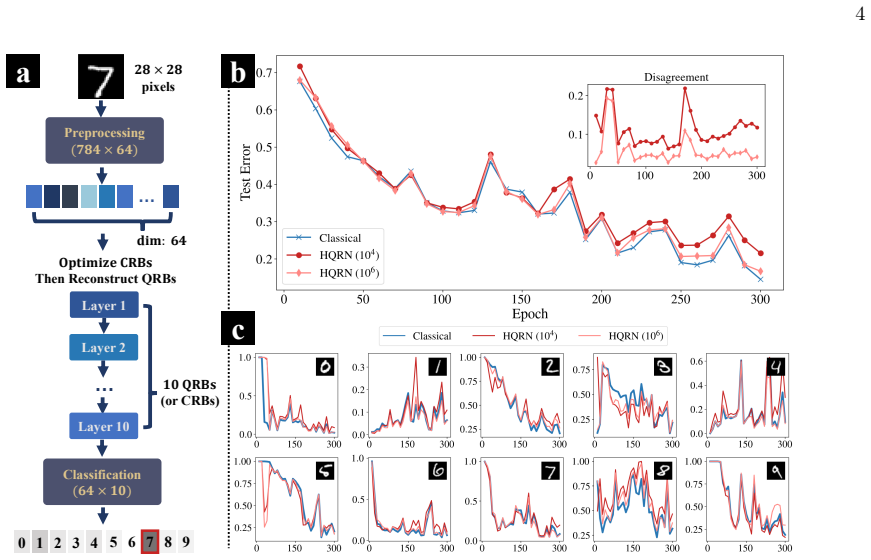
We introduce a Hybrid Quantum Residual Network (HQRN) and establish an exact functional correspondence between its state evolution and the dynamics of classical networks with residual connections. When inputs are restricted to the computational basis, the HQRN reduces to its classical analog, enabling the direct translation of optimized classical weights into quantum unitary operations, effectively inheriting the landscape benefits of classical optimization. Conversely, when processing general mixed states, the HQRN leverages off-diagonal quantum correlations to resolve features inaccessible to its classical analog. We validate this framework through digit recognition and bipartite entanglement classification. Notably, HQRN achieves high classification accuracy even for adversarial separable states that mimic the marginal measurement statistics of entangled pairs. Our results bridge the gap between classical and quantum residual learning, paving a scalable pathway for deep quantum architectures.
Editorial analysis
A structured set of objections, weighed in public.
Axiom & Free-Parameter Ledger
axioms (1)
- domain assumption Quantum network state evolution can be engineered to match classical residual dynamics exactly when inputs are restricted to computational basis states.
invented entities (1)
-
Hybrid Quantum Residual Network (HQRN)
no independent evidence
Reference graph
Works this paper leans on
-
[1]
Schuld, I
M. Schuld, I. Sinayskiy, and F. Petruccione, An in- troduction to quantum machine learning, Contem- porary Physics56, 172 (2015)
2015
-
[2]
Biamonte, P
J. Biamonte, P. Wittek, N. Pancotti, P. Rebentrost, N. Wiebe, and S. Lloyd, Quantum machine learn- ing, Nature549, 195 (2017). 7
2017
-
[3]
Huang, M
H.-Y. Huang, M. Broughton, M. Mohseni, R. Bab- bush, S.Boixo, H.Neven,andJ.R.McClean,Power of data in quantum machine learning, Nature com- munications12, 2631 (2021)
2021
-
[4]
Sajjan, J
M. Sajjan, J. Li, R. Selvarajan, S. H. Sureshbabu, S. S. Kale, R. Gupta, V. Singh, and S. Kais, Quan- tum machine learning for chemistry and physics, Chemical Society Reviews51, 6475 (2022)
2022
-
[5]
Cerezo, G
M. Cerezo, G. Verdon, H.-Y. Huang, L. Cincio, and P. J. Coles, Challenges and opportunities in quan- tum machine learning, Nature computational sci- ence2, 567 (2022)
2022
-
[6]
Y.LeCun, Y.Bengio,andG.Hinton,Deeplearning, nature521, 436 (2015)
2015
-
[7]
Wu, W.-S
Y. Wu, W.-S. Bao, S. Cao, F. Chen, M.-C. Chen, X. Chen, T.-H. Chung, H. Deng, Y. Du, D. Fan, et al.,Strongquantumcomputationaladvantageus- ing a superconducting quantum processor, Physical review letters127, 180501 (2021)
2021
-
[8]
A. J. Daley, I. Bloch, C. Kokail, S. Flannigan, N. Pearson, M. Troyer, and P. Zoller, Practical quantum advantage in quantum simulation, Nature 607, 667 (2022)
2022
-
[9]
Huang, M
H.-Y. Huang, M. Broughton, J. Cotler, S. Chen, J. Li, M. Mohseni, H. Neven, R. Babbush, R. Kueng, J. Preskill,et al., Quantum advantage in learning from experiments, Science376, 1182 (2022)
2022
-
[10]
Aaronson, Read the fine print, Nature Physics 11, 291 (2015)
S. Aaronson, Read the fine print, Nature Physics 11, 291 (2015)
2015
-
[11]
Ristè, M
D. Ristè, M. P. Da Silva, C. A. Ryan, A. W. Cross, A. D. Córcoles, J. A. Smolin, J. M. Gambetta, J. M. Chow, and B. R. Johnson, Demonstration of quan- tum advantage in machine learning, npj Quantum Information3, 16 (2017)
2017
-
[12]
Huang, R
H.-Y. Huang, R. Kueng, and J. Preskill, Information-theoretic bounds on quantum ad- vantage in machine learning, Physical Review Letters126, 190505 (2021)
2021
-
[13]
Anshu, S
A. Anshu, S. Arunachalam, T. Kuwahara, and M. Soleimanifar, Sample-efficient learning of inter- acting quantum systems, Nature Physics17, 931 (2021)
2021
-
[14]
Lewis, D
L. Lewis, D. Gilboa, and J. R. McClean, Quantum advantage for learning shallow neural networks with natural data distributions, Nature Communications (2025)
2025
-
[15]
Zhao and D.-L
H. Zhao and D.-L. Deng, Entanglement-induced provable and robust quantum learning advantages, npj Quantum Information11, 127 (2025)
2025
-
[16]
Mind the gaps: The fraught road to quantum advantage
J. Eisert and J. Preskill, Mind the gaps: The fraught road to quantum advantage, arXiv preprint arXiv:2510.19928 (2025)
-
[17]
H.-Y. Huang, S. Choi, J. R. McClean, and J. Preskill, The vast world of quantum advantage, arXiv preprint arXiv:2508.05720 (2025)
-
[18]
Schuld, A
M. Schuld, A. Bocharov, K. M. Svore, and N. Wiebe, Circuit-centric quantum classifiers, Phys- ical Review A101, 032308 (2020)
2020
-
[19]
A. Mari, T. R. Bromley, J. Izaac, M. Schuld, and N. Killoran, Transfer learning in hybrid classical- quantum neural networks, Quantum4, 340 (2020)
2020
-
[20]
K. Beer, D. Bondarenko, T. Farrelly, T. J. Osborne, R. Salzmann, D. Scheiermann, and R. Wolf, Train- ing deep quantum neural networks, Nature commu- nications11, 808 (2020)
2020
-
[21]
Li, Knowledge distillation inspired variational quantum eigensolver with virtual annealing, New Journal of Physics28, 024501 (2026)
J. Li, Knowledge distillation inspired variational quantum eigensolver with virtual annealing, New Journal of Physics28, 024501 (2026)
2026
-
[22]
M. Broughton, G. Verdon, T. McCourt, A. J. Martinez, J. H. Yoo, S. V. Isakov, P. Massey, R. Halavati, M. Y. Niu, A. Zlokapa,et al., Tensor- flow quantum: A software framework for quantum machine learning, arXiv preprint arXiv:2003.02989 (2020)
-
[23]
I. Cong, S. Choi, and M. D. Lukin, Quantum convo- lutional neural networks, Nature Physics15, 1273 (2019)
2019
-
[24]
Ceschini, A
A. Ceschini, A. Carbone, A. Sebastianelli, M. Panella, and B. Le Saux, On hybrid quanvolu- tional neural networks optimization, Quantum Ma- chine Intelligence7, 18 (2025)
2025
-
[25]
Y. Li, Z. Wang, R. Han, S. Shi, J. Li, R. Shang, H. Zheng, G. Zhong, and Y. Gu, Quantum recur- rent neural networks for sequential learning, Neural Networks166, 148 (2023)
2023
-
[26]
Takaki, K
Y. Takaki, K. Mitarai, M. Negoro, K. Fujii, and M. Kitagawa, Learning temporal data with a varia- tional quantum recurrent neural network, Physical Review A103, 052414 (2021)
2021
-
[27]
Liang, W
Y. Liang, W. Peng, Z.-J. Zheng, O. Silvén, and G. Zhao, A hybrid quantum–classical neural net- work with deep residual learning, Neural Networks 143, 133 (2021)
2021
-
[28]
J. Wen, Z. Huang, D. Cai, and L. Qian, Enhanc- ing the expressivity of quantum neural networks with residual connections, Communications Physics 7, 220 (2024)
2024
-
[29]
Kashif and S
M. Kashif and S. Al-Kuwari, Resqnets: a residual approach for mitigating barren plateaus in quantum neural networks, EPJ Quantum Technology11, 1 (2024)
2024
-
[30]
J. R. McClean, S. Boixo, V. N. Smelyanskiy, R. Babbush, and H. Neven, Barren plateaus in quantum neural network training landscapes, Na- ture communications9, 4812 (2018)
2018
-
[31]
Larocca, S
M. Larocca, S. Thanasilp, S. Wang, K. Sharma, J. Biamonte, P. J. Coles, L. Cincio, J. R. McClean, Z. Holmes, and M. Cerezo, Barren plateaus in varia- tional quantum computing, Nature Reviews Physics 7, 174 (2025)
2025
-
[32]
K. He, X. Zhang, S. Ren, and J. Sun, Identity map- pings in deep residual networks, inEuropean confer- ence on computer vision(Springer, 2016) pp. 630– 645
2016
-
[33]
K. He, X. Zhang, S. Ren, and J. Sun, Deep resid- ual learning for image recognition, inProceedings of the IEEE conference on computer vision and pat- tern recognition(2016) pp. 770–778
2016
-
[34]
Pandey, K
D. Pandey, K. Niwaria, and B. Chourasia, Machine learning algorithms: a review, Mach. Learn6, 916 (2019)
2019
-
[35]
Cybenko, Approximation by superpositions of a sigmoidal function, Mathematics of control, signals and systems2, 303 (1989)
G. Cybenko, Approximation by superpositions of a sigmoidal function, Mathematics of control, signals and systems2, 303 (1989)
1989
-
[36]
Hornik, Approximation capabilities of multi- layer feedforward networks, Neural networks4, 251 (1991)
K. Hornik, Approximation capabilities of multi- layer feedforward networks, Neural networks4, 251 (1991). 8
1991
-
[37]
Lloyd, Universal quantum simulators, Science 273, 1073 (1996)
S. Lloyd, Universal quantum simulators, Science 273, 1073 (1996)
1996
-
[38]
LeCun, L
Y. LeCun, L. Bottou, Y. Bengio, and P. Haffner, Gradient-based learning applied to document recog- nition, Proceedings of the IEEE86, 2278 (2002)
2002
-
[39]
Deng, The mnist database of handwritten digit images for machine learning research [best of the web], IEEE signal processing magazine29, 141 (2012)
L. Deng, The mnist database of handwritten digit images for machine learning research [best of the web], IEEE signal processing magazine29, 141 (2012)
2012
-
[40]
B. S. Nagy, C. Foias, H. Bercovici, and L. Kérchy, Harmonic analysis of operators on Hilbert space (Springer Science & Business Media, 2010)
2010
-
[41]
Quantum algorithms for supervised and unsupervised machine learning
S. Lloyd, M. Mohseni, and P. Rebentrost, Quan- tum algorithms for supervised and unsupervised machine learning, arXiv preprint arXiv:1307.0411 (2013)
work page Pith review arXiv 2013
-
[42]
Ostmeyer, Optimised trotter decompositions for classical and quantum computing, Journal of Physics A: Mathematical and Theoretical56, 285303 (2023)
J. Ostmeyer, Optimised trotter decompositions for classical and quantum computing, Journal of Physics A: Mathematical and Theoretical56, 285303 (2023)
2023
-
[43]
R. F. Werner, Quantum states with einstein- podolsky-rosen correlations admitting a hidden- variable model, Physical Review A40, 4277 (1989)
1989
-
[44]
Li and S
J. Li and S. Kais, Entanglement classifier in chemi- cal reactions, Science advances5, eaax5283 (2019)
2019
-
[45]
Both Correct
J. Li and S. Kais, Quantum cluster algorithm for data classification, Materials Theory5, 6 (2021). 9 Supplementary Materials SI. THE OUTPUT OF SUCCESSIVE RESIDUAL BLOCKS In the Hybrid quantum residual network (HQRN) architecture, the output of thek-th quantum residual block (QRB) is obtained by mixing intermediate stateP n h(k) n |n⟩⟨n|with the inputρ (k−...
2021
discussion (0)
Sign in with ORCID, Apple, or X to comment. Anyone can read and Pith papers without signing in.