Facet-dependent Chemical Kinetics Governed Growth of Twisted Graphene Layers with Pre-designed Angles
Pith reviewed 2026-05-10 08:45 UTC · model grok-4.3
The pith
Selecting specific platinum grains enables pre-designed twist angles in CVD-grown twisted graphene layers.
A machine-rendered reading of the paper's core claim, the machinery that carries it, and where it could break.
Core claim
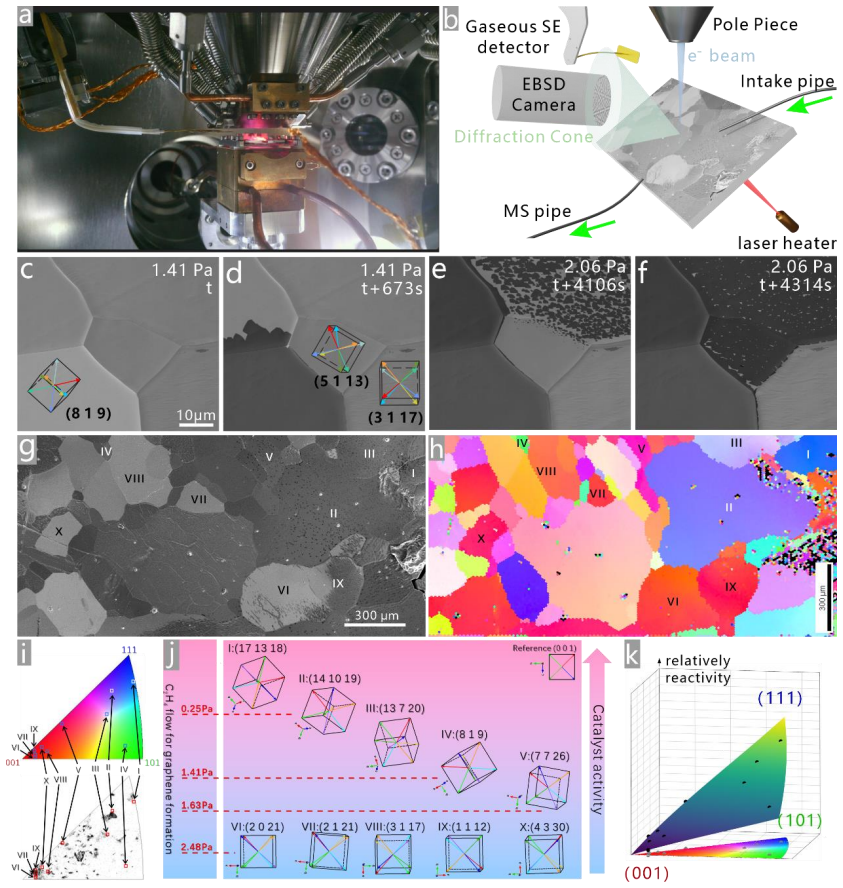
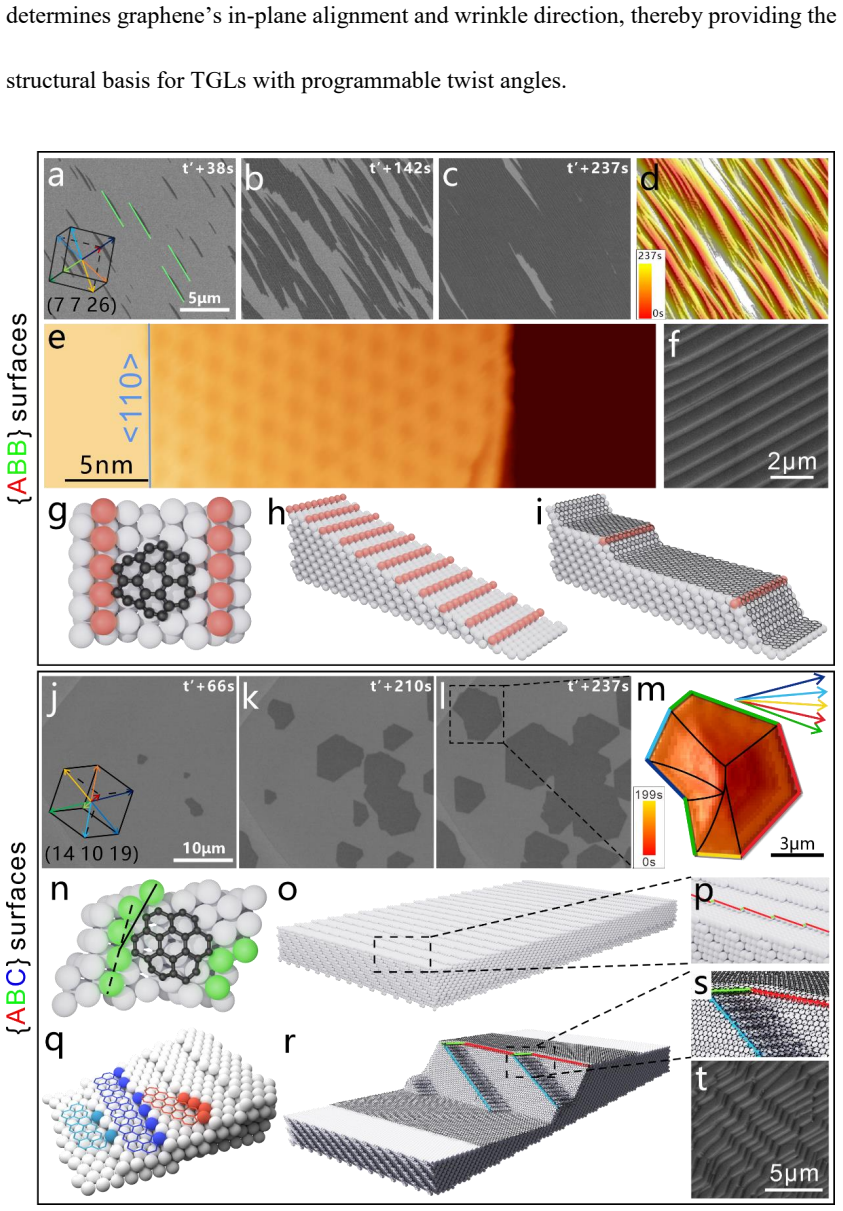
Through in situ observations the activity sequence of different Pt grains is attributed to the area ratio of exposed (110) facets during graphene-induced surface reconstruction, while graphene orientation is determined by grain-orientation-dependent surface morphology. Overlayer-induced step bunching and terrace reconfiguration then govern domain morphology and folding direction. These established correlations between grain index, growth priority, orientation, and folding allow a substrate-engineering framework in which specific platinum grains are rationally selected to produce TGLs with pre-designed twist angles, including the magic angle with flat-band dispersion.
What carries the argument
Facet-dependent chemical kinetics on Pt grains, specifically the area ratio of exposed (110) facets after reconstruction together with overlayer-induced step bunching that dictates folding direction.
If this is right
- Controlled folding and tearing of the graphene overlayer can be achieved by pairing adjacent grains with dramatically different catalytic activity and kink-free atomic steps.
- Programmable growth of high-quality TGLs becomes possible on open surfaces by rational selection of substrate grains.
- The same mechanistic insight offers a generalizable methodology for manipulating foldable two-dimensional materials via dynamic substrate reconstruction.
Where Pith is reading between the lines
- The method could be tested on other catalytic metals to see whether similar facet-area and reconstruction rules allow twist-angle design beyond platinum.
- If the grain-selection rules hold at larger scales, device arrays could be patterned directly by choosing substrate grain maps before growth.
- Flat-band samples produced this way would allow direct comparison of transport properties across many identically twisted regions on the same substrate.
Load-bearing premise
The observed correlations between Pt grain index, exposed (110) facet area ratio, graphene growth priority, orientation, and folding direction are stable enough to be used for reliable pre-design of twist angles without being overridden by other process variables.
What would settle it
Repeated CVD runs on the same identified grain-pair indices that produce twist angles or folding directions outside the narrow range predicted from the measured activity difference and step geometry.
Figures



read the original abstract
Twisted graphene layers (TGLs) provide a powerful platform for investigating multiple quantum phenomena, yet their scalable deployment is hindered by the lack of reliable synthesis with precise angle. Here, benefited from a deeper understanding of the interplay between grain index and graphene growth kinetics, we report a scalable strategy to grow TGLs with pre-designed twist angles on platinum (Pt) via chemical vapor deposition (CVD), Through a combination of complementary in situ methods, we identified the activity sequence of different Pt grains and attributed it to the area ratio of exposed (110) facets during graphene-induced surface reconstruction. Moreover, we revealed that CVD-grown graphene orientation is determined by the grain-orientation-dependent surface morphology. By leveraging the so-established correlations between grain index with both graphene growth priority and its orientation, we achieve controlled folding and tearing of graphene overlayer using a pair of adjacent grains with dramatically different catalytical activity and kink-free atomic steps. We reveal that overlayer-induced step bunching and terrace reconfiguration critically govern the domain morphology and folding direction. Building on this mechanistic insight, we demonstrate a substrate-engineering framework where specific platinum grains are rationally selected to yield TGLs with pre-designed twist angles, including magic angle with flat band dispersion. This work not only highlights fundamental kinetics of Pt catalyzed graphene CVD growth, but also offers a generalizable methodology for manipulating foldable two-dimensional materials via dynamic substrate reconstruction, exampled by programmable growth of high-quality TGLs on open surfaces.
Editorial analysis
A structured set of objections, weighed in public.
Referee Report
Summary. The paper claims that by exploiting facet-dependent chemical kinetics on Pt grains during CVD graphene growth, specific substrate grains can be rationally selected to produce twisted graphene layers (TGLs) with pre-designed twist angles, including the magic angle. In-situ observations link grain index to exposed (110) facet area ratios that dictate growth priority and orientation; adjacent grains with differing activity enable controlled folding via overlayer-induced step bunching and terrace reconfiguration, yielding TGLs whose angles are set by the chosen grain pair.
Significance. If the correlations prove robust, the work offers a scalable, non-random route to magic-angle and other twist-controlled graphene without transfer or stacking steps, directly enabling studies of flat-band physics and related quantum phenomena. The mechanistic attribution of growth kinetics to dynamic surface reconstruction provides generalizable insights for manipulating foldable 2D materials on reconstructible substrates.
major comments (3)
- [Abstract and Results (substrate-engineering framework)] Abstract and the substrate-engineering demonstration: the claim that specific Pt grains can be 'rationally selected' to yield pre-designed angles rests on selected examples and mechanistic attribution rather than quantitative distributions of achieved twist angles, success rates, or variability across repeated growths on identical grain pairs. This directly bears on the load-bearing assumption that grain-index and facet-ratio correlations dominate over process variability.
- [In-situ methods and results on facet-dependent kinetics] In-situ characterization of surface reconstruction and activity sequence: the reported ordering of Pt grains by catalytic activity is attributed to (110) facet area ratios without reported error bars, sample sizes, or exclusion criteria for outliers, leaving open whether the sequence is reproducible enough for reliable pre-design.
- [Results on overlayer-induced step bunching and folding] Experimental validation of folding control: while step bunching and terrace reconfiguration are invoked to govern folding direction, the manuscript provides no statistical test or parameter sweep showing that these factors override local kinetics, impurities, or minor temperature fluctuations in determining the final twist angle.
minor comments (1)
- [Figures] Figure captions and legends could more explicitly label grain indices, measured facet area ratios, and corresponding twist angles to allow direct mapping from substrate choice to outcome.
Simulated Author's Rebuttal
We thank the referee for the detailed and constructive report. The comments highlight important aspects of statistical robustness and reproducibility that we have addressed through revisions and additional analysis. Below we respond point by point to the major comments.
read point-by-point responses
-
Referee: [Abstract and Results (substrate-engineering framework)] Abstract and the substrate-engineering demonstration: the claim that specific Pt grains can be 'rationally selected' to yield pre-designed angles rests on selected examples and mechanistic attribution rather than quantitative distributions of achieved twist angles, success rates, or variability across repeated growths on identical grain pairs. This directly bears on the load-bearing assumption that grain-index and facet-ratio correlations dominate over process variability.
Authors: We agree that quantitative metrics strengthen the demonstration of rational selection. The original manuscript presented representative cases supported by the identified mechanistic correlations between grain index, facet ratios, and growth behavior. In the revised version we have added a new supplementary section with data from repeated growth runs on the same grain-pair combinations. This includes histograms of measured twist-angle distributions, success rates for achieving the target angle within a defined tolerance, and standard deviations across multiple independent CVD runs. These additions confirm that the grain-index and facet-ratio correlations are the dominant factors under the reported growth conditions, with variability remaining within acceptable bounds for pre-design. revision: yes
-
Referee: [In-situ methods and results on facet-dependent kinetics] In-situ characterization of surface reconstruction and activity sequence: the reported ordering of Pt grains by catalytic activity is attributed to (110) facet area ratios without reported error bars, sample sizes, or exclusion criteria for outliers, leaving open whether the sequence is reproducible enough for reliable pre-design.
Authors: We have revised the in-situ results section to include error bars derived from multiple independent measurements on different Pt grains of the same index. Sample sizes (n = 12–15 grains per index) and explicit exclusion criteria (e.g., grains showing visible contamination or incomplete reconstruction) are now stated in the methods and figure captions. The activity ordering remains unchanged after these controls, supporting its use for pre-design. revision: yes
-
Referee: [Results on overlayer-induced step bunching and folding] Experimental validation of folding control: while step bunching and terrace reconfiguration are invoked to govern folding direction, the manuscript provides no statistical test or parameter sweep showing that these factors override local kinetics, impurities, or minor temperature fluctuations in determining the final twist angle.
Authors: We acknowledge the value of explicit statistical validation. In the revision we have added a quantitative comparison of twist-angle outcomes under controlled variations in temperature and impurity levels, together with a simple statistical test (chi-squared) showing that the observed folding directions are significantly correlated with the presence of step bunching rather than random local kinetics. A limited parameter sweep is now discussed in the supplementary information; full factorial sweeps are experimentally constrained by the need for in-situ observation, but the available data indicate that step-bunching effects dominate within the narrow window of growth parameters used. revision: partial
Circularity Check
No significant circularity in experimental derivation chain
full rationale
The paper is an experimental materials science study relying on in-situ observations of Pt grain behavior, surface reconstruction, and graphene growth kinetics to establish empirical correlations. These observations directly inform the substrate-engineering framework for selecting grains to achieve target twist angles. No mathematical derivations, equations, or self-referential steps are present that reduce the claimed predictions or framework to fitted inputs or prior self-citations by construction. The central claims rest on mechanistic attribution from complementary characterization methods and demonstrations, which remain independent of the target result rather than tautological.
Axiom & Free-Parameter Ledger
axioms (1)
- domain assumption Graphene growth kinetics and orientation on Pt are governed by grain-orientation-dependent surface morphology and the area ratio of exposed (110) facets during reconstruction.
Reference graph
Works this paper leans on
-
[1]
Magic-angle graphene superlattices: a new platform for unconventional superconductivity
The Perdew -Burke-Ernzerhof parameterization of generalized gradient approximation (GGA) was used for the exchange -correlation function 64. The ion - electron interactions were embodied in projector augmented wave method with a cutoff energy of 400 eV 65, 66. The Grimme D FT-D3 method was used for the corrections of the interlayer van der Waals interacti...
-
[2]
(36) Zaefferer, S.; Schwarzer, R
DOI: 10.1038/s41563-023-01632-y. (36) Zaefferer, S.; Schwarzer, R. A. On-line interpretation of spot and Kikuchi patterns. In Materials Science Forum, 1994; Trans Tech Publ: Vol. 157, pp 247-250. (37) Van Strien, A. J.; Nieuwenhuys, B. E. Ethylene adsorption and decomposition on platinum single crystal surfaces. Surface Science 1979, 80, 226 -237. DOI: ht...
-
[3]
DOI: 10.1021/acs.nanolett.3c01173. (59) Utama, M. I. B.; Koch, R. J.; Lee, K.; Leconte, N.; Li, H.; Zhao, S.; Jiang, L.; Zhu, J.; Watanabe, K.; Taniguchi, T.; et al. Visualization of the flat electronic band in twisted bilayer graphene near the magic angle twist. Nature Physics 2021, 17 (2), 184-188. DOI: 10.1038/s41567-020-0974-x. (60) Li, Y.; Zhang, S.;...
discussion (0)
Sign in with ORCID, Apple, or X to comment. Anyone can read and Pith papers without signing in.