Recognition: unknown
sPHENIX measurement of Open-Charm Baryon-to-Meson Ratios in p+p collisions at RHIC
Pith reviewed 2026-05-10 07:58 UTC · model grok-4.3
The pith
sPHENIX has recorded enough unbiased p+p collisions to measure the open-charm baryon-to-meson ratio at RHIC for the first time.
A machine-rendered reading of the paper's core claim, the machinery that carries it, and where it could break.
Core claim
With its 2024 dataset of 100 billion unbiased p+p events, sPHENIX can now perform the first measurement of the open-charm baryon-to-meson ratio Λ_c⁺ / D⁰ at RHIC energies, where no prior baseline existed, thereby opening the study of charm-quark hadronization mechanisms and strange-to-light flavor meson ratios.
What carries the argument
The Λ_c⁺ / D⁰ ratio, which directly encodes the relative probability that a charm quark hadronizes into a baryon versus a meson.
If this is right
- The measured ratio supplies a vacuum reference that can be compared to the same ratio in Au+Au collisions to isolate medium-induced changes in hadronization.
- It constrains models of baryon formation for heavy quarks, including coalescence versus fragmentation scenarios.
- The same dataset permits a parallel measurement of strange-to-light open-charm meson ratios to test flavor-dependent production.
Where Pith is reading between the lines
- A measured ratio at RHIC that differs from LHC values would point to collision-energy dependence in charm baryon formation.
- Successful extraction here would confirm that sPHENIX's streaming readout and tracking are ready for precision heavy-flavor studies across p+p and A+A systems.
Load-bearing premise
The 100 billion unbiased p+p events combined with sPHENIX tracking and particle identification yield a clean enough sample of open-charm hadrons to extract the baryon-to-meson ratio without large systematic uncertainties.
What would settle it
If the reconstructed Λ_c⁺ and D⁰ signals cannot be separated from background with statistical significance or if systematic uncertainties remain larger than the expected ratio value, the claim that the dataset enables a first meaningful baseline measurement would fail.
Figures

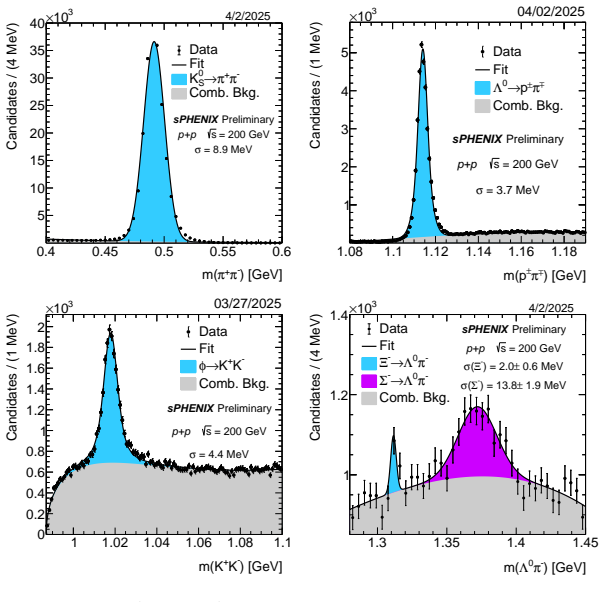

read the original abstract
sPHENIX is a state-of-the-art experiment at the Relativistic Heavy Ion Collider (RHIC), dedicated to the study of heavy-flavor and jet physics. Its precision tracking system, combined with streaming readout, enables heavy-flavor measurements with high-statistics and essentially unbiased data samples. During the 2024 run, sPHENIX was fully commissioned and recorded a sample of 100 billion unbiased $p$+$p$ collisions, together with a minimum-bias Au+Au dataset. The 2025 run further expanded the sPHENIX dataset with high-statistics $p$+$p$, O+O and Au+Au collisions. This extensive $p$+$p$ sample opens the door to heavy-flavor measurements with orders of magnitude more statistics than previously available at RHIC. Notably, there has been no prior measurement of the $\Lambda_c^+ / D^0$ baseline in $p$+$p$ collisions at RHIC energies. The large sPHENIX dataset now enables the first exploration of key open questions, such as the hadronization mechanism of baryons and the strange-to-light flavor meson ratio.
Editorial analysis
A structured set of objections, weighed in public.
Referee Report
Summary. The manuscript describes the sPHENIX experiment at RHIC, its precision tracking and streaming readout capabilities, and the 100 billion unbiased p+p collisions recorded in the 2024 run. It notes the absence of any prior Λ_c⁺/D⁰ measurement at RHIC energies and states that this dataset enables the first exploration of baryon hadronization mechanisms via the open-charm baryon-to-meson ratio.
Significance. If the anticipated measurement can be executed with controlled systematics, it would supply a missing p+p baseline essential for interpreting heavy-flavor results in Au+Au collisions at RHIC and for testing hadronization models. The high-statistics, minimum-bias character of the sample is a genuine experimental strength.
major comments (2)
- [Title and Abstract] Title and Abstract: The title announces a 'measurement' of the ratios, yet the text only describes the dataset and its enabling potential; no invariant-mass spectra, yield extractions, efficiency corrections, or ratio values are shown. This mismatch is load-bearing for the central claim.
- [Physics motivation and run-conditions sections] Physics motivation and run-conditions sections: The assertion that the 100 billion events 'yield a sufficiently clean and unbiased sample' to extract the ratio rests on unquantified assumptions about tracking efficiency, PID performance, and background subtraction; no signal-to-background estimates or systematic-uncertainty projections are supplied to support feasibility.
minor comments (2)
- [Run conditions] The center-of-mass energy for the p+p data set is not stated explicitly; add the value (e.g., √s = 200 GeV) for completeness.
- [Physics motivation] Consider adding a short table or paragraph summarizing expected statistical precision or decay channels (Λ_c⁺ → pK⁻π⁺, D⁰ → K⁻π⁺) to make the physics reach concrete.
Simulated Author's Rebuttal
We thank the referee for the careful and constructive review. The comments highlight important issues regarding the scope of the manuscript and the need for quantitative support for our claims. We address each major comment below and will incorporate revisions to strengthen the paper.
read point-by-point responses
-
Referee: [Title and Abstract] Title and Abstract: The title announces a 'measurement' of the ratios, yet the text only describes the dataset and its enabling potential; no invariant-mass spectra, yield extractions, efficiency corrections, or ratio values are shown. This mismatch is load-bearing for the central claim.
Authors: We agree that the current title and abstract create an expectation of a completed measurement that the manuscript does not fulfill. The paper is intended to document the sPHENIX detector performance, the 100 billion unbiased p+p events recorded in 2024, and the fact that this dataset enables the first Λ_c⁺/D⁰ measurement at RHIC energies, where none existed previously. No final ratio values, spectra, or corrections are presented because the full analysis is still underway. In the revised version we will change the title to 'sPHENIX Dataset and Capabilities for Open-Charm Baryon-to-Meson Ratio Measurements in p+p Collisions at RHIC' and rewrite the abstract to state clearly that the work reports the enabling dataset and experimental reach rather than the extracted physics result. revision: yes
-
Referee: [Physics motivation and run-conditions sections] Physics motivation and run-conditions sections: The assertion that the 100 billion events 'yield a sufficiently clean and unbiased sample' to extract the ratio rests on unquantified assumptions about tracking efficiency, PID performance, and background subtraction; no signal-to-background estimates or systematic-uncertainty projections are supplied to support feasibility.
Authors: The referee is correct that the feasibility statement would be more convincing with quantitative backing. The manuscript currently relies on the known performance of the sPHENIX tracking system and the minimum-bias character of the sample. In the revision we will add a dedicated subsection containing preliminary Monte Carlo studies. These will report expected tracking and PID efficiencies for D⁰ and Λ_c⁺ candidates, projected signal-to-background ratios in the relevant invariant-mass windows, and estimated statistical and systematic uncertainties on the Λ_c⁺/D⁰ ratio. This material will directly support the claim that the 100 billion events provide a viable path to the first RHIC measurement. revision: yes
Circularity Check
No significant circularity in direct experimental measurement
full rationale
This is an experimental proceedings paper reporting sPHENIX measurements of open-charm baryon-to-meson ratios in p+p collisions. It describes detector commissioning, the 100 billion unbiased event sample, and the motivation for the first Λ_c⁺/D⁰ baseline at RHIC energies. No equations, derivations, fitted parameters presented as predictions, or self-citation chains appear in the text; the central claims rest on the size and quality of the new dataset, which are externally verifiable and not reduced to the paper's own inputs by construction.
Axiom & Free-Parameter Ledger
Reference graph
Works this paper leans on
-
[1]
A. M. Sirunyanet al.[CMS Collaboration], Phys. Lett. B803(2020), 135328
2020
-
[2]
Acharyaet al.[ALICE Collaboration], Phys
S. Acharyaet al.[ALICE Collaboration], Phys. Rev. Lett.127(2021) no.20, 202301
2021
-
[3]
Acharyaet al.[ALICE Collaboration], JHEP12(2023), 086
S. Acharyaet al.[ALICE Collaboration], JHEP12(2023), 086
2023
-
[4]
J. R. Christiansen and P. Z. Skands, JHEP08(2015), 003
2015
-
[5]
He and R
M. He and R. Rapp, Phys. Lett. B795(2019), 117-121
2019
-
[6]
Plumari, V
S. Plumari, V . Minissale, S. K. Das, G. Coci and V . Greco, Eur. Phys. J. C78(2018) no.4, 348
2018
-
[7]
Adamet al.[STAR Collaboration], Phys
J. Adamet al.[STAR Collaboration], Phys. Rev. Lett.124(2020) no.17, 172301
2020
-
[8]
Adareet al.[PHENIX Collaboration], [arXiv:1501.06197 [nucl-ex]]
A. Adareet al.[PHENIX Collaboration], [arXiv:1501.06197 [nucl-ex]]
-
[9]
J. D. Osborn, A. D. Frawley, J. Huang, S. Lee, H. P. Da Costa, M. Peters, C. Pinkenburg, C. Roland and H. Yu, Comput. Softw. Big Sci.5(2021) no.1, 23
2021
-
[10]
X. Ai, C. Allaire, N. Calace, A. Czirkos, M. Elsing, I. Ene, R. Farkas, L. G. Gagnon, R. Garg and P. Gessinger, et al.Comput. Softw. Big Sci.6(2022) no.1, 8
2022
-
[11]
KFParticle wiki page, https://wiki.sphenix.bnl.gov/index.php?title=KFParticle
-
[12]
sPHENIX Public Results, https://www.sphenix.bnl.gov/index.php/PublicResults 5
discussion (0)
Sign in with ORCID, Apple, or X to comment. Anyone can read and Pith papers without signing in.